
新目标七年级英语上Unit6_Do_you_like_bananas_Section_B_1a--2c
- 格式:ppt
- 大小:5.88 MB
- 文档页数:33


人教版英语七年级上册教案:Unit6 SectionB(2a-2c)Unit6 SectionB(2a-2c)教案【教材版本与册数】新目标人教版七年级上册【单元名称】Unit 6 Do you like bananas?【课时】Section B 2a-2c(第4课时)【课型】Reading(阅读课)教材分析【本单元话题】喜欢和不喜欢(like and dislike)【本单元重点掌握目标】行为动词在一般现在时句子中的使用,应该是上一个单元内容的延伸,通过本单元的教学,学生应初步掌握行为动词一般现在时的肯定句、否定句、特殊疑问句、一般疑问句的构成以及简单的回答和表示食物的可数名词和不可数名词。
【教材内容坼分分析】本单元Section A主要是谈论喜欢和不喜欢(like and dislike),Section B进一步拓展了此话题,按照“听力输入--阅读训练--由读促写”的过程逐层递进。
【通过本单元的学习学生需掌握的综合技能】训练学生的听、说、读、写四项基本技能,学会询问对方与了解别人喜欢与不喜欢的食物,学会谈论自己与他人早、中、晚餐喜爱吃的食物,为其今后能在交际中恰当地表达自己的情感、灵活运用已经学过的常用功能项目、进一步学习并掌握新的语言功能奠定坚实的基础。
第 2 页第 3 页DEL C2 获取新知Step2Reading1. T: Well, let’s see some sports star’s eating habits. Cindy Smith is avolleyball star. What does she like for breakfast, lunch and dinner? Doesshe eat ice-cream? Now let’s r ead the magazine article about Cindy Smith.First, read the article and circle the food words.(Ss read the article and circle the food words quickly.)2.Read the article and fill in the blanks.3. We know Cindy has healthy eating habits. What food does she like? Whatfood doesn’t she like? Read the article and write five sentences aboutCindy’s eating habits. e.g.Cindy likes fruit for breakfast.1.带着问题阅读文章,寻找答案2.再读文章,完成练习学生能够自主阅读文章并寻找答案第 4 页(注意运用句型:Cindy likes … for … 或Cindy doesn’t like/eat … for …)4. Let some Ss read their sentences to the class.5. Then finish 2c.Write five sentences about Ci ndy’s eating habits.Cindy likes healthy food.1. Cindy ___loves fruit.____________________________2. She ____likes oranges and bananas._____________________________3. She _____likes salad for lunch.____________________________4. Cindy doesn’t ___like hamburgers for dinner._____________________5. She doesn’t ___eat ice-cream after dinner._______________________Step3 Language points 1. Sports star eats well!句中的well用作副词,意为“好”,用来修饰动词eat,意为“吃得好”。

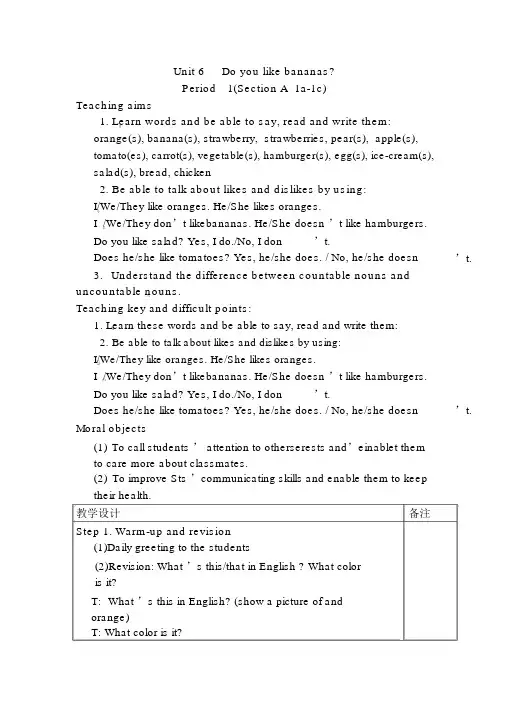
Unit 6Do you like bananas?Period 1(Section A 1a-1c)Teaching aims1. Learn words and be able to say, read and write them:orange(s), banana(s), strawberry, strawberries, pear(s), apple(s),tomato(es), carrot(s), vegetable(s), hamburger(s), egg(s), ice-cream(s),salad(s), bread, chicken2. Be able to talk about likes and dislikes by using:I/We/They like oranges. He/She likes oranges.I /We/They don’t likebananas. He/She doesn’t like hamburgers.Do you like salad? Yes, I do./No, I don’t.Does he/she like tomatoes? Yes, he/she does. / No, he/she doesn’t.3.Understand the difference between countable nouns and uncountable nouns.Teaching key and difficult points:1.Learn these words and be able to say, read and write them:2.Be able to talk about likes and dislikes by using:I/We/They like oranges. He/She likes oranges.I /We/They don’t likebananas. He/She doesn’t like hamburgers.Do you like salad? Yes, I do./No, I don’t.Does he/she like tomatoes? Yes, he/she does. / No, he/she doesn’t. Moral objects(1)To call students ’ attention to otherserests and’ei n ablet themto care more about classmates.(2)To improve Sts ’communicating skills and enable them to keeptheir health.教学设计备注Step 1. Warm-up and revision(1)Daily greeting to the students(2)Revision: What ’s this/that in English ? What coloris it?T:What ’s this in English? (show a picture of andorange)T:What color is it?Step 2. Presentation –New words.(1)Go on asking: What ’s this/that in English ? Whatcolor is it?T:What ’s this in English? (show a picture of anapple and if the student don’t know it, show thephonetic symbol of the word.)T: Spell it, please.S: A-P-P-L-E.T: What color is it?S: It ’s red.(Present the other three words as above: pear,strawberry, banana )T:We can call all of these things fruit . (Teach the newword “fruit ”.)Show pictures and ask the Ss “What arethese/those? ”and ask the SS to spell the pluralforms of these words: oranges, apples, pears,strawberries, bananas.(2)Repeat step (1) to present: carrot, carrots,tomato, tomatoes and vegetable, vegetables.(3)Present some more words by showing pictures. Get theSs to make an effort to pro nounce and spell the new words.Bread, hamburger ,hamburgers, milk, ice-cream,ice-creams, salad, chicken ,an egg, eggsWe can call all of these things food:食物3.Memory Challenge: Who has the best eyes?(1)Show the pictures, and say the plural forms of the nouns andsome uncountable noun.(2)Summarize. 可数名词有复数形式 , 不可数名词一般没有复数形式Step 3Presentation Target language 11. Show the pictures and say:I like tomatoes, but I don’ t like bread.2.Let students say:I like, but I don’t like ....3. Show the pictures and say:She likes bread, but she doesn’t like milk.He likes chicken, but he doesn’t like eggs.4.Let students say: He/She likes , but he/she doesn’tlike ....According Ss’answers and say:5. Sing a chant:Bananas, bananas, I like bananas! Salad, salad, I like salad!Strawberries, strawberries,I don ’t like strawberries!Pears, pears, he likes pears!Milk , milk, he likes milk!Tomatoes, tomatoes,He doesn ’t like tomatoes! Step 4 Work 1a .1. Read the words.2.T: Look at the pictures and fill in the chart .Fruit Food Vegetable3.Match the words with the things in the picture.4.Check the answers .Step 5 Present the new language 1 .1. T: Oh, we have lots of delicious fruits . I like apples best.Do you like apples ?S1 :Yes , I do. I like apples.S2: No, I don't . I like salad.T: Do you like salad ? S3: Yes , I do. I like salad./ No, I don't . I don’tlike salad.Step 6 Pairwork .1. T: Work in pairs .Ask and answer with your partners .(Before class the students have draw some pictures of the food )2. Get the Ss to ask and answer in pairs, using the sentences:’t.A: Do you like ?B: Yes, I do./ No, I don 3. When you ask andanswer, please fill in the chart. Name Like DislikeStep 7 Present the new language 2 .1.Show pictures and ask and answer questionsDoes she/he like ?Yes, she/he does. She/He likes/ No, she/he doesn ’t. She/He doesn ’tlike .Step 8 Pairwork .1. T: Work in pairs .Ask and answer with your partners .2.Get the Ss to ask and answer in pairs, using the sentences:Does she/he like ?Yes, she/he does. She/He likes/ No, she/he doesn ’t. She/He doesn ’tlike .3.According Ss’answers and ask “Do they like ? Yes, they do./ No, they don’t.”Step 9 Work on 1b.1.T: 1b. List en and number the conversations.2.Listen.3.Check the answers.4.Read after the tape.Step 10 work on 1c.1.First, practice the conversations in 1b.Then, make a survey and fill in the chart below.2. Report: I like milk and tomatoes, but I don’t like ice-cream. Mary likes oranges, but she doesn’liket milk orice-cream. Tom likes tomatoes and strawberries, but hedoesn ’ t like bread.Step 11 . HomeworkWrite down the report.Blackboard design:New Words Unit 6 Do you like bananas?Do you like?Yes , I do. I likeNo ,I don ’t. I don ’tlikeDoes she/he like ?Yes, she/he does. She/He likes/No, she/he doesn ’t. She/He doesn ’tlike.Period 2(Section A 2a-2d)Teaching aims:1. Words & expressionsBirthday, dinner, week, think about, food, sure, how/whatabout ? Burger, vegetable, fruit, apple, then2. Target languageI like strawberries, they’re delicious. Let’s have them.--Yes, I like them ,too./ No, I don’tlike them.I like salad, it ’s delicious. Do you like it?-- Yes, I do./No, I don’t but I likeice cream.Let ’ s have Let ’s think about the food.Ability goalsEnable students to talk about likes and dislikes.Learning ability goalsHelp students learn how to talk about likes and dislikes.2. Listening and speaking skills.Moral object:Learn to keep healthy.Teaching important / difficult pointsHow to talk about likes and dislikes with the target language.教学设计备注Step1 Warm up and revision.1.Everyday greeting.2.Review.Show the pictures and say the singularforms and the plural forms of the countable nouns.3.Show some pictures of the uncountable nouns.4.Summarize.(1).当可数名词复数再次出现时,用“They( 主语)或 them(宾语)”替代。