MATLAB卷积码程序
- 格式:pdf
- 大小:112.69 KB
- 文档页数:6
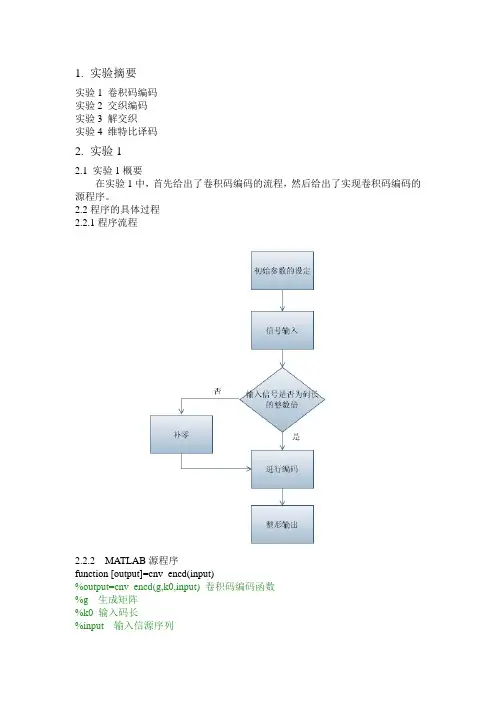
1、卷积码编码
function[output]=cnv_encd(input)
%output=cnv_encd(g,k0,input)卷积码编码函数
%g生成矩阵
%k0输入码长
%input输入信源序列
%output输出卷积编码序列
g=[111;101];编码矩阵
k0=1;
input=[1101];
ifrem(length(input),k0)>0
input=[input,zeros(size(1:k0-rem(length(input),k0)))];
end
n=length(input)/k0;
ifrem(size(g,2),k0)>0
error('Error,gisnotoftherightsize.')
end
li=size(g,2)/k0;
n0=size(g,1);
u=[zeros(size(1:(li-1)*k0)),input,zeros(size(1:(li-1)*k0))];
u1=u(li*k0:-1:1);
fori=1:n+li-2
u1=[u1,u((i+li)*k0:-1:i*k0+1)];
end
uu=reshape(u1,li*k0,n+li-1);
output=reshape(rem(g*uu,2),1,n0*(n+li-1));
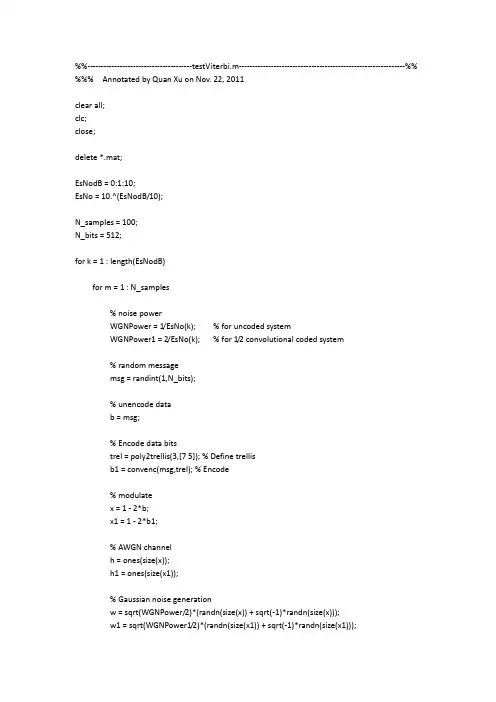
2、Viterbi译码程序
1)
functiony=bin2deci(x)
l=length(x);
y=(l-1:-1:0);
y=2.^y;
y=x*y';
2)
functiony=deci2bin(x,l)
y=zeros(1,l);i=1;
whilex>=0&i<=l
y(i)=rem(x,2);
x=(x-y(i))/2;
i=i+1;
end
y=y(l:-1:1);
3)
functiondistance=metric(x,y)
ifx==y
distance=0;
else
distance=1;
end
4)
function[next_state,memory_contents]=nxt_stat(current_state,input,L,k)
binary_state=deci2bin(current_state,k*(L-1));
binary_input=deci2bin(input,k);
next_state_binary=[binary_input,binary_state(1:(L-2)*k)];
next_state=bin2deci(next_state_binary);
memory_contents=[binary_input,binary_state];
5)
function[decoder_output,survivor_state,cumulated_metric]=viterbi(channel,snr_db)
G=[111;101];%G卷积编码矩阵,如(2,1,3)卷积码生成矩阵[111;101],可以根据
自己的需要输入编码矩阵k=1;%k信息源输入端口数k=1
channel=[110101001011];%信源编码
snr_db=6;%信噪比,可以通过调节信噪比大小观察viterbi译码的性能
%bpsk调制
channel_output=bpsk(channel,snr_db);%调用bpsk函数,得到信道编码
n=size(G,1);%n编码输出端口数量,(2,1,3)中n=2
ifrem(size(G,2),k)~=0%当G列数不是k的整数倍时
error('SizeofGandkdonotagree')%发出出错信息
end
ifrem(size(channel_output,2),n)~=0%当输出量元素个数不是输出端口的整数倍时
error('channeloutputnotoftherightsize')
end
N=size(G,2)/k;%得出移位数,即寄存器的个数
M=2^k;
number_of_states=2^(k*(N-1));%状态数
forj=0:number_of_states-1%j表示当前寄存器组的状态因为状态是从零
%开始的,所以循环从0到number_of_states-1
form=0:M-1%m为从k个输入端的信号组成的状态,总的状
%态数为2^k,所以循环从0到2^k-1%nxt_stat完成从当前的状态和输入的矢量得出下寄存器组的一个状态
[next_state,memory_contents]=nxt_stat(j,m,N,k);%调用nxt_stat函数
input(j+1,next_state+1)=m;
branch_output=rem(memory_contents*G',2);
nextstate(j+1,m+1)=next_state;
output(j+1,m+1)=bin2deci(branch_output);
end
end
%state_metric数组用于记录译码过程在每状态时的汉明距离
%state_metric大小为number_of_states2,(:,1)当前
%状态位置的汉明距离,为确定值,而(:,2)为当前状态加输入
%得到的下一个状态汉明距离,为临时值
state_metric=zeros(number_of_states,2);
depth_of_trellis=length(channel_output)/n;
channel_output_matrix=reshape(channel_output,n,depth_of_trellis);
survivor_state=zeros(number_of_states,depth_of_trellis+1);
fori=1:depth_of_trellis-N+1
flag=zeros(1,number_of_states);
if(i<=N)
step=2^(k*(N-i));
else
step=1;
end
forj=0:step:number_of_states-1
form=0:M-1
branch_metric=0;
binary_output=deci2bin(output(j+1,m+1),n);
forll=1:n
branch_metric=branch_metric+metric(channel_output_matrix(ll,i),binary_output(ll));
end
%选择码间距离较小的那条路径
%选择方法:
%当下一个状态没有被访问时就直接赋值,否则,用比它小的将其
覆盖if((state_metric(nextstate(j+1,m+1)+1,2)>state_metric(j+1,1)+branch_metric)|
flag(nextstate(j+1,m+1)+1)==0)
state_metric(nextstate(j+1,m+1)+1,2)=state_metric(j+1,1)+branch_metric;
survivor_state(nextstate(j+1,m+1)+1,i+1)=j;
flag(nextstate(j+1,m+1)+1)=1;
end
end
endstate_metric=state_metric(:,2:-1:1);
end
fori=depth_of_trellis-N+2:depth_of_trellis
flag=zeros(1,number_of_states);
%状态数从number_of_states→number_of_states/2→...→2→1
%程序说明同上,只不过输入矢量只为0
last_stop=number_of_states/(2^(k*(i-depth_of_trellis+N-2)));
forj=0:last_stop-1
branch_metric=0;
binary_output=deci2bin(output(j+1,1),n);
forll=1:n
branch_metric=branch_metric+metric(channel_output_matrix(ll,i),binary_output(ll));
end
if((state_metric(nextstate(j+1,1)+1,2)>state_metric(j+1,1)+branch_metric)|
flag(nextstate(j+1,1)+1)==0)
state_metric(nextstate(j+1,1)+1,2)=state_metric(j+1,1)+branch_metric;
survivor_state(nextstate(j+1,1)+1,i+1)=j;
flag(nextstate(j+1,1)+1)=1;
end
end
state_metric=state_metric(:,2:-1:1);
end
%从最佳路径中产生解码
%译码过程可从数组survivor_state的最后一个位置向前逐级译码
state_sequence=zeros(1,depth_of_trellis+1);
state_sequence(1,depth_of_trellis)=survivor_state(1,depth_of_trellis+1);
fori=1:depth_of_trellis
state_sequence(1,depth_of_trellis-i+1)=survivor_state((state_sequence(1,depth_of_trellis+2-i)+1),
depth_of_trellis-i+2);
end
decoder_output_matrix=zeros(k,depth_of_trellis-N+1);
fori=1:depth_of_trellis-N+1
%根据数组input的定义来得出从当前状态到下一个状态的输入信号矢量
dec_output_deci=input(state_sequence(1,i)+1,state_sequence(1,i+1)+1);
dec_output_bin=deci2bin(dec_output_deci,k);
%将一次译码存入译码输出矩阵decoder_output_matrix相应的位置
decoder_output_matrix(:,i)=dec_output_bin(k:-1:1)';
end
decoder_output=reshape(decoder_output_matrix,1,k*(depth_of_trellis-N+1));
cumulated_metric=state_metric(1,1);