
Unit 4 A good read Reading I
- 格式:ppt
- 大小:2.85 MB
- 文档页数:26
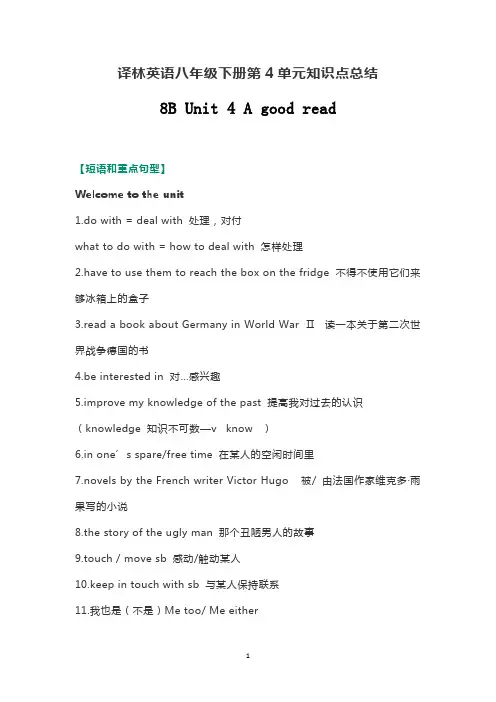
译林英语八年级下册第4单元知识点总结8B Unit 4 A good read【短语和重点句型】Welcome to the unit1.do with = deal with 处理,对付what to do with = how to deal with 怎样处理2.have to use them to reach the box on the fridge 不得不使用它们来够冰箱上的盒子3.read a book about Germany in World War Ⅱ读一本关于第二次世界战争德国的书4.be interested in 对…感兴趣5.improve my knowledge of the past 提高我对过去的认识(knowledge 知识不可数—v know )6.in one’s spare/free time 在某人的空闲时间里7.novels by the French writer Victor Hugo 被/ 由法国作家维克多·雨果写的小说8.the story of the ugly man 那个丑陋男人的故事9.touch / move sb 感动/触动某人10.keep in touch with sb 与某人保持联系11.我也是(不是)Me too/ Me eitherReading1.crash against the rocks 撞到岩石 (against 介词紧靠,碰,撞;反对,违背)2.swim as far as one can / could = swim as far as possible 游得尽可能远;奋力前游3.by the time = when 到……的时候4.feel the land under my feet 感觉到陆地在我的脚下5.be tired out 筋疲力尽6.fall down on the beach 倒在沙滩上7.go to sleep / fall asleep睡着、入睡8.as the sun was rising正当太阳升起时9.be tied to the ground 被栓/绑在地上10.feel something on my leg 感觉某个东西在我的腿上11.move up over my stomach and neck 在我的肚子和脖子上移动12.look down 向下看,俯视look down on 轻视,看不起13.the same size as 和……一样大be the same size as my little finger=be as big as my little finger14.start climbing all over me 开始爬遍我的全身15.there were around forty of them大约40个他们16.shout at 对……大喊大叫17.fall over 跌倒(后不能接宾语)18.get up 站起来,(使)起立;起床19.continue to do sth = continue doing sth 继续做某事20.move across one’s body爬过某人的身体21.begin talking to me开始和我交谈 begin to do sth/ doing sth22.I didn’t know what to say either. 我也不知道说什么。

牛津译林版英语八下Unit 4《A good read》(task)教学设计一. 教材分析牛津译林版英语八下Unit 4《A good read》主要介绍了一篇关于书籍推荐的文章。
通过阅读这篇文章,学生可以了解不同类型的书籍以及如何选择适合自己的书籍。
本课的主要内容包括:词汇学习、语法结构、阅读理解、口语表达和写作练习。
本节课的教学重点是让学生能够理解文章的主旨大意,掌握相关的词汇和语法结构,并能够运用所学知识进行口语表达和写作。
二. 学情分析学生在学习本课之前,已经掌握了基本的英语语法结构和词汇,具备一定的阅读理解能力。
然而,学生在口语表达和写作方面还存在一定的困难,需要通过本节课的学习来进行巩固和提高。
此外,学生对于不同类型的书籍有一定的了解,但可能对于如何选择适合自己的书籍还存在一定的困惑。
三. 教学目标1.知识目标:学生能够掌握本课中的相关词汇和语法结构,理解文章的主旨大意。
2.能力目标:学生能够运用所学知识进行口语表达和写作,提高阅读理解能力。
3.情感目标:学生能够激发对阅读的兴趣,学会如何选择适合自己的书籍。
四. 教学重难点1.重点:学生能够掌握本课中的相关词汇和语法结构,理解文章的主旨大意。
2.难点:学生能够运用所学知识进行口语表达和写作,提高阅读理解能力。
五. 教学方法本节课采用任务型教学法,通过引导学生完成各种任务,激发学生的学习兴趣,提高学生的参与度。
同时,运用交际法进行口语教学,让学生在真实的语境中进行语言实践。
此外,还采用合作学习法,让学生在小组合作中共同完成任务,培养学生的团队协作能力。
六. 教学准备1.教学材料:教材、多媒体课件、黑板、粉笔。
2.教学设备:计算机、投影仪、音响设备。
七. 教学过程1.导入(5分钟)教师通过提问方式引导学生谈论自己喜欢的书籍,激发学生的学习兴趣。
例如:“Do you like reading? What kind of books do you like?”学生回答后,教师总结并板书本课的主题“A good read”。

8B Unit4 A good read教案Comic strip and Welcome to the unit教学目标l了解不同类别书的的英文表达。
2能用英语谈论喜欢的书以及喜欢的原因。
3激发学生对阅读的兴趣。
教学内容四会内容词汇:read cooking Ge rmany knowledge spare Frenchwriter ugly touch词组:a book about improve my knowledge ofin your spare time French writer句型:Have you decided what to do with these books?What do you like to read in your spare time?I like reading novels and plays.The story of the ugly man Quasimodo really touched me.三会内容词汇:novel教学准备1教学挂图。
2配套磁带或光盘。
教学步骤Welcome to the unitStep I导入1教师说:Wh en I'm free, I like re ading books. Books help me improve my knowledge. Do you like reading in your spare time? 如果有学生回答喜欢阅读, 教师可接着问学生:Wh at books have you read recently? 让学生说出最近阅读的图书的书名。
2教师从学生的回答中选择类别不同的书名, 写在黑板上, 让学生根据书名判断书的类别, 教师说:What type of book is this? 从而引出书的各种类别, 如science科学、cooking烹饪、travel旅游、health健康、fantasy幻想、history 历史、novel小说、play戏剧等。

《英语》(必修·第二册)Unit 4 Exploring literatureWelcome to the unit & Reading (I)I. Learning objectivesBy the end of the lesson, students will be able to:1. know about the structure, the figure of speech and writing skills used in the text;2. express their opinions on what qualities a great work of literature should have;3. talk about their favourite work of literature by the three qualities.II. Key competence focus1. Analyse the writing skills used in the text.2. Talk about their favourite work of literature by the three qualities.III. Predicted area of difficultyTalk about their favourite work of literature by the three qualities.IV. Teaching proceduresStep 1 Lead-in1.T asks Ss to read the excerpts from two famous works of literature and discuss the following questions.Which of the excerpts makes you feel like reading the whole book? Why?【设计意图:通过阅读文学名著的摘录,引出本节课话题,启发学生思考,从而激发学生的阅读兴趣。