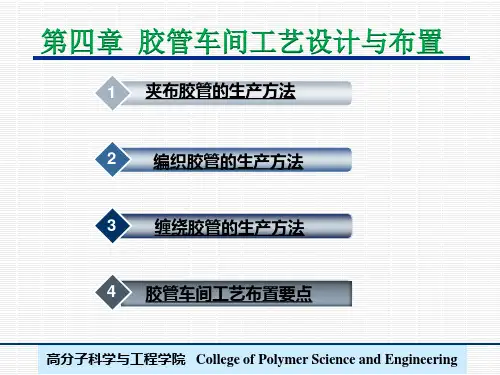
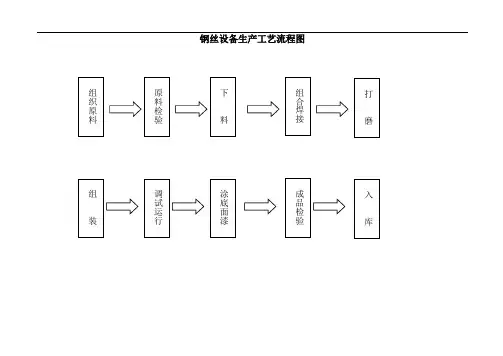
钢丝设备生产工艺流程图
- 格式:doc
- 大小:29.00 KB
- 文档页数:1

录井工艺流程简介及工艺流程图英文回答:Introduction to Logging Process and Process Flowchart.Logging is an essential process in the oil and gas industry that involves the collection of data from boreholes or wells. This data is crucial for evaluating the potential of hydrocarbon reserves, determining reservoir characteristics, and making informed decisions regarding drilling and production operations.The logging process typically involves the use of specialized tools and equipment that are lowered into the wellbore to measure various parameters. These parameters include the properties of the rock formations, fluid content, and pressure conditions. The collected data is then analyzed to provide valuable insights into the subsurface conditions.The logging process can be divided into several stages, including pre-logging preparations, tool deployment, data acquisition, data interpretation, and reporting. Let me explain each stage in more detail:1. Pre-logging Preparations:Before the logging operation begins, thorough planning and preparation are necessary. This includes reviewing well data, identifying the objectives of the logging job, and selecting the appropriate logging tools and techniques.2. Tool Deployment:Once the preparations are complete, the logging tools are assembled and prepared for deployment. These tools may include wireline logging tools, logging while drilling (LWD) tools, or measurement while drilling (MWD) tools. The tools are then lowered into the wellbore using a winch system ora drilling rig.3. Data Acquisition:As the logging tools descend into the wellbore, they start collecting data at various depths. The data is transmitted to the surface in real-time or stored in memory for later retrieval. The types of data collected can vary depending on the logging technique used. For example, resistivity logs measure the electrical properties of the rock formations, while sonic logs measure the speed of sound waves.4. Data Interpretation:Once the data is acquired, it is then processed and interpreted by logging engineers or geoscientists. They analyze the data to identify lithology, porosity, fluid saturation, and other important reservoir characteristics. This helps in assessing the potential for hydrocarbon production and making decisions regarding well completion and stimulation techniques.5. Reporting:Finally, the interpreted data is compiled into a comprehensive report that summarizes the findings of the logging operation. This report is shared with the project team, including drilling engineers, geologists, and reservoir engineers, to aid in decision-making and planning future operations.In conclusion, the logging process plays a crucial role in the oil and gas industry by providing valuable information about subsurface conditions. It involves pre-logging preparations, tool deployment, data acquisition, data interpretation, and reporting. The collected data helps in evaluating reservoir potential and making informed decisions for drilling and production operations.中文回答:录井是石油和天然气行业中的一个重要工艺流程,它涉及从钻井井眼或井口收集数据。

目录1.概述2.施工顺序3.框架内合成塔的结构尺寸及重量4.吊装工艺流程图5.吊装理论计算6.理论计算负载7.吊装步骤8.安全技术措施9.人员安排10.吊装机索具需用计划1.概述:山西丰喜华瑞煤化工有限公司,其生产1830尿素项目。
本装置内共有最重的设备为220吨,且安装在混凝土框架内,施工场地比较狭窄,对设备的吊装有一定的难度,为了能安全、按期地完成本装置的吊装任务,我公司根据具体情况特编制本施工方案以满足施工要求。
2、施工顺序:2.1本次吊装的总顺序为:先难后易,先大后小,先高后矮,先里后外。
2.2吊装方法的选用:根据甲方的施工要求以及我公司以往的经验,我公司通过对现场的实地勘察以及我公司现有的吊装能力,我们决定选用“单桅杆提吊法”来完成框架内四台设备的吊装,框架外的设备采用吊车吊装来完成。
3、框架内合成塔的结构尺寸及重量:位号名称尺寸(㎜)单台总重量(㎏)型式尾部四方头重量(t)大盖重量(㎏)大盖螺栓重量(t)氨合成塔DN18000 220000 立式8 25000 44吊装工艺流程图:技术及机具准备锚锭装置卷扬机设置桅杆组对缆风绳设置设备吊点设置检查竖立桅杆辅助设施拆除竖立桅杆提升索具设置调整索具设置试吊提升系统设置溜尾系统设置牵引索具设置吊装设备就位桅杆拆除辅助吊车、索具拆除5吊装理论计算:本方案只计算合成塔,其它设备参照本计算执行。
6.1理论计算负载:6.1.1Q计﹦(Q+q)K﹦264000Kg式中Q计——理论计算负载Q ——拆除顶盖和三通后的实际重量(230000 Kg)q ——吊索具重量约10吨k ——动负系数取K=1.16.1.2上吊索的选用:采用四弯八股,则单股绳的受力为T=132000/6=22000 Kg,取8倍的安全系数,则单股绳的破断拉力应≥22000×8=176000 Kg,查表可得钢丝绳的直径为:d=56mm,选用6×37-φ56的钢丝绳作上吊索,其长度为132m,两条。

刮板输送〔转载〕机〔不含电气局部〕大修工艺一、刮板输送〔转载〕机检修工艺作业流程设施初步解体入厂→预查查收→外面冲洗→解体分类→零零件冲洗判定→零零件分类维修、修复→零件组装→总装→试运行、调整→喷漆防腐→查收出厂。
二、刮板输送〔转载〕机检修标准〔一〕机头、机尾传动部1.机头、机尾、过渡槽、桥架槽无开焊。
机架双侧的对中板的垂直度允差不得大于 2mm。
机架上安装传动装置的定位面、孔切合技术文件的要求。
2.机头架、机尾架与过渡槽的连结要严实,搭接局部无卷边,上下左右交织不得大于 3mm,机头架螺栓孔不得变形严重。
3.压链器连结坚固,磨损不得超出 6 mm。
超出时,可用电焊或热喷涂方法修复。
4.整体链轮组件、盲轴安装切合技术文件的要求。
采纳分体链轮构造时,半滚筒、半链轮组合空隙应切合设计要求,一般在 1~ 3mm 范围内。
5.机头轴、机尾轴转动灵巧,不得有卡碰现象。
〔二〕机械传动装置1.机壳各轴孔尺寸精度、粗拙度、中心距、各孔的形位公差,均应切合技术文件的要求。
2.机壳和联接罩上的螺纹孔、定位孔、台修复后切合技术文件的要求。
3.轴承无显然磨损印迹,游隙切合要求,转动灵巧无异响。
4.紧固件无显然塑性变形。
5.各零件无损害,无显然磨损印迹、变形。
6.密封件和有机软管所有更新。
7.组装时各零零件要仔细冲洗,不得有锈斑,机壳内不得有任何污杂物。
8.各传动部安装、调整后切合技术文件的要求。
9.减速器按规定注入润滑油。
液力耦合器作耐压试验并注入规定品种和体积的介质。
10.制动盘、联轴器、耦合器动均衡试验切合技术文件的要求。
11.减速器、链轮组件无渗漏现象。
冷却、润滑装置齐备、完满,无渗漏现象。
12.安装完成,人力试转无卡阻现象。
〔三〕链轮、舌板、分链器1.链轮齿面应无裂纹或严重磨损,链轮承托水平圆环链的平面的最大磨损:节距≤ 22mm 时,不得超出 5mm;节距≥ 22mm 时,不得超出 6mm〔可用水平圆环链置于链轮上,检查圆环链上表面与轮毂的距离〕。