
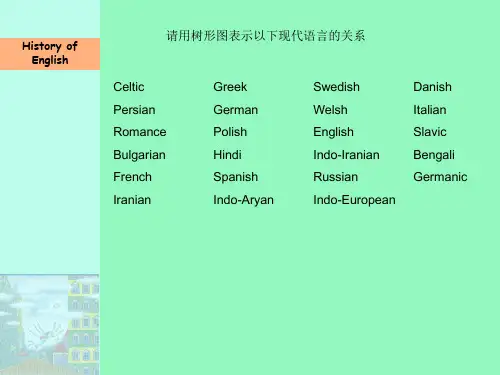
词汇学练习 第八章 英语词汇的来源
- 格式:ppt
- 大小:455.50 KB
- 文档页数:8

词汇学中的motivation摘要:一、motivation的概念与作用二、词汇学中motivation的分类及特点三、motivation在词汇学习中的应用四、提高词汇学习效果的方法正文:词汇学是一门研究词汇的形成、发展、结构和使用的学科。
在词汇学中,motivation(动机)是一个重要的概念,它指的是词汇形式与其意义之间的内在联系,体现了词汇的理据性。
本文将从motivation的概念与作用、分类及特点、在词汇学习中的应用以及提高词汇学习效果的方法等方面进行阐述。
一、motivation的概念与作用在词汇学中,motivation指的是词汇形式与其意义之间的内在联系,它是词汇发展变化的重要驱动力。
motivation可以分为外部动机和内部动机。
外部动机是指词汇形式受到外部环境、文化、历史等因素的影响而发生变化;内部动机是指词汇形式在其内部结构、语音、语法等方面表现出一定的规律和特点。
motivation在词汇学习中具有重要作用,它有助于我们更好地理解和掌握词汇。
二、词汇学中motivation的分类及特点1.外部动机:词汇形式受到外部环境、文化、历史等因素的影响而发生变化。
例如,英语中许多词汇来源于其他语言,如法语、拉丁语等,这些外来词汇的引入是受到文化交流的驱动。
2.内部动机:词汇形式在其内部结构、语音、语法等方面表现出一定的规律和特点。
例如,英语中有许多派生词,如unhappy(不快乐)、careless (粗心的)等,这些词汇是通过在词根基础上添加前缀、后缀等构词成分形成的。
三、motivation在词汇学习中的应用1.了解词汇的起源和演变:通过研究词汇的motivation,我们可以了解词汇的起源、发展过程以及词汇之间的联系,有助于我们更好地掌握词汇。
2.推测词汇的意义:在遇到生词时,可以根据词汇的motivation推测其大致意义,有助于提高词汇理解能力。
3.记忆词汇:了解词汇的motivation有助于我们更容易地记住词汇,提高词汇记忆效果。
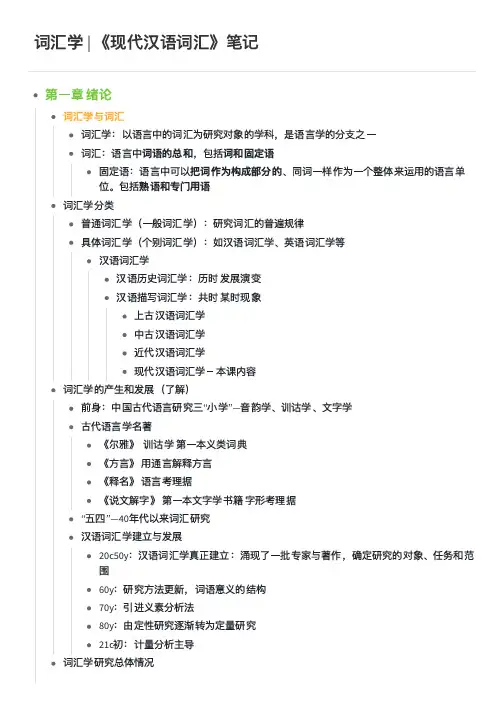
词汇学 | 《现代汉语词汇》笔记第⼀章绪论词汇学与词汇词汇学:以语⾔中的词汇为研究对象的学科,是语⾔学的分⽀之⼀词汇:语⾔中词语的总和,包括词和固定语固定语:语⾔中可以把词作为构成部分的、同词⼀样作为⼀个整体来运⽤的语⾔单位。
包括熟语和专⻔⽤语词汇学分类普通词汇学(⼀般词汇学):研究词汇的普遍规律具体词汇学(个别词汇学):如汉语词汇学、英语词汇学等汉语词汇学汉语历史词汇学:历时发展演变汉语描写词汇学:共时某时现象上古汉语词汇学中古汉语词汇学近代汉语词汇学现代汉语词汇学-本课内容词汇学的产⽣和发展(了解)前身:中国古代语⾔研究三“⼩学”—⾳韵学、训诂学、⽂字学古代语⾔学名著《尔雅》训诂学第⼀本义类词典《⽅⾔》⽤通⾔解释⽅⾔《释名》语⾔考理据《说⽂解字》第⼀本⽂字学书籍字形考理据“五四”—40年代以来词汇研究汉语词汇学建⽴与发展20c50y:汉语词汇学真正建⽴:涌现了⼀批专家与著作,确定研究的对象、任务和范围60y:研究⽅法更新,词语意义的结构70y:引进义素分析法80y:由定性研究逐渐转为定量研究21c初:计量分析主导词汇学研究总体情况词汇学研究内容:以现代汉语词汇为研究对象,研究词的性质、创造和结构、词义内容、词义发展、词的各种关系、词汇划分与关系等现代汉语词汇特点语素以单⾳节为主,词以双⾳节为主,但单⾳节词使⽤频率更⾼多⾳节词主要来源古代汉语:仿佛徘徊犹豫其他语⾔:咖啡巧克⼒沙发词语呈现双⾳化趋势为什么?内在驱动⼒:词义表达复杂化的需求与有限词形之间的⽭盾社会发展:旧词新义、⾳变构词、两个词复合构词语⾳系统简化(避免同⾳)明确表意:新产⽣的双⾳词意义明确;原有单⾳节词部分义项被取代⽽减少审美追求(双⾳节的韵律形式)句法词汇化受外来词影响结果:⻓度增加,表义明确途径单⾳节语素前或后加上辅助性相关成分:眼泪头发⽑笔松⿏⽉亮眉⽑单⾳节语素的前⾯或后⾯添加⼀个不表示具体意义的附加成分:⽼⻁阿姨桌⼦⽯头意义相同、相近或相对的单⾳节语素联合起来使⽤:国家意义寻找⽛⻮⽪肤忘记停⽌单⾳节语素重叠:哥哥妈妈爸爸仅仅静静紧紧星星单⾳节词替换成与原语素⽆关的双⾳节词:眼睛(⽬)筷⼦(箸)匣⼦(椟)⼤腿(股)三⾳节词省略其中⼀个因素照相机—相机外国语—外语电视机—电视四⾳节及其以上的词语缩略:对外贸易—外贸国有企业—国企复合词为主,内部构造与短语⼤体⼀致:并列偏正动宾动补主谓同义词数量多,同⾳语素多:适应不同需要,之间互补,具有多样性和可伸缩性词汇与⾮词汇界限模糊,切词困难语素构词理据性强,即语素义对词义有明显提示作⽤少量语素构成⼤量合成词缺少词形变化成语⼀般由四个⾳节组成⾳节相对⽽⾔较短量词、语⽓词丰富离合词多,使⽤频率⾼叠⾳词多,重叠形式较为丰富词汇学与语⾔学相关学科的关系(了解)与语⾳学:语⾳是语⾔的物质外壳,是词语的存在形式词的意义靠语⾳⼿段来表现,语⾳是词的⾳响形式。

英语词汇学试题复习参考(分章节)英语词汇学试题Introduction and Chapter 1Basic Concepts of Words and Vocabula ry(练习1)I.Each of the statements below is followed by four alternative answers. Choose the one that would best complete the statement.1.Morphology is the branch of grammar which studies the structure or forms of words, primarilythrough the use of _________construct.A. wordB. formC. morphemeD. rootis traditionally used for the study of the origins and history of the form and meaning of words.A. SemanticsB. LinguisticsC. EtymologyD. StylisticsEnglish is derived from the language of early ______ tribes.A. GreekB. RomanC. ItalianD. Germanic4. Semantics is the study of meaning of different _________ levels: lexis, syntax, utterance, discourse, etc.A. linguisticB. grammaticalC. arbitraryD. semanticis the study of style . It is concerned with the user’s choices of linguistic elements in a particular________ for special effectsA. situationB. contextC. timeD. placeshares with lexicology the same problems: the form , meaning, origins and usages of words, but they have a _______ difference.A . spelling B. semantic C. pronunciation D. pragmatic7. Terminology consists of _______ terms used in particular disciplines and academic areas.A. technicalB. artisticC. differentD. academic8. __________refers to the specialized vocabularies by which members of particular arts, sciences, trades, and professions communicate among themselves.A. SlangB. JargonC. Dialectal wordsD. Argot9 ._________ belongs to the sub-standard language, a category that seems to stand between the standard general words including informal ones available to everyone and in-group words.A. JargonB. ArgotC. Dialectal wordsD. Slang10. Argot generally refers to the jargon of use is confined to the sub-cultural groups and outsiders can hardly understand it.A. workersB. criminalsC. any personD. policemanare words used only by speakers of the dialect in question.A. ArgotB. SlangC. JargonD. Dialectal words12. Archaisms are words or forms that were once in _________use but are now restricted only to specialized or limited use.A. commonB. littleC. slightD. great13. Neologisms are newly-created words or expressions, or words that have taken on ______meanings.A. newB. oldC. badD. good14. Content words denote clear notions and thus are known as_________ words. They include nouns, verbs, adjectives, adverbs and numerals.A. functionalB. notionalC. emptyD. formal15. Functional words do not have notions of their own. Therefore, they are also called _______words. Prepositions, conjunctions, auxiliaries and articles belong to this category.A. contentB. notionalC. emptyD. newII. Complete the following statements with proper words or expressions according to the course book.is a branch of linguistics, inquiring into the origins and _____of words.lexicology aims at investigating and studying the ______ structures of English words and word equivalents, their semantics, relations, _____development, formation and ______.18.English lexicology embraces other academic disciplines, such as morphology,______,etymology, stylistics, ________.19.There are generally two approaches to the study of words , namely synchronic and _______./doc/152063694.html,nguage study involves the study of speech sounds, grammar and_______.III. Match the words or expressions in Column A with those in Column B according to 1) basic word stock and nonbasic vocabulary 2) content words and functional words 3) native words and borrowed words 4)characteristics of the basic word stock.A B21 . Stability ( ) A. E-mail22. Collocbility( ) B. aught23. Jargon( ) C. por24. Argot ( ) D. uponwords( ) E. hypo26. Neologisms ( ) F. at heart27. Aliens ( ) G. man28. Semantic-loans( ) H. dip29. Archaisms ( ) I. fresh30. Empty words ( ) J. emirIV. Study the following words or expressions and identify 1) characteristics of the basic word stock 2) types of nonbasic vocabulary.31. dog cheap ( ) 32 a change of heart ( )33. can-opener ( ) ( )35. bottom line ( ) ( )37. auld ( ) 38. futurology ( )( ) 40. take ( )V. Define the following terms.41. word 42. Denizens 43. Aliens 44. Translation-loans 45. Semantic-loans VI. Answer the following Questionsthe relationship between sound and meaning, sound and form with examples.47. What are the main characteristics of the basic word-stock Illustrate your points with examples.48. Give the types of nonbasic vocabulary with examples.VII. Analyze and comment on the following.49. Classify the following words and point out the types of words according to notion.earth, cloud, run, walk, on, of, upon, be, frequently , the, five, but, a , never.50. Group the following borrowed words into Denizens, Aliens, Translation-loans, Semantic-loans.Dream, pioneer, kowtow, bazaar, lama, master-piece, port, shirtKey to Exercises:I. 1. historical, usages 18. semantics, . vocabularyII.21. G 22. F23. E24. H25. C26. A27. the basic word stock; productivity32. the basic word stock; collocabilitybasic word stock; argotword stock; slang35. nonbasic word stock; jargon36. nonbasic word stock ;terminologyword stock; dialectal words38. nonbasic word stock ,neologisms39. nonbasic word stock; archaisms40. the basic word stock; polysemyV-----VI. (see the course book)VII. 49. Content words: earth, clould, run, walk, frequently, never, fiveFunctional words: on, of, upon, be, the, but, a.50. Denizens: port, shirt,Aliens: bazaar, kowtowTranslation-loans: lama, masterpieceSemantic-loans:dream, pioneerChapter 2 The Development of the English Vocabulary and Chapter 3 Word Formation I(练习2)I. Each of the statements below is followed by four alternativeanswers. Choose the one that would best complete the statement.1.It is assumed that the world has approximately 3,000( some put it 5,000)languages, whichcan be grouped into the basis of similarities in their basic word stock and grammar.A. 500B. 4000C. 300D. 20002.The prehistoric Indo-European parent language is thought to be a highly ______language.A. inflectedB. derivedC. developedD. analyzed3.After the _________, the Germanic tribes called Angles ,Saxons, and Jutes came in greatnumbers.A. GreeksB. IndiansC. RomansD. French4.The introduction of ________had a great impact on the English vocabulary.A. HinduismB. ChristianityC. BuddhismD. Islamism5.In the 9th century the land was invaded again byNorwegian and Danish Vikings. With theinvaders, many ________words came into the English language.A. GreekB. RomanC. CelticD. Scandinavian6.It is estimated that at least ______ words of Scandinavian origin have survived in modernEnglish.A. 500B. 800C. 1000 .D. 9007.The Normans invaded England from France in 1066. The Norman Conquest started a continualflow of ______ words into English.A. FrenchB. GreekC. RomanD. Latin8.By the end of the _______century , English gradually came back into the schools, the lawcourts, and government and regained social status.A. 12thB. 13thC. 14th9.As a result , Celtic made only a ________contribution to the English vocabulary.A. smallB. bigC. greatD. smaller10. The Balto-Slavic comprises such modern languages as Prussian, Lithuanian, Polish, Czech, Bulgarian, Slovenian and _______.A. GreekB. RomanC. IndianD. Russian11.In the Indo-Iranian we have Persian , Bengali, Hindi, Romany, the last three of which arederived from the dead language.A. SanskritB. LatinC. RomanD. Greek12.Greek is the modern language derived from _______.A. LatinB. HellenicC. Indian D . Germanic13.The five Roamance languages , namely, Portuguese, Spanish, French, Italian, Romanian allbelong to the Italic through an intermediate language called _______.A. SanskritB. LatinC. CelticD. Anglo-Saxon14.The ________family consists of the four Northern EuropeanLanguages: Norwegian, Icelandic,Danish and Swedish, which are generally known as Scandinavian languages.A. GermanicB. Indo-EuropeanC. AlbanianD. Hellenic15.By the end of the _______century , virtually all of the people who held political or socialpower and many of those in powerful Church positions were of Norman French origin.A. 10th D. 13thII. Complete the following statements with proper words or expressions according to the course book.16.Now people generally refer to Anglo-Saxon as _______.17.. If we say that Old English was a language of full endings , Middle English was one of______.18.It can be concluded that English has evoked from a synthetic language (Old English) tothe present _____ language.19.The surviving languages accordingly fall into eight principal groups , which can be groupedinto an Eastern set: Balto-Slavic , Indo-Iranian ,Armenian and Albanian; a Western set :Celtic, Italic, Hellenic, _______.20.It is necessary to subdivide Modern English into Early (1500-1700)and _____ Modern English. III. Match the words or expressions in Column A with those in Column B according to 1) origin of the words 2)history off English development 3) language family.A B21. Celtic ( )22. religious ( )( ) C. Persian24. French ( )25. Old English ( ) E. abbot( ) F. skirtEnglish ( ) G. sunu28. Modern English ( ) H. lernen29. Germanic family ( ) I. freight( ) J. NorwegianIV.Study the following words or expressions and identify types of morphemes underlined.31. earth ( ) ( )33. predictor ( ) 34. radios ( )35. prewar ( ) 36. happiest ( )37. antecedent ( ) 38. northward ( )38. sun ( ) 40. diction ( )V. Define the following terms.41. free morphemes 42. bound morphemes 43. root 44. stemVI. Answer the following questions. Your answers should be clear and short.46. Describe the characteristics of Old English .47. Describe the characteristics of Middle English.48. Describe the characteristics of Modern English.VII. Answer the following questions with examples.49. What are the three main sources of new words50. How does the modern English vocabulary developKey to exercises:I.II. English 17. Leveled endings 18. analytic 19. Germanic (1700-up to the present )III.21. D 22. E 23. F 24. A 25. G 26. I 27. H 28. B 29. J 30. CIV.31. free morpheme/ free root 32. bound root 33. suffix 34. inflectional affix35. prefix 36. Inflectional affix 37. prefix 38. suffix 39. free morpheme/free rootroot( See the course book )VII. 49. The three main sources of new words are :(1)The rapid development of modern science and technology ,. astrobiology, greenrevolution ;(2)Social , economic and political changes; . Watergate, soy milk;(3)The influence of other cultures and language; . felafel, Nehru Jackets.50. Modern English vocabulary develops through three channels: (1) creation, . consideration, carefulness; (2) semantic change, . Polysemy, homonymy ; (3) borrowing ;. tofu, gongful. Chapter 3 The Development of the English Vocabulary and Chapter 4 Word Formation II(练习3)I.Each of the statements below is followed by four alternative answers. Choose the one that would best complete the statement.1.The prefixes in the words of ir resistible, non classical and a political are called _______.A.reversative prefixesB. negative prefixesC. pejorative prefixesD. locativeprefixes2.The prefixes contained in the following words are called ______: pseudo-friend, mal practice,mis trust.A. reversative prefixedB. negative prefixesC. pejorative prefixesD. locative prefixes3.The prefixed contained in un wrap, de-compose and dis allow are _________.A. reversative prefixedB. negative prefixesC. pejorative prefixesD. locative prefixes4.The prefixes in words extra-strong, overweight and arch bishop are _____ .A . negative prefixes B. prefixes of degree or size C. pejorative prefixes D. locative prefixes5.The prefixes in words bi lingual ,uni form and hemis phere are ________.A. number prefixesB. prefixes of degree or sizeC. pejorative prefixesD. locativeprefixesare contained in words trans-world, intra-party and fore head.A.Prefixes of orientation and attitudeB. Prefixes of time and orderC. Locative prefixesD. Prefixes of degree or size7. Rugby ,afghan and champagne are words coming from ________./doc/152063694.html,s of booksB. names of placesC. names of peopleD. tradenames8. Omega,Xerox and orlon are words from _________./doc/152063694.html,s of booksB. names of placesC. names of peopleD. tradenames, fore tell and post-election contain________.A.negative prefixesB. prefixes of degree or sizeC. prefixes of time and orderD. locative prefixes10.Mackintosh, bloomers and cherub are from _______A. names of booksB. names of placesC. names of peopleD. tradenames11.The prefixes in words new-Nazi, autobiography and pan-European are ________.A.negative prefixesB. prefixes of degree or sizeC. prefixes of time and orderD. miscellaneous prefixes12.The prefixes in words anti-government , pro student andcontra flow are _____-.A.prefixes of degree or sizeB. prefixes of orientation and attitudeC. prefixes of time and orderD. miscellaneous prefixes13.Utopia ,odyssey and Babbit are words from ________./doc/152063694.html,s of booksB. names of placesC. names of peopleD. tradenames14.The suffixes in words clockwise, homewards are ______.A. noun suffixesB. verb suffixesC. adverb suffixesD. adjective suffixes15.The suffixes in words height en, symbol ize are ________.A. noun suffixesB. verb suffixesC. adverb suffixesD. adjective suffixesII. Complete the following statements with proper words or expressions according to the course book.16. Affixation is generally defined as the formation of words by adding word-forming or derivational affixes to stem. This process is also known as_____., also called ________, is the formation of new words by joining two or more stems . Words formed in this way are called _________.18. __________ is the formation of new words by converting words of one class to another class.19. _________ is the formation of new words by combiningparts of two words or a word plusa part of another word . Words formed in this way are called blends or _____words.20 A common way of making a word is to shorten a longer word by cutting a part off the original and using what remains instead. This is called _______.III. Match the words or expressions in Column A with those in Column B according to types of suffixation.A B21. Concrete denominal noun suffixes ( ) A. priceless22. Abstract denominal noun suffixes ( ) B. downward23. Deverbal noun suffixes(denoting people.) ( ) C. engineer24. Deverbal nouns suffixes( denoting action, etc) ()D. darken25. De-adjective noun suffixes ()Eviolinist26. Noun and adjective suffixes ( )27. Denominal adjective suffixes ( ) G. arguable28. Deverbal adjective suffixes ( )29. Adverb suffixes ( ) I. adulthood30. Verb suffixes ( ) J. survivalIV.Study the following words or expressions and identify 1) types of clipping 2) types of acronymy and write the full terms.( ) 32. stereo ( ) 33. flu ( ) 34. pub ( ) 35. c/o ( )36. V-day ( ) 37. TB ( ) 38. disco ( ) ( ) 40. perm ( )V.Define the following terms .41. acronymy 42. back-formation 43. initialisms 44. prefixation 45.suffixationVI. Answer the following questions with examples.46. What are the characteristics of compounds47. What are the main types of blendings48. What are the main types of compoundsVII. Analyze and comment on the following:49. Use the following examples to explain the types of back-formation.(1) donate ----donation emote----emotion(2) loaf—loafer beg------beggar(3) eavesdrop---eavesdropping babysit---babysitter(4) drowse—drowsy laze---lazy50. Read the following sentence and identify the types of conversion of the italicized words.(1) I’m very grateful for your help. (2) The rich must help the poor.(3)His argument contains too many ifs and buts. (4) They are better housed and clothed.(5) The photograph yellowed with age. (6) We downed a few beers.Key to exercises :1. B2. C3. A4. B5. AII. 16. derivation , compounds 18. Conversion 19. Blending(pormanteau)III. 22. I 23. H 24. J. Front clipping, earthquake32. Back clipping, stereophonicand back clipping, influenzaclipping, public house35. Initialisms, care of36. Acronyms, Victory Day37. Initialisms, tuberculosis38. Back clipping, discotheque39. Front clipping, helicopter40. Phrase clipping, permanent wavesV-VI. (See the course book). There are mainly four types of back-formation.(1)From abstract nouns (2) From human nouns (3) From compound nouns and others(4) From adjectives50. (1)Verb to noun (2) Adjective to noun (3) Miscellaneous conversion to noun(4 ) Noun to verb (5) Adjective (6) Miscellaneous conversion to verbChapter 5 Word Meaning (练习4)I. Each of the statements below is followed by four alternative answers. Choose the one that would best complete the statement.1. A word is the combination of form and ________.A. spellingB. writingC. meaningD. denoting2._______is the result of human cognition, reflecting the objective world in the humanmind.A. ReferenceB. ConceptC. SenseD. Context3.Sense denotes the relationships _______the language.A. outsideB. withC. beyondD. inside4. Most English words can be said to be ________.A. non-motivatedB. motivatedC. connectedD. relatedis a(n) _______motivated word.A. morphologicallyB. semanticallyC. onomatopoeicallyD. etymologically6.Hopeless is a ______motivated word.A. morphologicallyB. onomatopoeicallyC. semanticallyD. etymologically7.In the sentence ‘ He is fond of pen ’ , pen is a ______ motivated word.A. morphologicallyB. onomatopoeicallyC. semanticallyD. etymologically8.Walkman is a _______motivated word.A. onomatopoeicallyB. morphologicallyC. semanticallyD. etymologically9.Functional words possess strong _____ whereas content words have both meanings, and lexicalmeaning in particular.A. grammatical meaningB. conceptual meaningC. associative meaningD. arbitrary meaningunstable, varying considerably according to culture, historical period, and the experience of the individual.A.Stylistic meaningB. Connotative meaningC. Collocative meaningD. Affective meaning meaning indicates the speaker’s _______towards the person or thing in question.A. feeling .B. likingC. attitudeD. understanding12. _________ are affective words as they are expressions of emotions such as oh, dear me, alas.A. PrepositionsB. InterjectionsC. ExclamationsD. Explanations13. It is noticeable that _______overlaps with stylistic and affective meanings because ina sense both stylistic and affective meanings are revealed by means of collocations.A.conceptual meaningB. grammatical meaningC. lexical meaningD. collocative meaningthe same language, the same concept can be expressed in ______.A. only one wordB. two wordsC. more than threeD. different wordsis the relationship between language and the ______.A. speakersB. listenersC. worldD. specific countryII. Complete the following statements with proper words or expressions according to the course book.16.In modern English one may find some words whose sounds suggest their ______/doc/152063694.html,pounds and derived words are ______ words and the meanings of many are the sum totalof the morphemes combined.18. _______ refers to the mental associations suggested by the conceptual meaning of a word.19. The meanings of many words often relate directly to their ______. In other words the historyof the word explains the meaning of the word.20. Lexical meaning itself has two components : conceptual meaning and _________.III. Match the words or expressions in Column A with those in Column B according to 1) types of motivation 2) types of meaning.A B21. Onomotopooeic motivation ( ) A. tremble with fear22. Collocative meaning ( ) B. skinny23. Morphological motivation ( ) C. slender24. Connotative meaning ( ) D. hiss25. Semantic motivation ( ) E. laconic26. Stylistic meaning ( ) F. sun (a heavenly body)27. Etymological motivation ( )28. Pejorative meaning ( ) H. home29. Conceptual meaning ( ) I. horse and plug30. Appreciative meaning ( ) J. pen and awordthe following words or expressions and identify 1)types of motivation 2) types of meaning.31. neigh ( ) 32. the mouth of the river ( )33. reading-lamp ( ) 34. tantalus ( )35. warm home ( ) 36. the cops ( )37. dear me ( ) 38. pigheaded ( )39. handsome boy ( ) 40. diligence ( )III.Define the following terms .41. motivation 42. grammatical meanings 43. conceptual meaning 44. associative meaning 45. affective meaning IV.Answer the following questions . Your answers should be clear and short.46. What is reference 47. What is concept 48. What is senseV.Analyze and comment on the following.49. Study the following words and explain to which type of motivation they belong.50. Explain the types of associative meaning with examples.Key to exercises:I. 1. CII.16. meanings motivation meaningIII.21. DIV.31. Onomatopoeic motivation 32. Semantic motivation33. Morphological motivation 34. Etymological motivation35. Connotative meaning meaning37. Affective meaning 38. pejorative39. collocative meaning 40. appreciativeV-VI. See the course book.VI.49. (1) Roar and buzz belong to onomatopoeic motivation.(2)Miniskirt and hopeless belong to morphological motivation.(3) The leg of a table and the neck of a bottle belong to semantic motivation.(4) Titanic and panic belong to etymological motivation.50. Associative meaning comprises four types:(1)Connotative meaning . It refers to the overtones or associations suggested by theconceptual meaning, traditionally known as connotations. It is not an essential part of the word-meaning, but associations that might occur in the mind of a particular user of the language. For example, mother , denoting a ‘female parent’, is often associated with ‘love’, ‘care’, etc..(2)Stylistic meaning. Apart feom their conceptual meanings, many words have stylisticfeatures, which make them appropriate for different contexts. These distinctive features form the stylistic meanings of words . For example, pregnant, expecting, knockingup, in the club, etc.,all can have the same conceptual meaning, but differ in their stylistic values.(3)Affective meaning. It indicates the speaker’s attitude towards the person or thingin question. Words that have emotive values may fall into two categories :appreciative or pejorative. For example, famous, determined are words of positive overtones;notorious, pigheaded are of negative connotations implying disapproval, contempt or criticism.(4)Collocative meaning. It consists of the associations a word acquires in its collocation.In other words, it is that part of the word-meaning suggested by the words before or after the word in discussion. For example, we say : pretty girl, pretty garden; we don’t say pretty typewriter. But sometimes there is some overlap between the collocations of the two words.Chapter 6 Sense Relations and Semantic Field (练习5)of the statements below is followed by four alternative answers. Choose the one that would best complete the statement.1.Polysemy is a common feature peculiar to ______.A. English onlyB. Chinese onlyC. all natural languagesD. some natural languages2.From the ______ point of view, polysemy is assumed to be the result of growth and developmentof the semantic structure of one and same word .A. linguisticB. diachronicC. synchronicD. traditional3._______ is a semantic process in which the primary meaning stands at the center and thesecondary meanings proceed out of it in every direction like rayes.A Radiation B. Concatenation C. Derivation D. Inflection4. _________ is the semantic process in which the meaning ofa word moves gradually away from its first sense by successive shifts until, in many cases, there is not a sign of connection between the sense that is finally developed and that which the term had at the beginning.A. DerivationB. RadiationC. InflectionD. Concatenationimportant criterion to differentiate homonyms from polysemants is to see their ______.A. spellingB. pronunciationC. etymologyD. usage6. ________refer to one of two or more words in the English language which have the same or very nearly the same essential meaning.A. PolysemantsB. SynonymsC. AntonymsD. Hyponyms7. The sense relation between the two words tulip and floweris _______.A. hyponymyB. synonymyC. polysemyD. antonymy8. _________ are words identical only in spelling but different in sound and meaning, . bow/bau/; bow/beu/.A. HomophonesB. HomographsC. Perfect homonymsD. Antonyms9. The antonyms: male and female are ______.A. contradictory termsB. contrary termsC. relative termsD. connected terms10.The antonyms big and small are ______.A. contradictory termsB. contrary termsC. relative termsD. connected terms11.The antonyms husband and wife are ______.A. contradictory termsB. contrary termsC. relative termsD. connected terms/doc/152063694.html,position and compounding in lexicology are words of _______.A. absolute synonymsB. relative synonymsC. relative antonymsD. contrary antonyms13.As homonyms are identical in sound or spelling, particularly ______, they are often employedin a conversation to create puns for desired effect of humor, sarcasm or ridicule.A. homographsB. homophonesC. absolute homonymsD. antonyms14.From the diachronic point of view, when the word was created, it was endowed with onlyone meaning . The first meaning is called ______.A. primary meaningB. derived meaningC. central meaningD. basic meaning15.Synchronically, the basic meaning of a word is the core of word-meaning called_______.A. primary meaningB. derived meaningC. central meaningD. secondary meaningII. Complete the following statements with proper words or expressions according to the course book.16.One important criterion for differentiation of homonyms from polysemants is to see their____, the second principal consideration is ________.17.In dictionaries, a polysemant has its meanings all listed under one ______whereas homonyms。
