
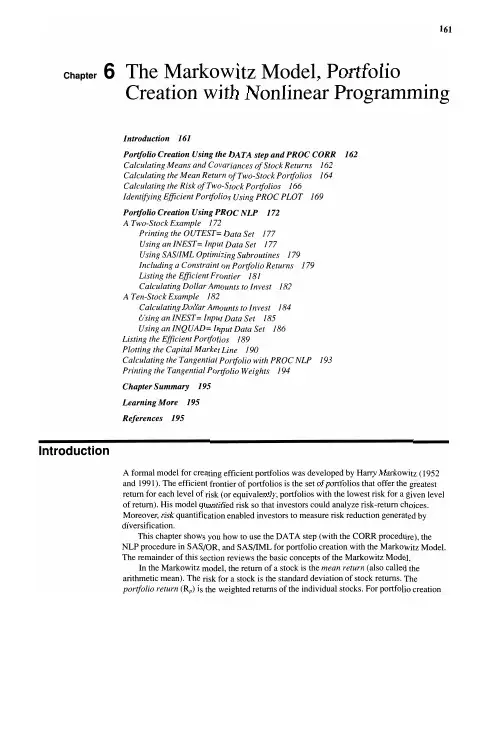
RaStockMarketAnalysisUsingTheSASSystem_ch06
- 格式:pdf
- 大小:695.12 KB
- 文档页数:36

Multinational Business Finance^ 12e (Eiteman,et al)Chapter 2 Financial Goals and Corporate Governance2.1Who Owns the Business?Multiple Choice1)Foreign stock markets are frequently characterized by controlling shareholders for the individual publicly traded firms. Which of the following is NOT identified by the authors as typical controlling shareholders?A)The government (for example, privatized utilities).B)Institutions (such as banks in Germany).C)Family (such as in France).D)All of the above were identified by the aiHhors as controlling shareholders・Answer: DDiff: 1Topic: 2」Who Owns the Business?Skill: RecognitionTrue/False1)In the U.S. and U.K. stock markets are characterized by ownership of firms concentrated in the hands of a few controlling shareholders. In contrast, the rest of the world tends to have more widespread ownership of shares.Answer: FALSEDiff: 1Topic: 2.1 Who Owns the Business?Skill: Recognition2.2What Is the Goal of Management?Multiple Choice1) "Maximize corporate wealth0A)is the primary objective of the non-Anglo-American model of management.B)as a management objective treats shareholders on a par with other corporate stakeholders such as creditors, labor, and local community・C)has a broader definition than just financial wealth・D)all of the aboveAnswer: DDiff: 1Topic: 2.2 What is the Goal of ManagementSkill: Recognition2)The Shareholder Wealth Maximization ModelA)combines the interests and inputs of shareholders, creditors, management, employees, and societ y.B)is being usurped by the Stakeholder Capitalism Model as those types of MNEs dominate their global industry segments.C)clearly places shareholders as the primary stakeholder.D)is the dominant form of corporate management in the European-Japanese governance system・ Answer: CDiff: 2Topic: 2.2 What is the Goal of ManagementSkill: Recognition3)The Stakeholder Capitalism ModelA)clearly places shareholders as the primary stakeholder.B)combines the interests and inputs of shareholders, creditors, management, employees, and societ y.C)has financial profit as its goal and is often termed impatient capital.D)is the Anglo-American model of corporate governance・Answer: BDiff: 2Topic: 2.2 What is the Goal of ManagementSkill: Recognition4)In the Anglo-American model of corporate governance, the primary goal of management is toA)maximize the wealth of all stakeholders・B)maximize shareholder wealth・C)minimize costs.D)minimize risk・Answer: BDiff: 1Topic: 2.2 What is the Goal of ManagementSkill: Recognition5)In finance, an efficient market is one in whichA)prices are assumed to be correct.B)prices adjust quickly and accurately to new information・C)prices are the best allocators of capital in the macro economy.D)all of the aboveAnswer: DDiff: 2Topic: 2.2 What is the Goal of ManagementSkill: Recognition6)Systematic risk can be defined asA)the total risk to the firm.B)the risk of the individual security・C)the risk of the market in general.D)the risk that can be systematically diversified away.Answer: CDiff: 2Topic: 2.2 What is the Goal of ManagementSkill: Recognition7)Unsystematic risk can be defined asA)the total risk to the firm.B)the risk of the individual security・C)the added risk that a firm's shares bring to a diversified portfolio.D)the risk of the market in general.Answer: BDiff: 2Topic: 2.2 What is the Goal of ManagementSkill: Recognition8)The study of how shareholders can motivate management to accept the prescriptions of the shaieholder wealth maximization model is calledA)market efficiency・B)the SWM model.C)agency theory.D)the SCM model.Answer: CDiff: 2Topic: 2.2 What is the Goal of ManagementSkill: Recognition9)Under the Shareholder Wealth Maximization Model of corporate governance, poor firm performance is likely to be faced with all but which of the following?A)Sale of shares by disgnintled current shareholders・B)Shareholder activism to attempt a change in current management.C)As a maximum threat, initiation of a corporate takeover・D)Prison time for executive management.Answer: DDiff: 2Topic: 2.2 What is the Goal of ManagementSkill: Conceptual10)Which of the following is a reason why managers act to maximize shareholder wealth in Anglo-American markets?A)The use of stock options to align the goals of shareholders and managers・B)The market for corporate control that allows for outside takeover of the firm・C)Performance based compensation for executive management.D)all of the aboveAnswer: DDiff: 2Topic: 2.2 What is the Goal of ManagementSkill: Conceptual11)Which of the following is NOT true regarding the stakeholder capitalism model?A)Banks and other financial institutions are less important creditors than securities markets.B)Labor unions are more powerful than in the Anglo-American markets.C)Governments interfere more in the marketplace to protect important stakeholder groups・D)All of the above are TRUE・Answer: ADiff: 2Topic: 2.2 What is the Goal of ManagementSkill: Conceptual12)The stakeholder capitalism modelA)typically avoids the flaw of impatient capital.B)tries to meet the desires of multiple stakeholders・C)may leave management without a clear signal about tradeoffs among the several stakeholders.D)all of the aboveAnswer: DDiff: 2Topic: 2.2 What is the Goal of ManagementSkill: Conceptual13)Which of the following is generally NOT considered to be a viable operational goal for a firm?A)Maintaining a strong local currency・B)Maximization of after-tax income.C)Minimization of the film's effective global tax burden・D)Correct positioning of the firms income, cash flows and available funds as to country and currenc y.Answer: ADiff: 2Topic: 2.2 What is the Goal of ManagementSkill: Conceptual14)Which of the following operational goals for the international firm may be incompatible with the others?A)Maintaining a strong local currency・B)Maximization of after-tax income.C)Minimization of the fkm's effective global tax burden・D)Each of these goals may be incompatible with one or more of the others.Answer: DDiff: 2Topic: 2.2 What is the Goal of ManagementSkill: Conceptual15)The primary operational goal for the firm is toA)maximize after-tax profits in each country where the firm is operating・B)minimize the total financial risk to the firm.C)maximize the consolidated after-tax profits of the firm・D)maximize the total risk to the firm.Answer: CDiff: 3Topic: 2.2 What is the Goal of ManagementSkill: ConceptualTrue/False1)The stakeholder capitalism model holds that total risk (operational and financial) is more important than just systematic risk・A)TrueB)FalseAnswer: ADiff: 1Topic: 2.2 What is the Goal of ManagementSkill: Recognition2)In recent years the trend has been for markets to increasing focus on the shareholder wealth form of wealth maximization・A)TrueB)FalseAnswer: ATopic: 2.2 What is the Goal of ManagementSkill: Recognition3)Patient Capitalism is characterized by short-term focus by both management and investors・Answer: FALSEDiff: 1Topic: 2.2 What is the Goal of ManagementSkill: Conceptual4)Agency theory states that unsystematic risk can be eliminated through diversification. Answer: FALSEDiff: 1Topic: 2.2 What is the Goal of ManagementSkill: Recognition5)The stakeholder capitalism model does not assume that equity markets are either efficient or inefficient.Answer: TRUEDiff: 1Topic: 2.2 What is the Goal of ManagementSkill: Conceptual6)The stakeholder capitalism model assumes that only systematic risk "counts11 or is a prime concern for management.Answer: FALSEDiff: 1Topic: 2.2 What is the Goal of ManagementSkill: Conceptual7)Dividend yield is the change in the share price of stock as traded in the public equity markets. Answer: FALSEDiff: 1Topic: 2.2 What is the Goal of ManagementSkill: Recognition1)Describe the management objectives of a firm governed by the shareholder wealth maximization model and one governed by the stakeholder wealth maximization model. Give an example of how these two models may lead to different decision-making by executive management.Answer: Shareholder wealth maximization attempts to do just that, typically through the maximization of share price. Stakeholder wealth maximization is much more difficult because of the necessity to satisfy many stakeholders all having approximately equal claim on the objectives of management. These stakeholders may include shareholders, creditors, customers, employees, and community. Differing decisions may occur in a situation that involves significant social costs. For example, in the U.S. the decision to shift production from a local factory to a foreign one may be in large based on the change in NPV as the result of the move with only minor consideration of the impact that a change in location would have on the community at large or the local employees・ A manager of a stakeholder driven firm may place equal or greater emphasis on the local employees and community and choose to maintain the current facility rather than move even if the foreign operation provided a much greater NPV. Ultimately, the latter may cause an inefficient allocation of scarce resources and lead to an overall lower standard of living.Diff: 3Topic: 2.2 What is the Goal of ManagementSkill: Conceptual2.3 Corporate GovernanceMultiple Choice1) Which of the following broad topics is NOT identified as an area to be established as good corporate governance practice by the Organization for Economic Cooperation and Development (OECD)?A)Protect the rights of shareholders・B)Disclosure and transparency.C)The proper role of stakeholders in the governance of the firm・D)All of the above should be a concern of good corporate governance・Answer: DDiff: 2Topic: 2.3 Corporate GovernanceSkill: Recognition2)The relationship among stakeholders used to determine and control the strategic direction and performance of an organization is termed _______ ・A)corporate governanceB)Anglo-American activismC)capital structureD)working capital managementAnswer: ADiff: 2Topic: 2.3 Corporate Governance3)When discussing the structure of corporate governance, the authors distinguish between internal and external factors. _______ is an example of an internal factor, and ________ is an example of an external factor・A)Equity markets; executive managementB)Debt markets; board of directorsC)Executive management; auditorsD)Auditors; regulatorsAnswer: CDiff: 2Topic: 2.3 Corporate GovernanceSkill: Recognition4)Which of the following is NOT commonly associated with a government affiliated form of corporate governance regime?A)No minority influence・B)Lack of transparency・C)State ownership of enterprise・D)All are associated with this type of corporate governance regime.Answer: DDiff: 2Topic: 2.3 Corporate GovernanceSkill: Recognition5)Generally speaking, which of the following is NOT considered an important factor in the composition and control of corporate boards of directors?A)The number of insider vs outside directors・B)The total number of directors on the board・C)The composition of the compensation committee・D)All of the above are important factors of board composition.Answer: DDiff: 2Topic: 2.3 Corporate GovernanceSkill: Recognition6)Signed into law on July 30, 2002, the _______ Act requires CEOs of publicly traded companies to vouch for the veracity of the firm's published financial statements.A)Smoot-HawleyB)Humphrey-HawkinsC)McCain-MerrillD)Sarbanes-OxleyAnswer: DDiff: 1Topic: 2.3 Corporate Governance7)The Sarbanes-Oxley Act, passed by the U.S. Congress in July 2002, was designed toA)reinstitute heavy tariffs on international trade・B)reform corporate governance・C)limit the Federal Reserve Board s ability to engage in the buying and selling of gold.D)limit trade with countries deemed lenient on terrorism・Answer: BDiff: 1Topic: 2.3 Corporate GovernanceSkill: RecognitionTrue/False1)Regarding comparative corporate governance regimes: Bank-based regimes characterized by government influence in bank lending and a lack of transparency is often found in countries such as Korea and Germany.Answer: TRUEDiff: 2Topic: 2.3 Corporate GovernanceSkill: Recognition2)Investor protection is typically better in countries with codified civil law (the Code Napoleon) than in countries with a legal system based in English common law.Answer: FALSEDiff: 2Topic: 2.3 Corporate GovernanceSkill: Conceptual3)The relatively low cost of compliance with the Sarbanes-Oxley Act (SOX) has been a surprising benefit of the act.Answer: FALSEDiff: 1Topic: 2.3 Corporate GovernanceSkill: Recognition4)According to recent research, family-owned firms in some highly-developed economies typically outperform publicly-owned firms.A)TrueB)FalseAnswer: ADiff: 2Topic: 2.3 Corporate GovernanceSkill: Recognition。
南京工程学院英文文献及译文作者:张所炜学号:209100738 系部:经济与管理学院专业:信息管理与信息系统题目:“投入产出分析系统”的设计与实现指导者:黄传峰副教授2014年 2月Emerging challenging in regional input-output analysisGeoffrey J. D. HewingsUniversity of Illinois at Urbana-Champaign USAandRodney C. JensenUniversity of Queensland St. Luci AustraliaAbstract.The changing interests and focus of research in the field of regional input-output analysis is examined. After reviewing some of the recent trends and suggesting the tenor of the prevailing philosophy in the field, attention is focused on three, interdependent emerging trends. These are characterized as (1)the conceptualization of input-output within the traditions of econometric analysis;(2) the integration of input-output with other regional and interregional models and (3) attempts to link input-output analysis with regional growth and development theory. I. PrefaceTo our knowledge, Michael Mischaikow's research interests have not directly encompassed regional input-output analysis. However, as Editor of the Annals, and as a highly respected statesman in regional science, he has had a significant influence in fostering the growth and development of many analytical techniques in regional analysis including input-output analysis. Several very important and influential articles have appeared in the Annals, many as the result of Mischaikow's initiative and encouragement. He has been a firm, committed champion of our sub-field of regional input-output analysis. We are pleased to have the opportunity to offer this paper as part of his Festschrift , both as a mark of personal appreciation and encouragement, and to honor the outstanding contribution of a valued colleague.II. IntroductionThe field of regional analytical modelling is undergoing a significant new surge of interest and development. In this paper, some of these developments will be reported in the context of a set of emerging ehallenges in the field of regional input-output analysis. First, however, the current state of the art will be reviewed briefly. Thereafter,some general comments will be made about the prevailing philosophy in input-output analysis. The fifth section of the paper will address the emerging trends as a way of establishing a possible agenda for the future. The final part of the paper provides some concluding comments.III. The State of the Art in Regional Input-Output AnalysisWith several recent contributions under this umbrella (Miller and Blair, 1985; Richardson, 1985; Hewings and Jensen, 1986), the need for yet another comprehensive review of input-output at the regional level is not a high priority. The objective in this section is not to provide the detailed coverage that these papers and monographs have contributed, but rather a summary and overview of general trends and directions. This overview is intended to facilitate the discussion in later sections of the paper.Two important points need to be established as a preface to an overview of important developments in input-output. First, while regional input-output models have become an accepted and much-used part of the arsenal of analytical techniques, there is a strong suspicion that many analysts have a higher level of awareness of the model's limitations than they have of its utility. This comment is made on the basis of casual empiricism derived from referees' comments on input-output papers submitted to journals and commentary made on similar papers presented at professional meetings. We see this primarily as a result of the continued high level of debate, evaluation, and testing which has characterized the field of regional input-output, probably far more than most other fields of economic analysis. This healthy debate and critical introspection has been in the traditions of an academic and professional environment aimed at continued improvement and evaluation of existing analytical skills. It is no exaggeration to suggest that the most informed and consistent critics of aspects of the input-output methodology are those actively and diligently involved in research on the technique. As is so often the ease, the negative aspects of such activities tend to fUter through to those with marginal interest and knowledge of the technique, with more efficiency than positive aspects, creating in this ease an image of input-output which is less encouraging than that warranted by the reality ofprogress. In a sense, this situation provides evidence of a Gresham's Law of Information--the bad driving out the good.Second, there is also an underlying perception that input-output models have not adapted well to the needs of the modern analyst; there appears to be some feeling that "more modern" methods are increasingly required in routine analytical situations, as the "life cycle" of input-output analysis proceeds past some peak of activity. We see such an attitude as extraordinary in light of the current unprecedented expansion in the use of input-output at the regional level~ where the technique is rapidly becoming routine in planning and impact studies, and obviously filling a need to an increasing extent. While it would be unfortunate if this paper devolved merely into a defense of the technique, some of these perceptions are widely held to be sound. Hence, some summary statement of the current status of the field and its developments appears to be appropriate and is provided below.An examination of the literature suggests that a number of important developments can be highlighted:(1)he rapid growth in the adoption of input-output analysis, for planning,forecasting and general impact analysis, at the regional level in countries of all political persuasions and levels of development, to the stage of routine application. Recent experience would appear to be counter to any suggestion that input-output analysis has reached and passed its zenith. In fact, input output appears to be entering a new stage of expanded routine application. In many ways, the challenges facing the construction and ultimate use of regional input-output models are as great as they were two or three decades ago, yet they are of a different kind. Of particular importance has been the gradual use of these models in developing economies, particularly in the context of integrated models (see below).(2)the decline in the attention given to the production of regional input outputtables{ new input-output tables are appropriately regarded as routine rather than significant events. No special fanfare is accorded the production of regional input-output tables in the developed world--unless some novelaccounting scheme, data collection method or particular application has been associated with their development. The process hasjbecorne routine, accelerated by the availability of several competing personal computer packages which will enable the construction of a regional input-output table with minimal regional data (for a partial review, see Sivitanidou and Polenske, 1987). Furthermore, there has been a greater recognition in the literature of the linkages between a number of important modelling paradigms. Thus, the bi-proportional or RAS technique which was first developed for updating input-output tables has been shown to be part of a broad family of matrix estimation techniques on the one hand (see Batten, 1982; Boyce and Batten, 19861 Nagurney, 19871 Willikens, 1981) and a special case of general error analysis in matrix systems on the other hand (see Sonis and Hewings, 1987).This recognition has lead to a great deal of shared expertise and an enriching of the analytical tools{ the flexibility afforded by entropy, contingency table and network approaches (such as those of Kadas and Klafsky, 1976 and the variational inequality proposals by Nagurney, 1987) to matrix estimation has provided the analyst with a choice of approaches which,for the most part, do not depend entirely on the data set available.(3)a movement towards the development of hybrid input-output tables, acompromise position between groups who advocated the construction of tables from survey data alone and those whose position is that nonsurvey techniques will produce tables of the requisite quality. Alternative approaches to the construction of regional tables dominated the literature for much of the 1970s. While extreme positions were taken in the earlier years, there would appear to have been significant mellowing of opinions and movements towards the center, the center being defined as the recognition that partial survey or hybrid tables would become the dominant construction technique.In part, this compromise was reached on both pragmatic and analytic grounds.In the former case, the recognition that the days of massive appropriation of funds by state, provincial and local government agencies for the de novoconstruction of input-output tables was over propelled researchers to ponder the alternatives. On the other hand, there was increasing evidence that the census mentality, namely that all entries in an input-output table had to be obtained from survey data, was probably misplaced. Notions of analytical importance began to provide the way for a compromise which would allow the investigator to maximize the quality of the effort involved in any data collection by focusing on garts of the system whose direct estimation was deemed critical. While debate now centers on the identification of these elements, few articles have appeared in the recent past which have ventured far from a notion of support for the development of hybrid.(4)a recognition that integrated and more specialized models, with theinput-output model as one component, will be more important at the regional level in the coming years, and the development of operational models of this type. While Isard's "Channels of Synthesis" chapter in Methods of Regional Analysis was considered by some as an unattainable goal, it was visionary and propitious in its ability to suggest a trend which appears to be dominating the development of regional analytical models in the 1980s. More attention wig be devoted to this issue in Section V.(5)the increasing attention which has been given to problems of errors andsensitivity in input-output models, a11owing reasonable perspectives of model robustness to be established. While some of the earlier input-output analysts raised questions about errors in the input-output model (in construction and in application), these issues were treated sotto voee by the profession for the most part. Only recently have some of these problems been revisited; rather than presenting major impediments to the use of the input-output model, a ease can be made that the raising of the issue has created some significant breakthroughs in the analytical utility of the model.Again, more discussion will be devoted to this issue in Section V.IV. The Prevailing Philosophy in Regional Input-Output AnalysisThis section presents some summary statements which describe our view of theprevailing philosophy in input-output analysis. In the preceding seetion, it was noted that over the last two decades, there has been a significant change in the focus of attention in regional input-output analysis. Three phases in the development may be articulated and these have led to the currently developing philosophy which many analysts in the field seem to share.First, the generation of regional input-output tables, a daunting challenge given computational and data resources, dominated the early phase of regional input-output survey-based work. For the most part, the tables which were constructed were influenced very heavily by the type of table constructed at the national level; concomitantly, most of the applications with the associated regional model mirrored the developments at the national level. In fact, during this period, the separation of "regional" and "national" analysts was relatively weak; thereafter, this separation increased to the point where, today, there appears to be little or no contact between the two groups."The second phase may be ascribed the label "accuracy issues" as debate centered on the acceptability of various (survey versus nonsurvey) methods for construction. The resolution on table construction saw movement towards a common ground aided by Jensen's (1980) attempt to distinguish between holistic and partitive accuracy. This distinction, often misinterpreted as simply a choice between two operational views of accuracy (see Richardson, 1985), raised the notion that the integrity of the table as a whole as a "portrait" of an economy is perhaps a more worthy objective than attending to the accuracy of large numbers of analytically insignificant cells.The third phase has witnessed several different approaches to the construction of hybrid tables, as analysts sought to provide more explicit ways of identifying the set of entries for which "superior data" were required. Unresolved at the present time is the issue of the a priori identification of these critical data sets in cases in which no existing table is available. This dilemma has lead to two important new developments which provide not only substantial challenges for input-output analysis but for regional analysis in general.Essentially, these developments seek to view the matrix of transactions (broadly defined to include other than interindustry transactions) as a representation of the structure of the economy. With this representation, the second perspective then seeks to use these structures to establish a taxonomy of economies and suggest the development of possible theories about the evolutions of economies over time and space. While these ideas have been articulated in detail elsewhere (see Hewings, Jensen and West, 1987; Jensen, West and Hewings, 1987; Jensen et al. 1987), some of the implications will be reviewed here.The first point to note is that regional growth and development theory has, for the most part, ignored the issue of structure in the sense of the structure of the economy embodied in the input-output table and associated model. Attention has been focused on aggregate indicators such as the' distribution of output, income or employment among major sectors but rarely on the interdependence existing among these sectors. While some parts of growth center theory have attempted to view regional growth in terms of the generation of linkages, the overall changes in the structure of the economy are rarely mentioned.Secondly, there exists a large number of input-output tables for regions of different sizes and at different stages of development. No attempt has been made to regard these as a sample of "photographs" of the structure of their economies at one point in time; while the photographic record is incomplete, the opportunity to view these as samples from a space-time development continuum appears to have been ignored. The need for some creative interpretive techniques to handle missing "records" (i.e., input-output tables for some regions or points in time) would appear to be paramount if this opportunity is not to be lost.While trying to avoid any suggestion of economic determinism, the third issue which arises 'focuses on our ability to use information about regional economic structures in building up a taxonomy of regional economies. It is felt that this taxonomy would be useful for a number of reasons--assisting the development of hybrid input-output tables for regions in which only limited information is available, providing guidance on possible development trends in regions undergoing change and,most importantly, testing for the existence of a fundamental economic Structure. Further discussion on this topic will follow in Section V.This change in philosophy reflects a sense in which the input-output model is now seen as part of the broader picture of regional growth and development rather than simply as an analytical tool designed to assist in providing answers for limited impact analyses. It is this broader picture which will be traced in more detail in the next section.V. Emerging Trends in Regional Input-Output AnalysisIn this section, the discussion will amplify many of the issues raised thus far, but wiU focus them more specifically to a set of three, interdependent, emerging trends. The term "regional" should be read as covering single-region, interregional and multiregional models and the term "input-output" should be considered very broadly (see Figure 1). The three trends may be labelled as (1) econometric input-output analysis; (2) integrated input-output modelling and (3) input-output and regional growth and development theory.5.1 Econometric Input-Output AnalysisScholars exposed to input-output analysis for the first time, are keenly aware of the fact that while conceptualized within conventional economics, it has been necessarily operationalized and developed, for the most part, outside the mainstream of rigorous econometric practice. While some early attempts were made to avoid this unfortunate distinction (see Jackson and West, 1987 and Sonis and Hewings, 1987 for a review), the fact remains that input-output analysis has often been presented, like much economic analysis, as more accurate than justified by available data sources. For example, little attention in the literature has been given to the sampling problems involved in data collection and the impact that errors in data might have on the model's reliability. The prevailing view that data inconsistencies in many survey-based models were rather crudely arbitraged lead Gerking (1976a, 1976b, 1979) to initiate a renewed charge for more analytical rigor in the development of the tables. The subsequent debate with Miernyk (1976, 1979) is now well known and wig not be reviewed here. However, several important developments took place almostsimultaneously--Bullard and Sebald's (1977) research on the issue of analytical importance, and the work of West (1981, 1986) and Jackson (1986) in developing distributions associated with errors in individual coefficients.5.2 Integrated Input-Output ModellingIt is unfortunate that in many textbooks, regional analytical models are presented as competitors rather than as alternatives within a broader conceptual framework. In the last decade, however, some of the most important developments in the field have been in the direction of linking the input-output model with one or more other models (see Batey and Madden, 1981, 1983 and 1986 for an excellent collection). This research has generated a new perspective on the input-output model; concerns about data collection, aggregation, accuracy and causality have had to be raised anew in the context of a larger, more encompassing analytical framework. Figure I describes some of the "linkages" in these new developments; only a few examples of the linked models are provided. The main purpose of the illustration is to reveal that there are a number of alternative approaches which seem to be converging on what we might term a general equilibrium framework. In this regard, input-output analysis is reestablishing the spirit of the Walrasian framework from which it was initially derived by Leontief. This trend may be illustrated in the evolution of the computable general equilibrium models which grew out of dissatisfaction with the input-output model and the limitations of the linear programming formulation. Here, the input-output model is but one part of the general interdependence captured in theeconomy, although a very important component nonetheless. The expansion of the input-output model in the direction of social accounts has recently been extended in the form of transaction value social accounts. Here, the accounting framework has been enhanced through the development of equations designed to estimate some of the parameters which appear in the SAM per se (see Drud, Grais, and Pyatt, 1985).Clearly, the distinction between the two approaches, general equilibrium and transaction value social accounts, may soon disappear. One major advantage of the framework is the added flexibility afforded for the analyst interested indeveloping more detail in one aspect of the model as many actors and relationships are made endogenous. For example, Van Di]~ and Oosterhaven (1986) have been able to link a vacancy chain model (to capture labor market changes) with an input-output model to explore the effects of government policy initiatives in employment creation in the northern part of The Netherlands. Batey and Madden's work (1981, 1983) in linking the input-output model with consumption behavior of households of different types is well known. Less well known is the important contribution of Bell, Hazell and Slade (1982) in linking the social accounting system to a project appraisal framework along the lines initially proposed by Tinbergen (1966) and implemented for an input-output model alone for Papua New Guinea by Karunaratne (1976).Some of the more ambitious attempts to link models have involved econometric, linear programming and environmental components integrated with or joined in some fashion with regional input-output models. Several of these efforts have been reviewed in Hewings and Jansen (1986), and Hewings (1986); the additional insights gained from the linkage far outweighed the extra effort involved in developing the model in almost all these cases. More recently, there have been some ventures into regional computer general equilibrium modelling at the regional level (see Ko and Hewings, 1986; Spencer, 1987; Harrigan, McGregor and Swales as well as Dixon et al., 1982).However, the linkage of models is not costless; in particular, one needs to draw attention to what Taylor and Lysy (1979) refer to as the closure rules. In many cases, the models contain a structure in which there are more variables than equations,leading to the delicate decision as to what is endogenous and what exogenous. The issue is not trivial and different choices can often lead to very different results in the estimation of many parameters. From another perspective, there is the issue of just what is driving the system (see Hewings, 1986). As more and more activities and relationships are determined endogenously, the driving mechanism for the regional or national economy is often reduced to a small subset of exogenous variables.5.3 Input-Output and Regional Growth and Development TheoryIn section IV, it was noted that some recent work had proposed utilizing the set of input-output tables now available in a more creative way to further regional growth and development theory. In this regard, a taxonomy of regional economies was proposed as a major initial objective to provide the basis for the development of an hypothesis to explain the evolution of economies over time and space. A critical component of this taxonomy was thought to be the notion of a fundamental economic structure. This notion represents an elaboration of the concept of a fundamental structure of production introduced by Simpson and Tsukui (1965) since it would include aspects other than interindustry transactions.The major research questions here are the degree to which a fundamental economic structure can be identified (several approaches are reviewed in I-Iewings, Jensen and West, 1987), its stability over time (within one region) and over space (across the spectrum of economies from small, rural ones to sophisticated national-level economies) and its importance in conditioning the pace and future development of economies.There is a further opportunity to integrate some of the issues noted in the first two emerging trends in section V, namely econometric analysis and integrated modelling. For example, the issue of analytical importance of the elements in the fundamental economic structure offers a challenge to examine the nature of change and its repercussions throughout the rest of the economy in question. In addition, the issue of integration may be addressed in the same context. Assume, for example, that this change is generated by the adoption of an innovation in production by a small number of firms within one region or the production of a new product. In this regard,the opportunity now exists to link Input-output analysis and innovation theory in a rigorous analytical fashion (see Hewings, Sonis and Jensen, I987). Changes in the regional input-output portion of the production function may be traced in terms of their impact upon the rest of the system and, in an interregional context, in terms of the competition for inputs or markets. The input-output model affords the possibility for generating the indirect effects of innovation diffusion in production and in innovation adoption in consumption by households and other components of what is traditionally referred to as final demand. On the other hand, the rich conceptual framework offered by innovation diffusion theory provides an appropriate context in which the general process of coefficient change can be considered.VL ConclusionsFrom this discussion, is there a sense of a substantial set of opportunities in the field of input-output analysis? The answer would appear to be most strongly affirmative. The issues which have been raised and the work conducted to date have merely scratched the surface that the new sets of issues facing input-output analysts are more challenging, interesting and exciting than many of those of the past.区域投入产出分析的新兴挑战Geoffrey J. D. HewingsUniversity of Illinois at Urbana-Champaign USAAndRodney C. JensenUniversity of Queensland St. Luci Australia摘要:区域投入产出分析研究领域不断变化的兴趣和研究的重点,回顾最近的一些趋势和区域投入产出的主流哲学,并把注意力集中在三个相互依存的新兴趋势。

mortgage抵押barter物物交换rates of exchange汇率credit union信用社double coincidence of wants需求双重巧合stock index股票指数surplus unit资金盈余单位deficit unit资金短缺单位 a means of payment for goods购货的支付手段repayment of debts债务偿还interest rate fluctuation利率波动financial asset金融资产money supply货币供给checking account支票账户Federal Reserve note联邦票据Federal Reserve bank联邦银行market mutual funds市场互助资金overnight loans隔夜贷款financial institution金融机构economic life经济生活be converted into转换成 a medium of exchange交换媒介unit of account记账单位stock market股票市场circulate流通,发行suspend使中止quota配额,定额,限额agreement协定,协议redeem将(纸币)兑换成硬币,用(股票等)兑取现金inflation通货膨胀,(物价)暴涨appreciate增值,涨价surveillance看守,监视,监督,检查International Monetary System国际货币体系balance of payments收支平衡International Monetary Fund (IMF)国际货币基金(组织) Bretton Woods System布雷顿森林体系The General Agreement on Tariffs and Trade(GATT)关贸总协定par value面值IMF system国际货币基金体系paper gold/SDRs纸黄金/特别提款权favorable payments balances国际收支顺差the gold standard金本位The Jamaica System牙买加体系Plaza Agreement广场协议Louvre Accord卢浮宫协议European Monetary System欧洲货币体系security证券denomination(货币)计值单位,面额commission佣金marketable适于销售的auction拍卖yield收益,回报default违约secure抵押,担保acceptance承兑fraudulent欺诈的fixed interest income固定利息收入bearish market 熊市bullish market牛市risk/return tradeoff风险回报考量mutual fund互助资金coupon bonds息票债券compound bonds复利time deposit定期存款tie up占用,冻结secondary market二级市场account receivable应收账款money market investment货币市场投资cash investment现金投资money market instrument货币市场工具Treasury Bills(T-bills)国债,国库券certificate of deposit(CD)大额存单commercial paper商业票据bankers’ acceptance银行承兑汇票Eurodollars欧洲美元repo回购协议dividend红利,股息hedge套期保值opportunity cost机会成本preferred stock优先股real assets不动产common stocks普通股EPS(Earning Per Share)每股收益fall short of不符合,达不到investment decision投资决策real interest rate实际利率excepted returns预期回报personal risk个人风险timing risk时机风险tenure risk时期风险company risk公司风险financial risk财务风险management risk管理风险market risk市场风险liquidity risk流动风险interest risk利率风险inflation risk通货膨胀风险exchange rate risk汇率风险reinvestment risk再投资风险national and international risk国家和国际风险economic risk经济风险industry risk工业风险tax risk税收风险political risk政治风险impact作用,影响survival生存havoc破坏,混乱unpredictability不可预期swap掉期,互换,做交易subsidiary子公司,辅助物indebtedness亏欠,欠债invoice发票,开发票offset抵消,冲销,补偿monetary units货币单位foreign currency外币in the absence of缺少,如果没有forward foreign exchange market远期外汇市场foreign currency swap外汇掉期spot transaction即期交易forward transaction远期交易parent company母公司home currency本币forward delivery远期交割set off抵消,抵补citizenship公民credit贷记debit借记reserve储备resident居民multinational corporations跨国公司balance of payments国际收支double-entry bookkeeping复式记账法capital and financial account资本与金融账户investment income投资收益tangible trade有形贸易trade deficit贸易赤字trade surplus贸易盈余intellectual properties知识产权capital inflow资本流入capital outflow资本流出portfolio investment间接投资,(有价)证券投资money market instruments货币市场工具official reserve assets官方储备资产foreign direct investment(FDI)外国直接投资address开立order指定的人bearer来人affiliate分支机构remittance汇款collection托收present提示cash兑现withdraw提取protest做拒绝证书round整数的bill of exchange汇票sight draft即期汇票arrival draft货到付款汇票time draft远期汇票grace period宽限期be bound to一定的,必定的collecting bank代收行remitting bank托收行crossed cheque划线支票open cheque现金支票traveler’s cheque旅行支票in one’s presence当某人面Traveler’s Letter of Credit旅行信用证Economists define money(or equivalently, the money supply)as anything that is generally accepted in repayment for goods or services or in repayment for debts.经济学家将货币(或货币供给)定义为在商品或服务的支付中或在偿还债务中被普遍接受的任何东西。
