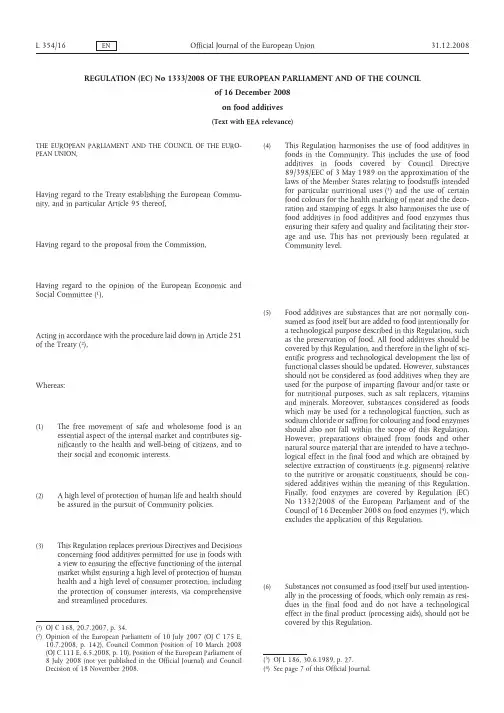
REGULATION(EC)No1333/2008OF THE EUROPEAN PARLIAMENT AND OF THE COUNCILof16December2008on food additives(Text with EEA relevance)THE EUROPEAN PARLIAMENT AND THE COUNCIL OF THE EURO-PEAN UNION,Having regard to the Treaty establishing the European Commu-nity,and in particular Article95thereof,Having regard to the proposal from the Commission,Having regard to the opinion of the European Economic and Social Committee(1),Acting in accordance with the procedure laid down in Article251 of the Treaty(2),Whereas:(1)The free movement of safe and wholesome food is anessential aspect of the internal market and contributes sig-nificantly to the health and well-being of citizens,and totheir social and economic interests.(2)A high level of protection of human life and health shouldbe assured in the pursuit of Community policies.(3)This Regulation replaces previous Directives and Decisionsconcerning food additives permitted for use in foods witha view to ensuring the effective functioning of the internalmarket whilst ensuring a high level of protection of humanhealth and a high level of consumer protection,includingthe protection of consumer interests,via comprehensiveand streamlined procedures.(4)This Regulation harmonises the use of food additives infoods in the Community.This includes the use of foodadditives in foods covered by Council Directive89/398/EEC of3May1989on the approximation of thelaws of the Member States relating to foodstuffs intendedfor particular nutritional uses(3)and the use of certainfood colours for the health marking of meat and the deco-ration and stamping of eggs.It also harmonises the use offood additives in food additives and food enzymes thusensuring their safety and quality and facilitating their stor-age and use.This has not previously been regulated atCommunity level.(5)Food additives are substances that are not normally con-sumed as food itself but are added to food intentionally fora technological purpose described in this Regulation,suchas the preservation of food.All food additives should becovered by this Regulation,and therefore in the light of sci-entific progress and technological development the list offunctional classes should be updated.However,substancesshould not be considered as food additives when they areused for the purpose of imparting flavour and/or taste orfor nutritional purposes,such as salt replacers,vitaminsand minerals.Moreover,substances considered as foodswhich may be used for a technological function,such assodium chloride or saffron for colouring and food enzymesshould also not fall within the scope of this Regulation.However,preparations obtained from foods and othernatural source material that are intended to have a techno-logical effect in the final food and which are obtained byselective extraction of constituents(e.g.pigments)relativeto the nutritive or aromatic constituents,should be con-sidered additives within the meaning of this Regulation.Finally,food enzymes are covered by Regulation(EC)No1332/2008of the European Parliament and of theCouncil of16December2008on food enzymes(4),whichexcludes the application of this Regulation.(6)Substances not consumed as food itself but used intention-ally in the processing of foods,which only remain as resi-dues in the final food and do not have a technologicaleffect in the final product(processing aids),should not becovered by this Regulation.(1)OJ C168,20.7.2007,p.34.(2)Opinion of the European Parliament of10July2007(OJ C175E,10.7.2008,p.142),Council Common Position of10March2008(OJ C111E,6.5.2008,p.10),Position of the European Parliament of 8July2008(not yet published in the Official Journal)and Council Decision of18November2008.(3)OJ L186,30.6.1989,p.27.(4)See page7of this Official Journal.(7)Food additives should be approved and used only if theyfulfil the criteria laid down in this Regulation.Food addi-tives must be safe when used,there must be a technologi-cal need for their use,and their use must not mislead theconsumer and must be of benefit to the consumer.Mis-leading the consumer includes,but is not limited to,issuesrelated to the nature,freshness,quality of ingredients used,the naturalness of a product or of the production process,or the nutritional quality of the product,including its fruitand vegetable content.The approval of food additivesshould also take into account other factors relevant to thematter under consideration including societal,economic,traditional,ethical and environmental factors,the precau-tionary principle and the feasibility of controls.The useand maximum levels of a food additive should take intoaccount the intake of the food additive from other sourcesand the exposure to the food additive by special groups ofconsumers(e.g.allergic consumers).(8)Food additives must comply with the approved specifica-tions,which should include information to adequatelyidentify the food additive,including origin,and to describethe acceptable criteria of purity.The specifications previ-ously developed for food additives included in Commis-sion Directive95/31/EC of5July1995laying downspecific criteria of purity concerning sweeteners for use infoodstuffs(1),Commission Directive95/45/EC of26July1995laying down specific purity criteria concerningcolours for use in foodstuffs(2)and Commission Directive96/77/EC of2December1996laying down specific puritycriteria on food additives other than colours and sweeten-ers(3)should be maintained until the corresponding addi-tives are entered in the Annexes to this Regulation.At thattime,the specifications related to such additives should beset out in a Regulation.Those specifications should relatedirectly to the additives included in the Community lists inthe Annexes to this Regulation.However,considering thecomplex character and substance of such specifications,forthe sake of clarity they should not be integrated as such inthe Community lists but should be set out in one or moreseparate Regulations.(9)Some food additives are permitted for specific uses for cer-tain authorised oenological practices and processes.Theuse of such food additives should comply with this Regu-lation and with the specific provisions laid down in the rel-evant Community legislation.(10)In order to ensure harmonisation,the risk assessment andapproval of food additives should be carried out in accor-dance with the procedure laid down in Regulation(EC)No1331/2008of the European Parliament and of theCouncil of16December2008establishing a commonauthorisation procedure for food additives,food enzymesand food flavourings(4)(11)Under Regulation(EC)No178/2002of the European Par-liament and of the Council of28January2002layingdown the general principles and requirements of food law,establishing the European Food Safety Authority and lay-ing down procedures in matters of food safety(5),theEuropean Food Safety Authority(hereinafter referred to asthe Authority)is to be consulted on matters likely to affectpublic health.(12)A food additive which falls within the scope of Regulation(EC)No1829/2003of the European Parliament and of theCouncil of22September2003on genetically modifiedfood and feed(6)should be authorised in accordance withthat Regulation as well as under this Regulation.(13)A food additive already approved under this Regulationwhich is prepared by production methods or using start-ing materials significantly different from those included inthe risk assessment of the Authority,or different fromthose covered by the specifications laid down,should besubmitted for evaluation by the Authority.‘Significantlydifferent’could mean,inter alia,a change of the productionmethod from extraction from a plant to production by fer-mentation using a micro-organism or a genetic modifica-tion of the original micro-organism,a change in startingmaterials,or a change in particle size,including the use ofnanotechnology.(14)Food additives should be kept under continuous observa-tion and must be re-evaluated whenever necessary in thelight of changing conditions of use and new scientificinformation.Where necessary,the Commission togetherwith the Member States should consider appropriateaction.(15)Member States which maintained on1January1992pro-hibitions on the use of certain additives in certain specificfoods which are considered traditional and are producedon their territory should be permitted to continue to applythose prohibitions.Moreover,as regard products such as‘Feta’or‘Salame cacciatore’,this Regulation should be with-out prejudice to more restrictive rules linked to the use ofcertain denominations under Council Regulation(EC)No510/2006of20March2006on the protection of geo-graphical indications and designations of origin for agri-cultural products and foodstuffs(7)and Council Regulation(EC)No509/2006of20March2006on agricultural prod-ucts and foodstuffs as traditional specialities guaranteed(8).(1)OJ L178,28.7.1995,p.1.(2)OJ L226,22.9.1995,p.1.(3)OJ L339,30.12.1996,p.1.(4)See page1of this Official Journal.(5)OJ L31,1.2.2002,p.1.(6)OJ L268,18.10.2003,p.1.(7)OJ L93,31.3.2006,p.12.(8)OJ L93,31.3.2006,p.1.(16)Unless subject to further restrictions,an additive may bepresent in food,other than by direct addition,as a result ofcarry-over from an ingredient in which the additive waspermitted,provided that the level of the additive in thefinal food is no greater than would be introduced by theuse of the ingredient under proper technological condi-tions and good manufacturing practice.(17)Food additives remain subject to the general labelling obli-gations as provided for in Directive2000/13/EC of theEuropean Parliament and of the Council of20March2000on the approximation of the laws of the Member Statesrelating to the labelling,presentation and advertising offoodstuffs(1)and,as the case may be,in Regulation(EC)No1829/2003and in Regulation(EC)No1830/2003ofthe European Parliament and of the Council of22Septem-ber2003concerning the traceability and labelling ofgenetically modified organisms and the traceability of foodand feed products produced from genetically modifiedorganisms(2).In addition,specific provisions on the label-ling of food additives sold as such to the manufacturer orto the final consumer should be contained in thisRegulation.(18)Sweeteners authorised under this Regulation may be usedin table-top sweeteners sold directly to consumers.Manu-facturers of such products should make information avail-able to the consumer by appropriate means to allow themto use the product in a safe manner.Such informationcould be made available in a number of ways including onproduct labels,Internet websites,consumer informationlines or at the point of sale.In order to adopt a uniformapproach to the implementation of this requirement,guid-ance drawn up at Community level may be necessary.(19)The measures necessary for the implementation of thisRegulation should be adopted in accordance with CouncilDecision1999/468/EC of28June1999laying down theprocedures for the exercise of implementing powers con-ferred on the Commission(3).(20)In particular the Commission should be empowered toamend the Annexes of this Regulation and to adopt appro-priate transitional measures.Since those measures are ofgeneral scope and are designed to amend non-essential ele-ments of this Regulation,inter alia,by supplementing itwith new non-essential elements,they must be adopted inaccordance with the regulatory procedure with scrutinyprovided for in Article5a of Decision1999/468/EC.(21)On grounds of efficiency,the normal time-limits for theregulatory procedure with scrutiny should be curtailed forthe adoption of certain amendments to Annexes II and IIIrelating to substances already authorised under other Com-munity law as well as any appropriate transitional mea-sures related to these substances.(22)In order to develop and update Community law on foodadditives in a proportionate and effective way,it is neces-sary to collect data,share information and coordinate workbetween Member States.For that purpose,it may be usefulto undertake studies to address specific issues with a viewto facilitating the decision-making process.It is appropri-ate that the Community finance such studies as part of itsbudgetary procedure.The financing of such measures iscovered by Regulation(EC)No882/2004of the EuropeanParliament and of the Council of29April2004on officialcontrols performed to ensure the verification of compli-ance with feed and food law,animal health and animalwelfare rules(4).(23)Member States are to carry out official controls in order toenforce compliance with this Regulation in accordancewith Regulation(EC)No882/2004.(24)Since the objective of this Regulation,namely to lay downCommunity rules on food additives,cannot be sufficientlyachieved by the Member States and can therefore,in theinterests of market unity and a high level of consumer pro-tection,be better achieved at Community level,the Com-munity may adopt measures,in accordance with theprinciple of subsidiarity as set out in Article5of the Treaty.In accordance with the principle of proportionality,as setout in that Article,this Regulation does not go beyondwhat is necessary in order to achieve that objective.(25)Following the adoption of this Regulation the Commis-sion,assisted by the Standing Committee on the FoodChain and Animal Health,should review all the existingauthorisations for criteria,other than safety,such as intake,technological need and the potential to mislead the con-sumer.All food additives that are to continue to be autho-rised in the Community should be transferred to theCommunity lists in Annexes II and III to this Regulation.Annex III to this Regulation should be completed with theother food additives used in food additives and foodenzymes as well as carriers for nutrients and their condi-tions of use in accordance with Regulation(EC)No1331/2008[establishing a common authorisation pro-cedure for food additives,food enzymes and food flavour-ings].To allow a suitable transition period,the provisionsin Annex III,other than the provisions concerning carriersfor food additives and food additives in flavourings,shouldnot apply until1January2011.(26)Until the future Community lists of food additives areestablished,it is necessary to provide for a simplified pro-cedure allowing the current lists of food additives con-tained in the existing Directives to be updated.(1)OJ L109,6.5.2000,p.29.(2)OJ L268,18.10.2003,p.24.(3)OJ L184,17.7.1999,p.23.(4)OJ L165,30.4.2004,p.1.Corrected by OJ L191,28.5.2004,p.1.(27)Without prejudice to the outcome of the review referred toin recital25,within one year following the adoption of thisRegulation the Commission should set up an evaluationprogramme for the Authority to re-evaluate the safety ofthe food additives that were already approved in the Com-munity.That programme should define the needs and theorder of priorities according to which the approved foodadditives are to be examined.(28)This Regulation repeals and replaces the following acts:Council Directive of23October1962on the approxima-tion of the rules of the Member States concerning thecolouring matters authorised for use in foodstuffs intendedfor human consumption(1),Council Directive65/66/EECof26January1965laying down specific criteria of purityfor preservatives authorised for use in foodstuffs intendedfor human consumption(2),Council Directive78/663/EECof25July1978laying down specific criteria of purity foremulsifiers,stabilizers,thickeners and gelling agents foruse in foodstuffs(3),Council Directive78/664/EEC of25July1978laying down specific criteria of purity forantioxidants which may be used in foodstuffs intended forhuman consumption(4),First Commission Directive81/712/EEC of28July1981laying down Communitymethods of analysis for verifying that certain additives usedin foodstuffs satisfy criteria of purity(5),Council Directive89/107/EEC of21December1988on the approximationof the laws of the Member States concerning food additivesauthorised for use in foodstuffs intended for human con-sumption(6),Directive94/35/EC of the European Parlia-ment and of the Council of30June1994on sweetenersfor use in foodstuffs(7),Directive94/36/EC of the Euro-pean Parliament and of the Council of30June1994oncolours for use in foodstuffs(8),Directive95/2/EC of theEuropean Parliament and of the Council of20February1995on food additives other than colours and sweeten-ers(9),Decision No292/97/EC of the European Parliamentand of the Council of19December1996on the mainte-nance of national laws prohibiting the use of certain addi-tives in the production of certain specific foodstuffs(10)and Commission Decision2002/247/EC of27March2002suspending the placing on the market and import ofjelly confectionary containing the food additive E425kon-jac(11).However,it is appropriate that certain provisionsof those acts remain in force during a transitional periodto allow time for the preparation of the Community listsin the Annexes to this Regulation,HAVE ADOPTED THIS REGULATION:CHAPTER ISUBJECT MATTER,SCOPE AND DEFINITIONSArticle1Subject matterThis Regulation lays down rules on food additives used in foods with a view to ensuring the effective functioning of the internal market whilst ensuring a high level of protection of human health and a high level of consumer protection,including the protection of consumer interests and fair practices in food trade,taking into account,where appropriate,the protection of the environment.For those purposes,this Regulation provides for:(a)Community lists of approved food additives as set out inAnnexes II and III;(b)conditions of use of food additives in foods,including in foodadditives and in food enzymes as covered by Regulation(EC) No1332/2008[on food enzymes],and in food flavourings as covered by Regulation(EC)No1334/2008of the Euro-pean Parliament and of the Council of16December2008on flavourings and certain food ingredients with flavouring properties for use in and on foods(12);(c)rules on the labelling of food additives sold as such.Article2Scope1.This Regulation shall apply to food additives.2.This Regulation shall not apply to the following substances unless they are used as food additives:(a)processing aids;(b)substances used for the protection of plants and plant prod-ucts in accordance with Community rules relating to plant health;(c)substances added to foods as nutrients;(d)substances used for the treatment of water for human con-sumption falling within the scope of Council Directive 98/83/EC of3November1998on the quality of water intended for human consumption(13);(1)OJ115,11.11.1962,p.2645/62.(2)OJ22,9.2.1965,p.373.(3)OJ L223,14.8.1978,p.7.(4)OJ L223,14.8.1978,p.30.(5)OJ L257,10.9.1981,p.1.(6)OJ L40,11.2.1989,p.27.(7)OJ L237,10.9.1994,p.3.(8)OJ L237,10.9.1994,p.13.(9)OJ L61,18.3.1995,p.1.(10)OJ L48,19.2.1997,p.13.(11)OJ L84,28.3.2002,p.69.(12)See page34of this Official Journal.(13)OJ L330,5.12.1998,p.32.(e)flavourings falling within the scope of Regulation(EC)No1334/2008[on flavourings and certain food ingredients with flavouring properties for use in and on foods].3.This Regulation shall not apply to food enzymes falling within the scope of Regulation(EC)No1332/2008[on food enzymes],with effect from the date of adoption of the Commu-nity list of food enzymes in accordance with Article17of that Regulation.4.This Regulation shall apply without prejudice to any spe-cific Community rules concerning the use of food additives:(a)in specific foods;(b)for purposes other than those covered by this Regulation.Article3Definitions1.For the purposes of this Regulation,the definitions laid down in Regulations(EC)No178/2002and(EC)No1829/2003 shall apply.2.For the purposes of this Regulation the following definitions shall also apply:(a)‘food additive’shall mean any substance not normally con-sumed as a food in itself and not normally used as a charac-teristic ingredient of food,whether or not it has nutritive value,the intentional addition of which to food for a tech-nological purpose in the manufacture,processing,prepara-tion,treatment,packaging,transport or storage of such food results,or may be reasonably expected to result,in it or its by-products becoming directly or indirectly a component of such foods;The following are not considered to be food additives:(i)monosaccharides,disaccharides or oligosaccharides andfoods containing these substances used for their sweet-ening properties;(ii)foods,whether dried or in concentrated form,includ-ing flavourings incorporated during the manufacturingof compound foods,because of their aromatic,sapid ornutritive properties together with a secondary colour-ing effect;(iii)substances used in covering or coating materials,which do not form part of foods and are not intended to beconsumed together with those foods;(iv)products containing pectin and derived from dried apple pomace or peel of citrus fruits or quinces,or froma mixture of them,by the action of dilute acid followedby partial neutralisation with sodium or potassium salts(liquid pectin);(v)chewing gum bases;(vi)white or yellow dextrin,roasted or dextrinated starch, starch modified by acid or alkali treatment,bleachedstarch,physically modified starch and starch treated byamylolitic enzymes;(vii)ammonium chloride;(viii)blood plasma,edible gelatin,protein hydrolysates and their salts,milk protein and gluten;(ix)amino acids and their salts other than glutamic acid, glycine,cysteine and cystine and their salts having notechnological function;(x)caseinates and casein;(xi)inulin;(b)‘processing aid’shall mean any substance which:(i)is not consumed as a food by itself;(ii)is intentionally used in the processing of raw materials, foods or their ingredients,to fulfil a certain technologi-cal purpose during treatment or processing;and(iii)may result in the unintentional but technically unavoid-able presence in the final product of residues of the sub-stance or its derivatives provided they do not presentany health risk and do not have any technological effecton the final product;(c)‘functional class’shall mean one of the categories set out inAnnex I based on the technological function a food additive exerts in the foodstuff;(d)‘unprocessed food’shall mean a food which has not under-gone any treatment resulting in a substantial change in the original state of the food,for which purpose the following in particular are not regarded as resulting in substantial change: dividing,parting,severing,boning,mincing,skinning,par-ing,peeling,grinding,cutting,cleaning,trimming,deep-freezing,freezing,chilling,milling,husking,packing or unpacking;(e)‘food with no added sugars’shall mean a food without thefollowing:(i)any added monosaccharides or disaccharides;(ii)any added food containing monosaccharides or disac-charides which is used for its sweetening properties;(f)‘energy-reduced food’shall mean a food with an energy valuereduced by at least30%compared with the original food ora similar product;(g)‘table-top sweeteners’shall mean preparations of permittedsweeteners,which may contain other food additives and/or food ingredients and which are intended for sale to the final consumer as a substitute for sugars;(h)‘quantum satis’shall mean that no maximum numerical levelis specified and substances shall be used in accordance with good manufacturing practice,at a level not higher than is necessary to achieve the intended purpose and provided the consumer is not misled.CHAPTER IICOMMUNITY LISTS OF APPROVED FOOD ADDITIVESArticle4Community lists of food additives1.Only food additives included in the Community list in Annex II may be placed on the market as such and used in foods under the conditions of use specified therein.2.Only food additives included in the Community list in Annex III may be used in food additives,in food enzymes and in food flavourings under the conditions of use specified therein.3.Food additives in Annex II shall be listed on the basis of the categories of food to which they may be added.4.Food additives in Annex III shall be listed on the basis of the food additives,food enzymes,food flavourings and nutrients or categories thereof to which they may be added.5.Food additives shall comply with the specifications as referred to in Article14.Article5Prohibition of non-compliant food additives and/ornon-compliant foodNo person shall place on the market a food additive or any food in which such a food additive is present if the use of the food addi-tive does not comply with this Regulation.Article6General conditions for inclusion and use of food additivesin Community lists1.A food additive may be included in the Community lists in Annexes II and III only if it meets the following conditions and, where relevant,other legitimate factors,including environmental factors:(a)it does not,on the basis of the scientific evidence available,pose a safety concern to the health of the consumer at the level of use proposed;(b)there is a reasonable technological need that cannot beachieved by other economically and technologically practi-cable means;and(c)its use does not mislead the consumer.2.To be included in the Community lists in Annexes II and IIIa food additive must have advantages and benefits for the con-sumer and therefore serve one or more of the following purposes:(a)preserving the nutritional quality of the food;(b)providing necessary ingredients or constituents for foodsmanufactured for groups of consumers with special dietary needs;(c)enhancing the keeping quality or stability of a food orimproving its organoleptic properties,provided that the nature,substance or quality of the food is not changed in such a way as to mislead the consumer;(d)aiding in the manufacture,processing,preparation,treat-ment,packing,transport or storage of food,including food additives,food enzymes and food flavourings,provided that the food additive is not used to disguise the effects of the use of faulty raw materials or of any undesirable practices or techniques,including unhygienic practices or techniques, during the course of any such activities.3.By way of derogation from paragraph2(a),a food additive which reduces the nutritional quality of a food may be included in the Community list in Annex II provided that:(a)the food does not constitute a significant component of anormal diet;or(b)the food additive is necessary for the production of foods forgroups of consumers with special dietary needs.。