
Kondo effect and spin filtering in coupled quantum dots
- 格式:pdf
- 大小:423.22 KB
- 文档页数:9

学号:201105774题目名称: 强耦合下的光子阻塞效应研究题目类型: 研究论文学生姓名: 董昌瑞院(系): 物理与光电工程学院专业班级: 物理11102班指导教师: 邹金花辅导教师: 邹金花时间: 2015年1月至2015年6月目录毕业论文任务书` (I)指导教师评审意见 (VIII)评阅教师评语 (IX)答辩记录及成绩评定 (X)中文摘要 (XI)外文摘要 (XII)1引言 (1)2 基础理论知识 (1)2.1 光力振子系统 (1)2.2二能级原子与光场相互作用的全量子理论 (2)2.3光场关联函数 (5)2.4 光子计数统计 (8)3 模型方程与结果分析 (10)3.1模型方程 (10)3.2 方程分析 (12)4总结与展望 (14)参考文献 (14)致谢 (16)毕业论文任务书`院(系)物理与光电工程学院专业物理班级物理11102 学生姓名董昌瑞指导教师/职称邹金花/副教授1.毕业论文(设计)题目:强耦合下的光子阻塞效应研究2.毕业论文(设计)起止时间: 2015 年1月1 日~2015 年 6月10 日3.毕业论文(设计)所需资料及原始数据(指导教师选定部分)[1] A Ridolfo, M Leib, S Savasta, M J Hartmann. Photon Blockade in the Ultrastrong CouplingRegime [J]. Phys. Rev. Lett., 2012, 109: 193602-1~193602-5[2] Jieqiao Liao, C K Law. Cooling of a mirror in cavity optomechanics with a chirped pulse [J]. Phys. Rev. A, 2011, 84: 053838-1~053838-6[3] P Komar, S D Bennett, K Stannigel, S J M Habraken, P Rabl, P Zoller, M D Lukin. Single-photon nonlinearities in two-mode optomechanics [J]. Phys. Rev. A, 2013, 87: 013839-1~013839-10[4] T Ramos, V Sudhir, K Stannigel, P Zoller, T Kippenbrg. Nonlinear quantum optomechanics viaindividual intrinsic two-level defects [J]. Phys. Rev. Lett., 2013, 110: 193602-1~193602-5 [5] G Anetsberger, O Arcizet, Q P Unterreithmeier, R Riviere, A Schliesser, E M Weig, J P Kotthaus,T Kippenberg. Near-field cavity optomechanics with nanomechanical oscillators [J]. Nat. Phys., 2009, 5: 909~914[6] S J M Habraken, W Lechner, P Zoller. Resonances in dissipative optomechanics withnanoparticles: Sorting, speed rectification, and transverse coolings [J]. Phys. Rev. A, 2013, 87: 053808-1~053808-8[7] K Qu, G S Agarwal. Fano resonances and their control in optomechanics [J]. Phys. Rev. A, 2013,87: 063813-1~063813-7[8] A Nunnenkamp, K Borkje, S M Girvin. Cooling in the single-photon strong-coupling regime ofcavity optomechanics [J]. Phys. Rev. A, 2012, 85: 051803-1~051803-4[9] Y C Liu, Y F Xiao, X S Luan, C W Wong. Dynamic Dissipative Cooling of a MechanicalResonator in Strong Coupling Optomechanics [J]. Phys. Rev. A, 2013, 110: 153606-1~153606-5[10] A Nunnekamp, K Borkie, S M Girvin. Single-photon optomechanics [J]. Phys. Rev. Lett., 2011,107: 063602-1~063602-5[11] J M Dobrindt, I Wilson-Rae, T J Kippenbeg. Parametric Normal-Mode Splitting in CavityOptomechanics [J]. Phys. Rev. Lett., 2008, 101: 263602-1~263602-4[12]樊菲菲. 光力振子与原子间量子纠缠和振子压缩的研究[D]. 华中师范大学,2014[13] 张文慧. 光机械腔系统的动力学行为[D]. 华中师范大学,2014[14]詹孝贵. 腔光机械系统中电磁诱导透明及其相关现象的理论研究[D]. 华中科技大学,20134.毕业论文(设计)应完成的主要内容在阅读大量文献的基础上,完成开题报告,并通过开题答辩。

非线性光学部分介质在强激光场作用下产生的极化强度与入射辐射场强之间不再是线性关系,而是与场强的二次、三次以至于更高次项有关,这种关系称为非线性。
凡是与非线性有关的光学现象称为非线性光学现象,属于非线性光学的研究内容。
非线性光学一方面研究光辐射在非线性介质中传播时由于和介质的非线性相互作用自身所受的影响,另一方面则研究介质本身在光场作用下所表现出的特性。
在光通信中,主要是进入高速通信,10g,尤其是40G,随着入纤光功率的增强,非线性效应逐渐显现,系统设计必须加以考虑这方面的影响,于是在40G里面变出现了形形色色的编码。
以下切入正题1、《Nonlinear Fiber Optics》和《Applications of Nonlinear Fiber Optics》Agrawl ,这2本书从书名大家应该也可以看出是偏重于光纤通信应用的,目前第一个已经到第四版,第二个为第二版了,包括中译本,论坛都有,大家可以搜索下就可以都看到了。
/viewthread. ... =nonlinear%2Boptics/viewthread. ... =nonlinear%2Boptics2、Boyd W.R的《nonlinear optics》3rdW. Boyd教授在2002年被任命为Rochester大学M. Parker Givens Professor of Optics,lz发的应该是第二版,该书1992年第一版,第二版在第一版的基础上增加了很多新内容,并对以前的内容做了不少修订,在2008年的4月,该书又出了第三版。
整体来说,该书内容比较深,学校里的高年级研究生和一般研究人员可参考。
W.Boyd今年5月份曾代表美国光学学会来南京开会下载链接:/viewthread. ... =nonlinear%2Boptics3、华裔学者沈元镶的《非线性光学原理》沈是这方面非常牛b的,他的导师算是非线性光学方面的开创者吧,并因此获得了诺贝尔奖。

东南大学硕士学位论文第二章MgBz双能带结构的特点§2.1引言在钉扎力的理论计算中,会用到~些实验能直接测量的物理量。
所以研究MgB2的钉扎力,就要对其双能带结构有清晰的了解。
MgB2是一种典型的非理想第二类超导体,它具有很高的临界温度(To=39K)和和较大的Ginzburg-Landau参数【1】(g-=26)。
MgB2的费米面是由两维的。
带和三维的n带组成的f2-5】,这个结论已经由扫描隧道光谱M、比热‘叫、点接触谱‘lOm]、拉曼光谱[…、光发射谱【1’…、核磁共振‘“,平面热电导㈣及中子散射的实验【11证实。
由实验,可以得到MgS2(主要是单晶样品)双能带结构的一些特点:两个能带的各向异性“g-19]、涡旋图像叫、l艋界场Ⅲ垮等。
通过分析计算,可以得到对钉扎力计算有用的量,例如上临界磁场、两个能带的贡献比等等。
下面详细介绍MgB2双能带结构的特点。
§2.2MgB2的晶体结构一般来说,固体物质的原子结构决定它的化学性质和许多与其相关的物理特性。
在研究MgB2双能带结构特点前,先对MgB2超导体的晶体结构进行简单的介绍,这样对理解MgB2的超导机制以及预测其性质特点都具有极其重要的意义。
我们参考了已有的研究成果,将MgB2的晶体结构加以简单的介绍:图2—1MgB2的晶体结构第二章Mga2双能带结构的特点图2—1给出了MgB2的晶体结构示意图口1。
MgS2的结构属六方晶系,其空间群代码是191(符号:P/6ma)。
由x射线及早期的结构分析脚1得出的晶格参数分别是:a=O.3086I吼、o=0.3524nlll。
MgB2的原胞中含有三个原子,由一个镁原子和两个硼原子组成。
图中小球代表B原子,大球代表Mg原子。
Mg原子形成的六角密堆积层和B原子形成的类石墨结构层交替分布,Mg原予和B原子分别占据Ia和2d位置,每个固体物理学原胞含有一个形式结构的单元。
与石墨类似,MgB2中的B—_B链显示出很强的各向异性,这是由于B原子之间的层间距离比层内距离大的多的缘故。
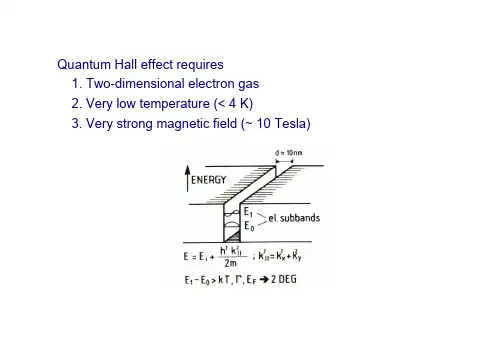
Quantum Hall effect requires1. Two-dimensional electron gas2. Very low temperature (< 4 K)3. Very strong magnetic field (~ 10 Tesla)Measurement of Hall resistanceClassical prediction: Hall resistivity µ Br XY=B/neBWhat’s actually been observed at 8 mKPlateaus at (h/e2)/n, h/e2=25.8128 k WRdeviates from (h/e2)/n by less than 3 ppmHon the very first report of the quantum Hall effect(von Klitzing, Phys. Rev. Lett. 1980)l This result is independent of the shape/size of sample. l Different materials lead to the same effect(Si MOSFET, GaAs heterojunction…)à a very convenient resistance standardà a very accurate way to measure aa-1 = h/e2c » 137.036 (unit-indep.)(Kinoshita, Phys. Rev. Lett. 1995)experimenttheoryWhy Rhas to be exactly (h/e2)/n ?HThe importance of1. Landau level (à discrete levels)2. Disorder and localization (à plateaus)3. Hidden gauge symmetry (à quantization of R H)(Laughlin, Phys. Rev. 23, 5632 (81))Adventures to the 2-dim electron system'80discovery of QHE (von Klitzing)connection with topology (Laughlin, Thouless)fractional QHE(Stormer, Tusi, Gossard)fractional charged excitation (Laughlin)Superfluid analogy (CSGL theory, S.C. Zhang)Scaling of plateau transition (Pruisken)'90global phase diagram (Kivelson, Lee, Zhang)edge states as chiral Luttinger liquid ? (X.G. Wen)composite fermion description (Jain)charge-vortex duality (Shahar)stripe phase (Lilly et al)skyrmion excitation for v=1 (Sondhi)ß spin'00 Josephson-like effect in bilayer system (Girvin, MacDonald) ßpseudo-spinDegeneracy of a Landau level (LL)Cyclotron orbitsNumber of degenerate orbitals for each LLD = F/F0 (F: flux quantum)eg. for F = 10 T × 1 cm2D = 1011If N = 1011/ cm2, then filling factor n = 1Search and discovery, Physics Today2000 June*: Spin and isospin: exotic order in QH ferromagnets (Girvin)2000 May:QHE - in pentacene?2000 Apr*:The composite fermion: a quantum particle andits quantum fluids (Jain)1998 Dec:Physics Nobel prize goes to Tsui, Stormer, and Laughlinfor the FQHE1998 Dec:Two-dimensional electron gases continue to exhibitintriguing behavior (Charge density wave)1997 Nov:Fractional charged quasiparticles signal their presence with noise 1997 Feb:In a QH System, is the insulator really a conductorin vortex clothing? (Duality)1996 Sep:One-dimensional systems show signs of interacting electrons(edge states as 1-D chiral Luttinger liquid)1995 July:In a two-dimensional electron system, the skyrmion's the limit 1994 June:Experiment reveals a new type of electron system(edge states as 1-D chiral Luttinger liquid)1993 July:Half-filled Landau level yields intriguing data and theory 1990 Dec:Evidence accumulates, at last, for the Wigner crystal1990 Jan:Experiments provide evidence for the fractional chargeof quasiparticles1989 Nov: Bosons condense and fermions exclude, but anyons...?1988 Sep: Universal singular behavior is observed in QHE (localization) 1988 Jan: QHE shows surprising even-denominator plateau1985 Dec: von Klitzing wins Nobel physics prize for QHE 1983 July: FQHE indicates novel quantum liquid1981 June: QHE yields e^2/h to part per millionskyrmionTopological property of skyrmiontip of position r tip of spin nl continuous r à n mapping"wrapping" number = integer Q Trobust again continuous deformationl skyrmion charge Q e = n e Q T。