
高中英语语法_省略
- 格式:ppt
- 大小:276.50 KB
- 文档页数:19

高中英语语法总结——强调句、It的用法、省略和插入语一、强调句(一)强调句句型1、陈述句的强调句型:It is/ was + 被强调部分(通常是主语、宾语或状语)+ that/ who(当强调主语且主语指人)+ 其它部分。
e.g. It was yesterday that he met Li Ping.2、一般疑问句的强调句型:同上,只是把is/ was提到it前面。
e.g. Was it yesterday that he met Li Ping?3、特殊疑问句的强调句型:被强调部分(通常是疑问代词或疑问副词)+ is/ was + it + that/ who + 其它部分?e.g. When and where was it that you were born?4、强调句例句:针对I met Li Ming at the railway station yesterday.句子进行强调。
强调主语:It was I that (who) met Li Ming at the railway station yesterday.强调宾语:It was Li Ming that I met at the railway station yesterday.强调地点状语:It was at the railway station that I met Li Ming yesterday.强调时间状语:It was yesterday that I met Li Ming at the railway station.5、注意:构成强调句的it本身没有词义;强调句中的连接词一般只用that, who,即使在强调时间状语和地点状语时也如此,that, who不可省略;强调句中的时态只用两种,一般现在时和一般过去时。
原句谓语动词是一般过去时、过去完成时和过去进行时,用It was …,其余的时态用It is …。
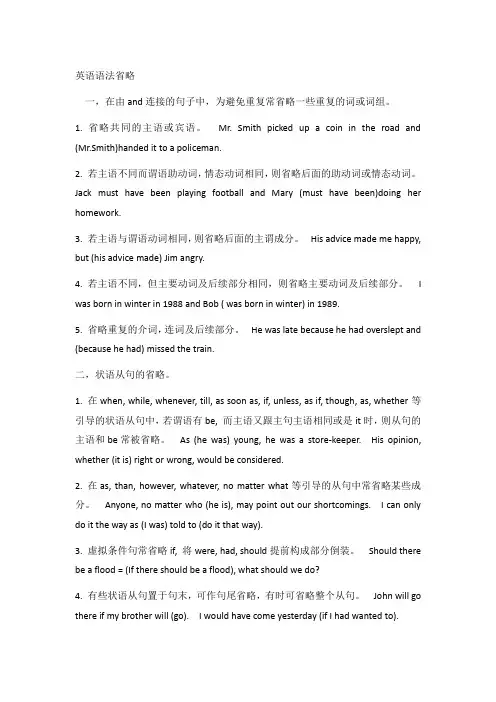
英语语法省略一,在由and连接的句子中,为避免重复常省略一些重复的词或词组。
1. 省略共同的主语或宾语。
Mr. Smith picked up a coin in the road and (Mr.Smith)handed it to a policeman.2. 若主语不同而谓语助动词,情态动词相同,则省略后面的助动词或情态动词。
Jack must have been playing football and Mary (must have been)doing her homework.3. 若主语与谓语动词相同,则省略后面的主谓成分。
His advice made me happy, but (his advice made) Jim angry.4. 若主语不同,但主要动词及后续部分相同,则省略主要动词及后续部分。
I was born in winter in 1988 and Bob ( was born in winter) in 1989.5. 省略重复的介词,连词及后续部分。
He was late because he had overslept and (because he had) missed the train.二,状语从句的省略。
1. 在when, while, whenever, till, as soon as, if, unless, as if, though, as, whether等引导的状语从句中,若谓语有be, 而主语又跟主句主语相同或是it时,则从句的主语和be常被省略。
As (he was) young, he was a store-keeper. His opinion, whether (it is) right or wrong, would be considered.2. 在as, than, however, whatever, no matter what等引导的从句中常省略某些成分。

第25章否定句一.概念否定句指否定陈述句的句子. 二.相关知识点精讲1.用not构成的否定句:主语+助动词/ be+not+… 例句:例句:He is not back yet. It is not true. We haven’t forgotten you.You shouldn’t be so silly.We haven’t been invited yet.He won’t go, but they will.Money could not buy happiness. I like the salad, but I don’t like this soup.He wants a girl friend, but he doesn’t want to get married.You didn’t understand what I said, did you ?You needn’t try to explain.I didn’t use to like opera, but now I’m getting interested.I usedn’t to like opera, but now I’m getting interested.2.祈使句的否定句:Don’t+动词原形…。
例句:例句:Don’t worry. I’ll look after you.Don’t believe a word he says.Don’t be so rude.3. 非谓语动词(不定式,分词,动名词)的否定式:把not放在to do; doing; 的前面。
It’s important not to worry.He said he deeply regretted not being able to help. Not knowing what to do, Shelly asked advice of her friend. He reproached me for not having told it to him. 4. not与除谓语以外的其他句子成分连用:Come early, but not before six. It’s working, but not properly.I believe he will succeed, though not without some difficulty. elieve; I’m afraid; I guess; I suppose; I expect之后,构成省略句。