
终稿Dreiser
- 格式:ppt
- 大小:857.50 KB
- 文档页数:14

SYMBOLISM IN THE GREAT GATSBYA Thesispresented toThe College of Foreign Languages Chongqing University of Posts and TelecommunicationsIn Partial Fulfillmentof the Requirements for the Degree ofBachelor of ArtsByYang ChunmeiJune 2014摘要象征主义是十九世纪末法国重要的文学思潮。
第一次世界大战前,它传播到欧洲多个艺术领域,许多作家认为,任何事物都应该有相应的内涵,内心世界和外部世界是相互渗透的,人们可以挖掘出隐藏在象征本体里的一切象征意义,因此,它提倡人们可以使用大量的意象来暗示微妙的内心世界,并将它们有机融合在一起。
《了不起的盖茨比》是弗·斯科特·菲茨杰拉德最具代表性和最受欢迎的作品之一,长期以来国内外众多学者从不同角度进行研究。
它强烈抨击了美国20世纪20年代物质主义盛行,人们内心世界的腐败和道德沦丧的社会现状。
作者巧妙地运用象征手法向读者展示一个灯绿梦渺的美国梦。
弗·斯科特·菲茨杰拉德挑选出小说中最能代表美国20世纪20年代期间社会现状的典型人物,通过他们各自对价值观截然不同的反应和所采取的行为,以此表明美国梦破灭的必然性。
关键词:象征主义;美国梦;物质主义;幻灭ABSTRACTSymbolism was regarded as an important literary trend in France at the end of the nineteenth century. Before World War I, it spread to various art fields in Europe, the writers who were for it believed that anything should have corresponding meaning, the inner world and outer world were inducted each other, and people can dig out hidden symbolism from everything. Therefore, it advocated that people can use substantial images to suggest the subtle inner world, and blend two of them together skillfully, one of the unique charms in the novel The Great Gatsby is the abundant use of symbols.In the novel, F. Scott Fitzgerald uses symbols to depict the various characters and deepen the theme; he connects the visual real world with the abstract inner world by using masses of potential symbolism, showing readers characteristics, personality as well as charms of protagonists vividly; meanwhile, the proper use of symbolism adds up infinite art charm and enhances ideological implication of the work, making the novel loved by a great number of readers.The Great Gatsby is one of the most representative and popular works of F. Scott Fitzgerald, it strongly criticizes the rich’s priority for materialism and the loss of morality as well as their corruption of the inner world,also in the novel the social reality of the United States in 1920s is deeply exposed with numerous symbols by F. Scott Fitzgerald. In order to show readers a lively and bright plot, he elaborately arranges each section, taking the protagonists for example, F. Scott Fitzgerald picks out the most typical characters from different social classes in the novel to reflect their respective values during 1920s in the United States, according to their different reactions and behaviors towards materialism and morality, the author aims to indicate the inevitable tragedy and evaporation of the American dream.Key words: symbolism, the American Dream, materialism, evaporationOutlineTitle: Symbolism in The Great GatsbyThesis Statement: Symbols in The Great Gatsby represent Gatsby’s disillusions of the American Dream as well as the social moral loss.1. Introduction2. Symbolism of Colors2.1 Green: Dream and Hope2.2 White: Innocence and Beauty VS Evil and Horror2.3 Blue: Gloom, Peace and Fantasy2.4 Yellow: Power, Wealth and Status3. Symbolism of Protagonists3.1 Daisy: Selfishness and Materialism3.2 Gatsby: visionary and tragic3.3 Nick: onlooking and Injustice4. The American Dream in The Great Gatsby4.1 The American Dream4.2 Disillusion of the American Dream4.3 Inevitable Evaporation of the American Dream5. ConclusionBibliography1 IntroductionThe United States had an unprecedented economic prosperity after World War I, the life quality of people showed an uprising trend, while their mental world was descending sharply under the brand--new social environment, that is, the younger generation of America were addicted to hedonism regardless of the traditional religious beliefs and morality, they indulge themselves in the unprincipled recreation, excessively emphasizing on materials but ignoring mentality, which resulted in the disillusion of the American dream.The publication of The Great Gatsby in 1925 is the reflection of “the Jazz Age” –“the period from 1918-1929, the years between the end of World War I and the start of the roaring twenties; ending with the rise of the Great Depression, the traditional values of this age see a sharp decline while the great American stock market soars.” (Wikipedia: the Jazz age) F. Scot Fitzgerald uses a unique narration way to describe hero—Gatsby’s life. As a narrator, Nick is tired of his hometown—Midwest life and comes to New York. He rents a small apartment in the suburb of West Egg. He is Daisy’s cousin, and neighbor of Gatsby who owns a luxurious mansion. Gatsby and Daisy once love each other when they are young, but end up with Gatsby’s poverty. Then he joins World War I, and Daisy marries Tom Buchanan—a wealthy guy and they give birth to a daughter. Five years later, the Buchanan move from Chicago to the west, and Nick starts to have frequent contacts with the Buchanan; during five years, Gatsby accumulates amounts of wealth by means of illegal activity and comes to New York following Daisy. He buys a luxurious villa—Gatsby mansion. Each Saturday he would hold a grand party to attract the married Daisy, fancying arousing her notice and restart the relationship. On an accidental occasion, Gatsby learns that Nick is Daisy’s cousin, so he begs Nick to arrange a meeting for them. After that date, both Daisy and Gatsby have frequent date. However, he gradually realizes that Daisy is vane and secular not as what she used tobe, Gatsby’s beautiful dream finally breaks, but he still insists on her and has a glimmer of fantasy, which makes him suffer from a miserable outcome in the end. Later, Daisy drives Gatsby’s car to run over and kills Tom’s mistress Myrtle Wilson after drunk driving, but Tom and Daisy put the blame on Gatsby with conspiracy brutally, resulting in Gatsby’s death by George Wilson’s gun shot. While Daisy and Tom travel to Europe, there are only two people—Nick and Gatsby’s father to attend Gatsby’s funeral. Gatsby becomes a victim of selfish and cruel Daisy.F. Scott Fitzgerald describes a picture of tragic American dream with poetic language and ample colors. There are many symbols in the novel. Symbolism will be analyzed respectively from the following aspects: colors, protagonists and the American Dream will be mentioned.2 Symbolism of ColorsAmong so many symbols in the novel, most of which are colors: white represents purity, innocence and emptiness, depravation; during the process of describing Gatsby’s dream, green night becomes an important image, it means not only dream and hope, but also a bubble; besides, yellow means wealth, status and evil, and so on. The following part will illustrate different colors thoroughly.2.1 GreenGreen is the color of nature, representing hope and dream. When he is seventeen, Gatsby wears a shabby green sweater, presenting an optimistic and hopeful image; when he falls in love with Daisy deeply, however, Gatsby is too poor to marry her. Daisy immediately marries a millionaire –Tom Buchanan. So Gatsby struggles out from the bottom of society, though, he is not for a life of luxurious and material comforts, but for the “pure love”, which is an ideal and indescribable romantic illusion, a permanent expectation for him. After Gatsby makes a fortune, he is still obsessed with his love—Daisy, he spares no effort to attract and pursue Daisy, since it is his only dream, in his mind, Daisy symbolizes all of what he dreams, in a word, Daisy is his hope, goals and incardination of love.And again at the end of the novel, it refers to green:“Gatsby believes in the green night: the orgiastic future that year by year recedes before Man, it eludes Man then, but that’s no matter—tomorrow Man will run faster, stretch out his arms farther…and one fine morning.”(Fitzgerald2013:113)here the symbolism of green night is American’s enthusiastic and reckless pursuit for the illusory American Dream. In Gatsby’s eyes, green night is his guide on the one hand, which makes him feel his dream is on the way and easy to grasp; on the other hand, it is so attractive, twinkling, and vague. Finally, when his ultimate dream is lost, the green light that symbolizes hope disappears forever from him, which leads to the access to dream becoming adark journey. F. Scott Fitzgerald links it with Gatsby’s blind pursuit for Daisy purposely, making the green light have an obvious irony. F. Scott Fitzgerald suggests that the American Dream is devastated by the excessive pursuit for materials, contributing to a futile effort. Green is Gatsby’s hope, but it is his impractical pursuit for the green light that results in his tragedy.2.2 YellowYellow is a symbol of power, wealth and luxury. It is one of the most widely used colors in the novel. In order to regain his true love, Gatsby conveys abundant information all the time to Daisy: his gorgeous and expensive car that he takes is yellow; his tie that he wears while dating with Daisy is golden; his cars, food, bars that he owns when he holds various, luxurious, grand, illuminated banquets, are all yellow; his comb that is shown to Daisy is also purely golden; In addition, Daisy is regarded as the golden girl, her name is a kind of flower with the color of yellow ; Jordan Baker has a withered golden hair, and his arms are golden; two of girls in the banquets are with golden skirts; it is the golden cocktail music that is played in the banquets all the time; All of the yellow symbols represent a noisy, wealthy and money-oriented atmosphere, it seems that everywhere in the society is full of the color of yellow.During the Jazz age, money is a symbol of success and status, people would rather desert their own moral conception and deceive each other without guilty just for money. In a word, yellow becomes seductive and charming, while Gatsby’s tragedy results in the golden lie, he struggles for the color all of his life, but his dream is destroyed at last. In such case, yellow symbolizes the characteristics of the society and the destiny of people.2.3 WhiteWhite generally symbolizes purity and innocence, but in the novel, it symbolizes horror and loneliness. The first time Daisy runs into Gatsby, she wears white clothes and drives a white car, which indicates that Daisy is pure and elegant, but Daisy’s inner heart is hollow and shallow; she lives in a white palace-stylebuilding and the curtains are white, all of which are a symbol of Daisy’s tiresome and empty spirit. White is a cold color, taking Daisy’s heart for instance, Gatsby almost uses up all of his youth and passion for her, including sacrificing himself, but she is so cold that ignores what Gatsby does for her and takes it for granted. In the eastern part of material world, her strong desire for money and material things has already twisted her into a greedy, selfish and vulgar woman.Besides, from the perspective of Gatsby, there are also a lot of symbols related to the white color: the villa that Gatsby buys and the suits that he wears, which means that he is as hollow as Daisy, he has nothing to do but pursue Daisy, even Gatsby owns more and more wealth, he has no way to save Daisy’s degraded soul, because it is the nature of Daisy. Gatsby spends his whole life on unpractical illusions, to some degree, he is rather stupid. Therefore, the color of white in the novel has a strong irony too.2.4 BlueBlue is the color of the sky and the sea, which means a broad scale, while it also means gloom and depression. In the novel, F. Scott Fitzgerald describes something connected with dream and unreality. He uses blue to describe Gatsby’s house: blue lawn that is an important part in his life, and blue garden; Gatsby also gets a blue navy clothes from the captain due to his upright characteristics. All of these symbolize Gatsby’s dream and melancholy.In Chapter two of the novel,the eyes of Doctor T. J. Eckleburg are blue, with bleak look, watching the gray valley, indicating an unfortunate disaster. In the author’s opinion, this is God’s eyes; she knows that Gatsby’s dream is doomed to fail, so her eyes are sad and gloomy. And George Wilson believes that Doctor T. J. Eckleburg’s eyes are existence of God. After his wife dies by conspiracy:“He muttered, after a long silence. “I told her she might fool me but she couldn’tfool God. I took her to the window’—with an effort he got up and walked to therear window and leaned with his face pressed against it—‘and I said, “Godknows what you have been doing, everything you have been doing. You may foolme, but you cannot fool God!”’ standing behind him, Michaelis saw with a shockthat he was looking at the blue eyes of doctor T. J. Eckleburg, which had justemerged, pale and enormous, from the dissolving night. ” (Fitzgerald 2013:100) In other words, F. Scott Fitzgerald presents the symbolisms of various colors vividly, green, on one hand, represents Gatsby’s hope and dream, he is as energetic as others; on the other hand, it seems like a prediction that Gatsby is doomed to fail. Yellow stands for wealth and status in the novel. Gatsby makes effort to climb up and accumulate money in order to cater for Daisy and prove that he also belongs to the upper class; actually, he never realizes his illusion from the beginning to the end. White is a symbol of horror and ignorant, Daisy is a typical epitome of the Jazz age. Blue is a symbol of gloom and depression in the novel. Doctor T. J. Eckleburg’s blue eyes seem to indicate the tragedy of all the people. Besides symbolisms of colors, the symbols of protagonists are worth analyzing.3 Symbolism of the ProtagonistsIt is evident that a vivid description of main character plays a key role in advancing the plots. The Great Gatsby selects several typical protagonists to reflect their different characteristics and values, and imply the hedonism during the Jazz age.3.1 DaisyDaisy is the heroine in the novel; she is Gatsby’s dream love. As a typical material girl, she is a symbol of money. She is a girl with beautiful appearance, attractive eyes, and erogenous voice. Five years ago, the poor Gatsby falls in love with the wealthy girl at the first sight, but he is so poor that he cannot afford the wedding expenses, they have to end the relationship finally. Because in Daisy’s eyes, money is the only judge to measure anything, love is no exception. For her, money is the only almighty God, the true, the good, and the beautiful are not qualified to surpass it. Daisy once loves him, but when she finds Gatsby is penniless, she never hesitates to abandon him and turns to Tom who is wealthy and illustrious but vulgar. In the material world, Gatsby’s love with Daisy is fragile and vulnerable. Daisy believes that love is not the bread of life, she is eager to live an abundant and carefree life. Actually, she is the incardination of the American Dream, which looks beautiful and pure, almost close to touch, but it is just an illusion, and finally vanishes.Though she owns abundant materials, she is very lonely and empty. While Nick has come to dinner with her family, when Tom and Jordan are chatting in another room, she uncovers her mask, tells all of her inner feelings sincerely. She complains about her unhappiness. Besides, in her daily life, although he often says something that seems to be foolish and jokes with others, she arms herself, pretends herself to be happy and live an ideal life like a carefree child, actually, she is unhappy, and no one is reliable for her to share her miserable life except Nick.3.2 GatsbyGatsby, the hero of the novel, is a sheer dreamer. He is the symbol of the American younger generation after the First World War I. Gatsby’s pursuit and evaporation for dream are also what the youth dream: individually heroic ideal and the miraculous American Dream makes them believe that one can reach their own inner world that they yearn for only if they try their effort, so they come to the world with hope, looking forward to establishing a kingdom of their own in the new world, but eventually they find that what they desire and pursue are just self-deceptive, the American Dream is never to be achieved. In his short life time, he uses all kinds of means to pursue Daisy, but what a pity is that even though he costs too much to win her heart, he is killed by his beloved indirectly, and even no one is willing to attend his funeral. From the beginning to the end, he is blindfold in his own relationship; he has never experienced the true love. At the age of 17 to 18, Gatsby regards young ladies as ignorance, so he looks down upon the girls, but poor Gatsby only loves Daisy crazily, in his eyes, Daisy is beautiful, and she has an outstanding family background, Gatsby is the only one that attracts Daisy among so many suitors, here it can be seen that Gatsby loves not Daisy herself but the wealth and social status that Daisy stands for, he eagerly climbs up to upper class, so he thinks that he loves Daisy not anything else, but it can be inferred that Gatsby is trapped into the hypocritical love without self-conscious. In order to win Daisy, he takes various illegal measures to accumulate amounts of wealth. After reunion with Daisy, who is a frivolous and materialistic person, Gatsby tries to invite her to his villa just to show how rich he is now. In his mind, Daisy is the incarnation of a holy and pure heart, just like her white skirt, even Gatsby finds Daisy is a secular woman, not the same one as she used to be, but he doesn’t want to give her up. Actually, Gatsby just wants to use wealth, materials and Daisy to mask his poor birth, and win the social recognition and admiration. In Gatsby's mind, as long as there are material wealth and social status, he can regain Daisy, and he can prove his self—value. Gatsby, through illegal means to win a huge amount of wealth, makes up his personal life, so that he can achieve his dream.After Gatsby makes material success, then he has been very close to achieve the dream, he has almost caught the dream. But the very moment, everything is destroyed. Gatsby should have realized that his dreams are entirely on the basis of material; his pursuit of an illusory ideal just makes him realize that Daisy's mind is full of money, but he never understands they belong to different worlds, representing different values. And his total unconsciousness is destined to die. But in the process of interaction for Nick and the gang, even though he has contempt and disdains Gatsby, Gatsby treats love sincerely and selflessly.3.3 NickNick, as both the story teller and the moral judge, he has an irreplaceable place in the novel; he is indispensable to the progression of the story as well as to the in-depth exposure of the American Dream. Nick, as the novel's first narrator, in this novel, he has created a kind of immersive feeling that is rising up, making the whole novel not only fascinating but also more dramatic. He observes all of what happens to Gatsby, as Gatsby’s friend and neighbor, Daisy’s cousin, Tom’s classmate, he has an inextricable link with them. He cannot stand the eastern United States because of the vague and moral indifference, he witnesses the destruction of Gatsby’s growing, all the disappointment and disgust for the eastern community, and in the course, in order to further improve and standardize his own responsibility and morality, he decides to go back west. What happens in the eastern part of the story that makes Nick feel so disappointed and disgus ted is that something swallows Gatsby’s spiritual things and makes him temporarily lose interest in any temporary moment of joy and sorrow, so that he is no longer interested in participating in swollen treasures, and no longer occasionally catches the glimpse of the human heart's honor. He feels disgusted about the reality, but he is also immersed in the ugly environment, he describes Gatsby as a great man even though he sells wine illegally and pursues Daisy in an inappropriate way. “Whenever you feel like criticizing any one, just remember that all the people in this world haven’t had the advantages that you’ve had.”(Fitzgerald, 2013:1)According to his narration and comment, Nick shows a totally different type of life style between Gatsby and Daisy.In a sense, Daisy, from the beginning to the end, is a wretch, she never experiences a true love, for her, wealth and status are more important than love, she pursues something illusory in her whole life, which causes her empty and ignorant life. Gatsby and Nick, in the realization of their own American dream on the road, are losers. Gatsby, although achieves the material success, in spirit he collapses; Nick has been purified, although in spirit and perfection, but never gets the measure of success from the perspective of worldly material wealth. In the final analysis, all the three people are the victim of the American dream, which results in their tragedy.4 The American Dream in The Great GatsbyFor Americans, American dream is a faith that a person can achieve what he is eager for only if striving as much as possible, success would be on the way. Actually, it is not enough. The following parts will analyze the breakdown of American dream, the disillusion of American dream as well as the inevitable evaporation of American dream in detail.4.1 The American DreamWhen it comes to the breakdown of American Dream, there are two notable people that should be noticed.One is Norman Mailer. his fourth novel—An American Dream (1966),The book is written in a poetic style with metaphor that creates unique and hypnotizing narrative and dialogue. Mailer peels away the layers of the social norms to reveal a world of pure appetite and relentless cruelty.The other one is Edward Albee. He feels the reality of American society cannot be compromised and must be disclosed. In his play The American Dream (1961), he ironically criticizes people who only go for external things rather than seeking the practical, to meet the appearance of bodybuilding but ignore the internal weakness.Actually, The idea of the American Dream is rooted in the United States Declaration of Independence which proclaims that “all men are created equal and that they are endowed by their Creator with certain inalienable Rights including Life, Liberty and the pursuit of Happiness.”(Wikipedia: the United States Declaration of Independence)The American Dream is based on an ideal realm that everyone can develop their ability and finally become successful only if they are continuously making their own efforts; it is an equal opportunity to expect success in spite of family background. Americans have traditionally believed that only through hardwork, will they change destiny and obtain wealth. The American Dream is originally to achieve the dual progress in spirit and materials; however, it is gradually replaced by sheer money and pleasure. The American Dream is bait for encouraging young men to struggle and fight, and then can get what they seeks for. In fact, it is just an illusion that never comes true. Although it can make people inspired and enhance morale, it disappears quickly. The tragedy Gatsby can illustrate the point. Gatsby is embodied in the conflict of American life’s dream and reality; he is always living in his own fantasy and regarding it as reality, even pursuing it persistently. He was born poor, but he is eager for a better life.4.2 Disillusion of the American DreamFor each American, the American dream is a hope for success, it is a ladder from penniless to wealthy, and it attracts people to go to west and tries to become millionaires. Until the nineteenth century, the accumulation of wealth and material prosperity of the country suddenly gets to an unprecedented expansion, the American Dream is no longer full of positive and moral energy, spiritual need and material need are strongly conflicted, and people own more and more wealth but declined morality. The Great Gatsby is just the real description of the American society in 1920s, during which all traditional values turn into pure and mad pursuit for money. Gatsby’s dream is to combine love and money, at first, the reason why he pursues money is just to become wealthy and successful, and then he is to pursue his dream—the fantastic love, the two dreams belong to “love dream”. Therefore, the evaporation of love dream means all of his dreams are evaporated. Since Gatsby has rich materials, he is eager for restarting with Daisy. However, the American Dream cannot become true only with amounts of wealth in America; even Daisy is an ambitious, selfish, hypocritical and material girl, nevertheless, Gatsby regards her as the incardination of perfection, and pursues her at all costs, actually, it is just an illusion that cannot be realized. But he continues to chase the unrealistic dream blindly, which leads to his tragedy.4.3 Inevitable Evaporation of the American DreamThe Great Gatsby is considered as one of the typical American novel to reflect the atmosphere of the Jazz Age, F. Scott Fitzgerald describes Gatsby, the hero of the novel, as a “great” man, because he has no other dream except for love, although he also has many deficiencies and does illegal wine making, from the beginning to the end in the novel, Gatsby has only one goal, that is pursuing Daisy in spite of any obstacles, just because of the “great” goal, he is able to accumulate amounts of wealth to the upper social status. However, in the postwar era, true love is difficult to pursue, material is beyond love; in addition, Gatsby even sacrifices himself for his love, Gatsby is to Daisy what Americans are to the American dream. F. Scott Fitzgerald describes the image of Daisy deliberately to reveal the disillusion of American dream, Daisy’s beauty means the American Dream is attractive and attempting, and Daisy’s selfishness and emptiness means the American Dream is unrealistic and nonsense. Gatsby is incapable to distinguish the reality and the dream, so he spends the whole life in pursuing the illusion and creating a fantastic world. He only realizes that even though Daisy’s voice is full of money, he never realizes that they belong to totally different worlds and stands for various values. What makes Gatsby tragic is that he contributes his beautiful ideal to a superficial girl, the destroying of Gatsby’s illusion means the disillusion of the American Dream, his tragedy also reflects the author’s and the American dream pursuers’ tragedy. Gatsby and Daisy have different social statuses, for them, there is an insurmountable division, indicating his inevitable tragedy.5 ConclusionsIn the novel The Great Gatsby, F. Scott Fitzgerald successfully shapes an image of the victim--Gatsby, who has no connection with the upper class, but he becomes a millionaire through illegal means at last; From the perspective of materials, he is successful; but he fails in the unrealistic illusion; while Tom and Daisy stands for the upper class, but they have little morality, responsibility and dream, they are so poor in mental wealth. Through the novel, it seems to be an ordinary love story of Daisy and Gatsby to love and break up, but the author describes the girl as a symbol of youth, money and status who just pursues material wealth. In order to pursue his love, Gatsby pours into all his feelings and intellect, he is too naïve to believe that money is omnipotent including gaining love. Unfortunately, Daisy is a vulgar and selfish girl, he is not aware of the reality of the materialistic redundancy but spiritual boredom, he lives in fantasy, abandoned by Daisy and ignored by the society, which finally causes irreparable outcome, he is a typical American young man in 1920s, what happens to him is a portrayal of splurge century. F. Scott Fitzgerald deeply exposes the sharp social contradiction in the Jazz Age of America behind the economic prosperity and the serious moral crisis faced by the Lost Generation, and reveals the nature of American life with strong responsibility, he describes a real American situation in the 1920s. The Great Gatsby is like a dream, F. Scott Fitzgerald deliberately designs each image, on one hand, it symbolizes the tragedy of Gatsby’s life; on the other hand, it contains the ups and downs of the American Dream. It is a real portrayal of the younger generation’s disillusion and anxiety in the Jazz Age, and his dream becomes a permanent historical mirror to the era.。
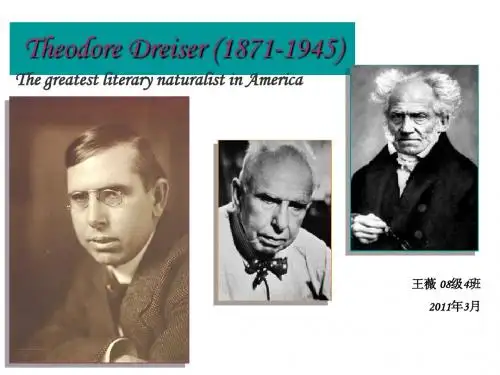
Theodore Dreiser (1871-1945)1) Biographical IntroductionBorn in Terre Haute, Indiana, the twelfth of thirteen children. German immigrant parents.His early years were full of poverty, emotional instability, religious bigotry in home, frequent moves dictated by financial necessity.At teen, in Chicago, he had a succession of minor jobs. After a year at Indiana University, he returned to Chicago, a reporter on the Chicago Globe.He worked for newspapers in St. Louis & Pittsburg before he arrived in New York in 1894.2) point of view(1) He embraced social Darwinism – survival of the fittest. He regarded Manas merely an animal driven by greed & lust in a struggle for existence in which only the ―fittest‖, the most ruthless, survive.(2) Life is predatory, a ―game‖ of the lecherous & heartless, a jungle strugglein which Man, being ―a waif and an interloper in Nature‖, a ―wisp in the wind of social forces‖, is a mere pawn in the general scheme of things, with no power whatever to assert his will.(3) No one is ethically free; everything is determined by a complex of internalforces & by the forces of social pressure.In the late 1970s, Dreiser took interest incommunism, American social problems, & the efforts of the oppressed to gain a better life.To Dreiser, not irreconcilable.The mechanistic foundations of life not as imprisoning but a complex of beauty & wonder in which the destructive forces could be lessoned through social change.the reconciliation : The Bulwark.(3) Style1) Without good structure2) Deficient characterization3) Lack in imagination4) Journalistic method5) Techniques in painting(4) Dreiser's Major WorksA prolific writer: Novels, collections of short stories, poems, plays, travel books,and essays (political), a number of autobiographical books.Sister CarrieThe Cowperwood Trilogy —The Financier, The Titan, and The StoicAn American TragedyOn Sister CarrieThe theme of the book:1. The theme in Sister Carrieis materialism. The theme is primarily personified through Carrie with her desire for a fine home, clothes and everything else money can buy.Materialism, including the desire for money, is an important theme in Sister Carrie. The materialism is shown mostly through Carrie's character but also through Hurstwood, a man with a respectable life and money, who still wants more and for that reason commits a crime. The city in itself is also a place of materialism, it is a place that offers all kinds of amusements, pleasures and things to buy, but to participate in what the city has to offer, one has to have money.2. It best embodies Dreiser’s naturalistic belief that men are controlled & conditioned by heredity, environment and chance, only a few extraordinary & unsophisticated human beings refuse to accept their fate wordlessly for their existence.Chicago is the scene of Sister Carrie.Dreiser uses Carrie to express his own longings for wealth, affection for the glitter & excitement of the city, which has come to symbolize the possibility for the realization of the American Dream.―The Magnet Attracting: a Waif amid Forces‖-controlled by two forces:1. internal forces:desires to fulfill American Dream, for social status & material comfort.(e. And yet she was intere sted in her charms…at a woman’s slipper)2. external forces- poverty: attraction of American Dream. (e. ―the magnet attracting city life‖;Carrie’s being attracted by Drouet’s material prospect, entrapped, became his mistress).Carrie is leaving home. This passage is typical Dreiser’s. He gives his thoughts about Carrie & the salesman she meets, and describes them.The first impression is not her opinions but her belongs. At the end of the novel, there is description of her, ends with the exact amount of money she holds. This emphasis on money will be a primary theme throughout the rest the novel. Discussion1. Please make comment on the three main characters.2. Please make comment on the end of the novel and the famous rocking chairsceneThree Main CharactersCarrie: She represents spirit, the longing for a finer & higher form of life, artistic aspiration, imagination, ideals, never be fully attained, without which life is meaningless.She refuses to accept her fate & instead strives unsuccessfully to find meaning & purpose for her existence.Drouet & Hurstwood not as ―saving hands‖;Drouet: an image of a woman pursuer with keen desire for the feminine.(…by an intense desires & admiration for the sex‖)He stands for the material lusts which lies at the bottom of worldly ambition. Hurstwood: A person with no higher goal than the satisfaction of his sensual inclination.3. chance: chance makes her an actress & her successConclusion:To Carrie, the world is cold & harsh, she is alone & helpless. She moves along, driven by desires , catches at any opportunities as first offered by Drouet, then by Hurstwood. A feather in the wind, she was totally at the mercy of forces she can’t comprehend, still less to say control.She just seeks to grasp the mystery of life, and thereby satisfies her desires for social status & material comfort. After a series of incidents & coincidences, Carrrie rises and obtains fame & comfort.The famous rocking chair scene:In spite of her success, she is not happy. She is lonely & dissatisfied. This is a picture of Carrie’s drifting with the tide. She has no control, no freedom of will, but she is not totally despairing, still singing & dancing, looking forward to bright future.. (This is the uniqueness of American naturalism: human impotence & hopelessness but not complete loss of confidence.)。

目录一、彼岸世界二、基督世界三、秘术世界摘要维里耶是法国象征主义文学的代表之一,他采用反现实主义的创作手法,常常给人一种难以捉摸的感觉,使读者陷入一种迷惘之中。
本文通过对“彼岸世界”、“基督世界”、和“秘术世界”三方面在维里耶作品中的表现的分析,表达了作家一种既模糊又热烈、既不确定又矛盾的思想,它们使人们摆脱了自己所处的悲惨境遇,进入了绝对和永恒的境界之中。
维里耶笔下的神奇世界与现代资产阶级社会是对立的。
神秘世界似乎更像一个“梦想乐园”,而不是真正的“理想”彼岸,更像反现实主义的一个“阵地”,而不是真正的信仰之殿。
关键词:彼岸世界基督世界秘术世界维里耶作品中的神秘世界维里耶,全名是奥古斯特·维里耶·德·李尔-阿当,法国人,生于1838年,于1889年去世,是法国近代文学史上的一位重要作家。
他一生酷爱写作,创作出了许多杰出作品,如《波特兰公爵》、《新大陆》、《未来的夏娃》、《崇高的爱》、《爱西丝》、《王位的继承人》《阿克赛尔》、《残酷故事》、《绝世佳肴》、《比安菲拉特家的小姐》等,其作品内容丰富,体裁多样,包括诗歌、戏剧、小说、随笔、艺术评论等;维里耶生前始终屈居二流作家之列,但随着时间的流逝,他的地位也逐渐上升,后来人对他的研究也越来越多,越来越深入,他的一些作品也开始被搬上了电视荧屏和戏剧舞台。
然而维里耶在文学上的经典地位的确立,却是在1986年,法国最具权威的伽利马出版社“七星文库”出版了《维里耶·德·李尔-阿当作品全集》后。
长期以来,维里耶一直未能在中国得到介绍,中国读者对他还比较陌生,商务印书馆出版《欧洲文学史》后,才首次把这位作家介绍给国内读者。
文学研究界常把维里耶、波德莱尔、马拉美、魏尔仑等作家视为象征主义的代表。
维里耶认为,理想的文学艺术是通过暗示的方法来表现隐藏在事物表面之后的真实,而不是机械地复制现实;文学艺术的目的是唤醒和启发读者,而不是让后者被动地接受某种确定的意义。
