高考虚拟语气讲解及练习(讲解部分)[1]
- 格式:doc
- 大小:68.50 KB
- 文档页数:8
1 虚拟语气用法详解 第一部分 在高三辅导学生备考过程中发现学生理解掌握和运用虑拟语气存在较大困难。下面将结合学生及备考实际,对虚拟语气进行较全面的归纳,并配以适当的例句和练习。 一、 帮助学生理解语气的涵义、种类、辨别各种不同的语气。 语气是动词的又一种形式,通过说话人所说的话体现出说话人对某一个动作或状态所持的态度和看法。英语中有三种语气: 1.陈述语气——用来陈述事实,广泛用于陈述句和疑问句中。现行中学英语教材中,绝大部分句子均属陈述句语气,句中谓语动词有各种时态和语态变化。 2.祈使语气——用来提出请求、要求、发出命令等,只用于祈使句。 3.虚拟语气——用于表达一种假设情况、主观愿望、请求建议等,即所说内容与事实相反,或者实现的可能性极小,或者是假想虑拟的情况。 (练习)判断下列各句属于哪种语气。 ① On the way up, I am busy taking pictures. ② Nike, fetch me some newspapers. ③ What if I were you? ④ Don’t forget to turn off the light. ⑤ He always takes his wife seriously. ⑥ I wish I would fly to the moon. Answers: ①陈述语气。 ②祈使语气 ③虚拟语气 ④祈使语气 ⑤陈述语气 ⑥虚拟语气 二、理解虚拟语气在非真实条件句中的三种典型构成与用法,并能熟练运用 条件句指主从复合句中的条件状语从句,分为真实条件句和非真实条件句两种。真实条件句表示所叙述的内容是事实,或者完全可能成为现实,句子中的谓语动词用陈述语气;非真实条件句表示所叙述的内容与事实相反或实现的可能性极小,句子中的谓语动词用虚拟语气。 (练习)判断下列各句属于哪种条件句。 ① If he doesn’t hurry, he miss the bus. ② If I were you, I would accept his offer. ③ If I have time, I will come. ④ If you hadn’t come to his school, I wouldn’t have known you. Answers: ①真实条件句 ②非真实条件句 ③真实条件句 ④非真实条件句
第二部分
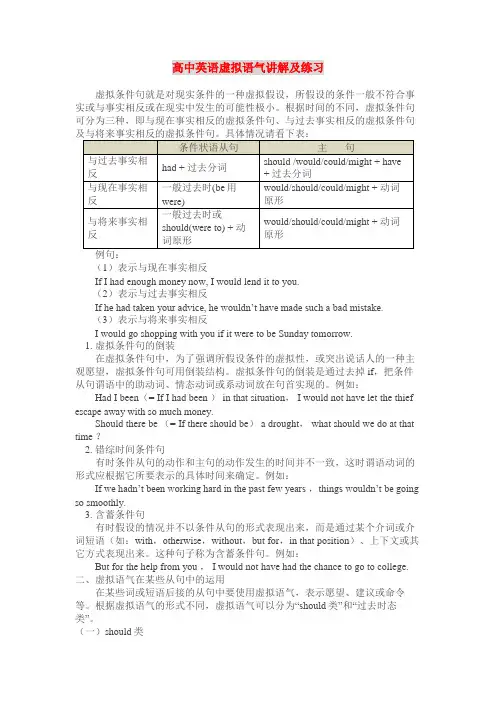
一、 条件句中的虚拟语气 1. 条件句中虚拟语气的形式 从句中提出一种与客观现实不相符或根本不可能存在的条件,主句会产生的一种不可能获得的结果。条件句中的虚拟语气根据不同的时间有三种不同的形式。 时间 从句谓语形式 主句谓语形式 2
将来 动词过去式(be用were) should + 动词原形 were to + 动词原形 would / should / might / could + 动词原形 现在 动词过去式(be 用 were) would / should / might / could + 动词原形 过去 had +动词过去分词 would / should / might / could have + 动词过去分词 2. 条件中的虚拟语气的举例 (1) 将来时的条件句中的虚拟语气。如: If he should go to Qing Hua University, he would make full use of his time. 如果他要上清华大学的话,他就会充分利用他的时间了。 If he were to come here, he would tell us about it. 如果他要来的话,他会通知我们一声。 (2) 现在时的条件句中的虚拟语气。如: If he were free, he would help us. 要是他有空的话,它会帮助我们的。 If he studied at this school, he would know you well. 如果他在这所学校学习的话,它会对你很熟悉。 (3) 过去时的条件句中的虚拟语气。如: If I had seen the film, I would have told you about it. 我如果看过这场电影,我会把电影内容告诉你了。 If I had got there earlier, I would have met Mr. Li. 如果我早点到那儿,我就会会到了李先生。 3. 运用条件句中的虚拟语气时,须注意的几个问题 (1) 当从句的主语为第三人称单数时,谓语动词若是系动词be时,可用was代替were。但在倒装虚拟结构及if I were you, as it were中,只能用were。如: Were I ten years younger, I would study abroad. 要是我还年轻十岁的话,我会去国外学习。 If I were you, I would try my best to grasp the chance. 要是我是你的话,我要尽力抓住这次机会。 (2) 有时,虚拟条件句中,主、从句的动作若不是同时发生时,须区别对待。 ①从句的动作与过去事实相反,而主句的动作与现在或现在正在发生的事实不符。如: If I had worked hard at school, I would be an engineer, too. 如果我在学校学习刻苦的话,我现在也会使工程师了 If they had informed us, we would not come here now. 如果他们通知过我们的话,我们现在就不会来这里了。 ②从句的动作与现在事实相反,而主句的动作与过去事实不符。如: 3
If he were free today, we would have sent him to Beijing. 如果他今天有空的话,我们会已经派他去北京了。 If he knew her, he would have greeted her. 要是他认识她的话,他肯定会去问候她了。 ③从句的动作与过去发生的情况相反,而主句的动作与现在正在发生的情况相反。如: If it had not been raining too much, the crops would be growing much better. 如果天不下太多的雨的话,庄家会长得更好。 If he had been working hard, he would be working in the office now. 要是他工作一直努力的话,他现在已进了办公室了。 (3) 当虚拟条件句的谓语动词含有were, should, had时,if可省略,而将were, should, had等词置于句首。如: Should he agree to go there, we would send him there. 要是他答应去的话,我们就派他去。 Were she here, she would agree with us. 如果她在这儿的话,她会同意我们的。 Had he learnt about computers, we would have hired him to work here. 如果她懂一些电脑知识的话,我们会已经聘用他来这里工作了。 (4) 有时,句子没有直接给出假设情况的条件,而须通过上下文或其他方式来判断。如: I would have come to see you, but I was too busy. 我本该来看你了,然而我太忙了。 But for his help, we would be working now. 要不是他的帮助,我们还会在工作呢。 Without your instruction, I would not have made such great progress. 要是没有你的指导,我不会取得如此大的进步。 (5) 有时,虚拟条件句中,主、从句可以省略其中的一个,来表示说话人的一种强烈的感情。 ①省略从句 He would have finished it. 他本该完成了。 You could have passed this exam. 你应该会通过这次考试了。 ②省略主句 If I were at home now. 要是我现在在家里该多好啊。 If only I had got it. 要是我得到它了该多好啊。 二、其他状语从句的虚拟语气 1. 目的状语从句中的虚拟语气 (1) 在for fear that, in case, lest引导的目的状语从句中,若用虚拟语气时,从句谓语为: should + 动词原形。并且 should不能省略 She examined the door again for fear that a thief should come in. 她又把门检查了一遍,以防盗贼的进入。 4
He started out earlier lest he should be late. 他很早就出发了以防迟到。 (2) 在so that, in order that所引导的目的状语从句中,从句中的谓语为: can / may / could / might / will / would / should + 动词原形。如: He goes closer to the speaker so that he can hear him clearer. 他走近说话的人以便能挺得更清楚。 He read the letter carefully in order that he should not miss a word. 他把信读得很仔细以便不漏掉一个单词。 2. 让步状语从句中的虚拟语气 (1) 在even if, even though 所引导的让步状语从句中,可用虚拟语气,主句、从句的结构与if所引导的条件从句结构相同。如: Even if he were here himself, he should not know what to do. 即是他亲自来也不知该怎么办。 Nobody could save him even though Hua Tuo should come here. 及时华佗再世也就不了他。 (2) 在whatever, whichever,whenever,whoever, wherever,however, no matter wh-word 等引导的让步状语从句中,从句虚拟语气结构为: ① may +动词原形(指现在或将来)。如: We will finish it on time no matter what / whatever may happen. 不管发生什么事,我们都要按时完成。 We will find him wherever / no matter where he may be. 无论他在哪里,我们都要找到他。 I will wait for him no matter how late he may come. 不管他来的多么晚,我都会等他。 ② may +完成式(指过去) ,主句结构不限。如: You mustn’t be proud whatever / no matter what great progress you may have made. 不管你取得了多么大的进步,你也不能骄傲。 We must respect him no matter what / whatever mistakes he may have made. 不管他翻过什么错误,我们必须尊敬他。 (3) 在though, although等引导的让步状语从句中,从句虚拟语气结构为 should +动词原形,主句结构不限。如: Although / Though he should often be late, he is a good student. 尽管他经常迟到,他还是个好学生。 Although / Though he should be secretary, he must obey the rules. 尽管他是书记,他也必须遵守规定。 3. 方式状语从句中的虚拟语气 as if, as though引导的方式状语从句常用虚拟语气。虚拟语气的结构为: 表示所发生的时间 虚拟语气结构 发生在主句动作之前 had + 过去分词 与主句动作同时发生 过去时(be 用were ) 发生在主句动作之后 would / could / might / should+原形动词