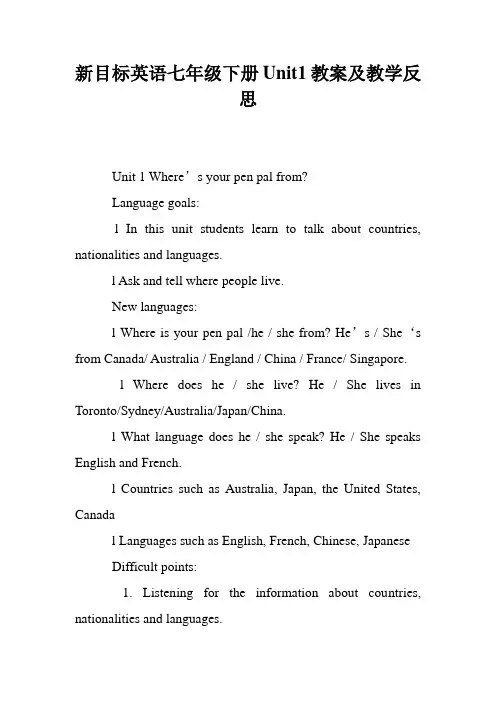
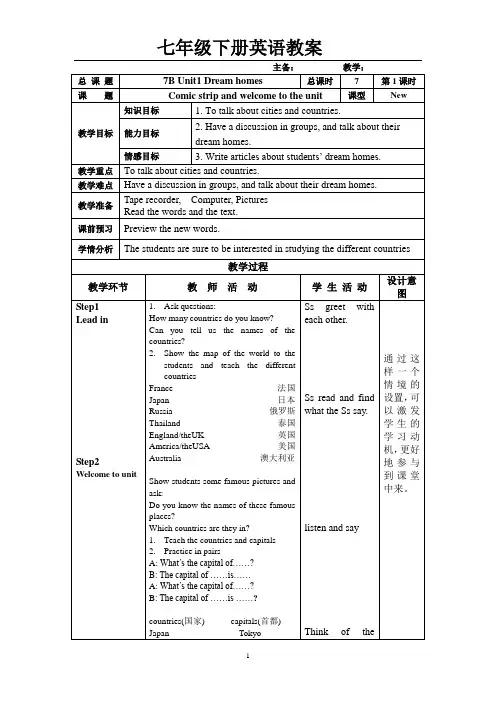
人教版英语七年级下册第一单元教案全文共3篇示例,供读者参考篇1Unit 1: A Letter to GrandmaLesson Objectives:Learn vocabulary related to travel and tourismPractice writing informal lettersUnderstand the use of past tense verbsDevelop skills in reading for main ideas and detailsPre-class Preparation:Before coming to class, I will review the new words and expressions from the unit's vocabulary list. I'll try to guess their meanings from the context and look up any unfamiliar ones in the dictionary. Preparing early will help me understand the lessons better.Warm-up Activity:The teacher will likely start with a fun warm-up, maybe asking us about our experiences traveling or writing letters tofamily members. I'll try to be an active participant and share any relevant experiences to get into the right mindset for the unit.Vocabulary Learning:New words related to travel, like "sightseeing," "souvenir," and "scenery" will be introduced through pictures, examples, and context clues. The teacher will have us repeat the words for pronunciation practice. I'll make sure to take detailed notes on the vocabulary items and their meanings.Reading Practice:We'll read a sample letter that Danny wrote to his grandmother about his trip to Beijing. While reading, I'll underline any traveling vocabulary words I recognize. The teacher will guide us to identify the main idea and key details of the letter. We may also analyze Danny's use of informal language and past tense verbs in his writing.Language Focus:The grammar focus for this unit is the simple past tense. The teacher will explain its formation and usage through examples like "I visited the Great Wall last summer." We'll do controlled practice exercises to get the hang of forming statements and questions in the past tense.Letter Writing:Putting our skills together, we'll learn the format and conventions for writing informal letters. The teacher will provide a model, and we'll discuss the different sections like the greeting, body paragraphs, and closing.Guided Writing:For guided practice, the teacher may give us a writing prompt like: "Write a letter to your cousin describing your last holiday trip." I'll try to follow the model and incorporate the new vocabulary words and past tense verbs. The teacher will provide feedback to improve our writing.Independent Practice:Finally, we'll get a homework assignment to write an informal letter independently, maybe describing an imaginary trip. I'll aim to showcase what I've learned about letter writing, using descriptive language and accurate grammar.Review and Assessment:At the end of the unit, the teacher will review the key points we've covered through quizzes or games. I'll participate actively to reinforce my learning and identify any areas I need to improve.Overall, this unit allows me to develop my reading, writing, vocabulary, and grammar skills in an engaging, travel-themed context. I'm excited to explore new language and share my travel experiences or imaginations through letter writing!篇2Unit 1: A Day's WorkLesson 1: A Great JobHey everyone! It's me again, ready to share my notes on the latest unit we're covering in English class. This time, it's all about different jobs and careers. I've got to admit, I'm pretty excited about this one - who doesn't love dreaming about their future job when they're a kid?We started off by reading a text called "A Great Job." It's all about this guy named Mike who works as a ranger at a national park. His daily tasks include things like leading hiking tours, monitoring wildlife, and maintaining the trails. Sounds like an awesome gig if you ask me!Our teacher had us read through the passage and identify all the key details about Mike's job duties. She really emphasized looking for words and phrases that describe what he does on a typical day. Things like "keep an eye on the animals," "showpeople around the park," and "make sure the paths are clear." Stuff like that.After we went over the reading, she put us into small groups to practice using those job vocabulary words in some role-play scenarios. My group had to act out a mini interview where I was applying to be a park ranger. I had to really sell my qualifications and explain why I'd be great at tasks like the ones we just read about. My friend played the hiker interviewer and kept grilling me with questions. It was pretty fun, not gonna lie!For homework, we have to write a short personal narrative imagining what a day would be like if we had Mike's job as a park ranger. I'm picturing starting my morning off by doing some animal tracking, then leading a group hike and pointing out all the cool plants and critters we see along the way. Maybe I'd get to rescue a stranded hiker who got lost and ran out of supplies? Who knows, I'll have to get creative with this one!Lesson 2: The World's WorkersOkay, our next lesson was all about different career paths people can take across all kinds of fields and industries. Our teacher started us off by brainstorming a huge list of jobs on the board - everything from doctors and teachers to athletes and YouTubers.Then she had us read a few short passages that each highlighted a different career. One was about a marine biologist who studies shark behavior. Another focused on a software developer who designs apps. They gave an overview of the typical workday and responsibilities for each role.After the readings, we did an exercise where we had to match up different job titles to their corresponding descriptions and duties. That one really helped solidify my understanding of what each occupation actually entails. For instance, I finally understood that architects are the ones who plan out the designs for buildings, while construction workers are the folks who physically build them.We also spent some time talking about how the job market is always evolving, with new careers constantly emerging thanks to technological advancements and societal changes. For example, roles like social media managers and drone operators barely existed a couple decades ago. Our teacher challenged us to predict what kinds of crazy new jobs might become popular in the years ahead as AI and other cutting-edge tech keeps advancing.My prediction? Maybe robot counselors who help AI systems work through their artificial existential crises? Hey, a guy can dream!For homework, we have to do some career research by interviewing a parent or other adult about their line of work. We need to ask about their daily responsibilities, the skills required, what drew them to that field originally, and so on. I'm going to interview my uncle who's an electrician - should be interesting to get the inside scoop on what his job is really like.Lesson 3: Preparing for the FutureOur latest lesson was all about planning ahead for our future education and career paths. It's wild to think we'll need to start making some big decisions like that in just a few years!The teacher kicked things off with a presentation that walked us through some key steps for choosing a potential career direction based on our interests, strengths, and values. She had us take a little quiz to get a sense of what general fields we might want to explore further based on the types of tasks and subjects we're naturally drawn towards.For example, if you're an artistic person who loves expressing yourself creatively, careers in fields like graphicdesign, entertainment, and communications could be a good fit. If you're more of a meticulous thinker who excels at math and problem-solving, you might look into engineering, architecture, computer science, or finance. And if you're a total nature buff, maybe conservation work, marine biology, or environmental law could appeal to you.Once we had those general career cluster results, the teacher went over different educational pathways that can prepare you for each field, like pursuing a particular university major, attending a vocational school, doing job training or an apprenticeship program, etc. It really drove home the point that the classes you take and decisions you make in high school can have a huge impact in setting you up for your dream career down the road.The homework assignment for this lesson was to pick one potential career we're interested in and create a visual roadmap for how we could work towards it over the next 5-10 years. Things like which classes and extracurriculars to focus on in high school, possible college majors or training programs, approx. income and growth potential for that field, internship opportunities, and so on.I decided to map out a plan for possibly becoming a video game developer since I'm obsessed with gaming and pretty decent at coding. My roadmap involves taking tons of computer science and graphic design coursework, joining a game development club in high school, potentially getting an internship at a local game studio over summers, then majoring in computer science or game design in college. If I really stick to this path, maybe I could end up designing the next big hit RPG or multiplayer shooter one day? A guy can dream!Well, that's a wrap on our latest unit exploring different careers and preparing for the future world of work. It's been a good reminder that we've got to start thinking seriously about this stuff, even though high school graduation still feels ages away. I'll be sure to loop you in on what other juicy topics we cover next in English class. Until next time!篇3Unit 1: A Bamboo WavewatcherLesson PlanHi there! I'm stoked to share my lesson plan for the first unit of our new English textbook. This unit is called "A Bamboo Wavewatcher" and it's all about this awesome old guy named LinHui who lives on a remote island. Get ready for some epic storytelling and tons of useful vocabulary!Warm Up (5 mins)To get our brains in the English zone, we'll do a quick word scramble. The teacher will put some scrambled words on the board related to the ocean, islands, and nature. We'll race to unscramble them first. Vocab preview FTW!Pre-Reading Discussion (10 mins)Next up, the teacher will show us some picturesque photos of tropical islands and beautiful blue waves crashing on the shoreline. We'll discuss what we imagine island life is like - super chill but also maybe a bit isolating? The teacher will ask us to predict what the story might be about based on the title.Story Pages 1-3 (20 mins)Alright, plot time! We'll take turns reading aloud the beginning of the story which introduces Lin Hui, the "bamboo wavewatcher." As we read, we'll underline any words we don't know so we can circle back. The teacher will pause periodically to clarify vocabulary (e.g. "bamboo pole", "launching spot", "crested wave") and check comprehension. We'll discuss Lin's unique lifestyle watching the waves.Vocabulary Practice (15 mins)Now it's time to hammer down those new vocab words from the reading. The teacher will put us into small groups and have us match the words to their definitions, act some out through charades, and use others in example sentences. Seeing the words in context and getting our bodies moving will help cement them in our brains!Language Points (15 mins)While the vocab is fresh, we'll go over key grammar patterns that showed up, like the past continuous tense describing Lin's habitual actions ("would be watching", "used to launch"). The teacher will give more examples and we'll practice making our own sentences using the patterns correctly.Story Pages 4-6 (25 mins)Refreshed from our break, we'll continue following Lin's story as it takes an unexpected turn (no spoilers!). We'll read carefully to identify the main events, characters, andLinHui's shifting emotions throughout this dramatic section. I'm predicting some sort of wild adventure or challenge headed his way!Pair Discussion (10 mins)To process the plot development, we'll turn to our partners and discuss how we would feel if we were in Lin's situation. What would we do next? How would this experience change our perspective on life? Getting into Lin's mindset will deepen our understanding.Post-Reading Tasks (20 mins)Now it's time to put our critical thinking caps on. The teacher will give us a few interpretive essay prompts about the story's major themes (e.g. "Describe Lin Hui's special connection to nature and the ocean"). We'll outline and draft a short response, practicing incorporating evidence from the text.Wrap Up (5 mins)To leave a lasting impression, the teacher will show a short video clip depicting stunning wavescapes and serene island scenery. We'll do a quickwrite reflecting on how Lin Hui's life made us feel amazed, peaceful, adventurous, or any other resonant emotions.Homework: Reading OverFor homework, we'll re-read the entire story at home, highlighting the most beautiful descriptive language we can find.Come ready to share your favorite quotes and imagery with the class next time!I'm psyched to dive into this fascinating tale with you all. Soak up those good ocean vibes and expand your English abilities along the way. Until next class, catch you on the wave!。