
国际经济学第7章(Helen)
- 格式:ppt
- 大小:683.50 KB
- 文档页数:21

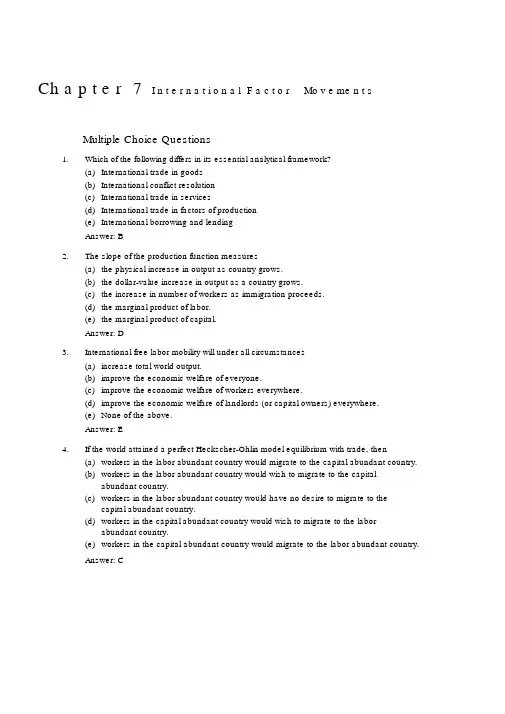
Ch a p t e r 7 I n t e r n a t i o n a l F a c t o r Mo v e me n t s
Multiple Choice Questions
1. Which of the following differs in its essential analytical framework? (a) International trade in goods (b) International conflict resolution (c) International trade in services (d) International trade in factors of production (e) International borrowing and lending
Answer: B
2. The slope of the production function measures (a) the physical increase in output as country grows. (b) the dollar-value increase in output as a country grows. (c) the increase in number of workers as immigration proceeds. (d) the marginal product of labor. (e) the marginal product of capital.
Answer: D
3. International free labor mobility will under all circumstances (a) increase total world output. (b) improve the economic welfare of everyone. (c) improve the economic welfare of workers everywhere. (d) improve the economic welfare of landlords (or capital owners) everywhere. (e) None of the above.

国际经济学第九版英⽂课后答案第7单元
CHAPTER 7
ECONOMIC GROWTH AND INTERNATIONAL TRADE
OUTLINE
7.1 Introduction
7.2 Growth of Factors of Production
7.2a Labor Growth and Capital Accumulation Over Time
7.2b The Rybczynski Theorem
7.3 Technical Progress
7.3a Neutral, Labor-Saving, and Capital-Saving Technical Progress
7.3b Technical Progress and the Nation's Production Frontier
Case Study 7-1: Changes in Relative Resource Endowments of Various Countries and Regions Case Study 7-2: Change inCapital-Labor Rations in Selected Countries
7.4 Growth and Trade: The Small Country Case
7.4a The Effects of Growth on Trade
7.4b Illustration of Factor Growth, Trade, and Welfare
7.4c Technical Progress, Trade, and Welfare
Case Study 7-3: Growth of Output per Worker from Capital Deepening, Technological
Change, and Improvements in Efficiency
7.5 Growth and Trade: The Large-Country Case

精品好文档,推荐学习交流
仅供学习与交流,如有侵权请联系网站删除 谢谢1 CHAPTER 7
ECONOMIC GROWTH AND INTERNATIONAL TRADE
OUTLINE
7.1 Introduction
7.2 Growth of Factors of Production
7.2a Labor Growth and Capital Accumulation Over Time
7.2b The Rybczynski Theorem
7.3 Technical Progress
7.3a Neutral, Labor-Saving, and Capital-Saving Technical Progress
7.3b Technical Progress and the Nation's Production Frontier
Case Study 7-1: Changes in Relative Resource Endowments of Various Countries and Regions
Case Study 7-2: Change in Capital-Labor Rations in Selected Countries
7.4 Growth and Trade: The Small Country Case
7.4a The Effects of Growth on Trade
7.4b Illustration of Factor Growth, Trade, and Welfare
7.4c Technical Progress, Trade, and Welfare
Case Study 7-3: Growth of Output per Worker from Capital Deepening, Technological
lecture7跨国企业直接投资(见书334页)
MNEs (multinational enterprises), FDI, Trade and Development
There is much debate as to the role of multinational (or global) companies, their
influence on the international economy and the benefits or costs that FDI may bring to
developing countries.
关于跨国或全球公司有很多争议,其对国际经济的影响和FDI对发展中国家带来的利益和代价
Trade then and now (from time to time)
Traditionally, international trade has been based on the idea of comparative
advantage leading to gains in productive efficiency.
This assumes products and services do move across international borders and that
factors of production do not move across international borders
It is evident that - increasingly - the second assumption is wrong...
传统上,国际贸易是基于比较优势带来的生产效率。这假定了产品和服务是跨国的,生产要素是不跨国的。 很显然,第二个假设,即生产要素不跨国是错的。
An Overview of Motives for FDI 外商直接投资的动机