
英语倒装结构小结-经典
- 格式:ppt
- 大小:695.00 KB
- 文档页数:28
倒装结构
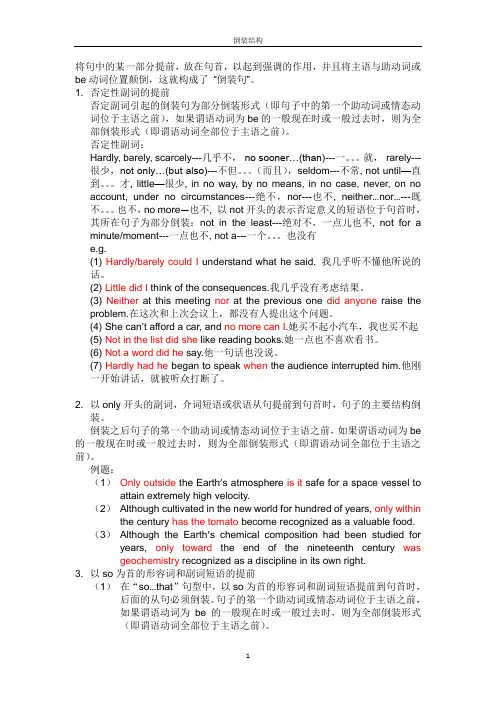
1 将句中的某一部分提前,放在句首,以起到强调的作用,并且将主语与助动词或be动词位置颠倒,这就构成了 “倒装句”。
1. 否定性副词的提前
否定副词引起的倒装句为部分倒装形式(即句子中的第一个助动词或情态动词位于主语之前),如果谓语动词为be的一般现在时或一般过去时,则为全部倒装形式(即谓语动词全部位于主语之前)。
否定性副词:
Hardly, barely, scarcely---几乎不, no sooner…(than)---一。。。就, rarely---很少,not only…(but also)---不但。。。(而且),seldom---不常, not until—直到。。。才, little—很少, in no way, by no means, in no case, never, on no
account, under no circumstances---绝不,nor---也不, neither…nor…---既不。。。也不,no more—也不, 以not开头的表示否定意义的短语位于句首时,其所在句子为部分倒装:not in the least---绝对不,一点儿也不, not for a
minute/moment---一点也不, not a---一个。。。也没有
e.g.
(1) Hardly/barely could I understand what he said. 我几乎听不懂他所说的话。
(2) Little did I think of the consequences.我几乎没有考虑结果。
(3) Neither at this meeting nor at the previous one did anyone raise the
problem.在这次和上次会议上,都没有人提出这个问题。
(4) She can’t afford a car, and no more can I.她买不起小汽车,我也买不起

英语倒装句用法经典总结
In English grammar, an inverted sentence is a type of sentence in which the subject
and the verb are switched around. This can occur in various situations, and the use of
inverted sentences can add emphasis, create a more formal tone, or simply follow a
specific grammatical structure. In this document, we will provide a classic summary of
the usage of inverted sentences in English.
1. Inversion with negative adverbs。
When starting a sentence with a negative adverb such as "never", "rarely", "seldom",
"hardly", "scarcely", or "little", the subject and the auxiliary verb are inverted. For
example:
Never have I seen such a beautiful sunset.
Rarely does she complain about her workload.
2. Inversion after "only"
When "only" is used at the beginning of a sentence, the subject and the auxiliary verb

英语完全倒装句的用法和例子
一、完全倒装句的定义
倒装句是指将句子的主语和谓语的位置互换的句子,通常分为完全倒装和部分倒装。完全倒装是指将谓语动词完全移到主语之前的句子,通常只用于一般现在时和一般过去时。完全倒装的目的有时是为了强调句子的某一部分,有时是为了使句子更加生动或符合语言习惯。
二、完全倒装句的结构和用法
1. 以地点副词(here,there)、时间副词(now,then)开头的句子
当句子以地点副词(here,there)或时间副词(now,then)开头,且句子的主语是普通名词时,句子用完全倒装。这种结构通常用来表示某人或某物的出现或消失,或者用来引出话题。例如:
Here comes the bus! 公交车来了!
There goes the bell. 铃声响了。
Now begins our story. 我们的故事开始了。
Then followed a long silence. 接着是一阵长久的沉默。注意:如果句子的主语是代词时,则不倒装。例如:
Here we are. 我们到了。
There he goes. 他走了。
Now you see it, now you don't. 现在你看到了,现在你看不到了。
Then she said goodbye. 然后她说再见。
2. 表方位的地点副词(out,in,up,down,away,off)等
当句子以表方位的地点副词(out,in,up,down,away,off)等开头,为了使句子更生动,常将这些副词提前到句首,这时用完全倒装。这种结构通常用来描述某人或某物的动作或状态。例如:
Out rushed the children. 孩子们冲了出去。
In came a boy. 一个男孩走了进来。
Up went the balloon. 气球飞了起来。
Down fell the tree. 树倒了下来。
Away flew the bird. 鸟飞走了。

高中英语知识点归纳句子的主谓一致和倒装结构
主谓一致是英语语法中的一个基本概念。在句子中,主语和谓语动词需要在人称和数上保持一致。主谓一致的错误会导致句子结构混乱,使读者产生困惑。另外,英语中还有一种特殊的句子结构,称为倒装结构。倒装结构指的是将谓语动词放在主语之前,通常出现在某些特定的句子或语境中。本文将对主谓一致和倒装结构进行归纳总结。
主谓一致结构要求主语和谓语动词在人称和数方面保持一致。具体而言,当主语是第三人称单数时,谓语动词需要加上-s或-es。例如:
- He plays tennis every day.(他每天打网球。)
- The sun rises in the east.(太阳从东方升起。)
当主语是第一人称单数或复数时,谓语动词保持原形不变。例如:
- I love reading books.(我喜欢看书。)
- We study English every day.(我们每天学习英语。)
此外,在使用连接词(如and、or、but等)连接多个主语时,谓语动词的人称和数要与最靠近的主语保持一致。例如:
- Mary and Alice are good friends.(玛丽和爱丽丝是好朋友。)
倒装结构是英语中另一种常见的句子结构。在倒装句中,谓语动词位于主语之前。倒装结构的使用与特定的句子或语境有关。以下是常见的倒装结构类型: 1. 完全倒装结构:主语与谓语动词完全颠倒。常用于以副词、介词短语或状语从句开头的句子中。例如:
- In the garden sat a beautiful girl.(花园里坐着一个漂亮的女孩。)
- Not only did he pass the exam, but he also got the highest score.(他不仅通过了考试,而且还获得了最高分。)
2. 部分倒装结构:只将助动词、情态动词或系动词放在主语之前,而谓语动词仍然位于主语之后。例如: