基于热链路分裂多径路由算法的最优路由高级算法(IJCNIS-V6-N8-7)
- 格式:pdf
- 大小:378.81 KB
- 文档页数:8
I.J. Computer Network and Information Security, 2014, 8, 48-55 Published Online July 2014 in MECS (http://www.mecs-press.org/) DOI: 10.5815/ijcnis.2014.08.07
Copyright © 2014 MECS I.J. Computer Network and Information Security, 2014, 8, 48-55 Optimal Route Based Advanced Algorithm using Hot Link Split Multi-Path Routing Algorithm Akhilesh A. Waoo Bansal Group of Institutions, Bhopal, 462022, India Email: akhilesh_waoo@rediffmail.com Sanjay Sharma Maulana Azad National Institute of Technology, Bhopal, India Email: ssharma66@rediffmail.com Manjhari Jain Bansal Group of Institutions, Bhopal, India Email: golujain1986@gmail.com Abstract—Present research work describes advancement in standard routing protocol AODV for mobile ad-hoc networks. Our mechanism sets up multiple optimal paths with the criteria of bandwidth and delay to store multiple optimal paths in the network. At time of link failure, it will switch to next available path. We have used the information that we get in the RREQ packet and also send RREP packet to more than one path, to set up multiple paths, It reduces overhead of local route discovery at the time of link failure and because of this End to End Delay and Drop Ratio decreases. The main feature of our mechanism is its simplicity and improved efficiency. This evaluates through simulations the performance of the AODV routing protocol including our scheme and we compare it with HLSMPRA (Hot Link Split Multi-Path Routing Algorithm) Algorithm. Indeed, our scheme reduces routing load of network, end to end delay, packet drop ratio, and route error sent. The simulations have been performed using network simulator OPNET. The network simulator OPNET is discrete event simulation software for network simulations which means it simulates events not only sending and receiving packets but also forwarding and dropping packets. This modified algorithm has improved efficiency, with more reliability than Previous Algorithm. Index Terms—AODV, MANET, Optimal Path, OPNET, Packet Drop, Route Error, Routing Load. I. INTRODUCTION Recently Ad hoc networks are enjoying unprecedented research issues, and are expected to offer opportunities for utilization of network applications in new scenarios in which today Internet-based communication paradigms are not applicable. Generally, ad hoc networks will be formed in situations where no predetermined subnet structure (infrastructure) is available, and for which is known. Ad hoc networks are typically considered to be composed of mobile wireless devices, having rapid change in pathways. This characteristic of Ad hoc network often causes to be viewed more quite different than traditional networks; there are some strong commonality which, as require to learn and understand it better (Elizabeth M, et. al. 2003). Mobile Ad-Hoc networks (MANETS) are self-configured and infrastructure less network with more number of mobile devices connected via a wireless links. [19]. Energy conservation in ad-hoc networks is very important due to the limited energy availability in each wireless node [15]. Ad hoc networks are typically considered to be composed of mobile wireless devices, with the result that the interconnection pathways between the devices can change rapidly. This characteristic often causes ad hoc networks to be viewed more quite different than traditional networks; however, our experience shows that instead there is a strong commonality which, as we learn to understand it better, will illuminate not only the nature of ad hoc networks but also some fundamental aspects of networking [14]. The MANET is the combination of mobile nodes (MN) and wireless communication links. They are connected to each other without the help of access point (AP) and it is shown in Fig. 1. For efficient communication in MANET, the frequent link establishment is mandatory and it has application in disaster area, battle field etc. It requires the routing protocols to establish the connection and route data packets [17]. Optimal Route Based Advanced Algorithm using Hot Link Split Multi-Path Routing Algorithm 49
Copyright © 2014 MECS I.J. Computer Network and Information Security, 2014, 8, 48-55
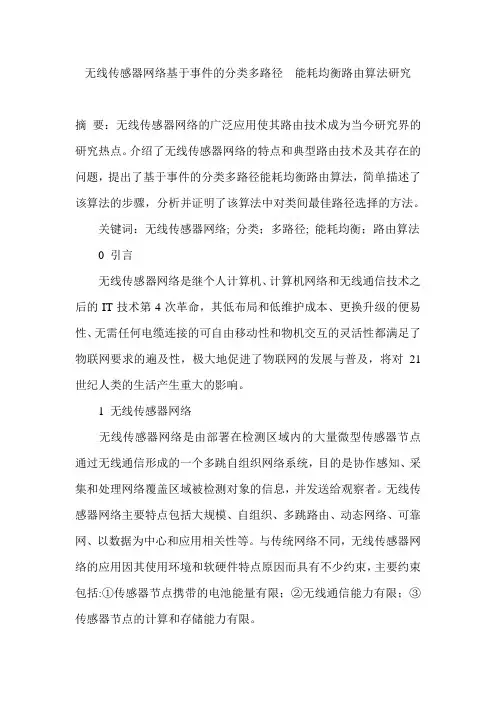
Fig.1. Ad Hoc Network System Architecture Multipath routing can be fundamentally more efficient than the currently used single-path routing protocols. It can significantly reduce congestion in ―hot spots‖, by deviating traffic to unused network resources, thus improving network utilization and providing load balancing [21]. Moreover, congested links usually result in poor performance and high variance. For such circumstances, multipath routing can offer steady and smooth data streams. In recent years, computer communication networks have developed rapidly. The reason why it develops so rapidly is due to one of the critical technologies—routing technology. For routing packets in the Internet, either a single-path can be used for all the packets from a source to a destination or multiple paths can be utilized. Many different kinds of single path routing, such as Dijkstra algorithm [21], SWP algorithm [22], and WSP algorithm [23] and so on, have been proposed. But according to these methodologies, transit node can only conduct data forward and transmission through single path, which will make message incline to take up nodes and links which have stronger processing capacity. Thereby, it easily leads to link congestion, data packet loss, network throughput reduction, link load unbalanced, which always makes some nodes and links in the state of congestion or overload , but the other in the low state in most times. The secondary paths can be used to transmit data packets, in case the primary path fails due to node mobility or battery failure, which avoids extra node mobility or battery failure, which avoids extra overhead generated by a fresh route discovery. These multiple paths are more advantageous in larger networks, where he number of route breaks are high. In a network composed of mobile nodes, changes in the network topology required the frequent rebuilding of routes, so maintaining stable routes may be infeasible. Therefore, MANET is a communication network of a set of mobile nodes, placed together in an ad hoc manner, without any fixed infrastructure that communicate with one another via wireless links. All nodes have routing capabilities and forward data packets for other nodes in multi-hop manner. A Node can enter or leave the network at any time due to its mobility; the network topology continuously changes during deployment. The need for exchange of digital information outside the typical wired office or unarranged environment is growing such as a class of students may need to interact during a lecture; business associates serendipitously meeting in an airport may wish to share files; or disaster recovery personnel may need to coordinate relief information after a hurricane or flood like disasters. The devices used by these information producers and consumers can be considered a node in a MANET [2]. Extensive research works for MANETs are carried out mainly in the fields of Medium Access Control (MAC), routing, resource management, power control, and security issues. MANET Routing Protocols are so important in Dynamic Multi hop Networks, various MANET Routing Protocols have been proposed with several research issues in the last few years. Generally following properties are expected in MANET routing protocols:- To increase its reliability, a routing protocol for MANET should be distributed in manner in order By considering power-efficiency as an important feature, a routing protocol must be designed for unidirectional links. To avoid overhead, a hybrid routing protocol should be much more reactive than proactive A routing protocol should be having features of Quality of Service (QoS) [12]. II. ROUTING IN MANET Routing is the process of information exchange from one host to the other host in a network by forwarding packets towards its destination using most efficient path among the available in routing. Efficiency of the communication path is measured in various parameters such as number of hops, traffic, security, and energy of nodes etc. In MANET each host node acts as specialized router itself [4]. A. Different Strategies Routing protocol for mobile ad-hoc network (MANET) can be categorized in three strategies. Flat and Hierarchical architecture. Pro- active and Re- active routing protocol. Hybrid protocols. B. Flat Vs. Hierarchical Architecture Hierarchical network architecture topology consists of multiple layers where top layers are more seen as master of their lower layer nodes. There are cluster of nodes and one gateway node among all clusters has a duty to communicate with the gateway node in other cluster. In this schema there is a clear distribution of task. Burden of storage of network topology is on gateway nodes, where communicating different control message is dependent on cluster nodes. But this architecture breaks down when there is single node (Gateway node) failure. Gateway node becomes