
牛津译林版高中英语必修三2.reading
- 格式:pptx
- 大小:219.44 KB
- 文档页数:20

2020牛津译林版新教材高中英语必修三课文原文B3U2 Natural disastersReadingPupil’s lives spared during Falmont earthquakeBy Raymond Tran18 MarchFALMONT—On 17 March, 476 students and 36 teachers at Falmont Primary School escaped an earthquake that hit the county at 2:27 p.m. Only 5 students suffered slight injuries, despite the current figures of 7 killed and over 200 injured in the disaster area at large.Alice Brown, head teacher at Falmont Primary School, was teaching when the floor began to shake. Her students' reaction was quick and correct—they moved under their desks, head first, and held on to the legs of the desks. At the same time, Miss Brown quickly opened the classroom door, in case it became damaged during the shaking and could not open. There were loud crashes of glass breaking and things falling to the ground, but the students remained still and waited calmly and quietly.The moment the shaking stopped, Miss Brown sensed it was the best time for the class to make their escape. She signalled to her students to exit the classroom in an orderly line covering their heads with their hands. Within one minute and twenty seconds, the whole class went down the stairs and rushed to the playground. Soon students from other classes arrived too. After a roll call confirmed that all were safe and sound, they relaxed, laughing, crying and hugging each other.“We practise earthquake safety procedures twice a year,”said Miss Brown, “so the kids were calm enough to protect themselves during the earthquake.”By Jessie Cable21 DecemberNEWDALE—On 20 December, a series of huge waves caused by an undersea earthquake raced across the ocean near Goldshore and left thousands dead. Goldshore Beach was the only local beach to survive the disaster without any loss of life. A 10-year-old girl, Sabrina Andron,helped around 100 people escape danger with her knowledge of tsunamis.The day began like any other on Goldshore Beach. People were walking, running or simply sitting on the sandy beach, enjoying the warm sea air and the soft wind that brushed their hair. Sabrina was one of the happy tourists until she noticed something odd. “The water was like the bubbles on the top of a beer,”she later explained. “It wasn't calm and it wasn't going in and then out. It was just coming in and in and in.”Sabrina had just learnt about tsunamis in a Geography lesson. It immediately occurred to her that these were signs of an approaching tsunami.Sabrina was frightened, but she soon kept her head. She warned her parents of the danger, though at first they just thought she was joking. However, Sabrina was certain that a terrible disaster was on its way and kept asking her parents to talk to a safety officer. To her great relief, the officer immediately realized the coming danger. The beach was rapidly cleared of people, just before the huge waves crashed into the coast.B3U2 Extended readingThe Last Day of Pompeii(Excerpt)Edward Bulwer-Lytton (1803-1873) was a talented British writer who left his mark on the English language. His classic novel The Last Days of Pompeii imagines life in the ancient Roman city of Pompeii in the year 79, when Mount Vesuvius erupted. This terrible natural disaster destroyed Pompeii completely, but it also kept the ancient city as it was for future ages. Since 1748, Pompeii has been systematically unearthed. Today it is an international tourist destination.Pompeii was a typical Roman city. In its little shops, its tiny palaces, its forum, its wine bars, its theatre—in the energy and skill of its people, you saw a model of the whole Roman Empire. Trading ships bringing imports to the city or carrying exports overseas, along with golden pleasure boats for the rich, were crowded together in the glassy water of the port. The boats of the fishermen moved rapidly in all directions. Above all, the cloud-capped top of Mount Vesuvius appeared. Its ashy rocks, now dark, now light, told a story of past eruptions that might have warned the city what was to come!The awful night rolled slowly away, and the dawn greyly broke on THE LAST DAY OF POMPEII! The crowd looked upwards, and saw, with unspeakable fear, a huge cloud shooting from the top of the volcano. It took the form of a huge tree: the trunk, blackness, the branches, fire! This fire moved and changed in colour with every moment: now it was wildly bright, now of a pale and dying red, and now again it burnt with an unbearable light!The cries of women broke out; the men looked at each other, but were silent. At that moment, they felt the earth shaking beneath their feet; beyond in the distance, they heard the crash of falling roofs. A moment later, the mountain-cloud seemed to roll towards them, dark and rapid, like a river;at the same time, it threw out a shower of ashes and huge pieces of burning stone! Over the empty streets—over the forum—far and wide—with many a noisy crash in the stormy sea—fell that awful shower!Each turned to fly—each running, pressing, pushing against the other. If, in the darkness, wife was separated from husband, or parent from child, there was no hope of their meeting again. Each hurried blindly and fearfully on. So came the earthquake ... and so ended life in Pompeii.Nearly seventeen centuries had rolled away before the city of Pompeii was dug from its silentresting place. Its walls were fresh as if painted yesterday; not a single colour changed on the rich pattern of its floors. In its forum, the half-finished columns seemed as if just left by the workman's hand. Long after fire and ash came for the people of Pompeii, the remains of their beautiful city survive to remind us that human lives burn bright and short.。

《英语》(选择性必修·第三册)Unit 2Out of this worldExtended readingI. Learning objectivesBy the end of the lesson, students will be able to:1. understand the usage of the following words: origin, frequency, motive, investment, calculate, coverage, mechanic, assistant, incredibly;2. use the above words in new situations;3. analyse some complex sentences in the text;4. summarize the author’s arguments for space exploration.II. Key competence focusMaster and use the above words in new situations.III. Predicted area of difficulty1. Use the above words in new situations.2. Understand some complex sentences in the text.IV. Teaching proceduresStep 1 Reading1. Reading for the main idea and outline of the text.T: Go through the magazine article and find out the main idea of the text.T: Now you have read through the whole text. What’s the main idea of the text?T: Right. The title Why we explore has told us the theme of the text. The main idea is “reasons for space exploration”.T: What should we do to work out the outline of the text?T: In the argumentative essay, you’ll find every first sentence of each paragraph is the subject sentence of the paragraph. Condense and reshape the sentences, and you’ll outline the text. Now please finish part A on page 26.2. Reading for the details.T: Read the text again and fill in the blanks with the given words in their proper forms.economy, education, explore, discovery, investment, origination, learn, know Why do we have interest in the (1)________ of the space? Our nature drives us to know the (2)________. As a result, we learn more about how the universe (3)________ and evolves. Then we can predict where it goes. As we (4)_______ more about the universe, we may find life in outer space. As space technologies like shock absorbers and liquid hydrogen (5)________ and researched, we may solve some big problems on the Earth. Though we have(6)________ the space industry hugely, the space industry can create jobs and benefit us (7)________. What’s more, the next generations(8)________ and inspired to participate in it.3. T asks Ss to finish part B.T: The article talks about the advantages of space exploration. Do you agree or disagree with the author’s opinion? Why?4. T asks Ss to finish part C.T: Our exploration of space has already taught us many things. What do you think the future of space exploration holds for human understanding? Give reasons for your opinion and support your reasons with evidence.【设计意图:首先引导学生获得文章的主旨,再获得文章的主干信息,由此形成课文的概要。
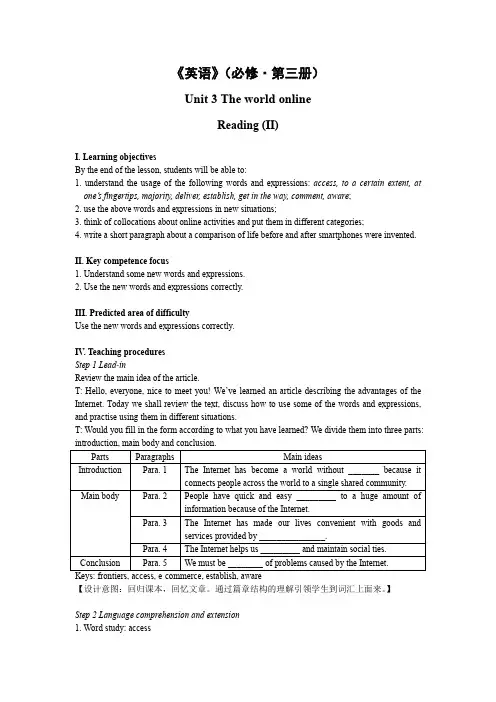
《英语》(必修·第三册)Unit 3 The world onlineReading (II)I. Learning objectivesBy the end of the lesson, students will be able to:1. understand the usage of the following words and expressions: access, to a certain extent, at one’s fingertips, majority, deliver, establish, get in the way, comment, aware;2. use the above words and expressions in new situations;3. think of collocations about online activities and put them in different categories;4. write a short paragraph about a comparison of life before and after smartphones were invented.II. Key competence focus1. Understand some new words and expressions.2. Use the new words and expressions correctly.III. Predicted area of difficultyUse the new words and expressions correctly.IV. Teaching proceduresStep 1 Lead-inReview the main idea of the article.T: Hello, everyone, nice to meet you! We’ve learned an article describing the advantages of the Internet. Today we shall review the text, discuss how to use some of the words and expressions, and practise using them in different situations.T: Would you fill in the form according to what you have learned? We divide them into three parts:【设计意图:回归课本,回忆文章。