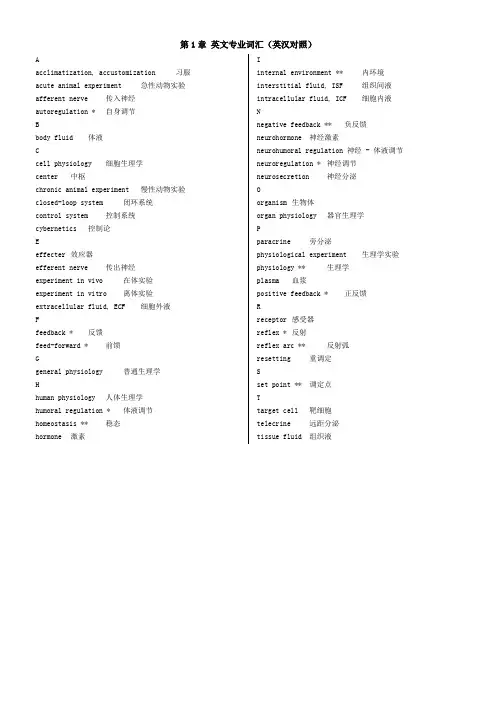
第1章英文专业词汇(英汉对照)Aacclimatization, accustomization 习服acute animal experiment 急性动物实验afferent nerve 传入神经autoregulation * 自身调节Bbody fluid 体液Ccell physiology 细胞生理学center 中枢chronic animal experiment 慢性动物实验closed-loop system 闭环系统control system 控制系统cybernetics 控制论Eeffecter 效应器efferent nerve 传出神经experiment in vivo 在体实验experiment in vitro 离体实验extracellular fluid, ECF 细胞外液Ffeedback * 反馈feed-forward * 前馈Ggeneral physiology 普通生理学Hhuman physiology 人体生理学humoral regulation * 体液调节homeostasis ** 稳态hormone 激素Iinternal environment ** 内环境interstitial fluid, ISF 组织间液intracellular fluid, ICF 细胞内液Nnegative feedback ** 负反馈neurohormone 神经激素neurohumoral regulation 神经 - 体液调节neuroregulation * 神经调节neurosecretion 神经分泌Oorganism 生物体organ physiology 器官生理学Pparacrine 旁分泌physiological experiment 生理学实验physiology ** 生理学plasma 血浆positive feedback * 正反馈Rreceptor 感受器reflex * 反射reflex arc ** 反射弧resetting 重调定Sset point ** 调定点Ttarget cell 靶细胞telecrine 远距分泌tissue fluid 组织液第2章英文专业词汇(英汉对照)Aabsolute refractory period** 绝对不应期acetylcholine, ACh** 乙酰胆碱acetylcholinesterase** 乙酰胆碱酯酶actin* 肌动蛋白 ; 肌纤蛋白action potential** 动作电位activation** 激活active transport** 主动转运adenylyl cyclase, AC** 腺苷酸环化酶after depolarization* 后去极化after hyperpolarization* 后超极化after-potential* 后电位afterload** 后负荷all-or-none response** “全或无”反应amphiphilic molecule* 双嗜性分子analogue signal 模拟信号antigen 抗原antiport** 反向转运antiporter* 反向转运体aquaporin, AQP 水孔蛋白arrhythmia 心律失常atrial natriuretic peptide, ANP* 心房钠尿肽autophosphorylation 自身磷酸化autorhythmicity** 自律性Bbarrier function 屏障功能blocker 阻断剂brain natriuretic peptide, BNP* 脑钠尿肽a -bungarotoxin a - 银环蛇毒CCa 2+ -binding protein, CaBP* 钙结合蛋白calcium channel 钙通道calcium-induced Ca 2+ release, CICR** 钙触发钙释放calcium pump* 钙泵calcium release channel** 钙释放通道calmodulin, CaM ** 钙调蛋白cardiac muscle* 心肌carrier** 载体cell* 细胞cell membrane* 细胞膜central nervous system 中枢神经系统channel* 通道chemically-gated ion channel** 化学门控通道chloride channel 氯通道cholesterol* 胆固醇Cl - equilibrium potential, E Cl* Cl - 平衡电位clathrin 网格蛋白close** 关闭coated pit 有被小窝coated vesicle 有被囊泡competitive inhibition* 竞争抑制complete tetanus 完全性强直收缩concentration gradient 浓度梯度conformational change 构象变化connexin* 连接蛋白connexon* 连接子contractility** 肌肉收缩能力cross-bridge* 横桥cross-bridge cycling* 横桥周期cyclic adenosine monophosphate, cAMP** 环一磷酸腺苷cyclic guanosine monophosphate, cGMP** 环一磷酸鸟苷cytokine 细胞因子cytosol 胞质Ddark band 暗带deactivation** 去激活dense band 致密带dense body* 致密体dense patch 致密斑dephosphorylation 去磷酸化depolarization** 去极化detachment 解离diacylglycerol, DG* 二酰甘油duration of stimulus 刺激持续时间Eelectrical gradient 电位梯度electrical synapse* 电突触electrically excitable cell 电可兴奋细胞electrocardiogram, ECG 心电图electrochemical driving force* 电化学驱动力electroencephalogram, EEG 脑电图electromechanical coupling* 电 - 机械耦联electromyogram 肌电图electrotonic potential** 电紧张电位electrotonic propagation** 电紧张扩布endocytosis** 入胞endocytotic vesicle 吞饮泡endplate membrane* 终板膜endplate potential, EPP** 终板电位ensemble current 总体平均电流enzyme-linked receptor* 酶联型受体equilibriam potential* 平衡电位exchanger** 交换体excitability** 兴奋性excitable cell** 可兴奋细胞excitation** 兴奋excitation-contraction coupling** 兴奋 - 收缩耦联excitation-secretion coupling** 兴奋 - 分泌耦联exocytosis** 出胞Ffacilitated diffusion via carrier** 经载体易化扩散facilitated diffusion via ion channel** 经通道易化扩散fluid mosaic model* 液态镶嵌模型fluid-phase endocytosis* 液相入胞Ggap junction** 缝隙连接gap junction channel** 缝隙连接通道gastric parietal cell 壁细胞gate 闸门gating** 门控generator potential 发生器电位genetic expression 基因表达G protein* G 蛋白G protein effector** G 蛋白效应器G protein-linked receptor** G 蛋白耦联受体glucose 葡萄糖D-glucose carrier 右旋葡萄糖载体glucose transporter, GLUT** 葡萄糖转运体glycolipid* 糖脂glycoprotein* 糖蛋白growth factor 生长因子guanine nucleotide-binding protein** 鸟苷酸结合蛋白guanyly l cyclase, GC** 鸟苷酸环化酶guanylyl cyclase receptor** 鸟苷酸环化酶受体Hheavy chain 重链heterotrimeric GTP-binding protein 三聚体 G 蛋白homeodomain 同源结构域hyperpolarization** 超极化Iinactivation** 失活incomplete tetanus 不完全强直收缩initial length** 初长度inositol triphosphate, IP 3 ** 三磷酸肌醇integral protein* 整合蛋白intensity of stimulus 刺激强度intercalated cell 闰细胞intermediate filament 中间丝inward current** 内向电流ion channel** 离子通道ion-channel receptor** 离子通道型受体ion pump** 离子泵ionic selectivity* 离子选择性iontropic receptor** 促离子型受体IP 3 receptor, IP 3 R** IP 3 受体isometric contraction** 等长收缩isotonic contraction** 等张收缩Jjunctional cleft* 接头间隙junctional SR, JSR* 连接肌质网KK + equilibriam potential, E K ** K + 平衡电位K + leak channel** 钾漏通道Lligand* 配体ligand-gated ion channel* 配体门控通道light band 明带light chain 轻链lipid* 脂质lipid bilayer* 脂质双层load 负荷local current** 局部电流local potential** 局部电位longitudinal SR, LSR* 纵行肌质网longitudinal tubule 纵管low-density lipoprotein, LDL* 低密度脂蛋白L-type Ca 2+ channel* L 型钙通道Mmacroscopial current* 宏膜电流mechanically-gated ion channel** 机械门控通道membrane capacitance, C m * 膜电容membrane conductance** 膜电导membrane potential** 膜电位membrane protein-mediated transport膜蛋白介导的跨膜转运membrane resistance* 膜电阻metabotropic receptor** 促代谢型受体Michealis constant, K m * 米氏常数miniature endplate potential, MEPP** 微终板电位mitogen-activated protein kinase, MAPK丝裂原激活的蛋白激酶M line M 线molecular switch* 分子开关motor unit** 运动单位muscle tonus** 肌紧张multi-unit smooth muscle* 多单位平滑肌myofibril 肌原纤维myofilament sliding theory** 肌丝滑行理论myosin* 肌球蛋白 ; 肌凝蛋白myosin light chain, MLC* 肌球蛋白轻链myosin light chain kinase, MLCK*肌球蛋白轻链激酶myosin light chain phosphatase , MLCP*肌球蛋白轻链磷酸酶NN 2 -A C h receptor cation channel**N 2 型 ACh 受体阳离子通道**Na + -Ca 2+ exchanger Na + -Ca 2+ 交换体Na + equilibrium potential, E Na ** Na + 平衡电位Na + -glucose symporter Na + - 葡萄糖同向转运体Na + -H + exchanger Na + -H + 交换体Na + , K + -ATPase* Na + , K + -ATP 酶Na + , K + , Cl - cotransporter Na+,K+,Cl - 同向转运体negative after-potential* 负后电位nerve impulse 神经冲动neuromuscular junction* 神经 - 肌接头nitric oxide, NO** 一氧化氮NO synthase, NOS** 一氧化氮合酶non-synaptic chemical transmission* 非突触性化学传递nonselective cation channel 非选择性阳离子通道Ooligosaccharide 寡糖open probability 开放概率optimal initial length** 最适初长度outward current** 外向电流overshoot** 超射Ppacemaker** 起步点passive electrical property 被动电学特性passive transport** 被动转运patch clamp** 膜片钳performance of contraction** 收缩效能peripheral protein* 表面蛋白permeability* 通透性phagocytosis* 吞噬pharmacomechanical coupling* 药物 - 机械耦联phosphatase 磷酸酶phosphatidylinositol bisphosphate, PI2 *二磷酸磷脂酰肌醇phosphodiesterase , PDE** 磷酸二酯酶phospholipase A 2 , PLA 2 * 磷脂酶 A 2 phospholipase C, PLC** 磷脂酶 Cphospholipid* 磷脂phosphorylation 磷酸化physical diffusion 物理扩散pinocytosis* 吞饮plasma membrane* 质膜polarization** 极化polysaccharide 多糖positive feedback 正反馈postsynaptic potential 突触后电位potassium channel 钾通道positive after-potential* 正后电位prejunctional membrane* 接头前膜preload** 前负荷primary active transport** 原发性主动转运protein* 蛋白质propagation 传播protein kinase 蛋白激酶protein kinase A, PKA 蛋白激酶 Aprotein kinase C , PKC 蛋白激酶 Cprotein kinase G, PKG 蛋白激酶 Gproton pump 质子泵Qquantal 量子quantal release** 量子式释放Rrate of change of intensity to time 强度对时间的变化率receptor 受体receptor-mediated endocytosis** 受体介导入receptor potential 感受器电位receptor tyrosine kinase 受体酪氨酸激酶recovery from inactivation** 复活relative refractory period** 相对不应期repolarization** 复极化resting potential** 静息电位retched action* 棘齿作用ryanodine receptor, RYR** ryanodine 受体Ssaltatory conduction** 跳跃式传导sarcomere* 肌节sarcoplasmic reticulum, SR* 肌质网sarcotubular system 肌管系统saturation* 饱和现象second messenger** 第二信使secondary active transport** 继发性主动转运selectivity filter 选择性滤器shortening 缩短signaling transduction** 信号转导simple diffusion** 单纯扩散single channel conductance 单通道电导single channel current* 单通道电流single-unit smooth muscle* 单个单位平滑肌size principle** 大小原则skeletal muscle* 骨骼肌slow wave 慢波smooth muscle* 平滑肌sodium channel 钠通道sodium-potassium pump** 钠 - 钾泵sodium pump* 钠泵spatial summation** 空间总和spike potential** 锋电位stimulation** 刺激striated muscle* 横纹肌subnormal period** 低常期subthreshould stimulus 阈下刺激summation** 总和supranormal period** 超常期suprathreshold stimulus 阈上刺激symport** 同向转运symporter* 同向转运体synaptic vesicle 突触囊泡 ; 突触小泡Ttemporal summation** 时间总和tension 张力terminal cistern* 终池tetanus** 强直收缩tetraethylammonium, TEA 四乙铵tetrodotoxin, TTX 河豚毒thick filament 粗肌丝thin filament 细肌丝three-legged protein 三脚蛋白threshold** 阈值threshold intensity** 阈强度threshold potential** 阈电位threshold stimulus** 阈刺激time-dependence* 时间依赖性transmembrane current 跨膜电流transmembrane diffusion* 跨膜扩散transmembrane a helice 跨膜 a 螺旋transmembrane potential** 跨膜电位7-transmembrane receptor 7 次跨膜受体transmitter-gated ion channel* 递质门控通道transporter** 转运体transverse tubule 横管triad 三联管tropomyosin* 原肌球蛋白 ; 原肌凝蛋白troponin* 肌钙蛋白troponin C, TnC* 肌钙蛋白 C troponin I, TnI* 肌钙蛋白 I troponinT, TnT* 肌钙蛋白 TT tubule* T 管tubocurarine 筒箭毒twitch** 单收缩tyrosine-kinase-associated receptor*酪氨酸激酶结合型受体tyrosine kinase receptor, TKR** 酪氨酸激酶受体Uuniport** 单(物质)转运uniporter* 单(物质)转运体Vvaricosity* 曲张体visceral smooth muscle* 内脏平滑肌voltage clamp* 电压钳voltage-dependence* 电压依赖性voltage-gated ion channel** 电压门控通道Wwater channel 水通道wave front** 波前ZZ disk Z 盘Z line Z 线第3章英文专业词汇(英汉对照)Aagglutination ** 红细胞凝集agglutinin ** 凝集素agglutinogen ** 凝集原Albumin 白蛋白antihemophilic factor 抗血友病因子a 2 - antiplasmin a 2 - 抗纤溶酶antithrombin ** 抗凝血酶a 1 antitrypsin a 1 抗胰蛋白酶aplastic anemia 再生障碍性贫血Bbasophil * 嗜碱性粒细胞basophilic normoblast 早幼红细胞bleeding time * 出血时间blood* 血液blood cells * 血细胞blood coagulation ** 血液凝固blood component therapy ** 成分输血blood group ** 血型blood volume ** 血量bone marrow 骨髓bone marrow transplantation , BMT 骨髓移植burst forming unit-erythroid, BFU-E*爆式红系集落形成单位burst promoting activity, BPA * 爆式促进活性Cchemokine * 趋化因子chemotaxis * 趋化性C 1 inhibitor C 1 抑制物clotting time, CT * 凝血时间coagulation factor; clotting factor ** 凝血因子collagen 胶原colloid osmotic pressure ** 胶体渗透压colony forming unit, CFU * 集落形成单位colony forming unit-erythroid, CFU-E* 红系集落形成单位colony-forming unit-granulocyte-macrophage, CFU-GM粒 - 单核系祖细胞colony-forming unit-megakaryocyte, CFU-MK 巨核系祖细胞colony stimulating factor, CSF * 集落刺激因子committed progenitors * 定向祖细胞contact factor 接触因子 ; Hageman 因子cross-match test ** 交叉配血试验cycloxygenase 环加氧酶crystal osmotic pressure ** 晶体渗透压Ddemarcation membrane system, DMS * 分界膜系统dendritic cell 树突状细胞diapedesis 白细胞渗出Eeosinophil * 嗜酸性粒细胞eosinophile chemotactic factor A 嗜酸性粒细胞趋化因子 Aerythrocyte; red blood cell, RBC * 红细胞erythrocyte sedimentation rate, ESR ** 红细胞沉降率erythropoietin, EPO* * 促红细胞生成素extramedullary hemopoiesis 骨髓外造血extrinsic pathway ** 外源性凝血途径FFerri 铁fibrin ** 纤维蛋白fibrin-stabilizing factor , FSF 纤维蛋白稳定因子fibrinogen * 纤维蛋白原fibrinolysis ** 纤维蛋白溶解 ; 纤溶folic acid 叶酸forward typing 正向定型GGlobulin 球蛋白glycoprotein, GP 糖蛋白granulocyte 粒细胞granulocyte- colony stimulating factor, G-CSF 粒细胞集落刺激因子granulocyte-macrophage- colony stimulating factor,GM-CSF粒 - 巨噬细胞集落刺激因子Hhematocrit ** 血细胞比容hemoglobin, Hb * 血红蛋白hemopoiesis * 造血hemopoietic microenvironment ** 造血微环境hemopoietic stem cells * 造血干细胞hemostasis ** 止血heparin ** 肝素heparin cofactor Ⅱ肝素辅因子Ⅱhereditary spherocytosis 遗传性球形红细胞增多症high molecular weight kininogen, HMWK高分子量激肽原histamine 组胺human leukocyte antigen, HLA ** 人类白细胞抗原5-hydroxytryptamine, 5-HT 5 - 羟色胺hypoxia 缺氧hypoxia-inducible factors-1, HIF-1 * 低氧诱导因子 - 1 Iinterferon- a , INF- a 干扰素 - ainterleukin, IL 白细胞介素 ; 白介素intrinsic factor ** 内因子intrinsic pathway ** 内源性凝血途径iso-osmotic solution * 等渗溶液isotonic solution * 等张溶液Lleukocyte; white blood cell, WBC * 白细胞leukotrienes, LT 白(细胞)三稀lymphocyte * 淋巴细胞Ma 2 - macroglobulin a 2 - 巨球蛋白macrophage* 巨噬细胞macrophage- colony stimulating factor, M-CSF巨噬细胞集落刺激因子major basic protein , MBP 主要碱性蛋白megakaryocyte * 巨核细胞monocyte * 单核细胞Nnatural killer, NK* 自然杀伤细胞neutrophil * 中性粒细胞Newtonian fluid 牛顿液体Oorthochromatic normoblast 晚幼红细胞osmotic fragility ** 红细胞渗透脆性 ; 脆性osmotic pressure ** 渗透压Pperoxydase 过氧化物酶phagocytosis * 吞噬phosphatidylserine, PS 磷脂酰丝氨酸phospholipase A 2 , PLA 2 磷脂酶 A 2plasma * 血浆plasma proteins * 血浆蛋白plasma thromboplastin 血浆凝血活酶plasma thromboplastin antecedent 血浆凝血活酶前质plasmin ** 纤溶酶 ; 血浆素plasminogen ** 纤维蛋白溶解酶原 ; 纤溶酶原 ; 血浆素原plasminogen activator * 纤溶酶原激活物plasminogen activator inhibitor type-1, PAI-1 *纤溶酶原激活物抑制物 - 1 plastic deformation ** 可塑变形性platelet; thrombocyte * 血小板platelet adhesion ** 血小板黏附platelet aggregation ** 血小板聚集platelet-derived growth factor, PDGF 血小板源生长因子platelet factor 4, PF 4 血小板因子 4platelet factor V, PF 5 血小板因子 Vplatelet release ** 血小板释放platelet secretion ** 血小板分泌polychromatic normoblast 中幼红细胞polymorphonuclear leukocyte * 多形核白细胞precursors * 前体细胞prekalikrein 前激肽释放酶proaccelerin 前加速素易变因子proconvertin 前转变素稳定因子prostacyclin, PGI 2 * 前列环素protein C, PC ** 蛋白质 Cprothrombin 凝血酶原prothrombinase complex ** 凝血酶原酶复合物Rreticulocyte 网织红细胞reverse typing 反向定型rouleaux formation ** 红细胞叠连Sself renewal 自我复制serum ** 血清slow-reacting substance of anaphylaxis, SAS-A过敏性慢反应物质survival factor 存活因子suspension stability ** 悬浮稳定性Tthrombin ** 凝血酶b -t hromboglobulin b - 血小板球蛋白thrombomodulin, TM ** 凝血酶调节蛋白thrombopoietin, TPO * 血小板生成素thrombospondin 凝血酶敏感蛋白thromboxane A 2 , TXA 2 ** 血栓烷 A 2tenase complex * 因子Ⅹ酶复合物tissue factor, TF * 组织因子tissue factor pathway 组织因子途径tissue factor pathway inhibitor, TFPI **组织因子途径抑制物tissue plasminogen activator, t-PA **组织型纤溶酶原激活物transferrin * 转铁蛋白tumor necrosis factor a , TNF a 肿瘤坏死因子 aUuniversal donor 万能供血者universal recipient 万能受血者Vvascular endothelial growth factor,VEGF血管内皮生长因子viscosity ** 粘度vitamin B 12 维生素 B 12vit amin K 维生素 K第4章英文专业词汇(英汉对照)Aabsolute refractory period, ARP ** 绝对不应期action potential duration ** 动作电位时程adrenomedulin, ADM * 肾上腺髓质素angiotensin Ⅱ , Ang Ⅱ ** 血管紧张素Ⅱangiotensin-converting enzyme, ACE **血管紧张素转换酶angiotensinogen 血管紧张素原antidiuretic hormone,ADH ** 抗利尿激素aortic nerve 主动脉神经arterial baroreceptor ** 动脉压力感受器arterial blood pressure 动脉血压arterial pulse 动脉脉搏arteriole 微动脉arteriovenous shunt * 短路血管atrial natriuretic peptide, ANP ** 心房钠尿肽atrioventricular delay ** 房 - 室延搁autorhythmic cell * 自律细胞autorhythmicity ** 自动节律性 ; 自律性axial flow 轴流axon reflex * 轴突反射Bbaroreceptor reflex ** 压力感受性反射blood flow ** 血流量blood pressure ** 血压blood-brain barrier ** 血 - 脑屏障blood-cerebrospinal fluid barrier ** 血 - 脑脊液屏障blood viscosity * 血液粘滞度blood pressure in the capillary 毛细血管血压bradykinin ** 缓激肽brain ischemic response * 脑缺血反应brain natriuretic peptide, BNP * 脑钠尿肽buffer nerve ** 缓冲神经Ccapacitance vessel * 容量血管capillary filtration coefficient * 滤过系数capture * 抢先占领cardiac cycle ** 心动周期cardiac efficiency * 心脏的效率cardiac index ** 心指数cardiac output ** 心输出量cardiac reserve ** 心泵功能储备 ; 心力储备cardiac sympathetic tone * 心交感紧张cardiac vagal tone * 心迷走紧张cardiac working cell * 工作细胞cardiopulmonary receptor ** 心肺感受器cardiovascular center * 心血管中枢cardiovascular reflex * 心血管反射cardiovascular system 心血管系统carotid sinus nerve 颈动脉窦神经caudal ventrolateral medulla, CVLM 延髓尾端腹外侧部central venous pressure ** 中心静脉压cerebrospinal fluid 脑脊液chemoreceptor ** 化学感受器chemoreceptor reflex ** 化学感受性反射colloid osmotic pressure of plasma 血浆胶体渗透压colloid osmotic pressure of the interstitial fluid组织液胶体渗透压compensatory pause ** 代偿性间歇conductivity ** 传导性coronary circulation ** 冠脉循环C-type natriuretic peptide, CNP* C 型钠尿肽Ddelayed rectifier K + current * 延迟整流钾流depressor reflex ** 减压反射diastole ** 舒张期diastolic pressure ** 舒张压distribution vessel * 分配血管Eectopic pacemaker * 异位起搏点edema 水肿effective filtration pressure, EFP ** 有效滤过压effective refractory period, ERP ** 有效不应期ejection fraction ** 射血分数electrocardiogram, ECG ** 心电图end-diastolic pressure * (心室)舒张末期压力end-diastolic volume * (心室)舒张末期容积b -endorphin* b - 内啡肽endothelin, ET * 内皮素endothelium-derived relaxing factor, EDRF *内皮舒张因子endothelium-derived vasoconstrictorfactor, EDCF *内皮缩血管因子end-systolic volume 收缩末期容积epinephrine ** 肾上腺素exchange vessel * 交换血管Ffast channel * 快通道fast response action potential * 快反应动作电位fast response cell 快反应细胞filtration ** 滤过Hheart rate ** 心率heart sound ** 心音hemodynamics * 血流动力学heterometric regulation ** 异长调节high pressure receptor * 高压力感受器histamine * 组胺homometric regulation ** 等长调节hydrostatic pressure 静水压hydrostatic pressure in interstitial fluid组织液静水压Iinotropic state * 变力状态integration pattern 整合型式interstitial fluid 组织液inward rectification * 内向整流inward rectifier K + channel * 内向整流钾通道Kkallidin * 血管舒张素kallikrein* 激肽释放酶kinin * 激肽kininogen 激肽原Llaminar flow 层流latent pacemaker * 潜在起搏点local response period * 局部反应期long lasting calcium current * L 型钙电流long-term regulation 长期调节low pressure receptor * 低压力感受器lymph 淋巴lymphatic system 淋巴管系统Mmaximal repolarization potential * 最大复极电位mean arterial pressure * 平均动脉压mean circulatory filling pressure ** 循环系统平均充盈压metarteriole 后微动脉minute volume * 每分输出量minute work * 每分功 ; 分功membrane responsiveness curve ** 膜反应曲线microcirculation ** 微循环momentum 动量myocardial contractility ** 心肌收缩能力myogenic activity * 肌源性活动NNa + background current * 钠背景电流natriuretic peptide, NP * 钠尿肽negative chronotropic action * 负性变时作用negative dromotropic action * 负性变传导作用negative inotropic action * 负性变力作用Newtonian fluid 牛顿液nitric oxide, NO * 一氧化氮non-Newtonian fluid 非牛顿液norepinephrine ** 去甲肾上腺素normal pacemaker ** 正常起搏点nucleus of the tractus solitarius , NTS 孤束核Oopioid peptide * 阿片肽overdrive suppression * 超速驱动压抑Ppacemaker current * 起搏电流parasympathetic vasodilator nerve fiber副交感舒血管神经纤维period of atrial systole * 心房收缩期period of isovolumic contraction ** 等容收缩期period of isovolumic relaxation ** 等容舒张期period of rapid ejection ** 快速射血期period of rapid filling ** 快速充盈期period of slow ejection * 减慢射血期period of slow filling * 减慢充盈期period of ventricular ejection ** 射血期peripheral resistance ** 外周阻力peripheral venous pressure * 外周静脉压phase 4 spontaneous depolarization * 4 期自动去极化phonocardiogram * 心音图plateau ** 平台期Poiseuille's law 泊肃叶定律positive chronotropic action ** 正性变时作用positive dromotropic action ** 正性变传导作用positive inotropic action ** 正性变力作用postcapillary resistance vessel ** 毛细血管后阻力血管precapillary resistance vessel **毛细血管前阻力血管precapillary sphincter 毛细血管前括约肌preferential pathway * 优势传导通路premature excitation * 期前兴奋premature systole ** 期前收缩pressure dieresis 压力性利尿prostacyclin * 前列环素prostaglandin, PG * 前列腺素prostaglandin I 2 , PGI 2 * 前列腺素 I 2 (即前列环素)pulmonary circulation * 肺循环pulse pressure ** 脉搏压 ; 脉压pump current * 泵电流Rreabsorption ** 重吸收relative refractory period, RRP ** 相对不应期renal-body fluid system 肾 - 体液控制系统rennin ** 肾素renin-angiotensin-system, RAS **肾素 - 血管紧张素系统resetting * 重调定resistance of blood flow ** 血流阻力rostral ventrolateral medulla, RVLM * 延髓头端腹外侧部Sshear rate * (血流)切率shear stress 切应力short-term regulation 短期调节sinus rhythm ** 窦性节律slow channel * 慢通道slow response action potential * 慢反应动作电位slow response cell 慢反应细胞specialized conduction system (心内)特殊传导系统staircase phenomenon; treppe 阶梯现象Starling law of the heart ** 心的定律stroke volume ** 每搏输出量 ; 搏出量stroke work ** 每搏功 ; 搏功supranormal period, SNP ** 超常期sympathetic vasoconstrictor nerve fiber *交感缩血管神经纤维sympathetic vasoconstrictor tone * 交感缩血管紧张sympathetic vasodilaor nerve fiber 交感舒血管神经纤维systole ** 收缩期systolic pressure ** 收缩压Ttetrodotoxin, TTX 河豚毒thoroughfare channel ** 直捷通路tonus ** 紧张transient outward current * 一过性外向电流transmural pressure * 跨壁压turbulent flow 湍流true capillary 真毛细血管Vvascular system 血管系统vasoconstrictor nerve fiber ** 缩血管神经纤维vasodilator never fiber * 舒血管神经纤维vasomotion * 血管舒缩活动vasomotor nerve fiber 血管运动神经纤维vasopressin, VP ** 血管升压素velocity of blood flow ** 血流速度ventricular compliance * 心室顺应性ventricular function curve ** 心室功能曲线volume conductor 容积导体volume receptor ** 容量感受器WWindkessel vessel ** 弹性储器血管第5章英文专业词汇(英汉对照)Aabdominal breathing** 腹式呼吸abdominal muscle 腹肌airway 气道airway resistance** 气道阻力alveolar dead space** 肺泡无效腔alveolar ventilation** 肺泡通气 ; 肺泡通气量alveolus (复 alveoli )肺泡anatomical dead space** 解剖无效腔aortic body 主动脉体apnea 呼吸暂停 ; 窒息apneusis 长吸式呼吸area of respiratory membrane 呼吸膜面积arterial blood 动脉血液artificial respiration 人工呼吸Bbaroreceptor 压力感受器bicarbonate ion 碳酸氢根离子Biot breathing 比奥呼吸body position 体位Bohr effect* 波尔效应breathing 呼吸的bronchial 支气管的bronchiole; bronchiolus 细支气管bronchus (复 bronchi )支气管Ccarbaminohemoglobin* 氨基甲酰血红蛋白carbon dioxide 二氧化碳carbon dioxide dissociation curve* CO2解离曲线carbon monoxide 一氧化碳carbonic anhydrase* 碳酸酐酶carotid body* 颈动脉体central chemoreceptor ** 中枢化学感受器chemoreceptive reflex** 化学感受性反射chemoreceptor** 化学感受器Cheyne-Stokes breathing 陈 - 施呼吸chloride shift Cl - 转移compliance* 顺应性compliance of chest wall 胸廓的顺应性compliance of lung 肺的顺应性cough reflex * 咳嗽反射cross-sectional area 横截面积cyanosis 紫绀Ddead space* 无效腔deep breathing 深呼吸defensive reflex 防御反射diaphragm 膈肌diffusion 扩散diffusing capacity of lung* 肺扩散容量diffusion coefficient 扩散系数diffusion rate 扩散速率dipalmitoyl phosphatidyl choline*二棕榈酰卵磷脂2,3-diphosphoglycerate 2,3 - 二磷酸甘油酸distensibility 可扩张性dorsal respiratory group 背侧呼吸组driving force 驱动力dyspnea* 呼吸困难Eelastic resistance* 弹性阻力emphysema; pneumonectasis 肺气肿eupnea** 平静呼吸exhalation 呼出 ; 呼出物 ; 呼气exhale 呼出 ; 呼气expiration** 呼气expiratory movement 呼气运动expiratory muscle 呼气肌expiratory neuron 呼气神经元expiratory reserve volume** 补呼气量expiratory-inspiratory phase spanning neuron呼气 - 吸气跨时相神经元expired air 呼出气external environment 外环境external intercostals muscle 肋间外肌external respiration 外呼吸Ffibrosis 纤维化forced breathing* 用力呼吸forced expiratory volume** 用力呼气量forced vital capacity* 用力肺活量functional residual capacity**功能余气量 ; 功能残气量Ggas diffusion* 气体扩散gas exchange* 气体交换gas exchange in lungs* 肺换气gas exchange in tissues* 组织换气gas partial pressure* 气体分压gasping 喘息样呼吸gasping center 喘息中枢HHaldane effect* 何尔登效应hemoglobin 血红蛋白Herin g-Breuer reflex* 黑 - 伯反射hydrogen ion concentration 氢离子浓度hypercapnia 高碳酸血hyperventilation 通气过度hypocapnia 低碳酸血hypoventilation 通气不足hypoxemia 低氧血hypoxia 缺氧 ; 低氧hysteresis 滞后现象Iinelastic resistance* 非弹性阻力inertial resistance* 惯性阻力inhalation 吸入(法) ; 吸入剂inhale 吸入 ; 吸气inspiration** 吸气inspiratory capacity** 深吸气量inspiratory movement 吸气运动inspiratory muscle 吸气肌inspiratory neuron 吸气神经元inspiratory reserve volume ** 补吸气量inspiratory-expiratory phase spanning neuron 吸气 -呼气跨时相神经元inspired air 吸入气interface between liquid and gas 液 - 气界面internal intercostals muscle 肋间内肌internal respiration* 内呼吸intrapleural pressure** 胸膜腔内压intrapulmonary pressure** 肺内压Jjuxtacapillary receptor 毛细血管旁感受器Llung 肺Mmaximal voluntary ventilation* 最大随意通气量maximum expiratory flow volume , MEFV *最大呼气流速 - 容积medulla 延髓metabolic acidosis 代谢性酸中毒metabolic alkalosis 代谢性碱中毒minute ventilation ( volume ) **每分钟肺通气量Nneonatal respiratory distress syndrome新生儿呼吸窘迫综合征Oobstructive hypoventilation 阻塞性通气不足oxidation 氧化oxygen 氧oxygen capacity of blood* 血液氧容量oxygen capacity of Hb** Hb 氧容量oxygen content of blood* 血液氧含量oxygen content of Hb** Hb 氧含量oxygen dissociation curve** 氧解离曲线oxygen saturation of blood* 血液氧饱和度oxygen saturation of Hb** Hb 氧饱和度oxygenation 氧合oxyhemoglobin * 氧合血红蛋白Ppartial pressure 分压partial pressure of carbon dioxide 二氧化碳分压partial pressure of oxygen 氧分压p eripheral chemoreceptor * 外周化学感受器phrenic nerve 膈神经physiological dead space* 生理无效腔pleural cavity 胸膜腔pneumotaxic center* 呼吸调整中枢pneumothorax* 气胸pons 脑桥pontine respiratory group 脑桥呼吸组pre-B tzinger complex 前包钦格复合体pulmonary capacity* 肺容量pulmonary capillary 肺毛细血管pulmonary deflation reflex 肺萎陷反射pulmonary inflation reflex 肺扩张反射pulmonary stretch reflex ** 肺牵张反射pulmonary surfactant** 肺表面活性物质pulmonary ventilation** 肺通气 ; 肺通气量pulmonary volume* 肺容积Rresidual volume** 余气量 ; 残气量respiration; breath; breathe** 呼吸respiratory acidosis 呼吸性酸中毒respiratory alkalosis 呼吸性碱中毒respiratory bronchiole; alveolar bronchiole 呼吸性细支气管respiratory center* 呼吸中枢respiratory membrane* 呼吸膜respiratory movement* 呼吸运动respiratory muscle 呼吸肌respiratory neuron 呼吸神经元respiratory rhythm; breathing rhythm* 呼吸节律respiratory tract 呼吸道respiratory-related neuron 呼吸相关神经元restrictive hypoventilation 限制性通气不足Ssneeze reflex* 喷嚏反射specific compliance** 比顺应性static compliance* 静态顺应性surface tension 表面张力surfactant** 表面活性物质surfactant-associated protein 表面活性物质结合蛋白Ttension 张力terminal bronchiole 终末细支气管thickness of respiratory membrane 呼吸膜厚度thoracic breathing* 胸式呼吸thorax 胸 ; 胸廓tidal volume** 潮气量timed vital capacity* 时间肺活量total lung capacity** 肺总量transmural pressure* 跨壁压transport of gas* 气体运输transpulmonary pressure* 跨肺压Vvenous blood 静脉血液ventilation volume* 肺通气量ventilation/perfusion ratio** 通气 / 血流比值ventral respiratory group 腹侧呼吸组viscous resistance* 粘滞阻力vital capacity** 肺活量Wwork of breathing* 呼吸功第6章英文专业词汇(英汉对照)Aabsorption * * 吸收acetylcholine, ACh** 乙酰胆碱adaptive cytoprotection 适应性细胞保护作用adenosine* 腺苷amine precursor uptake and decarboxylation* APUD 细胞apoferritin 脱铁铁蛋白atropine 阿托品A uerbach plexus * 欧氏神经丛Bbasic electrical rhythm, BER * * 基本电节律basic secretion* 基础分泌bile ** 胆汁bile pigments 胆色素bile salt ** 胆盐bombesin ** 蛙皮素bradykinin 缓激肽brain-gut peptide* 脑 - 肠肽Brunner gland 十二指肠腺bulbogastrone * 球抑胃素Ccalcium-binding protein, CaBP 钙结合蛋白CCK-releasing peptide, CCK-RP C CK 释放肽cephalic phase* 头期chemical digestion* 化学性消化cholecystokinin, CCK * * 缩胆囊素cholesterol 胆固醇chylomicron * 乳糜微粒chime 食糜chymotrypsin ** 糜蛋白酶chymotrypsinogen * 糜蛋白酶原cimetidine 西咪替丁colipase * 辅脂酶countercurrent exchange mechanism 逆流交换机制cytoprotection* 细胞保护Ddefecation reflex * * 排便反射deglutition 吞咽digestion * * 消化direct cytoprotection 直接细胞保护作用Eelectrogenic sodium pump 生电性钠泵endocrine 内分泌enkephalin 脑啡肽enteric nervous system * 肠神经系统enterochromaffin-like cell, ECL cell 肠嗜铬样细胞entero-gastric reflex * * 肠 - 胃反射enterogastrone ** 肠抑胃素enterohepatic circulation of bile salt **胆盐的肠 - 肝循环enterokinase * * 肠激酶 ; 肠致活酶entero-oxyntin * 肠泌酸素epidermal growth factor, EGF 表皮生长因子extrinsic nervous system * 外来神经系统Ffast wave 快波ferritin 铁蛋白Ggap junction 缝隙连接gastric acid 胃酸gastric emptying * * 胃的排空gastric inhibitory polypeptide, GIP * * 抑胃肽gastric juice** 胃液gastric mucosal barrier* 胃黏膜屏障gastric phase* 胃期gastrin * * 胃泌素gastrin-releasing peptide, GRP ** 胃泌素释放肽gastrointestinal hormone * * 胃肠激素gastrointestinal peptides 胃肠肽glucagons 胰高血糖素gut brain 肠脑Hhelichobacter pylori, Hp 幽门螺杆菌histamine ** 组胺hydrochloric acid, HCl ** 盐酸Iinterstitial Cajal cell, ICC* Cajal 间质细胞intestinal juice; succus entericus 小肠液intestinal phase* 肠期intrinsic factor* 内因子intrinsic nervous system * 内在神经系统LLieberkuhn crypt 小肠腺lower esophageal sphincter, LES* 食管下括约肌Mmass peristalsis* 集团蠕动mastication 咀嚼mechanical digestion* 机械性消化meisser plexus * 麦氏神经丛micelle * 微胶粒microvillus 微绒毛migrating motor complex, MMC* 移行性复合运动mixed micelle * 混合微胶粒mucus * 黏液。