Structural manipulation of the catalysts for ammonia decomposition-Chapter 4
- 格式:pdf
- 大小:1.07 MB
- 文档页数:23
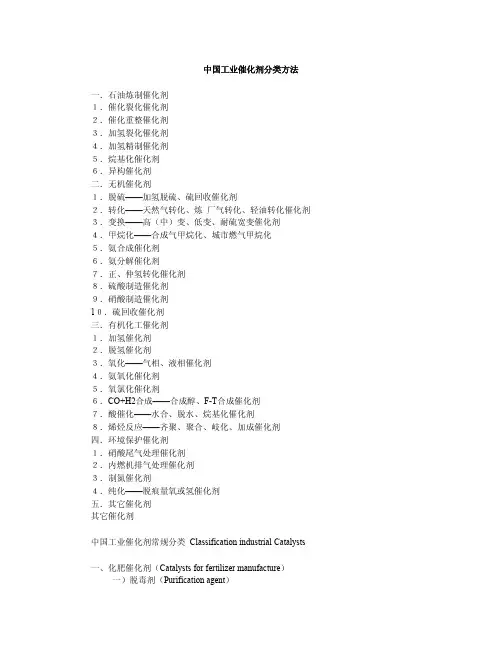
中国工业催化剂分类方法一.石油炼制催化剂1.催化裂化催化剂2.催化重整催化剂3.加氢裂化催化剂4.加氢精制催化剂5.烷基化催化剂6.异构催化剂二.无机催化剂1.脱硫——加氢脱硫、硫回收催化剂2.转化——天然气转化、炼厂气转化、轻油转化催化剂3.变换——高(中)变、低变、耐硫宽变催化剂4.甲烷化——合成气甲烷化、城市燃气甲烷化5.氨合成催化剂6.氨分解催化剂7.正、仲氢转化催化剂8.硫酸制造催化剂9.硝酸制造催化剂10.硫回收催化剂三.有机化工催化剂1.加氢催化剂2.脱氢催化剂3.氧化——气相、液相催化剂4.氨氧化催化剂5.氧氯化催化剂6.CO+H2合成——合成醇、F-T合成催化剂7.酸催化——水合、脱水、烷基化催化剂8.烯烃反应——齐聚、聚合、岐化、加成催化剂四.环境保护催化剂1.硝酸尾气处理催化剂2.内燃机排气处理催化剂3.制氮催化剂4.纯化——脱痕量氧或氢催化剂五.其它催化剂其它催化剂中国工业催化剂常规分类Classification industrial Catalysts一、化肥催化剂(Catalysts for fertilizer manufacture)一)脱毒剂(Purification agent)1.活性炭脱硫剂(Active carbon desulfurizer)2.加氢转化脱硫催化剂(Hydrodesulfurization Catalyst)3.氧化锌脱硫剂(Zinc oxide sulfur absorbent)4.脱氯剂(Dechlorinate agent)5.转化吸收脱硫剂(Converted-absoubed desulfurizer)a.氧化铁脱硫剂(Iron ozide desulfurizer)b.铁锰脱硫剂(Iron-Nanganese oxide desulfurizer)c.羰基硫水解催化剂(Carbonyl Sulfide hydrolysis)6.脱氧剂(Deoxidezer)7.脱砷剂(Hydrodearsenic Catalyst)二)转化催化剂(Reforming Catalyst)1.天然气一段转化催化剂(Nature gas primary reforming catalyst)2.二段转化催化剂(Secondary reforming catalyst)3.炼厂气转化催化剂(Refinery gas steam reforming catalyst)4.轻油转化催化剂(Naphtha steam reforming catalyst)三)变换催化剂(CO shift catalyst)1.中温变换催化剂(High temperature CO shift catalyst)2.低温变换催化剂(Low temperature CO shift catalyst)3.宽温耐硫变换催化剂(Sulfur tolerant shift catalyst)四)甲烷化催化剂(Methanation catalyst)1.甲烷化催化剂(Methanation Catalyst)2.城市煤气甲烷化催化剂(Town gas methanation Catalyst)五)氨合成催化剂(Ammonia synthesis Catayst)1.氨合成催化剂(Ammonia synthesis catalyst)2.低温氨合成催化剂(Low temperatuer ammonia synthesis catalyst)3.氨分解催化剂(Ammonia decomposition catalyst)六)甲醇催化剂(Methanol Catalyst)1.高压甲醇合成催化剂(High pressure methanol synthesis catalyst)2.联醇催化剂(Combined methanol synthesis catalyst)3.低压甲醇合成催化剂(Low pressure methanol synthesis catalyst)4.燃料甲醇合成催化剂(Fuel methanol synthesis catalyst)5.低碳混合醇合成催化剂(mixture of lower alcohols synthesis catalyst)七)制酸催化剂(Acid manufacture catalyst)1.硫酸生产用钒催化剂(Vanudium catalyst for manufacture of sulfuric acid)2.硝酸生产用铂网催化剂(Platinum ganze catalyst for manufacture3.非铂氨氧化催化剂(Non-platinum catalyst for ammonia oxidation)4.铂捕集网(platinum catch gamze)5.硝酸尾气处理催化剂(Treated catalyst for tail gas from nitric acid plant)八)制氮催化剂(Nitrogen manufacture catalyst)1.一段制氮催化剂(Frist stage catalyst for ammonia combined)2.二段制氮催化剂(Second stage catalyst for nitrogen manufacture)九)氧化催化剂(Oxidation catalyst)一氧化碳选择性氧化催化剂(CO selsctive oxidation catalyst)二、炼油催化剂(Refining catalyst)一)重整催化剂(Reforming catalyst)1.铂重整催化剂(Platinum reforming catalyst)2.双金属重整催化剂(dual metal reforming catalyst)3.多金属重整催化剂(Multimetal reforming catalyst)4.芳构化催化剂(Aromatization catalyst)5.烯烃二聚催化剂(Dimerization catalyst)6.异构化催化剂(Isomerization catalyst)二)流化裂化催化剂(Fluid Catalytic Cracking Catalyst,FCC Catalyst)1.天然裂化催化剂(Natural cracking catalyst)2.半合成流化裂化催化剂(Semi-synthetic fluid cracking catalyst)3.合成流化裂化催化剂(Synthetic fluid cracking catalyst)a.分子筛催化剂(Molecular sieve catalyst,Zeolite catalyst)b.硅镁锆催化剂(Zircomia-Magnesia-Silica catalyst)c.硅锆裂化催化剂(Zirconia-Silica-catalyst)4.FCC燃烧助剂(FCC combustion promoter)5.降低SOX催化剂(FCC sulfur oxides reduction catalyst)三)加氢裂化催化剂(Hydrocracking catalyst)1.镉镍催化剂(Tungsten-nickel Sulfide Catalyst)2.温和加氢裂化催化剂(Mild hydrocracking catalyst)四)加氢精制催化剂(Hyrorefining catalyst)1.加氢脱硫催化剂(Hydrodesulfurization catalyst)2.加氢脱氮催化剂(Hydrodenitrogenation catalyst)3.加氢脱金属催化剂(Hydrodemetallization catalyst)五)加氢处理催化剂(Hydrotreating catalyst)1.加氢催化剂(Hydrogenation catalyst)2.加氢饱和催化剂(Hydrostturation catalyst)3.渣油加氢脱硫催化剂(Residue hydrodesulfurization catalyst)六)烷基化催化剂(Alkylating catalyst)1.硫酸催化剂(Sulfuric acid catalyst)2.氢氟酸催化剂(Hydrofluoric acid catalyst)3.固体酸催化剂(Solid acid catalyst)七)其他催化剂1.硫回收催化剂(Sulfur recovery catalyst)2.克劳斯尾气处理催化剂(Claus Unit tail gas treatment catalyst)3.脱硫醇催化剂(Sweetening catalyst)三、石油化工催化剂(Petrochemica catalyst)一)聚合催化剂(Polymerization catalyst)1.齐格勒催化剂(Ziegler catalyst)2.齐格勒-纳塔催化剂(Ziegler-Natta Catalyst)3.过氧化物催化剂(Peroxide polymerization catalyst)4.茂金属催化剂(Metallocene catalyst)二)氧化催化剂(Oxidation catalyst)1.萘氧化制苯酐催化剂(Naphthalene oxidation to phthalic anhydride)2.邻二甲苯氧化制苯酐催化剂(O-xylene oxidation to phthalic anhydride3.苯氧化制顺酐催化剂(Benzene oxidation to maleic anhydride)4.丁烯氧化制顺酐催化剂(Butene oxidation to maleic anhydride)5.丁烷氧化制顺酐催化剂(Butane oxidation to maleic anhydride)6.乙烯氧化制环氧乙烷催化剂(Ethylene oxide catalyst)7.甲醇氧化制甲醛催化剂(Methanol oxidation to formaldehyde catalyst)8.环已烷氧化制已二酸催化剂(Adipic Acid Catalyst)9.丙烯氧化制丙烯酸催化剂(Propene oxidation to Acrylic Acid)10.醋酐制造催化剂(Acetic Anhydride Catalyst)11.丁烯氧化制醋酸乙烯催化剂(Ethylene oxidation to Acetylene)12.氧化脱氢催化剂(Oxydehydrogenation catalyst)13.乙烯氧氯化制氯乙烯催化剂(Ethylene oxchlorination catalyst)14.丙烯氨氧化制丙烯腈催化剂(Propene ammoxidation)三)加氢催化剂(Hydrogenation catalysts)1.苯加氢制环已烷催化剂(Benzene hydrogenation to cyclohexane catalyst)2.苯胺加氢制环已烷催化剂(Aniline hydrogenation to cyclohexylamine catalyst)3.苯酚加氢催化剂(Phenol hydrogenation catalyst)4.苯与四氢萘加氢催化剂(Naphthalene&tetrahydro naphthalene hydrogenation)5.油脂加氢催化剂(Fata and oils hydrogenation catalyst)6.脂肪腈加氢催化剂(Fatty nitriles hydrogenation to fatty amine catalyst)7.还原催化剂(Reduction catalyst)8.芳烃加氢催化剂(Aromatics hydrogenation catalyst)9.选择加氢催化剂(Selective hydrogenation catalyst)10.二烯烃选择加氢催化剂(Dialkenes selective hydrogenation catalyst)四)脱氢催化剂(Dehydrogenation catalysts)1.乙苯脱氢制苯乙烯催化剂(Erhylbenzene dehydrogenation to strene catalyst)2.异丙醇脱氢制丙酮催化剂(Isopropanol dehydrogenation to acetone catalyst)3.甲荃乙荃酮催化剂(Methyl ethyl ketone by hydrogenation catalyst)4.环烷脱氢催化剂(Naphthene dehydrogenation catalyst)5.脱氢环化催化剂(Dehydrocyclization catalyst)6.芳构环化脱氢催化剂(Aromatic cyclodehydrogenation catalyst)五)脱水催化剂(Dehydration catalyst)1.醇脱水制烯烃催化剂(Alcohols dehydration to alkenes catalyst)2.脂肪酸与氨脱水制脂肪腈催化剂(Fatty acid and ammonia dehydrating to fatty nitriles catalyst)六)羰基合成催化剂(Oxo catalyst)七)酯化催化剂(Esterification catalyst)四、环保催化剂(Environment protection catalyst)1.焚烧催化剂(Incineration catalyst for hydrocarbon produces echaust streams)2.电厂排气处理催化剂(Power station exhaust gas treating catalyst)3.硝酸尾气处理催化剂(Tail gas from nitric acid plant treating catalyst)4.汽车尾气催化剂(Automotive catalyst)日本工业催化剂分类一.石油炼制催化剂1.催化裂化催化剂2.催化重整催化剂3.加氢裂化催化剂4.加氢精制催化剂5.脱硫醇催化剂二.重油脱硫催化剂1.直接加氢催化剂2.间接加氢催化剂三.石油化工催化剂1.加氢选择脱催化剂2.氧化、氨氧化催化剂3.卤化、脱卤、烷基化、脱烷基化4.异构催化剂5.甲醇合成催化剂四.高分子聚合催化剂加聚、缩聚、开环聚合、加成聚合催化剂五.气体制造催化剂1.城市煤气制造催化剂2.脱硫、加氢脱硫催化剂3.烃类转化催化剂4.CO变换催化剂5.甲烷化催化剂六.油脂加氢催化剂1.硬化油加氢催化剂2.高级醇加氢催化剂七.医药食品用催化剂八.环保催化剂1.汽车排放气处理2.工业环保催化剂九.无机化学品制造用催化剂1.氨合成催化剂2.制硫酸催化剂3.制硝酸催化剂4.气氛制造催化剂美国工业催化剂分类一.石油炼制催化剂1.流化催化裂化催化剂2.加氢精制催化剂3.加氢裂化催化剂4.重整催化剂5.烷基化催化剂二.化学加工催化剂1.聚合催化剂2.有机合成催化剂3.氧化、氨氧化、氧氯化催化剂4.合成气制造催化剂5.加氢催化剂6.脱氢催化剂三.环境保护催化剂1.汽体排放气处理催化剂2.工业废气污染控制催化剂。

合成氨催化剂的研究进展第一篇:合成氨催化剂的研究进展合成氨催化剂的研究进展摘要:近20多年来,随着英国BP公司钌基催化剂的发明和我国亚铁基熔铁催化剂体系的创立,标志着合成氨催化剂进入了一个新的发展时期,本文主要介绍通过合成法合成的几种催化剂的研究进展。
关键字:合成氨;催化剂;合成法Abstract:Over the past 20 years, with the invention of the British BP ruthenium catalysts and creation of ferrous base molten iron catalyst system in our country, marked the ammonia synthesis catalyst has entered a new period of development, this paper mainly introduces through the several means of catalyst research progress of synthesis method of synthesis.Key Words: Ammonia;The catalyst;synthesis前言合成氨指由氮和氢气在高温高压和催化剂存在下直接合成的氨。
合成氨工业需要较低温度和压力下具有较高活性的催化剂。
90多年来,世界各国从未停止过合成氢催化剂的研究与开发。
目前,工业催化剂的催化效率在高温下已达90%以上,接近平衡氨浓度(因压力而异)。
例如,在15 MPa及475℃下,A301催化剂的催化效率接近100%。
要提高催化剂的活性,就只有降低反应温度.另一方面,工业合成氨的单程转化率只有15%~25%,大部分气体需要循环,从而增加了动力消耗。
为了提高单程转化率,也只有降低反应温度才有可能。
因此,合成氨催化剂研究总的发展趋势,就是开发低温高活性的新型催化剂,降低反应温度,提高氨的平衡转化率和单程转化率或实现低压合成氨。

ORIGINAL PAPERNH 3-Slip Catalysts:Experiments Versus Mechanistic ModellingA.Scheuer ÆM.Votsmeier ÆA.Schuler ÆJ.Gieshoff ÆA.Drochner ÆH.VogelPublished online:18July 2009ÓSpringer Science+Business Media,LLC 2009Abstract The oxidation of ammonia on a Pt/Al 2O 3coated monolith has been studied under automotive NH 3-slip catalyst conditions.Ammonia conversion as well as the selectivities towards the products N 2,N 2O and NO are well described by a mechanistic model that is based on reaction mechanisms originally developed for NH 3oxidation in nitric acid production plants.Keywords Pt ÁKinetic modelling ÁAmmonia oxidation ÁSlip catalyst1IntroductionAutomotive catalysts for selective catalytic reduction (SCR)of NO x by NH 3frequently are equipped with a short zone of an NH 3oxidation catalyst.The purpose of this so called NH 3-slip catalyst is to allow a more aggressive dosing of NH 3without increased NH 3emissions.First generation NH 3-slip catalysts applied a platinum based standard diesel oxidation catalyst formulation.Unfortu-nately,these catalysts show a high selectivity towards N 2O and NO.For this reason in the last years specialized NH 3oxidation catalysts with a higher selectivity towards N 2have been developed.The process of ammonia oxidation on Pt is a well studied subject in literature due to its importance in thenitric acid production.The reaction has been studied by a variety of experimental methods ranging from studies under UHV conditions on single crystal surfaces to kinetic experiments under atmospheric pressure on polycrystalline catalyst samples.Additionally the observations are sup-plemented by quantum chemistry [1–3].Based on these results a number of mechanistic models have been devel-oped [4–7],the most recent one being the mechanism of Kra¨hnert et al.[8].This mechanism forms the basis for our simulation work on NH 3-slip catalysts.The existing mechanisms have been developed for conditions that differ significantly from the conditions in automotive exhaust.The main difference is the NH 3con-centration which is in the ppm range in automotive appli-cations and in the percent range in technical NH 3oxidation.The promise of mechanistic kinetics is to allow inter-polation to reaction conditions not covered during the development of the mechanism.For this reason it is interesting to investigate how well the surface mechanisms originally developed for nitric acid production conditions can be adapted for automotive conditions.It seems that there are no kinetic studies of NH 3oxi-dation under automotive NH 3-slip catalyst conditions in literature.The objective of this paper is to fill this gap.2Methods 2.1ExperimentalA monolithic Pt/Al 2O 3catalyst (aged 16h,750°C)was tested for its ammonia oxidation performance.A special model catalyst with a thin washcoat layer (9.2l m)has been used in order to minimize diffusion limitations in theA.Scheuer ÁA.Schuler ÁA.Drochner ÁH.Vogel Ernst-Berl-Institute,TU-Darmstadt,Petersenstr.20,64287Darmstadt,GermanyM.Votsmeier (&)ÁJ.GieshoffUmicore AG &Co.KG,Rodenbacher Chaussee 4,63457Hanau,Germanye-mail:***************************.comTop Catal (2009)52:1847–1851DOI 10.1007/s11244-009-9351-9washcoat.Transient temperature-programmed experiments were performed in a tubular quartz reactor at high space velocities(300,000h-1)with low ammonia concentrations (100–600ppm),oxygen excess(3–12vol%)and the presence of water(5vol%).Reaction Products were ana-lyzed online with an FTIR-spectrometer.As all expected nitrogen species could be detected,except for N2,the amount of the latter was calculated from the mass balance.The TPR experiments were performed with a heating ramp from150to500°C and a consecutive cooling ramp from500to150°C both with an absolute rate of 2K min-1.2.2The Reaction MechanismThe simulations presented in this work are based on the reaction network of Kra¨hnert et al[8].The reactions are listed in Table1.The mechanism differentiates between two adsorption sites.Based on the DFT calculations for Pt(111)by Offermans et al.[3],ammonia adsorbs at on top sites(b),while[N]ad,[NO]ad and[O]ad adsorb at hollow sites(a).The consecutive activation of adsorbed ammonia by[OH]ad and[O]ad is lumped into a single reaction.The mechanism therefore neglects a detailed handling of [OH]ad and[NH x]ad species.2.3The Simulation ProgramThe reaction mechanism was implemented in a numeric model that solves the mass and heat balances for one single channel of a monolith[9].Heat and mass transfer between the gas and the wall is handled by mass transfer coeffi-cients.In all the simulation results presented in this paper diffusion resistance in the washcoat is neglected.It has been verified in separate calculations that diffusion resis-tance in the washcoat has a negligible effect on the simu-lation results for the extremely thin washcoat layer applied in this study.3Results and Discussion3.1Applicability of the Literature MechanismIn afirst step we want to test how well the literature mechanism[8]extrapolates,without further parameteriza-tion,to automotive exhaust conditions.The only adjustable parameter here is the concentration of active sites or the platinum dispersion.This parameter isfitted to the NH3 conversion in the light-off region(189–209°C)of the experiment shown in Fig.1.After adjustment of this single parameter the simulations describe ammonia consumption and product formation surprisingly well over the entire temperature range of the experiment.An interesting detail is the saturation of ammonia con-version at high temperatures.This effect is qualitatively predicted by the model.A detailed analysis of the simu-lation results reveals that under these conditions the non-activated NH3adsorption(R1)becomes rate limiting.Gas-wall mass transfer allows conversions of up to99%under these reaction conditions.The model significantly underestimates the N2O for-mation in Fig.1.This is not surprising since in the original development of the mechanism it was also found that the N2O formation under reaction conditions with oxygen excess is not well reproduced[8].The adjustment of the platinum dispersion to the data presented in Fig.1results in a value of0.24%.This value is unrealistically small.One potential explanation for the low dispersion is that the original mechanism was devel-oped on a platinum foil.Figure2shows an experiment where300ppm NO have been added to the feed.This experiment has also been simulated using the site density adjusted to the data of Fig.1.In the temperature range between175and250°C a net consumption of NO is observed in the experiments and NO addition to the feed has a significant impact on the consumption of NH3and the formation of N2andTable1The reaction network for ammonia oxidation.The mechanism assumes two different adsorption sites:a, hollow and b,on top sites[8]No.Reaction EquationR1NH3adsorption NH3?b?NH3-bR2NH3desorption NH3-b?NH3?bR3O2adsorprtion O2?2a?2O-aR4O2desorption2O-a?O2?2aR5NH3activation NH3-b?1.5O-a?N-a?1.5H2O?0.5a?b R6NO desorption NO-a?NO?aR7NO adsorption NO?a?NO-aR8N2formation2N-a?N2?2aR9NO formation N-a?O-a?NO-a?aR10N2O formation NO-a?N-a?N2O?2aespecially N2O.The literature mechanism does not predict this effect of NO on NH3consumption and N2O formation.3.2Adaptation of the Literature MechanismThe two main shortcomings of the literature reaction mechanism are that it underestimates the N2O formation and that it does not describe the NO conversion in the simultaneous presence of NH3and NO.The objective is now to adjust the reaction mechanism in a way that covers these effects.The conversion of NO by NH3requires an NO adsorp-tion step.This step is not included in most of the reaction mechanisms[6,7].One exception here is the mechanism of Kra¨hnert et al.and this is one of the reasons why this mechanism has been used in our work.In literature NO adsorption on platinum is generally assumed to be a non-activated process[10–12].In contrast to this previous work Kra¨hnert assumed an activated NO adsorption andfitted a value of63.5kJ mol-1for the activation energy.For our adapted mechanism we assume the NO adsorption to be a non-activated process.All remaining parameters have been simultaneouslyfit to the two data sets of Figs.1and2.The resulting parameter set is listed in Table2.Simulation results for the adapted mechanism are presented in Figs.1and2.The temperature dependence of NH3conversion and product formation can now be reproduced very well.Especially the N2O formation is now quantitatively reproduced for both experiments.Also,the NO conversion in Fig.2is now described by the model,mainly due to the assumption of a non-activated NO adsorption.The mechanism of Rebrov et al.assumes an NO decomposition reaction[5,6].It was attempted whether consideration of this reaction increases the performance of the mechanism.However,no further improvement of thefit could be obtained.3.3Limits of the MechanismFinally,Fig.3shows results for an experiment where the temperature wasfirst ramped up from150°C to550°C and then back to150°C.Clearly,a hysteresis is observed. The hysteresis is a reversible effect since it appears in three consecutive up-and downwards ramps.This hysteresis is not reproduced by the mechanistic model.Note that the ramp rate of2K/min is slow enough and the space velocity of300,000h-1is high enough,so that the hysteresis can not be a thermal phenomenon.CO oxidation is known to exhibit a similar hysteresis which is well reproduced by the currently available surface reaction mechanisms[13].In case of CO oxidation the hysteresis is caused by a switch between two steady states with a CO and an oxygen covered surface.Since the NH3oxidation mechanism uses different sites for NH3and oxygen,the afore mentioned effect can not explain the hysteresis.Rather, the hysteresis can be attributed to the well know mor-phological and chemical restructuring of the catalyst surface at higher temperatures.Such effects are not included in current mechanistic models.4ConclusionsA kinetic study of NH3oxidation under automotive NH3-slip catalyst operating conditions has been performed. Most of experimental results are qualitatively predicted by a surface reaction mechanism originally developed for technical ammonia oxidation conditions.After re-parame-terization the mechanism perfectly reproduces the NH3 conversion and product selectivities.This supports the general assumption that mechanistic kinetics are useful because they should extrapolate to reaction conditions not covered in the original mechanism development.Future research will need to show in how far the results are applicable to a more complex commercial NH3-slip catalyst optimized for high N2selectivity.References1.Baerns M,Imbihl R,Kondtratenko V,Kraehnert R,OffermansW,Van Santen R,Scheibe A(2005)J Catal232:226–2382.Imbihl R,Scheibe A,Zeng YF,Jansen APJ,van Santen RA(2007)Phy Chem Chem Phys9:3522–35403.Offermans WK,Jansen APJ,van Santen RA(2006)Surf Sci600:1714–17374.Pignet T,Schmidt LD(1975)J Catal40:212–2255.Rebrov EV,de Croon MHJM,Schouten JC(2002)Chem Eng J90:61–766.Rebrov EV,de Croon MHJM,Schouten JC(2003)Inst ChemEng81:744–7527.Scheibe A,Hinz M,Imbihl R(2005)Surf Sci576:131–1448.Kra¨hnert R,Baerns M(2008)Chem Eng J137:361–375Table2Comparison of kinetic parameters of this work with litera-ture[6,8]Reaction This work a Kra¨hnert a Rebrov aR1NH3adsorption k0 3.39102 2.09102 1.69104E a000R2NH3desorption k0 1.091010 5.59109 1.991013E a70.960.996.0R3O2adsorption k0 3.191049.09101 3.59102E a000R4O2desorption k08.891069.49108 1.091013E a199.4181.0213.2R5NH3activation k0 1.791016 1.791015 3.091016E a122.999.5141.0R6NO desorption k0 1.6910178.991016 1.591013E a105.3154.8143.0R7NO adsorption k0 2.991048.89106-E a063.5-R8N2formation k08.091019 2.6910178.091012E a164.9139.0124.0R9NO formation k0 5.291014 1.991016 2.191013E a118.5135.4131.0R10N2O formation k0 1.591022 4.091017 2.591010E a145.9155.298.9a Eain[kJ mol-1],k0for R1,R2and R7in[m3s-1mol-1K-1]for the rest in[s-1]9.Hayes RE,Mukadi LS,Votsmeier M,Gieshoff J(2004)TopCatal30,31:411–41510.Bourane A,Dulaurent O,Salasc S,Sarda C,Bouly C,Bianchi D(2001)J Catal Lett204:77–8811.Campbell CT,Ertl G,Segner J(1982)Surf Sci115:308–32212.Kieken L,Neurock M,Mei D(2005)J Phys Chem B109:2234–224413.Salomons S,Hayes RE,Votsmeier M,Drochner A,Vogel H,Malmberg S,Gieshoff J(2007)Appl Catal B70:305–313。