Unit1GreatScientists教案
- 格式:docx
- 大小:26.98 KB
- 文档页数:10
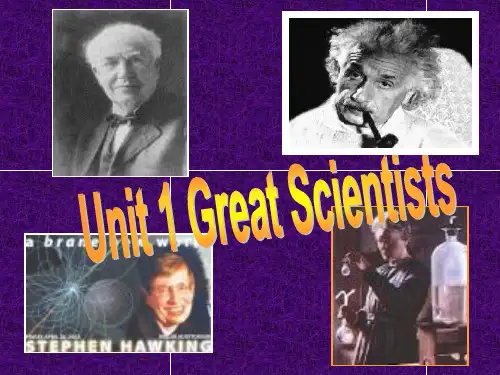
Unit 1 Great Scientists Topic: Great Scientists Functions: Learn to talk about great scientists. Learn to talk about contributions of great scientists. Learn to talk about stages in setting out a new scientific idea. Target language: What do you know about great scientists? Do you know how to prove a new idea in scientific research? What do you know about infectious disease? What do you know about cholera? What kind of scientific job do you want to do? Period 1 Warming up Teaching goals: 1. To talk about some great scientists and their achievements. Promote the Ss to know something. about great scientists. 2. Learn some new words and expressions. 3. To examine a new scientific idea. Teaching procedures: Step 1 Greeting and Lead-in T: I’m very glad to see you all here. After a long holiday, all of you look energetic and happy. I hope that we will work hard together happily all through the year. I do believe that a bright future is waiting for you. We are sure to realize our dreams in the near future. 1. What would you like to be in the future? 2. Do you want to be a scientist in the future? 3. Which scientists do you know? Show two videos about Steven Hawking. Step 2 Quiz Do the quiz, connecting the famous scientist with his contributions. Alexander Bell electricity Thomas Edison the First telephone Wright Brothers the electric Lamp Madame Curie black holes in Universe Franklin Theory of Gravity Steven Hawking the First Plane Elbert Einstein Radium Isaac Newton the Theory of Relativity Step3 What other scientists do you know? Show other great scientists referred to in our textbook. 1) Archimedes (287—212 BC) Ancient Greek. He was a mathematician. He found that if you put an object into water the water pushes the object up. It rises and partly floats. “Give me a place to stand on, and I can move the earth.” ----Archimedes 2) Charles Darwin (1808-1882) British naturalist. The Origin of Species was published in 1859. It explained how plants and animals had changed over time to fit in with a changing environment. His book showed that people had developed from apes. 3) Thomas Newcomen Thomas Newcomen, British (1663--1729) He improved the first steam pump built by Thomas Savery in 1698 and turned it into a steam engine for taking water out of mines in 1712. James Watt improved it still further in the 1770s 4) Gregor Mendel (1822—1884), Czech. The father of genetic. He grew pea plants and developed ideas on heredity (遗传) and inherited characteristics. Between 1856—1863 he grew 28,000 pea plants. He examined seven kinds of seed and plant characteristics and developed some laws of inheritance. 5) Leonardo da Vinci (Italian) (1452-1519) He was a famous Italian artist whose skill for showing human skin tones made his paintings seem to come alive. He used to study dead people in order to make his paintings as accurate as possible. Some of his famous paintings include “The Adoration of the Magi” and the “The Last Supper”. Later in his life he lived in France where he designed a submarine (潜水艇) and a flying machine. 6) Humphry Davy British. He did research into different gases and discovered the medical value of nitrous oxide (laughing gas) as an anaesthetic. (麻醉药) In 1815 he developed a safety lamp for miners. 7) Zhang Heng, Chinese ( 78-----139) He invented the first seismograph to indicate in the direction of an earthquake. It was in the shape of a cylinder with eight dragonheads round the top, each with a ball in its mouth. Around the bottom were eight frogs directly under a dragon’s head. When an earthquake occurred, a ball fell out of the dragon’s mouth, making a noise. Step 4 Summary Draw a conclusion: They all made a great contribution made great achievements succeeded in their scientific career overcome many difficulties Step 5 Discussion1 (Group Competition) Topic 1: What can you learn from these scientists? Topic 2: What qualities should we have to be a successful man? (Give the students several minutes to have a discussion. Then let them have a group competition.) Step 6 Show the picture of Zhong Nanshan (钟南山) to lead in a question. Do you know how to prove a new idea in scientific research? Step6 Discussion2 (Group Competition) Stages in setting out a new scientific idea: Draw a conclusion Think of a method Collect results Make a question Find a problem Analyze the results Find supporting evidence Step 7 Homework