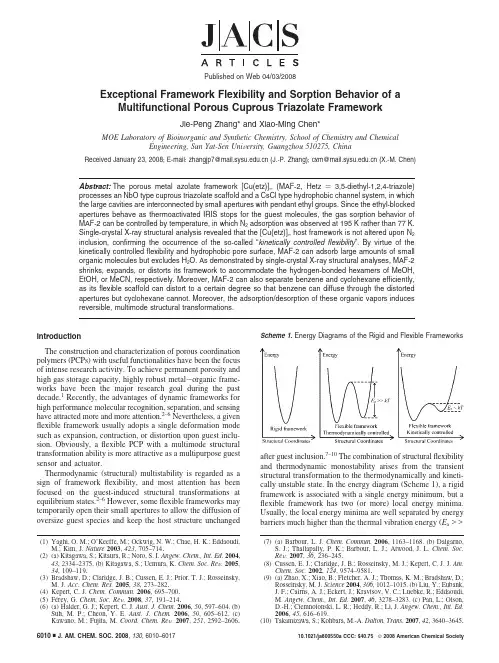
Exceptional Framework Flexibility and Sorption Behavior of aMultifunctional Porous Cuprous Triazolate FrameworkJie-Peng Zhang*and Xiao-Ming Chen*MOE Laboratory of Bioinorganic and Synthetic Chemistry,School of Chemistry and ChemicalEngineering,Sun Yat-Sen Uni V ersity,Guangzhou510275,ChinaReceived January23,2008;E-mail:zhangjp7@(J.-P.Zhang);cxm@(X.-M.Chen)Abstract:The porous metal azolate framework[Cu(etz)]∞(MAF-2,Hetz)3,5-diethyl-1,2,4-triazole)processes an NbO type cuprous triazolate scaffold and a CsCl type hydrophobic channel system,in whichthe large cavities are interconnected by small apertures with pendant ethyl groups.Since the ethyl-blockedapertures behave as thermoactivated IRIS stops for the guest molecules,the gas sorption behavior ofMAF-2can be controlled by temperature,in which N2adsorption was observed at195K rather than77K.Single-crystal X-ray structural analysis revealed that the[Cu(etz)]∞host framework is not altered upon N2inclusion,confirming the occurrence of the so-called“kinetically controlledflexibility”.By virtue of thekinetically controlledflexibility and hydrophobic pore surface,MAF-2can adsorb large amounts of smallorganic molecules but excludes H2O.As demonstrated by single-crystal X-ray structural analyses,MAF-2shrinks,expands,or distorts its framework to accommodate the hydrogen-bonded hexamers of MeOH,EtOH,or MeCN,respectively.Moreover,MAF-2can also separate benzene and cyclohexane efficiently,as itsflexible scaffold can distort to a certain degree so that benzene can diffuse through the distortedapertures but cyclohexane cannot.Moreover,the adsorption/desorption of these organic vapors inducesreversible,multimode structural transformations.IntroductionThe construction and characterization of porous coordinationpolymers(PCPs)with useful functionalities have been the focusof intense research activity.To achieve permanent porosity andhigh gas storage capacity,highly robust metal-organic frame-works have been the major research goal during the pastdecade.1Recently,the advantages of dynamic frameworks forhigh performance molecular recognition,separation,and sensinghave attracted more and more attention.2–6Nevertheless,a givenflexible framework usually adopts a single deformation modesuch as expansion,contraction,or distortion upon guest inclu-sion.Obviously,aflexible PCP with a multimode structuraltransformation ability is more attractive as a multipurpose guest sensor and actuator.Thermodynamic(structural)multistability is regarded as a sign of frameworkflexibility,and most attention has been focused on the guest-induced structural transformations at equilibrium states.2–6However,someflexible frameworks may temporarily open their small apertures to allow the diffusion of oversize guest species and keep the host structure unchanged after guest inclusion.7–10The combination of structuralflexibility and thermodynamic monostability arises from the transient structural transformation to the thermodynamically and kineti-cally unstable state.In the energy diagram(Scheme1),a rigid framework is associated with a single energy minimum,but a flexible framework has two(or more)local energy minima. Usually,the local energy minima are well separated by energy barriers much higher than the thermal vibration energy(E a>>(1)Yaghi,O.M.;O’Keeffe,M.;Ockwig,N.W.;Chae,H.K.;Eddaoudi,M.;Kim,J.Nature2003,423,705–714.(2)(a)Kitagawa,S.;Kitaura,R.;Noro,S.I.Angew.Chem.,Int.Ed.2004,43,2334–2375.(b)Kitagawa,S.;Uemura,K.Chem.Soc.Re V.2005, 34,109–119.(3)Bradshaw,D.;Claridge,J.B.;Cussen,E.J.;Prior,T.J.;Rosseinsky,M.J.Acc.Chem.Res.2005,38,273–282.(4)Kepert,mun.2006,695–700.(5)Férey,G.Chem.Soc.Re V.2008,37,191–214.(7)(a)Barbour,mun.2006,1163–1168.(b)Dalgarno,S.J.;Thallapally,P.K.;Barbour,L.J.;Atwood,J.L.Chem.Soc.Re V.2007,36,236–245.(8)Cussen,E.J.;Claridge,J.B.;Rosseinsky,M.J.;Kepert,C.J.J.Am.Chem.Soc.2002,124,9574–9581.(9)(a)Zhao,X.;Xiao,B.;Fletcher,A.J.;Thomas,K.M.;Bradshaw,D.;Rosseinsky,M.J.Science2004,306,1012–1015.(b)Liu,Y.;Eubank, J.F.;Cairns,A.J.;Eckert,J.;Kravtsov,V.C.;Luebke,R.;Eddaoudi, M.Angew.Chem.,Int.Ed.2007,46,3278–3283.(c)Pan,L.;Olson, Scheme1.Energy Diagrams of the Rigid and FlexibleFrameworks Published on Web04/03/2008kT),so the structuralflexibility is dominated by thermodynamic multistability,and structural interconversion is controlled bythermodynamic factors such as adsorption/desorption of guestmolecules.When energy barriers are comparable to,or smallerthan,the thermal vibration energy(E a≈kT),the higher local energy minima become unstable and quickly relax to the singlethermodynamically and kinetically stable state.Consequently,no thermodynamic multistability is present,and structuralflexibility/interconversion is now dominated by kinetic factorssuch as the diffusion of guest molecules.Therefore,this uniquestructuralflexibility can be denoted as kinetically controlledflexibility(KCF),in contrast with the thermodynamically controlledflexibility(TCF)arisen from the thermodynamic multistability.The low energy barrier nature of this system implies that the frameworkflexibility can be easily tuned by external variables,11pointing to a novel family of porous materials whose porous properties can respond to physical stimuli such as an electricfield and heat.12The KCF of a dynamic framework is suggested by the smallersize of the channel apertures compared with the moleculardimensions of the guests and corroborated by the negligibleframework alteration after guest inclusion.Unfortunately,unambiguous KCF is difficult to be confirmed due to the lackof sufficient structural information of the guest-free and guest-included materials7–10,12or the coexistence of KCF and TCF.13,14KCF can arise from several dynamic mechanisms such asframework distortion,internetwork(intermolecular)displace-ment,and other molecular motions that dispense with theframework distortion or internetwork displacement.Frameworkdistortion and internetwork displacement can produce largestructural and energetic differences,which is a key feature fordynamic behaviors such as diffusion of oversize guests andabnormal sorption isotherms.However,these large differencesimply that the host framework can easily undergo permanentstructural transformation upon sorption,leading to TCF ratherthan KCF.Either permanent or momentary,these mechanismsinduce lattice distortions and stresses that tend to fracture thelarge single crystals,making direct/precise structural charac-terization difficult.6,15,16On the other hand,some molecularmotions,such as the rotation/swing of noncoordinated functionalgroups in PCPs,may dispense with framework distortion orinternetwork displacement,17–19avoiding the above-mentioneddisadvantages.Nevertheless,such dynamic motions usuallygenerate relatively small aperture variations7,12and/or disordered structures.17–19Therefore,rational design and a conclusive demonstration of a KCF dominated dynamic porous framework remain an ongoing challenge.Metal azolate frameworks(MAFs)have attracted much attention in the aspects of crystal engineering in recent years.14,19–21We have designed and synthesized a NbO-type22 cuprous triazolate framework{[Cu(etz)]·guest}∞(Hetz)3,5-diethyl-1,2,4-triazole)with cubic symmetry(MAF-2c·g)by the aid of a solvothermal in situ ligand/metal reaction of cupric salt, propionitrile,and ammonia.19MAF-2c possesses a3D intersect-ing pore system whose large cavities are interconnected via short,small channels.Interestingly,the apertures of these channels are blocked by pendant,disordered ethyl groups with rotation/swingflexibility and may be continuously tuned from closed to open by cooperative motions of the ethyl groups without disrupting the[Cu(tz)]∞(tz)triazolato ring)scaffold, being similar to the IRIS stop used in optical cameras(Figure 1).Nevertheless,besides the symmetry-imposed disorder,10,18 MAF-2c·g loses guest molecules and single crystallinity to form a new material with an unknown structure,19precluding further verification of its KCF.We report herein the direct synthesis,structure,and property of this new material.Guest-free[Cu(etz)]∞was obtained as a trigonal phase(MAF-2)without any symmetry-imposed disor-der.This material demonstrated exceptional frameworkflex-ibility and sorption properties,e.g.,temperature-controllable sorption behavior,superior organic solvent/water and benzene/ cyclohexane selectivity,and multimode structural transformations. Experimental SectionMaterials and Physical mercially available reagents were used as received without further purification.Hetz was synthesized by a reported method.23Elemental analyses(C, H,N)were performed on a Perkin-Elmer240elemental analyzer. Thermal gravimetric analysis was performed under N2using a NETZSCH TG209system.Powder X-ray diffraction patterns were measured at a Rigaku D/M-2200T automated diffractometer.Gas and solvent vapor sorption isotherms were measured on a volumetric adsorption apparatus(Bel-max).Synthesis of[Cu(etz)]∞(MAF-2).A solution of Hetz(4.0mmol) in methanol(100mL)was dropwise added into a solution of [Cu(NH3)2]OH(4.0mmol)in aqueous ammonia/methanol(1/1,100 mL)with stirring at room temperature under N2atmosphere.The mixture was aged at50°C for3h and then evacuated under vacuum until half of the solvent was recovered.The white crystalline powder wasfiltered,washed with methanol,and dried in vacuum to give MAF-2(yield80–100%depending on the solvent recovery ratio). Anal.Calcd(%)for C6H10CuN3:C,38.39;H,5.37;N,22.39. Found:C,38.35;H,5.43;N,rge single crystals of MAF-2(11)(a)Wu,C.-D.;Hu,A.;Zhang,L.;Lin,W.-B.J.Am.Chem.Soc.2005,127,8940–8941.(b)Llewellyn,P.L.;Bourrelly,S.;Serre, C.;Filinchuk,Y.;Férey,G.Angew.Chem.,Int.Ed.2006,45,7751–7754.(c)Maji,T.K.;Matsuda,R.;Kitagawa,S.Nat.Mat.2007,6,142–148.(d)Dincaˇ,M.;Long,J.R.J.Am.Chem.Soc.2007,129,11172–11176.(e)Mulfort,K.L.;Hupp,J.T.J.Am.Chem.Soc.2007,129, 9604–9605.(f)Kawano,M.;Kawamichi,T.;Haneda,T.;Kojima,T.;Fujita,M.J.Am.Chem.Soc.2007,129,15418–15419.(12)(a)Chen,B.-L.;Ma,S.-Q.;Zapata,F.;Fronczek,F.R.;Lobkovsky,E.B.;Zhou,H.-C.Inorg.Chem.2007,46,1233–1236.(b)Ma,S.-Q.;Sun,D.-F.;Wang,X.-S.;Zhou,H.-C.Angew.Chem.,Int.Ed.2007, 46,2458–2462.(13)Atwood,J.L.;Barbour,L.J.;Jerga,A.;Schottel,B.L.Science2002,298,1000–1002.(14)Zhang,J.-P.;Kitagawa,S.J.Am.Chem.Soc.2008,130,907–917.(15)Rather,B.;Zaworotko,mun.2003,830–831.(16)Vittal,J.J.Coord.Chem.Re V.2007,251,1781–1795.(17)Horike,S.;Matsuda,R.;Tanaka,D.;Matsubara,S.;Mizuno,M.;Endo,K.;Kitagawa,S.Angew.Chem.,Int.Ed.2006,45,7226–7230. (18)Eddaoudi,M.;Kim,J.;Rosi,N.;Vodak,D.;Wachter,J.;O’Keeffe,(20)(a)Masciocchi,N.;Galli,S.;Sironi,ments Inorg.Chem.2005,26,1–37.(b)Zhang,J.-P.;Chen,mun.2006,1689–1699.(21)(a)Huang,X.-C.;Lin,Y.-Y.;Zhang,J.-P.;Chen,X.-M.Angew.Chem.,Int.Ed.2006,45,1557–1559.(b)Park,K.S.;Ni,Z.;Côté,A.P.;Choi,J.Y.;Huang,R.;Uribe-Romo,F.J.;Chae,H.K.;O’Keeffe, M.;Yaghi,O.M.Proc.Natl.Acad.Sci.U.S.A.2006,103,10186–10191.(c)Tian,Y.-Q.;Zhao,Y.-M.;Chen,Z.-X.;Zhang,G.-N.;Weng,L.-H.;Zhao,D.-Y.Chem.s Eur.J.2007,13,4146–4154.(d) Hayashi,H.;Côté,A.P.;Furukawa,H.;O’Keeffe,M.;Yaghi,O.M.Nat.Mater.2007,6,501–506.(22)(a)Chen,B.-L.;Ockwig,N.W.;Millward,A.R.;Contreras,D.S.;Yaghi,O.M.Angew.Chem.,Int.Ed.2005,44,4745–4749.(b)Lin, X.;Jia,J.-H.;Zhao,X.-B.;Thomas,K.M.;Blake,A.J.;Walker,G.S.;Champness,N.R.;George,M.W.;Hubberstey,P.;Schröder,M.Multifunctional Porous Cuprous Triazolate Framework A R T I C L E Swere obtained by heating the mixture in a Teflon-lined autoclave at120°C for2days,followed byfiltration and drying in vacuum. X-Ray Crystallography.The solvent-loaded single crystals were prepared by exposing MAF-2in the corresponding solvent vapor for a few days.Diffraction intensities were collected on a Bruker Apex CCD area-detector diffractometer(Mo K R).The structures were solved with direct methods and refined with a full-matrix least-squares technique with the SHELXTL program package.24Dini-trogen molecules were refined as a2-fold disorder with a0.25+ 0.25occupancy and a N-N distance of1.10(1)Å.Anisotropic thermal parameters were applied to all non-hydrogen atoms except the disordered EtOH molecules.The organic hydrogen atoms were generated geometrically.Solvent accessible volumes(void/%)for the[Cu(etz)]∞frameworks were calculated by the SOLV routine of PLATON2003.25Crystal data and refinement parameters for the complexes are summarized in Table1.Results and DiscussionMaterial Synthesis.The cubic phase MAF-2c·g was origi-nally synthesized in low yield(10–15%)by a solvothermal in situ metal/ligand reaction of cupric salt,propionitrile,and ammonia.19Due to the symmetry-imposed disorder of the ethyl groups,it is difficult to make a conclusive structural interpreta-tion of the ethyl conformations around each aperture.Moreover, MAF-2c·g easily loses guest molecules and single-crystallinity,Figure1.(a)NbO type coordination framework(2-fold disordered ethyl groups are shown as dashed bonds in red)and bcu type pore network(large yellow sphere:large pore inside the NbO cage;green column:short channel with double gate)structures of[Cu(etz)]∞.Each gate can tune its aperture size independently by rotation/swing motions of the three pendant ethyl groups without disrupting the[Cu(tz)]∞scaffold.(b-e)Perspective views of four representative channel states derived from the crystal structure of MAF-2c,i.e.,double closed,double open,closed-open,and open-closed,respectively(ethyl groups are colored in red and green to highlight the two different gates).Note that all channels can simultaneously adopt the closed-open/open-closed state,giving rise to a nonpermeable structure in the static point of view.Table1.Crystallographic Data and Refinement Parameters aMAF-2c·g19MAF-2MAF-2·N2MAF-2·MeOH MAF-2·EtOH MAF-2t·MeCN formula C6H12CuN3O C6H10CuN3C6H10CuN4C7H14CuN3O C8H16CuN3O C24H39Cu3N12 FW205.73187.71201.72219.75233.78686.29 space group Im3j R3j R3j R3j R3j P1jT/K123(2)123(2)93(2)123(2)123(2)123(2) a/Å14.9159(7)19.6891(8)19.6052(5)19.429(2)19.810(3)11.949(2) b/Å14.9159(7)19.6891(8)19.6052(5)19.429(2)19.810(3)12.263(4) c/Å14.9159(7)14.1971(7)14.2420(4)14.321(2)14.180(2)13.213(4) R/deg9090909090108.677(2)/deg9090909090108.348(1)γ/deg90120120120120104.458(3) V/Å33318.6(3)4766.3(4)4740.7(2)4681.7(8)4819.2(12)1603.2(7) Z12181818182D c/g cm-3 1.236 1.177 1.272 1.403 1.450 1.422µ/mm-1 1.934 2.007 2.025 2.061 2.007 2.005R1(I>2σ)0.05310.04020.03270.02660.03630.0436 wR2(all data)0.15720.07700.07610.05870.09930.0887 GOF 1.082 1.014 1.015 1.037 1.031 1.010void/%39.733.432.732.235.437.3a R1)ΣF o|-|F c/Σ|F o|,wR2)[Σw(F o2-F c2)2/Σw(F o2)2]1/2.A R T I C L E S Zhang and Chentransforming into a guest-free crystalline phase(MAF-2)with an unknown structure.The preparative difficulty is commonly encountered in the production of coordination polymers.Actually,the simple chemical compositions of binary metal-azolate frameworks imply that these materials can be facilely synthesized by simple acid–base reactions.Simply mixing[Cu(NH3)2]OH and Hetz in aqueous ammonia/methanol produces white crystalline pow-ders.After removal of the solvent,the binary cuprous triazolate can be isolated in quantitative yield.According to the elemental analysis and PXRD patterns,the product displays a composition and diffraction pattern identical to those of the guest-free rge,high-quality single crystals of MAF-2can be obtained by a solvothermal treatment of the reaction mixture. Framework Structure.The cubic MAF-2c possesses a regular (Im3j)NbO-type[Cu(tz)]∞scaffold,which is constructed by interconnection of square-planar nodes({Cu2(tz)2}fragments) with a90°interplanar angle between adjacent{Cu2(tz)2} fragments.The structural information of the3D NbO network can be simply visualized from its cagelike fragments(NbO cages).The large cavities(d)9Å)inside the NbO cages interconnect via eight hexagonal{Cu6(etz)6}rings(chair conformation)to form a3D intersecting pore system(void) 39.7%)with a regular bcu topology(dual net of NbO).26The chairlike,hexagonal{Cu6(etz)6}ring defines a short channel with a double gate.From the static point of view,all channels of MAF-2c appear to be simultaneously closed(d)1.5Å, smaller than any real molecule)by the pendant ethyl groups. Considering the rotation/swingflexibility of ethyl groups,the apertures may be continuously tuned to the open state,which permits the passage of a sphere with d<3.6Åor an irregular particle with the smallest cross-sectional dimensions<4.2Å(such as methane and nonbranched hydrocarbons).The suitable aperture-size variation implies that MAF-2c may potentially show KCF for a variety of guest molecules(Figure1).Nevertheless,symmetry-imposed disorder of the ethyl groups precludes any conclusive interpretation based on the crystal structure of MAF-2c.Single-crystal X-ray diffraction analysis of MAF-2revealed one Cu(I)cation and one etz anion in the crystallographically asymmetric unit and a distorted NbO type[Cu(etz)]∞network, without any symmetry-imposed disorder(R3j).As the local coordination geometries of MAF-2c and MAF-2are very similar,the network distortion should mainly arise from the rotation between adjacent{Cu2(tz)2}moieties,which reduces the interplanar angles from90°to79°.Straightforwardly,the unit-cell parameters of MAF-2(a,19.6891Å;c,14.1971Å; and V,4766.3Å3)are significantly different from the trigonal setting ones of MAF-2c(a,21.0943Å;c,12.9175Å;and V, 4977.8Å3).The transformation from MAF-2c to MAF-2 includes a large expansion in the c-axis(9.9%)and a large contraction in the ab plane(6.7%in axis length,12.9%in area), resulting in an anisotropic contraction(4.2%in volume).The NbO cages and cavities also distort in the same manner.The eight equivalent{Cu6(etz)6}rings of MAF-2c disproportion into two types in MAF-2.Thefirst type consists of two{Cu6(etz)6} rings(running along the c-axis),which are identical to the double-closed channels of MAF-2c.The other six{Cu6(etz)6} rings form the second type of channels,which are distorted in the same manner as the lattice,but are completely blocked by only two ethyl groups(Figure2).Consequently,the unoccupied space inside MAF-2can be safely described as isolated cavities, from the static point of view.On the other hand,the momentary rotation/swing motion of the ethyl groups can allow the passage of small guest molecules(as large as nonbranched hydrocar-bons),without disrupting the[Cu(tz)]∞scaffold.Therefore, MAF-2represents as a suitable candidate for the study of KCF. Framework Stability.According to thermal gravimetric(TG) analysis and X-ray diffraction studies,the guest-free MAF-2 does not change its structure(except small thermal expansion that has negligible impact on the static aperture size)from cryogenic to high temperature until decomposition above∼280°C.Although MAF-2is constructed by three-coordinated(or coordinatively unsaturated)cuprous centers,its chemical stability is remarkable.14The microcrystalline powder sample of the guest-free MAF-2can be handled in air,and its color changes from white to light green after several weeks depending on the humidity,implying the oxidation of Cu(I)in air is promoted by moisture.However,after prolonged exposure,the PXRD pattern of the light-green product still resembles that of MAF-2 (except some peak weakening),implying that the oxidation occurred on the particle surface rather than the pore surface. The hydrophobic,isolated pore system of MAF-2is responsible for these observations,as the water molecules may hardly pass through the hydrophobic,closed channels.Figure2.Perspective views of the distorted NbO type[Cu(tz)]scaffold (a)and the ethyl-blocked channels(b:running along the c-axis,c:running slanted to the c-axis)ofMAF-2.Figure3.N2sorption isotherms of MAF-2.Inset:Characteristic adsorption isobars for rigid porous materials(a)andflexible porous materials with temperature-dependent aperture size(b:for small guest,c:for large guest).Multifunctional Porous Cuprous Triazolate Framework A R T I C L E Sat 77K.On the other hand,MAF-2can readily adsorb supercritical N 2at 195K.The adsorption amount at 1atm (49mL/g)corresponds to 0.41N 2per formula unit or 2.5N 2per NbO cage,indicating the N 2molecules are adsorbed into the cavities of MAF-2rather than the particle surface.Because the static aperture size of MAF-2is too small for any real molecule,the apertures must open during the sorption process.The abnormal temperature-dependent sorption behavior of MAF-2is in contrast with those of rigid porous frameworks.When the temperature increases,the adsorption capacity of a rigid porous material at a given guest pressure decreases monotonously because the saturation pressure of the guest increases and the host–guest interaction decreases.However,flexible frameworks may start to adsorb a given gas until the temperature is high enough to open their apertures to allow the diffusion of the guest molecules.In contrast to the monotonously decreasing isobar of a rigid porous material,there is a characteristic onset adsorption (gate opening)temperature in the isobar of such a flexible material.In the case of MAF-2,the temperature-dependent gate-opening behavior should arise from the ethyl-blocked apertures,which behave as thermoactivated IRIS stops.As the effective aperture sizes of these flexible materials vary with temperature,size-different guest molecules could have different onset adsorption temperatures.Obviously,these flexible materials are of great importance in multipurpose gas separa-tion.12It should be noted that,the temperature-dependent gate-opening behavior could be derived from not only KCF,but also temperature-driven structure variation of the guest-free host framework.Nevertheless,the temperature-driven structure varia-tion of the guest-free MAF-2has been ruled out by single-crystal and powder X-ray diffraction studies.We also determined the structure of the gas-loaded single crystal to confirm that thermodynamic bistability is not involved in the gas sorption process of MAF-2.Direct structural information of the absorbed gas molecules is fundamental to the understanding of adsorption mechanism and rational design of porous frameworks.Due to the extremely weak host–guest interaction,crystal structure determination of the gas-loaded phases remains a great chal-lenge.Although some successes have been achieved for the gas-loaded PCPs with very small pores (strong confinement for the gas),27–29crystal structures concerning gas molecules absorbed in large pores are still very scarce.30In our experiment,a fully degassed single crystal of MAF-2was filled with N 2and flame-sealed in a glass capillary and then the temperature was decreased very slowly to 93K in a cold dinitrogen flow,ensuring as much N 2as possible is adsorbed at high temperature but the diffraction data were collected at low temperature (Table 1).Except some negligible thermal contraction,the host framework of the N 2-loaded MAF-2is identical to that of the guest-free one,precluding the occurrence of thermodynamic bistability during the adsorption process.Therefore,the gas sorption mechanism of MAF-2can be safely assigned to the KCF originated from the momentary rotation/swing motions of the ethyl groups.Interestingly,although the large cavity ofMAF-2is not expected to strongly confine the partially loaded N 2molecules at 93K,the N 2molecules were nicely refined in a 2-fold disordered model.The N 2molecules form close contacts to the triazolato rings,and each N 2is either parallel (N ···N 3.33–3.41Å)or staggered (N ···N 3.52–3.54Å)in relation to the 1,2-nitrogen atoms of etz (Figure 4).The intermolecular contacts between the N 2molecules (shortest N ···N 4.17Å,center ···center 4.79Å)are substantially longer than other known values,30indicating relatively strong adsorbent–adsorbate interactions in MAF-2·N 2.Vapor Sorption.Recovery,removal,and detection of small amounts of organic solvents from water,which rely on the selective binding of organic solvents over water,are of great technical,industrial,and environmental importance.Hydrophilic/hydrophobic affinity and pore size considerations are generally used to engineer porous materials with different binding abilities between water and organic solvents.Because hydrophilic building blocks are commonly used,many inorganic and metal -organic porous materials are known to adsorb water over organic molecules.Moreover,because the molecular size or kinetic diameter of H 2O is smaller than those of organic solvent molecules,size selective porous materials can only adsorb small water molecules over large organic molecules.Nevertheless,for PCPs,hydrophobic pore surfaces can be rationally introduced to adsorb organic molecules over H 2O.Li et al.have reported a hydrophobic PCP,zinc 5-tert -butyl isophthalate,which exhi-bits essentially zero water adsorption (∼1mg/g)up to the humidity P /P 0)0.65but significant MeOH adsorption (110mg/g at P /P 0)0.73).31Nevertheless,due to the large pore size required for the accommodation of organic molecules,capillary condensation of H 2O usually occurs for these hydrophobic porous materials at relatively high humidity and significantly reduces the organic/water selectivity.For example,Kitagawa et al.have demonstrated that a PCP with a hydrophobic pore surface does not show water uptake until P /P 0)0.59,which then abruptly rise to a high value (128mg/g)at higher humidity.32Inspired by the hydrophobic and closed channel structure,we anticipated that MAF-2could selectively separate organic solvents from water.Water,methanol,ethanol,and acetonitrile(27)(a)Matsuda,R.;Kitaura,R.;Kitagawa,S.;Kubota,Y.;Belosludov,R.V.;Kobayashi,T. C.;Sakamoto,H.;Chiba,T.;Takata,M.;Kawazoe,Y.;Mita,Y.Nature 2005,436,238–241.(28)Kubota,Y.;Takata,M.;Kobayashi,T.C.;Kitagawa,S.Coord.Chem.Re V .2007,251,2510–2521.(29)Takamizawa,S.;Nakata,E.-I.;Akatsuka,T.Angew.Chem.,Int.Ed.(31)Pan,L.;Parker,B.;Huang,X.-Y.;Olson,D.L.;Lee,J.Y.;Li,J.Figure 4.Perspective views of the absorbed N 2molecules (2-folddisordered sites are represented in red and green)in space-filling (left,with an NbO cage)and ball-and-stick modes (right).A R T I C L E S Zhang and Chenvapor sorption isotherms for MAF-2were measured at298K. As shown in Figure5,MAF-2exhibits a remarkable water resistance in the whole measured humidity range.The extremely low water uptake of MAF-2(3mg/g at P/P0)0.97)can be attributed to particle surface adsorption on uncoordinated defects,indicating essentially no water molecules can diffuse through the ethyl-blocked channels into the NbO cages.On the other hand,MAF-2can adsorb large amounts of MeOH,EtOH, and MeCN even at low relative pressures.The existence of onset adsorption pressures of these organic solvents near P/P0)0.02 indicates that the adsorption processes are restricted by diffusion barriers and/or weak host–guest interactions below the critical points.Obviously,the diffusion barriers are related to the ethyl-blocked apertures.Nevertheless,these organic solvents can open the ethyl-blocked channels to access the large internal cavities, but water cannot.Therefore,organic solvent/water separation can be performed at very high humidity(i.e.,small amounts of organic solvents vs large amount of water),which is close to the practical requirements.The weaker permeability of water compared to small organic solvents should be ascribed to the hydrophobicity of the ethyl groups,which interact very differ-ently to water and organic molecules.This unique instance demonstrated a viable strategy for designing porous materials with high organic molecule/water selectivity,in whichflexible, hydrophobic apertures are utilized to block the large internal cavities.To elucidate the adsorption mechanism of MeOH,EtOH,and MeCN,we also measured the crystal structures of the solvent-loaded MAF-2.Interestingly,the single crystals of the guest-free MAF-2have a high tendency to crack into smaller pieces in the MeCN vapor,while MeOH and EtOH vapors do not induce a significant change on the single crystal morphology. These phenomena are correlated to the degree of structural transformation upon solvent inclusion.The crystal structures of the MeOH-and EtOH-loaded materials are isostructural to the guest-free MAF-2,and the ethyl-blocked channels remain closed,confirming that KCF is dominant in the sorption processes of MeOH and EtOH.Nevertheless,small framework distortions are evident by comparing their unit-cell parameters. The inclusion of MeOH induces an anisotropic contraction (1.8%in volume),including a1.3%contraction in the a-axis and a0.9%expansion in the c-axis.In contrast,EtOH induces an anisotropic expansion(1.1%in volume),including a0.6%in which the largest distortions(ab plane contraction,c-axis expansion,and volume contraction)are observed for MAF-2·MeOH,while MAF-2·EtOH adopts the smallest distortion. Inside the large NbO cage of MAF-2·MeOH,six MeOH molecules form a chairlike hydrogen-bonded(O···O2.69Å) hexagon with S6symmetry,and the hydrophobic methyl groups are exposed on the outer sphere with weak interactions to the triazolato rings(CH3···N3.66Å)across the ab plane(Figure 6).33The framework contraction in the ab plane indicates that the MeOH hexamer is smaller than the NbO cage.More interestingly,the hydrogen-bonded MeOH hexamer behaves as a single molecule,which is relatively stiff to contract theflexible host framework rather than just expanding itself.The EtOH molecules also form similar hydrogen-bonded hexamers(dis-ordered)in MAF-2·EtOH,but host framework must expand to accommodate the enlarged guest hexamers.The adsorption of MeCN produces a triclinic structure, namely MAF-2t·MeCN,with highly unsymmetrical framework distortions,which can be evaluated by comparing its unit-cell parameters with the primitive unit-cell parameters of the cubic and trigonal phases(see Supporting Information).These distor-tions arise again from the rotations between adjacent{Cu2(tz)2} fragments,as MAF-2t·MeCN still retains the original local coordination geometries and overall coordination topology. Moreover,some of the ethyl groups adopt new conformations, reflecting their rotation/swingflexibilities.MAF-2t possesses four(crystallographic)types of channels,which are all blocked by the ethyl groups.These structural features reveal that the adsorption mechanism involves not only TCF but also KCF. Interestingly,six MeCN molecules located inside the NbO cage of MAF-2t construct a trigonal prism cluster by weak C-H···N interactions(Figure7).The shortest host–guest contacts are C-H···π(C···N3.68Å)and C-H···Cu(C···Cu3.79Å). To our knowledge,this is thefirst structurally characterized, matrix-isolated MeCN hexamer,which would be useful for the study of the structure and properties of acetonitrile.The frameworkflexibility of MAF-2,as revealed from the diverse structural transformations,implies the hexagonal {Cu6(tz)6}windows may undergo drastic distortions and cooperate with the KCF of ethyl groups to allow the passage of molecules which are larger than the above-studied guests, but other molecules exceeding the upper limit of theseflex-ibilities will be excluded.Consequently,this hypothesis naturallyFigure5.H2O,MeOH,EtOH,and MeCN sorption isotherms measured at 298K.P0is the saturation pressure(H2O3.17kPa,MeOH16.94kPa,EtOH 7.87kPa,MeCN11.80kPa).Figure6.Perspective views of the MeOH hexamer in space-filling(left, with a NbO cage)and ball-and-stick modes(right).Multifunctional Porous Cuprous Triazolate Framework A R T I C L E S。