
VI3 IC - 00 Introduction
- 格式:pdf
- 大小:384.71 KB
- 文档页数:9

IP3254
V1.0 1 / 14 Copyright © 2017, Injoinic Corp. 3节/4节串联用电池保护IC 1.简介 IP3254系列内置高精度电压检测电路和延迟电路,是用于3节或4节串联锂离子/聚合物可充电电池保护的IC。通过SEL端子的切换,可用来保护3节或4节串联电池。 2.特性 高精度电压检测保护*1 过充检测电压VCU: 可设置:3.5V ~ 4.1V,(50mV步进);4.1V ~ 4.575V,(25mV步进) 精度:±25mV 过充恢复电压VCL:可设置:3.45V ~ 4.05V,(100mV步进);4.05V ~ 4.4V,(50mV步进) 精度:±50mV 过放检测电压VDL: 可设置:1.8V ~ 2V,(50mV步进);2V ~ 3V,(100mV步进) 精度:±80mV 过放恢复电压VDR: 可设置:2V ~ 3.1V,(100mV步进) 精度:±100mV 三段过电流检测功能 过电流检测电压1:精度±0.01V 可设置:0.03 ~ 0.34V,10mV步进 过电流检测电压2:精度±0.05V 可设置:0.35 ~ 0.7V,50mV步进 过电流检测电压3:1.2V±0.3V 通过外接电容可设置过充电检测延迟时间、过放电检测延迟时间和过流检测延迟时间1(过流检测延迟时间2和流检测延迟时间3内部分别固定为1ms和200µs) 通过SEL端子可以实现3节/4节电池切换 0V充电功能 超低功耗: 工作模式:30µA 关断模式:3.5µA 封装:TSSOP-16 3.应用 锂离子可充电电池组 聚合物可充电电池组 *1 具体不同产品保护监测电压值请参考表2 4.引脚定义 VDDVC1VC2VC3VC4CTLSELNCCOPVMPDOPVINICCTCDTVSSNCTSSOP1612345678161514131211109 图1 IP3254引脚图 IP3254
1
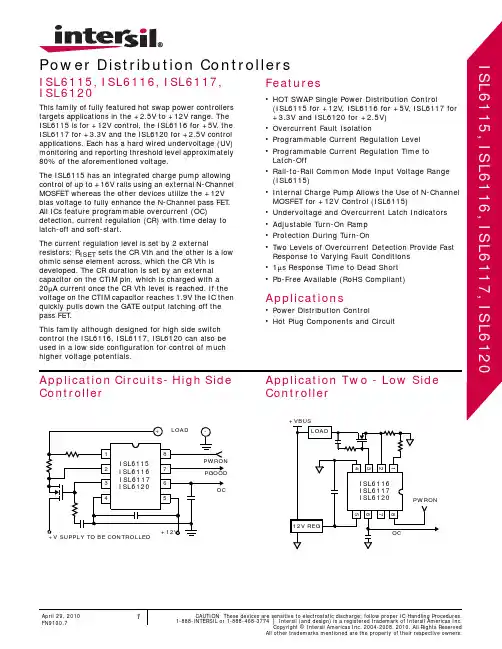
Power Distribution Controllers
ISL6115, ISL6116, ISL6117,
ISL6120
This family of fully featured hot swap power controllers
targets applications in the +2.5V to +12V range. The
ISL6115 is for +12V control, the ISL6116 for +5V, the
ISL6117 for +3.3V and the ISL6120 for +2.5V control
applications. Each has a hard wired undervoltage (UV)
monitoring and reporting threshold level approximately
80% of the aforementioned voltage.
The ISL6115 has an integrated charge pump allowing
control of up to +16V rails using an external N-Channel
MOSFET whereas the other devices utilize the +12V
bias voltage to fully enhance the N-Channel pass FET.
All ICs feature programmable overcurrent (OC)
detection, current regulation (CR) with time delay to
latch-off and soft-start.
The current regulation level is set by 2 external
resistors; R

Page 1 | | NI ELVIS PRODUCT FLYER NI Educational Laboratory Virtual Instrumentation Suite (NI ELVIS) CONTENTS NI ELVIS Detailed View of NI ELVIS III Key Features NI ELVIS III Soft Front Panels NI ELVIS III with Multisim Live™ NI ELVIS III with MathWorks Simulink® NI ELVIS III Application Programming Interface (API) Hardware Services Page 2 | | NI ELVIS NI ELVIS NI ELVIS III, NI ELVIS II+, and NI ELVIS II • Software includes interactive web and desktop soft front panels, instrumentation support for Windows and Mac, API support for LabVIEW and text-based languages, shipping examples, and detailed help files • Seven hardware instruments plus control I/O containing 16 AI, 4 AO, and 40 DIO • 4-channel, 100 MS/s (400 MS/s single channel), 50 MHz oscilloscope with 14-bit resolution • 16-channel, 100 MS/s logic analyzer/pattern generator • 16-channel, 1 MS/s analog input with 16-bit resolution • 40 DIO lines individually programmable as input, output, PWM, or digital protocols Project-Based Learning for the Modern Engineer NI ELVIS is a project-based learning solution that combines instrumentation, embedded design, and web connectivity for engineering fundamentals and system design. It provides a comprehensive teaching solution for engaging students in hands-on labs involving analog circuits, mechatronics, power electronics, instrumentation, digital communications, digital electronics, controls, and more. Each laboratory solution includes lab material and complete experiments developed by experts in industry and education, so students can explore theory in the physical laboratory with a safe, in-depth experience. With its hands-on approach, NI ELVIS helps educators teach students practical, experimental engineering skills. Built on the concept of teamwork, this solution connects students to their experiments, which enables them to collaborate using the same technology in over 35,000 companies worldwide. It combines the precision and accuracy of seven benchtop instruments with the speed and customization of industrial embedded controllers in one single platform. Students can use its easy, prebuilt interfaces to customize at a level not available in any other educational laboratory equipment. Page 3 | | NI ELVIS Table 1. NI offers three NI ELVIS models. Description Legacy NI ELVIS Legacy NI ELVIS with higher oscilloscope performance Latest NI ELVIS with integrated instrumentation and control I/O Oscilloscope 2 ch, 1.25 MS/s, 10 bits 2 ch, 100 MS/s, 8 bits 4 ch, 400 MS/s,1 14 bits Function Generator 1 ch, 5 MHz, 10 bits 1 ch, 5 MHz, 10 bits 2 ch, 100 MS/s, 15 MHz, 14 bits Logic Analyzer/Pattern Generator — — 16 ch, 100 MS/s IV Analyzer — — ±10 V, ±30 mA, 15 MHz Digital Multimeter 5½ digits 5½ digits 4½ digits Variable Power Supply ±12 V, 500 mA ±12 V, 500 mA ±15 V,2 500 mA Processor FPGA — — Xilinx Zynq-7020 AI/AO 16 ch, 16 bits/2 ch, 16 bits 16 ch, 16 bits/2 ch, 16 bits 16 ch, 16 bits/4 ch, 16 bits DIO 24 DIO, 15 PFI 24 DIO, 15 PFI 40 ch SFP Support Windows Windows Windows, Mac, Web Programming Language Support LabVIEW LabVIEW LabVIEW, Python, C, Simulink Enclosure plastic, white plastic, white metal, NI compass silver 1400 MS/s achieved on single channel only through repetitive sampling; 4-channel continuous sample rate is 100 MS/s. 2Variable power supply is rated to source from 1 V to 15 V and from -1 V to -15 V. Detailed View of NI ELVIS III Page 4 | | NI ELVIS Key Features Teach Innovation by Integrating Instrumentation with Embedded Design Projects that inherently challenge students to use innovative design thinking often involve interacting with an unknown process or device. Students are encouraged to understand the unknown through theory, simulation, and experimentation; however, projects that introduce the unknown in messy, multisystem environments tend to challenge the students to be much more innovative. Designing a test in this style requires not only knowledge of the specifications, equipment limitations, and fundamental concepts being applied but also the ability to contend with outside factors and grasp how one change can have a cascading effect on the experimental setup. Figure 1. NI ELVIS III To most effectively analyze concepts this way, students need the ability to not only instrument and analyze the experiment but also precisely control and manipulate the type and behavior of the inputs to the system. NI ELVIS III is the only engineering laboratory solution that combines seven traditional instruments with fully customizable I/O to enable the complete implementation of the concepts in this approach. Page 5 | | NI ELVIS Engage Students with a Modern, Web-Driven Experience NI ELVIS meets students where they are with a web interface that drives collaboration, reduces time to measurement, and integrates with teaching and learning resources to fully equip students in their educational careers. The seven instruments on NI ELVIS III are all accessed through a minimal installation for both Windows and Mac. This gives all students access to the instruments on their own computers instantly via USB, Ethernet, or Wi-Fi. The Bode Analyzer and the IV Analyzer are immediately accessible using a web soft front panel. This means that students can access the instruments on any device, computer, tablet, or cell phone without installing them. Only these two instruments are accessible via the web; however, every instrument will have an associated web soft front panel by the end of 2019. Figure 2. NI ELVIS Experiment and Simulation Comparison With NI ELVIS III, educators can find resources to teach and develop labs all in one place. Using the labs created for NI ELVIS, students gain access to the lab instructions, simulations, and instrument launcher all in the same window. Then, when students complete the labs, the answers are compiled and sent in as a lab report. Moving lab resources to the web with NI ELVIS III saves time and reduces the number of programs students need to use.
MFG 常用英文单字
Semiconductor半导体
导体、绝缘体和半导体主要依据导电系数的大小,决定了电子的移动速度。
导体:金、银、铜、铁、人、水……导电系数大,传导绝缘体:塑料、木头、皮革、纸……导电系数小、传导不半导体:硅中加锗、砷、镓、磷……平时不导电加特定电压后导电
Wafer 芯片或晶圆:原意为法国的松饼,饼干上有格子状的饰纹,与FAB内生产的芯片图形类
Lot 批;一批芯片中最多可以有25片,最少可以只有一片。
ID Identification的缩写。用以辨识各个独立的个体,就像公司内每一个人有自己的识别证。
Wafer ID 每一片芯片有自己的芯片刻号,叫Wafer ID。
Lot ID 每一批芯片有自己的批号,叫Lot ID。
Part ID 各个独立的批号可以共享一个型号,叫Part ID。
WIP Work In Process,在制品。从芯片投入到芯片产品,FAB内各站积存了相当数量的芯片,统称为FAB内的WIP 。
一整个制程又可细分为数百个Stage和Step,每一个Stage所堆积的芯片,称为Stage WIP。
Lot Priority 每一批产品在加工的过程中在WIP中被选择进机台的优先级。
Super Hot Run的优先级为1,视为等级最高,必要时,当Lo上一站加工时,本站便要空着机台等待Super Hot RuHot Run的优先级为2,紧急程度比Super Hot Run次一级。
Normal的优先级为3,视为正常的等级,按正常的派货原则视常班向生产指令而
Cycle time 生产周期,FAB Cycle Time 定义为:从芯片投入到芯片产生的这一段时间。Stage Cycle Time:Lot从进站等候开始到当站加工后出货时间点截