
Topic Two Medical Science
- 格式:ppt
- 大小:178.50 KB
- 文档页数:14

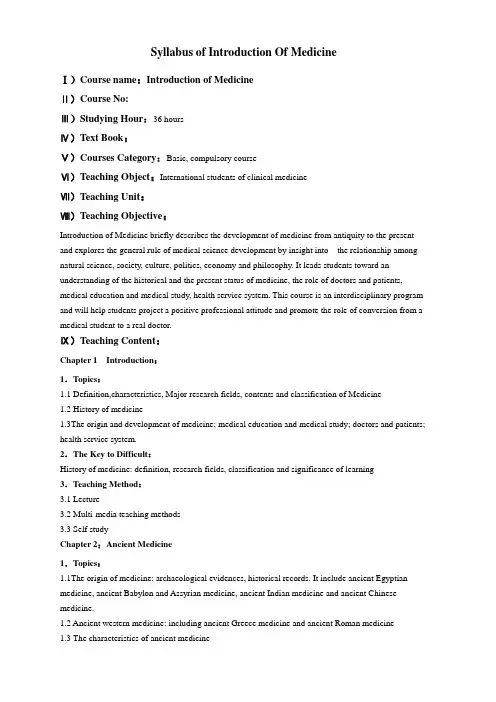
Syllabus of Introduction Of MedicineⅠ)Course name:Introduction of MedicineⅡ)Course No:Ⅲ)Studying Hour:36 hoursⅣ)Text Book:Ⅴ)Courses Category:Basic, compulsory courseⅥ)Teaching Object:International students of clinical medicineⅦ)Teaching Unit:Ⅷ)Teaching Objective:Introduction of Medicine briefly describes the development of medicine from antiquity to the present and explores the general rule of medical science development by insight into the relationship among natural science, society, culture, politics, economy and philosophy. It leads students toward an understanding of the historical and the present status of medicine, the role of doctors and patients, medical education and medical study, health service system. This course is an interdisciplinary program and will help students project a positive professional attitude and promote the role of conversion from a medical student to a real doctor.Ⅸ)Teaching Content:Chapter 1 Introduction:1.Topics:1.1 Definition,characteristics, Major research fields, contents and classification of Medicine1.2 History of medicine1.3The origin and development of medicine; medical education and medical study; doctors and patients; health service system.2.The Key to Difficult:History of medicine: definition, research fields, classification and significance of learning 3.Teaching Method:3.1 Lecture3.2 Multi-media teaching methods3.3 Self studyChapter 2:Ancient Medicine1.Topics:1.1The origin of medicine: archaeological evidences, historical records. It include ancient Egyptian medicine, ancient Babylon and Assyrian medicine, ancient Indian medicine and ancient Chinese medicine.1.2 Ancient western medicine: including ancient Greece medicine and ancient Roman medicine1.3 The characteristics of ancient medicine1.4 Development of Medicine in renaissance1.5 The characteristics of Medicine in renaissance2.The Key to Difficult:2.1 To master the characteristics of ancient medicine2.2 Social and cultural background of Medicine in renaissance2.3 Characteristics of medical development in middle ages and the Renaissance3.Teaching Method:3.1 Lecture3.2 Multi-media teaching methods3.3 Self studyChapter 3:17 th, 18 th and 19 th Century Medicine1.Topics:1.1 The 17 th century medicine(1) The natural science background of medical development and the representative figures: Bruno, G.; Dilderp, V.; Galileo Galilei; Kepler; et al.(2) The main medical achievement in 17 th century: William Harvey's discovery of blood circulation; the invention and application of microscopes; three views of medical theory (iatrophysics; iatrochemistry; vitalism); clinical medicine(3) Other characteristics of 17 th century medicine: the establishment of Institute of Medicine (IOM); the publication of medical journals; the beginning of medical international communication; the introduction of medicinal plants to Europe1.2 The 18 th century medicine(1) The social background of medical development: the fast development of scientific techniques; the formation of the view of mechanical materialism.(2) The main medical achievement in 18 th century. The progress of physiology: Galvsnism; the discoveries of Haller A. V on, Bell, C., Stephen H., et al. The establishment pathological anatomy: the idea of Morgagni G. B. about the sites and causes of disease .(3) The bed side teaching: Boerharve H.(4) The invention of percussion: Auenbrugger L.(5) The independence of obstetrics: the invention and application of obstetric forceps.(6) The application of statistics(7) The improvement of the public health condition(8) The vaccination invention: Edward Jenner1.3 The 19 th century medicine(1) The first half of 19 th century①The social background: the advances of natural science and philosophy.②The main medical achievements: cytology and cellular pathology (Schleiden MJ., Schwann Th. and Virchow, R); comparative anatomy and embryology (Cuvier G., Baer K., et al); pharmacology (the extraction of effective ingredient and production of chemical synthesized medicine); theestablishment of experimental pharmacology; physiology and experimental physiology; diagnostics (the invention of auscultation apparatus and mediate percussion)③The backward clinical medicine(2) The second half of 19 th century①The social background: the gradual rise of Japanese medicine and United States Medicine②The main medical achievements: bacteriology (the important contribution of Louis Pakoff’s re vealing phagocytosis, Widal’s reaction); the invention and application of anesthetization and sterilization; preventive medicine (sanitary survey, the foundation of reseasteur and Robert Koch to medicine and significance); immunology (Behri ng and Kitasato’s discovery of diphtheria antitoxin, Metchnirch institutes of public health); the emergence of forensic medicine ad nursing, the liberalization of psychotic patients, the foundation of International Red Cross (IRC).1.4 The characteristics and development patterns of the 17 ~19 century medicine.2.The Key to Difficult:2.1 To master the characteristics of 17 th, 18 th and 19 th century medicine2.2 Social and cultural background of Medicine in 17 th, 18 th and 19 th century3.Teaching Method:3.1 Lecture3.2 Multi-media teaching methods3.3 Self studyChapter 4:Chinese Medicine (Remote antiquity – A. D. 265)1.Topics:1.1 The origin of medicine (from remote antiquity to 21 st century B.C.)(1) The archaeological discoveries and historical legends relating to the origin of medicine.(2) The medical experience and knowledge of primitive men(3) The different viewpoints about the origin of medicine1.2 Early experience of medicine and the academic direction of Chinese medicine (The Xia Dynasty ~ the Spring and Autumn Period, 22 century B.C. ~ 476 B.C.)(1) The social background and culture, ideology(2) All aspects of medical knowledge①The historical records relating to the understanding of disease, such as the exploration of the causes of disease, the observation of epidemic diseases, the diagnosis of the disease, treatment of disease, etc.②The historical records on knowledge of the drugs, such as the drug records in The Book of Songs and the Book of Mountains and Seas③The invention of liquor and decoction and their historical significance④Health care and medical system at that time(3) The sprouting of Chinese traditional medical theories: The philosophical thoughts at that time and its influence to the formation of Traditional Chinese Medical Theories.1.3 The formation of Chinese academic system (The Warring States ~ the Three Kingdoms, 475 B.C. ~ A.D.265)(1) The social background and its influence to medicine(2) The contents and the value of the ancient medical books from Han dynasty tombs(3) The main contents and significance of four medical classics in ancient China:Huangdi’s Internal Classi cs, Difficult Classic, Typhoid and Miscellaneous Diseases, Shen Nong’s Materia Medica(4) The academic system of Chinese medicine, the characteristics and significance of differential treatment.2.The Key to Difficult:2.1 To master the formation of Chinese academic system2.2 The main contents and significance of four medical classics in ancient China3.Teaching Method:3.1 Lecture3.2 Multi-media teaching methods3.3 Self studyChapter 5:Chinese Medicine (Western Jin dynasty-YUAN dynasty, YEAR 265-1368) 1.Topics:1. 1 The all-round development of Chinese medicine (the Western Jin Dynasty ~ the Five Dynasties Year 265~960)(1) The social background and culture, ideology(2) The achievements made in respect of the medical books and Notes(3) Achievement in the Pulse and Syndrome of disease sources(4) The development of prescription books(5) The pharmacological development from Collective Notes to the Canon of Materia medica to New Materia Medica and its subsequent success(6) The achievement of the clinical subjects(7) The medical education level(8) The exchange between Chinese medicine and foreign medicine1.2 Medical experience and theoretical distillation (the Song Dynasty ~ the Yuan Dynasty, Year960~1386)(1) The social backgrounds in science, technology and ideology(2) The progress in the medicine administration(3) The achievements on medical books and prescription books(4) The new trends on pharmacological development and its achievements(5) The new progress of the medical subjects(6) Various medical thoughts and doctrines and their significance(7) The exchange between Chinese medicine and foreign medicine2.The Key to Difficult:2.1 Master the clinical experience is the mainstream of Chinese medicine in this period.2.2 Be familiar with the development of the various specialties and achievements.2.3 Understand the famous doctors in this period and their medical books.2.4 Understand the historical background in the Song Dynasty and Yuan Dynasty and the new theories set up by the doctors of the Song Dynasty and Yuan Dynasty.2.5 Understand the significance of the doctors’ academic thinking and innovation in theory.2.6 Understand the achievements in Chinese medicine administration, ancient books,prescription books, pharmacy and clinical medicine.3.Teaching Method:3.1 Lecture3.2 Multi-media teaching methods3.3 Self studyChapter 6:Chinese Medicine (MING AND QING dynasty-OPIUM War, YEAR 1368 -1840) 1.Topics:1.1 The social backgrounds in science, technology and ideology1.2 The achievements in the maturity and the heyday of Chinese medicine: the medical literature, medical journals and academic groups, clinical departments, pharmacology, medical systems, preventive health and so on1.3 The new progress and innovation in the field of medicine, epidemiology and anatomical physiology1.4 The impact of back-to-ancients thoughts on the development of Chinese medicine and issues of classical medical notes prosperity1.5 The exchange between Chinese medicine and foreign medicine2.The Key to Difficult:2.1 Master the new exploration and the innovative progress in medicine, infectious diseases and anatomical physiology.2.2 Understand that Chinese medicine reaches a peak and make a considerable progress in this period. 2.3 Understand the increasing improvement of the traditional academic system of Chinese medicine.3.Teaching Method:3.1 Lecture3.2 Multi-media teaching methods3.3 Self studyChapter 7:The intersection and conflict between Chinese and Western Medicine E(YEAR 1840-1949)1.Topics:1.1 The social backgrounds in science, technology and ideology1.2 The development of Chinese medicine: medical writings and pharmacotraditional Chinese medical formulae, etc.1.3 The spread and development of Western medicine in China1.4 The combination between Chinese and Western medicine its significance2.The Key to Difficult:2.1 Master the research on the relationship of Chinese and western medicine, the achievements and limitations of narrators of Chinese and western medicine and Understand the relationship of Chinese and Western medicine which has become a new issue in the history of modern Chinese medicine.2.2 Be familiar with the influence of the Western medicine importation and spread on Chinese medicine.2.3 Understand the development condition of Chinese medicine in the recent 100 years.3.Teaching Method:3.1 Lecture3.2 Multi-media teaching methods3.3 Self studyChapter 8:Development of Moden Chinese Medicine (YEAR 1949-Nowadays)1.Topics:1. 1The new policy for Chinese medicine1. 2 The prosperity and development of Chinese medicine in P.R. China1.3 The main achievement of contemporary Chinese medicine in the field of the prevention and cure of diseases, preclinical medicine, preventative medicine, medicine, combination between Chinese and western medicine, etc.1.4 The impact of Chinese medicine abroad and its international prospects1.5 The development trends of Chinese medicine in the future2.The Key to Difficult:2.1 Under the new economic, political and cultural conditions, the new achievements and development of Chinese medicine2.2 Be familiar with the policy environment which Chinese medicine possesses in this period.2.3 Understand the significance of combining Chinese and western medicine, the impact and prospects of Chinese medicine abroad.3.Teaching Method:3.1 Lecture3.2 Multi-media teaching methods3.3 Self studyChapter 9:Modern Medicine1.Topics:1.1 The social and cultural background: science and technology development.(1) Specialization of medical science, pharmaceutical sciences, diagnostics and therapeutics, etc(2) The internationalization of medical development(3) Modernization of medical techniques(4) Intersection of the various medical subjects creates new borderline subjects(5) The network of modern medicine(6) Human genome project (HGP) and the post-genome era(7) Proteome Project(8) The cancer genome project1.2 The branches of the modern medicine and their main research contents(1) Basic medicine: Biology; Anatomy; Physiology; Pathophysiology; Biochemistry; Microbiology; Parasitology; Immunology; Histology and Embryology; Pathology; Diagnostics; Medical psychology; Forensic Medicine; Neurology; Psychiatry; Pharmacology; Epidemiology; Protective medicine; Traditional Chinese Medicine, etc.(2) Clinical disciplines: Internal medicine; Surgery; Obstetrics & Gynaecology; Paediatrics; Clinical ecsomatics; Medical imageology; Integrated Traditional and Western Medicine, etc.1.3 The advance and development trend in various subjects of modern medicine: Molecule Biology; Immunology; Genetics; Transplantation; Gene Therapy; Geratology; New emerging Infection Diseases.1.4 The evolution of the medical models(1) Definition of medical model(2) The characteristics and transitions of medical models: Spirtualism medical model; Nature philosophical medical model;Mechanistic medical model; biomedical model; Bio-psycho-social medical model.(3) The characteristics of modern medicine and the disadvantages of biomedical model(4) The significance of the transition in medical models1.5 The characteristics of modern medicine development1.6 The enlightenment from the development of modern medicine.2.The Key to Difficult:2. 1 Master the modern medical polyclinic and their research contents.2.2 Be familiar with the main achievements and development tendency of the various subjects of modern medicine.2.3 Understand the contemporary background of science and technology.2.4 Master the concept and evolution of medical model.2.5 Be familiar with the bio-psycho-social medical model and its significance.2.6 Understand the development characteristics of modern medicine and the enlightenment.3.Teaching Method:3.1 Lecture3.2 Multi-media teaching methods3.3 Self studyChapter 10:Medical Eduction and Medical Study1.Topics:1.1 International medical education standards (“Standards” as the short form thereinafter) and their general requirements.(1) History background of constituting the Standards(2) Purpose of constituting the Standards(3) Concept of the Standards(4) Basic contents of two Standards in the world (international standards in medical education by the World Federation for Medical Education [WFME] and Global Minimum Essential Requirementsby the Institute for International Medical Education [IIME])1.2 Reform and development of medical education(1) The structures of medical education system, the categories of medical education process, its missions and characteristics.(2) Challenges confronted by medical education, the reform contents of medical education and teaching.(3) Medical education system and education reform in China.1.3 The characteristics of medical study(1) The characteristics of study in college and the influencing factors(2) The characteristics of medical study(3) The principles of medical study1.4 The strategies and methods of medical study: the memory methods of medical knowledge, the training methods of medical thinking, the study methods of medical courses, the study methodsin the medical internship, the training methods in research ability, and training methods of complex makings.2.The Key to Difficult:2.1 Master the methods and characteristics of medical study.2.2 Understand the international standards in medical education.2.3 Understand the characteristics of medical education, contents of education reform and confronted challenges.2.4 Understand the factors influencing study and the characteristics of study in college.3.Teaching Method:3.1 Lecture3.2 Multi-media teaching methods3.3 Self studyChapter 11:Doctors and Patients1.Topics:1.1 The role (character) of doctor(1) T he features of doctor’s role(2) The rights and obligations of a doctor, the duties of doctor(3) Occupational quality of doctors1.2 Role of patients: the need and expectation of patients, the rights and obligations of patients1.3 Medical interpersonal relationship and communication(1) Concept of communication, general skills of communication(2) How to communicate with patients better for doctors(3) Concept, model and influence factors of doctor-patient relationship, how to establish harmonious doctor-patient relationship, correctly dealing with interpersonal relationship in medical practice1.4 Problems related with law in clinical practice.(1) Concept of hygiene law and regulation, legal liability (obligation) in hygiene laws(2) Concept and grade of medical malpractice (Medical Accidents), identity and procedure of expert evaluation (technology identification) on medical malpractice(3) Several conditions that don’t belong to medical malpractice2.The Key to Difficult:2.1 Master the rights and obligations of doctor and patient in law.2.2 Master the concept, model and influence factors of doctor-patient relationship.3.Teaching Method:3.1 Lecture3.2 Multi-media teaching methods3.3 Self studyChapter 12:Health Services System1.Topics:1.1 The health services system: the definition, ingredients and functions.1.2 The health service system.(1) The hospital and the medical care system①The basic functions, the staff and classified methods of hospital②The developing process of hospital③The factors influencing the hospital development, including medical science, medical technology, nursing, medical education, medical insurance, the function of government, the ownership of hospitals, etc(2) The typical models of the international health system and the process of their reform1.3 The status of medical care in China.(1) The policies of health service①The forming and development of the policies after the establishment of P. R. China②The forming and significance of the policies in the new stage(2) The health resource, including the health organization, the hospital beds, the personnel, health financing, etc.(3) The main achievement of health service after the establishment of P. R. China(4) The health reform: the background, principles and tasks2.The Key to Difficult:2.1 Master the definition and ingredients of the health service system.2.2 Understand the models and development of the health system in some countries, such as England, American and China.2.3 Understand the policies of health service and the status of health reform in China.3.Teaching Method:3.1 Lecture3.2 Multi-media teaching methods3.3 Self studyⅩ)Practice:DiscussionⅪ)References:1. Bulletin of the History of Medicine2. Journal of History of Medicine and Allied Sciences3. Current Work in the History of Medicine4. Roy Porter, The Greatest Benefit to Mankind: A Medical History to Humanity, New York/London: W. W. Norton, 1997Ⅻ)Assessment Methods:1. Examination patterns:At the end of the course the student will be evaluated in the theory level, the ability of self-directed learning, presentation (or essay) and class attendance.2. Marks distribution: Theory Final Exam: 60% of total mark Regular marks: including Presentation: 25% and Independence learning: 10% Attendance: 5%。

关于疾病和意外的英语作文Disease and accidents are two of the most common and unfortunate occurrences that can drastically impact an individual's life. Whether it is a sudden illness or an unexpected accident, the consequences can be severe and long-lasting. Inthis essay, we will explore the historical background, different perspectives, case studies, critical evaluation, and future implications related to the impact of disease and accidents on individuals and society.Historically, the understanding and treatment of diseases and accidents have evolved significantly over time. In ancient times, diseases were often attributed to supernatural causes, and treatments were based on superstitions and rituals. Similarly, accidents were often seen as acts of fate or bad luck, with little understanding of preventive measures. However, with the advancement of medical science and technology, our understanding of diseases and accidents has improved, leading to better prevention, diagnosis, and treatment. The development of vaccines, antibiotics, and medical equipment has revolutionized the way we approach diseases, while safety regulations and awareness campaigns have helped reduce the incidence of accidents.From a societal perspective, there are different opinions and perspectives on how to address the impact of diseases and accidents. Some people believe that individuals should take personal responsibility for their health and safety, while others argue that it is the government's duty to provide adequate healthcare and safety measures. Additionally, there are cultural and religious beliefs that influence how diseases and accidents are perceived and dealt with in different societies. For example, some cultures may stigmatize certain diseases, leading to discrimination and social isolation for affected individuals.To illustrate the impact of diseases and accidents, let us consider a case study of a young woman who was diagnosed with a rare autoimmune disorder. This diagnosis not only affected her physical health but also took a toll on her mental and emotional well-being. She struggled with the stigma associated with hercondition and faced challenges in accessing appropriate medical care. Similarly, an example of the impact of accidents could be a construction worker who suffered a serious injury due to a workplace accident. This not only affected his ability to work and provide for his family but also caused emotional distress andfinancial hardship.In evaluating the impact of diseases and accidents, it is important to consider both the benefits and drawbacks of our current approach. On the one hand, medical advancements have led to better treatment outcomes and improved quality of life for many individuals. Similarly, safety regulations and awareness campaigns have helped reduce the incidence of accidents in various settings. On the other hand, there are still challenges in terms of access to healthcare and disparities in treatment outcomes. Additionally, accidents continue to occur due to negligence and lack of proper safety measures in certain industries.Looking towards the future, it is crucial to address the implications of diseases and accidents on individuals and society. This includes the need for continued investment in medical research and healthcare infrastructure to ensure access to quality care for all. Furthermore, there is a need for ongoing education and awareness about safety measures to prevent accidents in various settings. By addressing these issues, we can work towards a future where the impact of diseases and accidents is minimized, and individuals can lead healthy and safe lives.In conclusion, the impact of diseases and accidents on individuals and society is significant and multifaceted. By understanding the historical background, different perspectives, case studies, critical evaluation, and future implications related to this topic, we can work towards addressing the challenges and improving the outcomes for those affected. Through continued efforts in medical research, healthcare infrastructure, and safety measures, we can strive towards a future where the impact of diseases and accidents is minimized, and individuals can lead healthy and safe lives.。

克氏外科学英文版1. Introduction to Koch’s Surgical ScienceKoch’s Surgical Science is a comprehensive medical discipline that encompasses a wide range of surgical procedures, techniques, and principles developed by the renowned German surgeon, Dr. Robert Koch. This branch of medicine focuses on the diagnosis, treatment, and prevention of diseases and injuries through surgical interventions.2. Historical BackgroundDr. Robert Koch, born in Germany in 1843, made significant contributions to the field of surgery during the late 19th century. He was known for his innovative approaches to surgical procedures and his meticulous attention to detail. Koch’s Surgical Science emerged as a result of his groundbreaking work in various surgical specialties.3. Key Principles in Koch’s Surgical Science3.1 Precision and TechniqueKoch emphasized the importance of precision and technique in surgical interventions. He believed that meticulous attention to detail during surgery was crucial for successful outcomes. This principle includes proper patient positioning, accurate incision placement, careful tissue handling, and precise suturing techniques.3.2 Aseptic TechniqueKoch revolutionized the concept of aseptic technique in surgery by introducing sterilization methods for instruments, dressings, and operating theaters. He recognized the role of microorganisms in post-operative infections and developed protocols to minimize their presence during surgeries.3.3 Minimally Invasive SurgeryKoch advocated for minimally invasive surgical approaches whenever possible. He believed that smaller incisions reduced trauma to tissues, minimized scarring, accelerated recovery times, and improved patient outcomes overall.3.4 Evidence-based PracticeKoch emphasized the importance of evidence-based practice in surgical decision-making. He conducted extensive research on various surgical procedures and techniques before implementing them into clinical practice.4. Specialties within Koch’s Surgical Science4.1 General SurgeryGeneral surgery forms the foundation of Koch’s Surgical Science. It encompasses a broad range of surgical procedures involving the abdomen, gastrointestinal tract, endocrine system, and other vital organs. Some common general surgical procedures include appendectomy, hernia repair, cholecystectomy, and bowel resection.4.2 Orthopedic SurgeryOrthopedic surgery focuses on the diagnosis and treatment of musculoskeletal disorders. Koch’s principles apply to various orthopedic procedures such as joint replacements, fracture fixation, spinal surgeries, and sports medicine interventions.4.3 Cardiothoracic SurgeryCardiothoracic surgery involves surgical procedures related to the heart and lungs. Koch’s Surgical Science contributes to techniques like coronary artery bypass grafting (CABG), valve replacements, lung resections, and heart transplantations.4.4 NeurosurgeryNeurosurgery deals with disorders affecting the central nervous system. Within Koch’s Surgical Science framework, neurosurgeons performintricate procedures like brain tumor removals, spinal surgeries for disc herniation or stenosis, and treatment of neurological trauma.5. Advancements in Koch’s Surgical ScienceOver time, Koch’s Surgical Science has witnessed significant advancements due to technological innovations and medical research. These advancements include:•Introduction of laparoscopic surgery•Development of robotic-assisted surgery•Integration of imaging technologies in surgical planning •Enhanced understanding of anesthesia techniques•Application of regenerative medicine in surgical interventions6. ConclusionKoch’s Surgical Science is a comprehensive discipline that encompasses various surgical specialties guided by principles such as precision, aseptic technique, minimally invasive approaches, and evidence-based practice. This field continues to evolve with advancements in technology and research efforts aimed at improving patient outcomes and revolutionizing the practice of surgery worldwide.Note: The content provided is a sample outline based on thegiven task name. You can expand on each section and add moredetails to meet the required word count of 2000 words.。

药物试验英语作文高中Drug trials are a crucial part of the pharmaceutical industry, ensuring the safety and efficacy of new medications beforethey reach the market. Here's an essay on the topic:The Importance of Drug Trials in Pharmaceutical DevelopmentIn the quest for medical advancements, drug trials play a pivotal role in the development of new pharmaceuticals. These rigorous scientific procedures are designed to test the safety, efficacy, and optimal dosage of new drugs before they are approved for public use.Phases of Drug TrialsDrug trials are typically conducted in several phases. Thefirst phase involves a small group of healthy volunteers to evaluate the drug's safety and determine a safe dosage range. The second phase expands the trial to a larger group of patients to assess the drug's effectiveness and furthermonitor its safety. The third phase involves an even larger group of participants to confirm the drug's effectiveness, monitor side effects, compare it to commonly used treatments, and collect information that will allow it to be used safely.Ethical ConsiderationsEthical considerations are paramount in drug trials. Informed consent is a fundamental principle, ensuring thatparticipants are fully aware of the potential risks and benefits before agreeing to take part in the trial. Additionally, trials must be conducted under the supervision of an independent review board to ensure that the rights and well-being of the participants are protected.Challenges and InnovationsDrug trials face numerous challenges, including the high cost of research, the lengthy time required to bring a drug to market, and the risk of unforeseen side effects. However, with advancements in technology and the advent of personalized medicine, trials are becoming more targeted and efficient. For instance, genetic testing can help identify patients who are more likely to benefit from a particular drug, reducing the number of participants needed for a trial.The Role of Regulatory BodiesRegulatory bodies such as the Food and Drug Administration (FDA) in the United States play a critical role in overseeing drug trials. They set standards for the design and conduct of trials, review the data collected, and make decisions about whether a drug should be approved for use.ConclusionDrug trials are an essential component of modern healthcare.They not only ensure that new drugs are safe and effective but also contribute to the ongoing improvement of medical treatments. As we continue to push the boundaries of medical science, the importance of rigorous drug trials will only grow.This essay provides an overview of drug trials, their phases, ethical considerations, challenges, and the role of regulatory bodies in ensuring the safety and efficacy of new medications.。