
五年级英语上册课件_Unit_2_
- 格式:ppt
- 大小:4.10 MB
- 文档页数:64

五年级上册英语书第二课
Unit 2 of the English textbook for Grade 5 is all about
sports. In this lesson, students have the opportunity to
explore and learn about various sports activities. The
chapter covers popular sports such as football, basketball,
volleyball, and tennis, all while enhancing their English
language skills.
The unit begins with an introduction to different sports.
Students are engaged through colorful images and engaging
discussions. They learn new vocabulary related to sports,
such as "athlete," "score," and "team." The teacher
facilitates conversations about favorite sports and
encourages them to express their opinions.
After the introductory lesson, students delve deeper into
each sport. They explore the rules, playing techniques,
equipment, and famous athletes associated with each one. For example, they learn about football, its global popularity,
精品文档 用心整理
资料来源于网络 仅供免费交流使用 第三课时
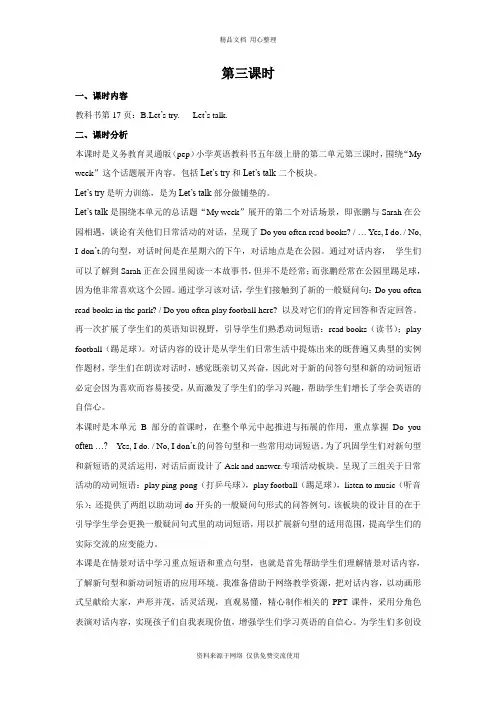
一、课时内容
教科书第17页:B.Let’s try. Let’s talk.
二、课时分析
本课时是义务教育灵通版(pep)小学英语教科书五年级上册的第二单元第三课时,围绕“My
week”这个话题展开内容。包括Let’s try和Let’s talk二个板块。
Let’s try是听力训练,是为Let’s talk部分做铺垫的。
Let’s talk是围绕本单元的总话题“My week”展开的第二个对话场景,即张鹏与Sarah在公园相遇,谈论有关他们日常活动的对话,呈现了Do you often read books? / … Yes, I do. / No,
I don’t.的句型,对话时间是在星期六的下午,对话地点是在公园。通过对话内容, 学生们可以了解到Sarah正在公园里阅读一本故事书,但并不是经常;而张鹏经常在公园里踢足球,因为他非常喜欢这个公园。通过学习该对话,学生们接触到了新的一般疑问句:Do you often
read books in the park? / Do you often play football here? 以及对它们的肯定回答和否定回答。再一次扩展了学生们的英语知识视野,引导学生们熟悉动词短语:read books(读书);play
football(踢足球)。对话内容的设计是从学生们日常生活中提炼出来的既普遍又典型的实例作题材,学生们在朗读对话时,感觉既亲切又兴奋,因此对于新的问答句型和新的动词短语必定会因为喜欢而容易接受,从而激发了学生们的学习兴趣,帮助学生们增长了学会英语的自信心。
本课时是本单元B部分的首课时,在整个单元中起推进与拓展的作用,重点掌握Do you
often …? Yes, I do. / No, I don’t.的问答句型和一些常用动词短语。为了巩固学生们对新句型和新短语的灵活运用,对话后面设计了Ask and answer.专项活动板块。呈现了三组关于日常活动的动词短语:play ping-pong(打乒乓球),play football(踢足球),listen to music(听音乐);还提供了两组以助动词do开头的一般疑问句形式的问答例句。该板块的设计目的在于引导学生学会更换一般疑问句式里的动词短语,用以扩展新句型的适用范围,提高学生们的实际交流的应变能力。
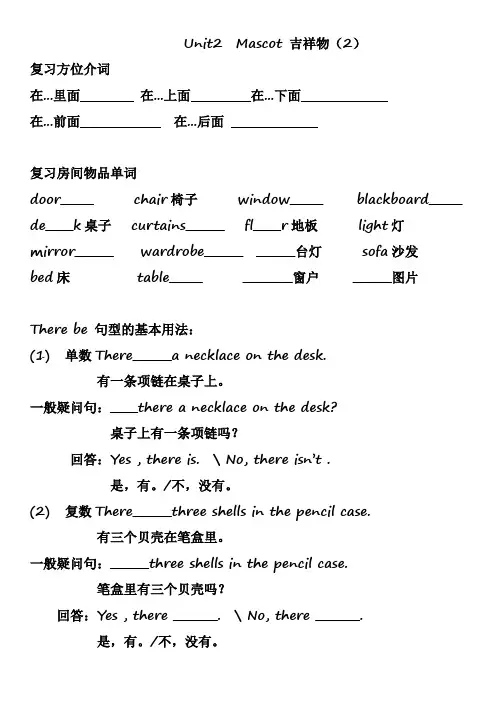
Unit2 Mascot 吉祥物(2)
复习方位介词
在...里面 在...上面 在...下面
在...前面 在...后面
复习房间物品单词
door______ chair椅子 window______ blackboard______
de_____k桌子 curtains_______ fl_____r地板 light灯
mirror_______ wardrobe_______ _______台灯 sofa沙发
bed床 table______ _________窗户 _______图片
There be 句型的基本用法:
(1) 单数There_______a necklace on the desk.
有一条项链在桌子上。
一般疑问句:_____there a necklace on the desk?
桌子上有一条项链吗?
回答:Yes , there is. \ No, there isn’t .
是,有。/不,没有。
(2) 复数There_______three shells in the pencil case.
有三个贝壳在笔盒里。
一般疑问句:_______three shells in the pencil case.
笔盒里有三个贝壳吗?
回答:Yes , there ________. \ No, there ________.
是,有。/不,没有。 ※变问句时将be动词提前。
There be有特点,主语放在be后面,单数主语用is ,复数主语要用are。
变否定很简单,be后要把not添。变疑问也不难,把be提到there前。

Unit2 My week
一.重点单词(.星期一到星期天首字母要大写,星期的第一天是星期天)。
Monday(Mon.) 星期一 Tuesday(Tue.) 星期二
Wednesday(Wed.) 星期三 Thursday(Thu.) 星期四
Friday(Fri.) 星期五 Saturday(Sat.) 星期六
Sunday (Sun.) 星期日 week一周
weekend周末 weekday工作日 day天
注意:(合成词)day:Monday;Tuesday;Wednesday;
Thursday;Friday;Saturday;Sunday
2. 科目:语文Chinese 数学maths 英语English
烹饪课cooking class 科学science 音乐music
美术art 计算机课computer class 足球课football class
体育课 PE class
3. 短语:do homework 做作业 watch TV 看电视
read books读书 wash my clothes 洗我的衣服
play football踢足球 play ping-pong打乒乓球
play basketball打篮球 play sports做运动
play the pipa 弹琵琶 draw pictures 画画
clean the room 打扫房间 do housework 做家务
listen to music 听音乐 on 在…..时候
on the weekend 在周末 (at) on weekends在周末
二.语音:
字母组合“ee, ea”在单词中的的发音:[ i: ]