
2011全国大学生数学建模B题附件1
- 格式:pdf
- 大小:110.51 KB
- 文档页数:3
全国2011年数学建模题目
A 题 疾病的诊断
现要你给出疾病诊断的一种方法。
胃癌患者容易被误诊为萎缩性胃炎患者或非胃病者。
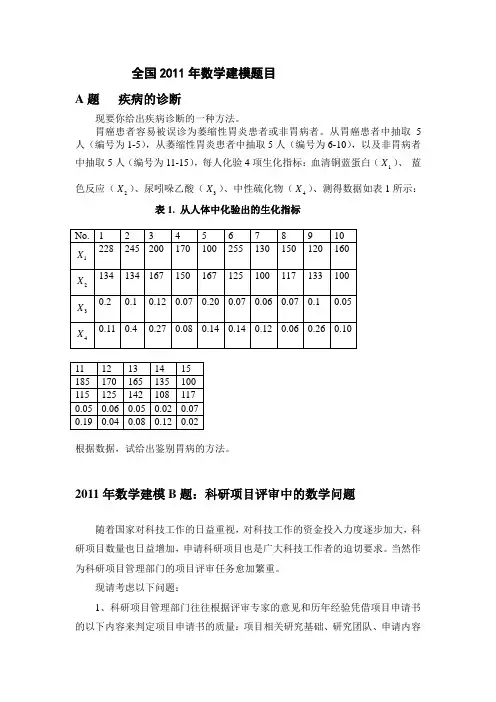
从胃癌患者中抽取5人(编号为1-5),从萎缩性胃炎患者中抽取5人(编号为6-10),以及非胃病者 中抽取5人(编号为11-15),每人化验4项生化指标:血清铜蓝蛋白(1X )、 蓝色反应(2X )、尿吲哚乙酸(3X )、中性硫化物(4X )、测得数据如表1所示:
表1. 从人体中化验出的生化指标
根据数据,试给出鉴别胃病的方法。
2011年数学建模B 题:科研项目评审中的数学问题
随着国家对科技工作的日益重视,对科技工作的资金投入力度逐步加大,科研项目数量也日益增加,申请科研项目也是广大科技工作者的迫切要求。
当然作为科研项目管理部门的项目评审任务愈加繁重。
现请考虑以下问题:
1、科研项目管理部门往往根据评审专家的意见和历年经验凭借项目申请书的以下内容来判定项目申请书的质量:项目相关研究基础、研究团队、申请内容
的创新性、申请内容的研究难度、研究思路与方法或技术方案的可行性、年度任务计划安排、申请资金预算合理性等等指标。
请你用数学建模的方法,利用上述指标(不限于上述指标,只要是合理指标)建立申请项目质量的评价标准。
2、现在科研项目管理部门一般采取专家评审办法,实现公平、公正一直是孜孜以求的目标,如何安排项目的评审也是科研管理重点关注的。
请你帮助解决以下项目安排:
a、100个项目,20个专家,要求每个项目要有3个专家评审,请给出合理的安排方案,并给出你认为合理的定义或说明;
b、10000个项目,要求每个项目要有3个专家评审,每个专家评审项目不超过20项,在a 的合理性要求下,请估计需要的专家数量。
Minimizing the Number of repeatersIntroductionVery high frequency (VHF) is the radio spectrum,whose frequency band ranges from 30MHz to 300MHz. VHF is always used for radio stations and television broadcasts. In addition, it is also used by signal transmission of sea navigation and aviation. Because the radio spectrum of VHF is transmitted through straight lines, a signal is easily influenced by geographical factors easily. Thus, signals become weak when it is transmitted and some low-power users need repeaters to amplify them and increase the transmission distance. We consider the situation in which every two repeaters are too close or the separate frequency is not far enough apart which can interference with each other. In order to mitigate the interference caused by the nearby repeaters, this paper employs a continuous tone-coded squelch system (CTCSS). We associate to each repeater a separate subaudible tone,that is, the subaudible tone (67Hz-250.3Hz) is added to VHF. In this way, repeaters recognize signals attached to the same subaudible tones just like secret keys. In this system, the nearby repeaters can share the same frequency pair. When users send the signals at one frequency, different repeaters with subaudible tones can recognize signals from the users the same subaudible tone. If the users in a certain area contact with each other, we should consider the signal’ s coverage area of the users and the repeaters. As long as the users’ signals are accepted by repeaters, the signals could be amplified to transmit farther. At the same time, the repeaters attached with the subaudible tones could only recognize the users with the same subaudible tones. Hence, we can consider repeaters corresponding to the number of the users, which leads to the problem of frequency channel. When the number of users in this area increases, we can add repeaters. If two repeaters have different subaudible tones, they would not communicate with each other. Thus, we should consider the problem of how the repeaters communicate with each other when they have different subaudible tones. In the mobile communication system,the spectrum is influenced by many factors such as reflex,diffraction and dispersion. Therefore, when the radio spectrum transmits in the mountainous area,we should still consider the factors above.Repeaters[4]Repeaters are a type of equipment which can amplify signals,make up the deamplification signals and support far distance communication.CTCSS[5]CTCSS(Continuous Tone Controlled Squelch System ) is short for subaudible tones, whose frequency ranges from 67Hz to 250.3Hz. It is added to the radio spectrum to make the signal carry with a unique secret key.AssumptionThe users in the area is uniform distributedThe signal of the radio spectrum in the area can’t be effected by environmentIn a certain period of time there are a small number of users removingAll repeaters have the same standardAnalysis and solution of the model to the first problemThe problem is to find a least number of repeaters in an area of radius 40 miles so that the users in this area can communicate with each other. Considering that the given area is flat, we assume that the signal ofeach repeater covers a circular area and the repeater lies in the center of the circle. The following Figure 1 shows the relationship of three adjacent repeaters.CFor case B of Figure 1, if three circles are tangent to each other, then we find that the center area cannot be covered by the singles. In order to make the signal cover the triangle area, we have to consider adding a For case C, if the intersection of three circles is not null, similar to case B, we also have to add another repeater. Thus, it is easy to find that case A, comparing with cases B and C, is optimal. Thus, we obtain the largest covering area When linked hexagons, as shown in Figure 2. Obviously, it looks like a honeycomb structure. In fact, the honeycomb pattern is one of the most efficient arrangement for radio spectrum. It transmits by the wireless medium of microwave, satellites and radiation. The structure has a feature of point-to-point transmission or multicast. It is widely used in UN Urban Network, Campus Network and Enterprise Network.Figure 2. some circles intersecting together form the closely linked hexagons Now we have a circle with radius of 40 miles. Then we analyze the distances of signals from users and repeaters covering in the circle. Because the differences for the users and repeaters in energy and height, they have different covering distances. We calculate the distances with the theory of space loss. The formula[6]is1288.120lg 20lg 40lg LM F h h d =+-+,LM the wireless lossF the communication working frequency(MHz)1h the height of the repeater (m)2h the height of the user(m)d the distance between the user and repeater(km) We assume that 150F MHZ =,1 1.5h m = and 230h m =, under the condition of the cable loss and antenna gain, we obtain the system gain()(1,21,2)i j SG Pt PA RA CL RR i j =+-++==.The system gain is the allowed decay maximum of the signal from the users to repeaters. If the system gain value is higher than the wireless loss, the users could communicate with each other. Reversely, the users could not communicate. We make the system gain value equals to the wireless loss, thus, we get the extremity distance between the user and repeater. Then we haveSG LM =We choose a typical repeater and the user facility. Thus, the parameters [6] and data of the repeaters are as followsThe transmitting power 120(43)Pt W dBm =The receiving sensitivity 1116RR dBm =-The antenna gain of the repeaters 9.8RA dB =The cable loss 2CL dB =The parameters of the interphoneThe transmitting power 24(36)Pt W dBm =The receiving sensitivity 2116RR dBm =-The antenna gain of the interphone 0PA dB =The system gain of the system from users to repeaters 1144.2SG dB =. Thus, we get the sending distance from the users to repeaters 113.8d km =. Prove in the same way, we have the system gain of the system from the repeaters to users 2151.2SG dB =, the sending distance from the repeaters to the users 220.7d km =According to the sending distance 113.8D km = between user and repeater as well as the property of regular hexagon, we calculate the distance between two repeaters. We obtain that 223.09D km =, which is described in Figure 3. Because 2D is shorter than 2'D , users in this area cannot communicate with each other. Thus, we consider the sending distance 2'D between two repeaters firstly. Then we calculate the distance between the user and the repeater again shown in Figure 4. Finally, we get that 1'12.4D km =.Figure 3. the calculation distance according to the sending distance from users to repeaters.Figure 4. the calculation distance according to the sending distance from repeaters to the users.According to the calculated distance 12'12.4'21.45D km D km ==, we know that the given circle has a radius of 40 miles. We firstly consider the signals ’ covered area of the repeaters. Thus, we get the distribution of the repeater stations in this area showed in Figure 5. The number of repeater stations is 37. However, we need to decide the amount of repeaters distributing in one station.channel (the signaling channel between two points to transmit and receive signals) to transmit signals. Hence, we need 27 frequency channels [2] to maintain the normal communication.In order to avoid the interference about the close frequency between two repeaters, we arrange each repeater 10 frequency channels. We have121145.0145.03145.06145.09145.6145.63145.66145.69146.2146.23146.26146.29146.8146.83146.86146.89147.4147.43147.46147.49Mhz Mhz MHz MHz Mhz Mhz MHz MHz pl r Mhz Mhz MHz MHz Mhz Mhz MHz MHz Mhz Mhz MHz MHz r ⎧⎧⎪⎪⎪⎪⎪⎪⎨⎨⎪⎪⎪⎪⎩⎩()233145.12145.15145.72145.75()()146.32146.35146.92146.95147.52147.55MHz MHzMHz MHz pl r pl MHz MHz MHz MHz MHz MHz ⎧⎪⎪⎪⎨⎪⎪⎪⎪⎪⎩ Here, n is the number of repeaters.In this method of distribution ,we ensure that the signal could still be recognized after transmission. We associate to each repeater a subaudible tone and the users need to use the same tone to receive the corresponding signal. We suppose each repeater station have the same repeaters attached with different subaudible tones. In this way, we guarantee the signals transmitting in this zone without interference. Because when one user sends a signal with a specific frequency, the repeater could send the signal after adding or subtracting 600 KHz. However, our frequency channels cover the whole scope of the frequency. Thus, the signal can be transmitted in this zone.Finally, we calculate the number of the repeaters in a repeater station and obtain the number is 3. Thus, the total number of the repeaters is 3*37111=.When the number of users in this zone increases to 10000, we consider the problem as the first model. In this situation, each repeater station should cover 10000/37270.3= users. Hence, we need 270 frequency channels to maintain the normal communication. Since the number of the channels is too large, it is wasteful to use 10 frequency channels for the first problem. Thus, we consider assigning each repeater station 30 channels. Furthermore, we get 9 repeaters. However, for the frequency rand ranging from145MHz to 148MHz, the channel changes to 11.1KHz, which leads to the channels interfering with each other. Hence, we make use of the CTCSS system to distribute the 9 repeaters different PL tones. We can build the repeaters which can transmit the same frequency and have different tones.11145145.03145.06145.09145.012145.015145.6145.63145.66145.69145.72145.75()146.2146.23146.26146.29146.32146.35146.8146.83146.86146.89146.92146.95147.4147.43147.46147.49147.52147.55r mhz pl ⎧⎪⎪⎪⎨⎪⎪⎪⎩1'1'145145.03145.06145.09145.012145.015145.6145.63145.66145.69145.72145.75()146.2146.23146.26146.29146.32146.35146.8146.83146.86146.89146.92146.95147.4147.43147.46147.49147.52147.55r mhz pl ⎧⎪⎪⎪⎨⎪⎪⎪⎩Thus, we calculate the number of the repeaters in a repeater station is 270/309=. Then the total number of the repeaters is 9*37333=.The model of the line-of-sight propagation considering the effect ofthe mountainsWe search some information on how to build the repeaters at the top of the mountains. According to the factors influencing the positions of the repeaters, we establish a model to simulate these impact factors of transmission of VHF radio spectrum.When repeaters are installed at the tops of the mountainous, the positions of the repeaters are related to the height of the antenna, its coverage radius, the repeater power and antenna gain. Thus, it is difficult to build the communication network. In order to build communication network well, we should do lots of experiments to ensure the positions of the repeaters according to actual geomorphic environment.Since mountains have different heights, we mainly consider three cases. Case 1 is that the heights of the mountains are 15m below, case 2 requires that the heights ranges from 15 to 30m and the last one is 30m above.The Egli modelThis model considers the height of the mountains below 15m. We assume that the mountains in this zone have no larger peaks, that is, this zone is a medium rolling terrain.This model is based on the data of the mobile communication, which is established by Federal Communications Commission (FCC). It is an empirical equation which is summarized from the data of the irregular terrain. This model based on the barrier height is applied to the VHF radio spectrum and the irregular terrain. It demands the barrier height above 15m. When the barrier height is under 15m ,we modify the model to verify the modified factor T C . The loss of the spectrum [1] equation is218820lg 40lg 20lg 20lg T LM F d h h C =++---.Here, we assume that d is the distance between the two antennas (m), h ∆is the height of thetopography. If we use b h to denote the practical height of the sending signal antenna, o h to denote the least effective height of the antenna and m h the practical height of the receiving signal antenna, then theeffective height of the sending signal antenna 1h satisfies1()2b o h h h m +=, and the effective height of the receiving signal antenna 2h satisfies2()2m o h h h m +=, 100-10-20-301020305070100200300500t h e m o d i f y i n g f a c t o r s K /d B /h mFigure 6[1]. the range of the modifying factor. We obtain the relationship between the height of the topography and the modifying factor from the empirical data. Furthermore, we get the equation with respect to h ∆and T C .C 1.6670.1094h25150T MHz F MHz =-∆<< C 2.250.1476h150162T MHz F MHz =-∆<< C 3.750.2461h 450470T MHz F MHz =-∆<<This model for irregular area is fit for the frequency ranging from 40 to 450MHz. When the frequency is higher than 25MHz or lower than 400MHz and the distance between two antennas is less than 64km, the error would be very small. Through the model we can evaluate the value of the wireless loss and the number of the repeaters.Figure 7 describes the positions of the mobile station, repeater and the barrier. Next, we introduce the concept of the clearance.Figure 7.The schematic of the clearanceT the position of the mobile stationR the position of the repeater1d the distance between the mobile station and the barrier2d the distance between the repeaters and the barrierAssume that the line HD is perpendicular to line RT, which is called clearance showed in Figure 7. Because the distance between the two antennas is very far, thus, the HD is short. Then we can substitute the hd for HC . If the radius of the first Fresnel region (the region is used to evaluate the transmission energy of the video spectrum.) is 1F , we regard 1/HC F as the relative clearance.The equation [2] of the radius of the first Fresnel region is12112d d F d d λ=+where λ is a parameter.When the radio spectrum transmits ,there are always many barriers such as constructions, trees and peaks blocking the spectrum. If the height of the barrier has not reached the first Fresnel zone ,the barrier would have little influence to the receiving frequency level. However, when it is in the zone, it will cause the added losses (the power losses of the sending power relative to the receiving power) to decrease the receiving electrical level. The diffraction losses /dB T h e d i f f r a c t i o n l o s s e s /d BFigure 7. The relationship between diffraction losses and clearance [1].The relationship between the added losses and the clearance caused by the barriers is showed in Figure 7. When the height of the barrier is under the line RT and the relative clearance is larger than 0.5,the added losses changes around 0db. In this situation,the practical receiving electrical level approaches the value of the space loss. We can get the value of the clearance HC is less than0.557F or a negative value. It may1hinder the transmission of direct wave. Thus, we should make the barriers lie below the line RT. Strengths●In the first model, we distribute each repeater 5 frequency channels, meanwhile the different repeatershave different PL tones. Thus, under the condition of avoiding the interference of repeaters with each other, we control the number of frequency channels least to make the transmission more efficient.●The model is established when the users are uniformly distributed. When the number of users increases,the number of repeaters increases. Thus, this model applies the zone where the users are unevenlydistributed.●The Egli model is a model considering the modifying factors, which make the mountains areas problembe easily understood.Weaknesses●In the signal’s coverage area of the repeaters, we assume that each channel only has one user. However,in the practical situation, there may not be one user. That is to say, we have wasted the channel.●Our model belongs to fixed channels distribution strategies, the larger number of the users, the largernumber of the channels. It leads to channel interference with each other when channel bandwidth is less than 8.3MHz. Thus, our model only suits for less number of users.●Considering the mountains environment is complex, in our model, we only consider one mountaineffecting the transmission of radio spectrum.References[1] Yao Dongping, Huang Qing and Zhao Hongli, Digital Microwave Communication, Beijing: Beijing Jiaotong University Press, 2004.7.[2] Theodore S. Rappaport, Wireless Communications: Principles and Practice, Second Edition, Prentice Hall PTR,2006.7[3] DeWitt H.Scott, Michael Krigline, Successful Writing for the Real World, Foreign Language Teaching and Research Press, 2009.2[4] /wiki/Repeater, 2011.2.12[5] /wiki/CTCSS, 2011.2.12[6] /view/2074265.htm,2012.2.14。

灰色模型对水资源短缺风险综合评价摘要本模型是对水资源短缺风险综合评价。
由数据表格我们可以发现用水总量等于农业用水、工业用水与第三产业以及生活等用水总和,当用水总量一旦大于水资源总量时,将会发生缺水风险。
针对问题一我们用灰关联分析求出各因素与用水总量的关联度,发现工业用水与用水总量具有最大的关联程度,故把工业用水作为最主要的风险因子。
针对问题二我们求出各因素(农业用水、工业用水与第三产业以及生活等用水、常住人口)与各年用水短缺量之间的关联度,取它们的均值,定义为综合风险系数ξ,当ξ∈[0,0.4]时属于低风险,当ξ∈(0.4,0.7]时属于中风险,当ξ∈(0.7,1]时属于高风险。
针对问题三我们根据灰色系统理论建立G(1,1)数学模型,对北京市未来三年水资源的短缺风险进行预测。
按照问题二中的风险等级划分标准,2010年为低风险年份,2011年为高风险年份,2012年为低风险年份。
问题四主要是根据问题一、二建立的数学模型得出的结论向北京市水行政主管部门写一份建议报告。
关键词:灰关联分析、关联度、综合风险系数、灰色模型GM(1,1)一、问题重述1.1问题背景水资源是重要的经济资源和战略资源。
尤其是进入21世纪以来,随着经济发展水平的进一步加快和人们生活水平的提高,公众对水资源的关注度越来越高近年来,从而围绕水资源安全问题而进行的水资源风险研究成为当前一大热点。
而我国、特别是北方地区水资源短缺问题日趋严重,水资源的合理利用以及风险评估逐渐成为焦点话题。
以北京市为例,北京是世界上水资源严重缺乏的大都市之一,其人均水资源占有量不足300m3,为全国人均的1/8,世界人均的1/30,属重度缺水地区,在题中附表中所列的数据给出了1979年至2000年北京市水资源短缺的状况。
北京市水资源短缺已经成为影响和制约首都社会和经济发展的主要因素。
政府采取了一系列措施, 如南水北调工程建设, 建立污水处理厂,产业结构调整等。

2011高教社杯全国大学生数学建模竞赛B题省一等奖承诺书我们仔细阅读了中国大学生数学建模竞赛的竞赛规则.我们完全明白,在竞赛开始后参赛队员不能以任何方式(包括电话、电子邮件、网上咨询等)与队外的任何人(包括指导教师)研究、讨论与赛题有关的问题。
我们知道,抄袭别人的成果是违反竞赛规则的, 如果引用别人的成果或其他公开的资料(包括网上查到的资料),必须按照规定的参考文献的表述方式在正文引用处和参考文献中明确列出。
我们郑重承诺,严格遵守竞赛规则,以保证竞赛的公正、公平性。
如有违反竞赛规则的行为,我们将受到严肃处理。
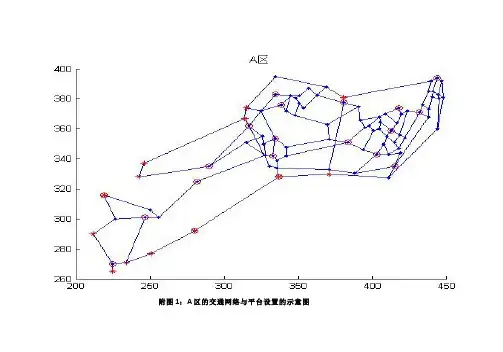
我们参赛选择的题号是(从A/B/C/D中选择一项填写): B我们的参赛报名号为(如果赛区设置报名号的话):B甲00226所属学校(请填写完整的全名):参赛队员(打印并签名) :1.2.3.指导教师或指导教师组负责人(打印并签名):日期: 2011 年 9 月 12 日赛区评阅编号(由赛区组委会评阅前进行编号):编号专用页赛区评阅编号(由赛区组委会评阅前进行编号):全国统一编号(由赛区组委会送交全国前编号):全国评阅编号(由全国组委会评阅前进行编号):交巡警服务平台的设置与调度摘要对于给各个交巡警服务平台分配管辖范围的问题,首先运用Dijkstra算法求出A 区交通网络中的任一路口节点到其他路口节点的最短路经值,再从道路的两个节点出发,选出具离它最近的交巡警服务平台,那么此道路就由所选的服务平台来管辖,这样可以依次选出各条道路所对应的交巡警服务平台,那么各交巡警服务平台相对应的管辖范围就能划分出来。
对于调度20各服务平台来封锁13条交通要道,也即13个路口节点的情况,假设每个路口节点只需一个服务平台的警力资源来封锁,建立一个有路程约束的最佳调度方案,得出进出城区的标号为12、14、16、21、22、23、24、28、29、30、38、48、62的路口节点分别由标号为12、9、16、14、10、13、11、15、7、8、2、5、4的交巡警服务平台的警力资源来封锁。