英语单词变化规则大汇总情况
- 格式:pdf
- 大小:132.49 KB
- 文档页数:11
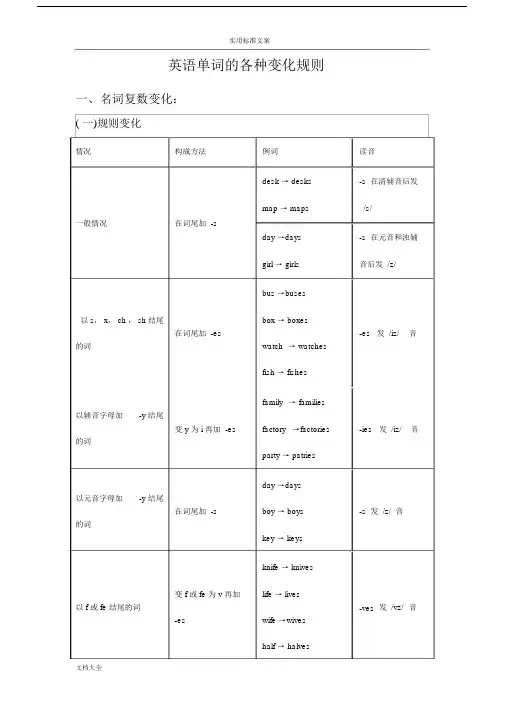
英语单词的各种变化规则一、名词复数变化:(一)规则变化情况构成方法例词读音一般情况在词尾加 -s desk→desksmap→maps-s 在清辅音后发/s/day→daysgirl→girls-s 在元音和浊辅音后发 /z/以s,x,ch,sh结尾的词在词尾加 -esbus→busesbox→boxeswatch→watchesfish→fishes-es 发 /iz/ 音以辅音字母加 -y结尾的词变y为i再加 -esfamily→famili esfactory→factoriesparty→patries-ies 发 /iz/ 音以元音字母加 -y结尾的词在词尾加 -sday→daysboy→boyskey→keys-s 发 /z/ 音以f或fe结尾的词变f或fe为v再加-esknife→kniveslife→liveswife→wiveshalf→halves-ves发 /vz/音以辅音字母加 -o 结尾的词在词尾加 -espotato→potatoestomato→tomatoeshero→heroes-es 发 /z/ 音以元音字母加 -o 结尾的词在词尾加 -sradio→radioszoo→zoos-s 发 /z/音注:以ce,se,ze,(d)ge等结尾的词加–s 读 /iz/license-licenses巧记以f\fe结尾的可数名词复数1)妻子骑牛拿起刀,wife,calf,knife ↑2)追得贼狼满街跑,thief,wolf →→→变f或fe为v,再加es3)碰倒架子丧己命,shelf,self,life ↓4)手帕树叶半空飘。
handkerchief,leaf,half ↓(二)名词复数的不规则变化:1.child→children(儿童)man→men(男人)woman→women (女人)an Englishman→two Englishmen(英国人)foot→feet(脚)tooth→teeth(牙)mouse→mice(老鼠)ox →oxen(公牛)goose→geese(鹅)2.单复同形deer,sheep,fish,Chinese,Japanese,Swiss, species,means除人民币,美元、英镑、法郎等都有复数形式。
如:a dollar,two dollars; a meter,two meters3.集体名词,以单数形式出现,但实为复数。
people police cattle是复数(Correctness:a person,a policeman,a head of cattle,the English,the British,the French,the Chinese,the Japanese,the Swiss )(Error:a people,a police,a cattle )表示国民总称时,作复数用。
(The Chinese are industrious and brave. 中国人民是勤劳勇敢的。
)4.以s结尾,仍为单数的名词1)maths,politics,physics等学科名词,为不可数名词,是单数。
2)news是不可数名词。
5. 表示由两部分构成的东西,glasses(眼镜) trousers (长裤) clothes(衣服)若表达具体数目,要借助数量词pair(对,双)a pair of glasses ,two pairs oftrousers\suit(套)6.另外还有一些名词,其复数形式有时可表示特别意思goods (货物) waters (水域) fishes (各种鱼)练习:写出下列各词的复数I _________ him _________ this ___________ her ______watch _______ child _______ photo ________ diary ______day________ foot________ book_______ dress ________tooth_______ sheep ______ box________ strawberry _____ thief _______ fish______ peach______ sandwich ______man______ woman_______ paper_______ juice___________ water________ milk________ rice__________ tea__________二、序数词变化规则(一)一般化规则:基数词+th→序数词(规则变化)four(四)→fourth(第四)six(六)→sixth(第六)seven(七)→seventh(第七)ten(十)→tenth(第十)eleven(十一)eleventh→(第十一)(二)**不规则变化的one(一)→first(第一)twenty-one →twenty-firsttwo(二)→second(第二)three(三)→third(第三)five(五)→fifth(第五)eight(八)→eighth(第八)fifty-eight →fifty-eighthnine(九)→ninth(第九)twelve(十二)→twelfth(第十二)(三)从13—19的基数词,都在个位数后加teen构成14→fourteen15→fifteen16→sixteen17→seventeen18→eighteen19→nineteen(四)整十的序数词,变y为ie再加th20 twenty→twentieth第二十30 thirty→thirtieth第三十40 forty→fortieth第十四50 fifty→fiftieth第五十60 sixty→sixtieth第六十70 seventy→seventieth第七十80 eight→eightieth第八十90 ninety→ninetieth第九十(五)分数的表达:分子用:基数词分母用:序数词特别要注意:当分子大于1时,分母要用:复数1/2 one second ; a half ; 1/4 a quarter ;3/4 three quarters 7/8 seven eighths3/5 three fifths(六)加减乘除表达a decimal number 小数a fraction 分数a percentage 百分数a odd number奇数an even number 偶数degrees 度数1) 加:and; plus; add to2+4=6Two and four is/equals six.或Two plus four is/equals six.或Two added to four equals six.2)减:minus ; subtract from 8-3=5Eight minus three is/equals five.或Three subtracted from eight is five.3)乘:multiply...by;multiplied by /times 3×5=15Multiply three by five is/equals fifteen.或Three multiplied by five is/equals fifteen.4)除:divide by.../divide ...by... 24÷8=3Twenty-four divided by eight is/equals three.或Divide 24 by 8 is /equals three.三.形容词比较级和最高级的变化规则:1.一般在词尾加er/est;2.以字母 e 结尾,加r/st ;3.以一个元音字母和一个辅音字母结尾,应双写末尾的辅音字母,再加er/st ;原级比较级最高级slim slimmer slimmestbig bigger biggesthot hotter hottestfat fatter fattestthin thinner thinnestwet wetter wettestred redder reddestsad sadder saddest4.以“辅音字母+y”结尾,先把y变i,再加er/st5.多音节词.和部分双音节词,在单词前面加more或mostimportant more important most importantdifficult more difficult most difficultinteresting more interesting most interestinguseful more useful most usefulbeautiful more beautiful most beautiful6.不规则形容词比较级:原级比较级最高级good/well better bestbad/ill worse worstmany/much more mostlittle less leastold older/elder oldest/eldestred redder reddestfar further/farther furthest /farthest写出下列形容词的比较级和最高级old__________ young________ tall_______ long________ short________ strong________ big________ small_______ fat_________ thin__________ heavy______ light________nice________ good_________ beautiful____________________ high_________ slow_______ fast________ low______ late__________ early_________ far_________ well_______四.动词第三人称单数变化规则1.一般情况下,直接加-s,如:cook-cooks, milk-milks2.以s. x. sh. ch. o结尾,加-es,如:guess-guesses, wash-washes, watch-watches, go-goes3.以“辅音字母+y”结尾,变y为i, 再加-es,如:study-studies写出下列动词的第三人称单数drink ________ go _________ stay ________ make ________ look _________ have_______ pass_______ carry ________ come________ watch______ plant_______ fly __________ study_______ brush________ do_________ teach________五.动词现在分词加ing的变化规则1.一般情况下,直接加ing,如:cook-cooking2.以不发音的e结尾,去e加ing,如:make-making, taste-tasting3. 以ie结尾的动词,把ie变为y再加ing。