
化学物质英文命名规律全
- 格式:pptx
- 大小:492.15 KB
- 文档页数:59

有机化合物的英文命名官能团决定着有机化合物的性质,所以按照官能团来对有机化合物进行分类是有机化学常用的一种分类方法。
根据不同的官能团,有机化合物主要可分为:烃(hydrocarbon )、醇( alcohol )、醚( ether )、醛( aldehyde )、酮( ketone )、羧酸(carboxylic acid )、酯(ester )、胺(amine)、酰胺( amide)、氨基酸(amino acid )和氰( nitrile )等。
现在国际上通常用( 当然也是英文书籍、期刊中经常使用)的是国际纯粹与应用化学联合会系统命名法 , 简称 IUPAC 系统命名法。
同时, 出于历史、习惯或简便原因, 也使用一些普通名(common name)或俗名 ( trivial name ) ,甚至缩略名( abbreviatedname ,如TNT和DDT 等)。
除特别说明外, 本文讲的命名法为IUPAC 系统命名法。
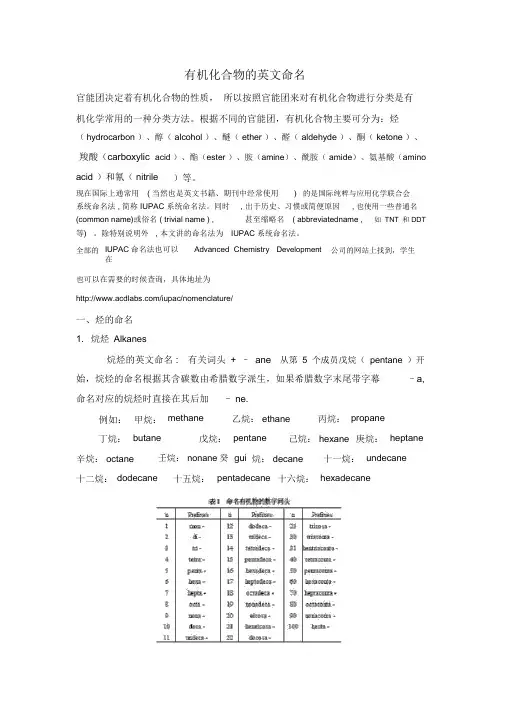
Advanced Chemistry Development 公司的网站上找到,学生全部的IUPAC命名法也可以在也可以在需要的时候查询,具体地址为/iupac/nomenclature/一、烃的命名1.烷烃Alkanes烷烃的英文命名 :有关词头+–ane从第5个成员戊烷(pentane)开始,烷烃的命名根据其含碳数由希腊数字派生,如果希腊数字末尾带字幕–a, 命名对应的烷烃时直接在其后加– ne.例如:甲烷:methane 乙烷: ethane 丙烷:propane丁烷:butane 戊烷:pentane 己烷: hexane 庚烷:heptane 辛烷: octane 壬烷: nonane 癸gui 烷: decane 十一烷:undecane十二烷:dodecane 十五烷:pentadecane 十六烷:hexadecane烷烃消去一个氢原子之后就变成烷基(alkyl radical ), 烷基的英文名称将对应的烷烃词尾 -ane 改为 –yl例如:甲基: methyl 乙基: ethyl 正丙基; n-propyl异丙基: isopropyl正丁基: n-butyl( 普通命名 )1-butyl(系统命名)新戊基: neopentyl正戊基 n-pentyl异戊基: isopentyl上表中的“ n ”即“ normal ” , 相当于中文的“正” , 表示烃基中无支链 ; “ iso ”相当于中 文的“异” , 通常指烷基的一端有 (CH ) 2 CH - 结构 ; “ sec ”、“ tert ”即“ secondary ”、3“tertiary ” , 相当于中文的“仲”和“叔” , 分别表示该基团以其中的“仲”和“叔”碳原子和别的基团相连接。

有机化学命名有机化合物系统命名的四个基本原则官能团次序规则-COOH > -SO3H > -COOR > -COX > -CONH2 > -CN > -CHO > -CO- > -OH > -SH > -NH2 > -C三C- > -C=C- > -OR > -SR > -F > -Cl > -Br > -I > -NO2即羧酸>磺酸>羧酸酯>酰卤>酰胺>腈>醛>酮>醇>硫醇>酚>硫酚>胺>炔烃>烯烃>醚>硫醚>卤代烃>硝基化合物当有机化合物含有多个官能团时,要以最优先的官能团为主官能团,其他官能团作为取代基例1如图所示,这个物质同时含有碳碳双键、氯原子、甲氧基、醛基和羧基,但是在这些官能团中,羧基是最优先的官能团,所以,该物质必须以羧酸来命名,而不能把母体作为烯烃、氯代烃、醚和醛来命名备注:-CHO在作为主官能团的时候叫醛基,作为取代基时叫甲酰基最长碳链原则(1)当有机物不含有官能团时,要选择含有碳原子最多的碳链作为主链例2如图所示,主链是蓝线所覆盖的碳链(2)如果发现有机物含有多个含有相同个数碳原子的最长碳链,应该选择含支链最多的最长碳链作为主链例3如图所示虽然红线覆盖的碳链和蓝线覆盖的碳链都是4个碳原子,但红线覆盖的碳链只有1个支链,而蓝线覆盖的碳链有2个支链,所以,应该选择蓝线覆盖的碳链为主链(3)如果发现有机物含有多个含支链个数相同的最长碳链,应考虑所有取代基的位次,要选择能使所有取代基的位次尽量小的并且含支链最多的最长碳链为主链(取代基编号规则详见最低系列原则)例4如图所示,红线覆盖的碳链和蓝线覆盖的碳链都是6个碳原子,而且,都是含有2个支链,此时,要考虑取代基的位次,红线覆盖的碳链的支链位次是2和4,而蓝线覆盖的碳链的支链的位次时2和5,所以红线覆盖的碳链的取代基位次小,所以,应该选择红线覆盖的碳链为主链(4)当有机化合物含有官能团时,要尽可能多的把该物质含有的所有官能团选入主链,并且最优先的作为命名母体的官能团必须在主链上,其余的原则与(1)-(3)相同最低系列原则(1)主链选定以后,要从主链的一边向另一边给主链编号,编号时,要优先让主官能团的编号(即位次)最小例5如图所示,当从左编号时,取代基占据的位次是3 6 10 11 当从右编号时取代基占据的位次是2 3 6 10 虽然2 < 3,但从左编号时主官能团羟基占据4号位,而从右编号时主官能团羟基占据9号位,命名时,必须要先让主官能团占据最低的位次之后才能考虑取代基的位次,所以,这个物质命名时必须是从左边编号,该物质的系统命名为11-甲基-10-硝基-3-氯-6-十二碳烯-4-醇(2)如果发现无论从主链的哪一边编号主官能团的位次都相同时,要尽量扰让所有的取代基的位次最小例6如图所示,这个物质的主官能团是碳碳双键,无论是从主链的哪一边编号,碳碳双键都是5号位,此时,要考虑取代基的位次,要尽量让所有的取代基的位次均最小,如果从左边编号,取代基占据2 4 9号位,如果从右边编号,取代基占据2 7 9号位,由于4 < 9,所以,这个物质命名时必须是从左边编号,系统命名为4-甲基-9-硝基-2-氯-5-癸烯(3)如果发现无论从主链的哪一边编号时,主官能团和所有取代基所占据的位次均相同时,应给最不优先的取代基最小的位次例7如图所示,这个物质的主官能团是碳碳双键,无论是从主链的哪一边编号,碳碳双键都是5号位,取代基是2号位和9号位,此时,要给最不优先的取代基最低的位次,由于氯原子比甲氧基优先,所以此时,要给甲氧基较低的位次,所以,这个物质命名时必须是从右边编号,该物质的系统命名为2-甲氧基-9-氯-5-癸烯取代基次序规则所有的取代基,如–COOH –Cl –OCH3等,都含有“-”部分,和“-”部分直接相连的原子称为取代基的第一个原子,取代基的次序规则如下(1)取代基的第一个原子的原子序数越大,该取代基越优先,孤对电子的原子序数默认是0,比如-NH2 的第一个原子是氮,原子序数是7 而-CHO的第一个原子是碳,原子序数是6,由于7 > 6,所以氨基比甲酰基优先(2)如果取代基的第一个原子相同,则看取代基的第一个原子与什么原子相连,比如异丙基和异丁基他们的第一个原子都是碳原子,而与异丙基的第一个原子相连的原子分别是“碳碳氢”,与异丁基的第一个原子相连的原子分别是“碳氢氢”按照顺序比较“碳碳氢”和“碳氢氢”的区别,发现碳和碳相同,最后的氢和氢也相同,但中间碳比氢的原子序数大,所以,异丙基比异丁基优先(3)如果取代基的第一个和第二个原子均相同,就继续向外推至第三个,第四个原子进行比较,直到比出那个取代基优先为止(4)如果取代基中含有双键或三键,就把双键和三键展开(芳香基如苯基也按照双键展开),比如乙烯基和氰基他们的第一个原子都是碳原子,而与乙烯基的第一个原子相连的原子相当于是“碳碳氢”,与氰基的第一个原子相连的原子相当于是“氮氮氮”,由于氮的原子序数大于碳和氢,所以氰基比乙烯基优先(5)如果取代基的第一个原子相同,在比较与第一个原子所连接的原子时出现了歧义,此时,则只比较与取代基的第一个原子相连的原子中原子序数最大的原子的原子序数,比如氯甲基和甲酰基他们的第一个原子都是碳原子,而与氯甲基的第一个原子相连的原子是“氯氢氢”,与甲酰基的第一个原子相连的原子相当于是“氧氧氢”,按照顺序比较“氯氢氢”和“氧氧氢”的区别,发现氯的原子序数比氧大,氧的原子序数比氢大,最后的氢和氢相同,这样,比较就产生了歧义,无法比较出氯甲基和甲酰基的优先次序,此时,应选择出和第一个原子相连的原子中原子序数最大的原子进行比较,氯甲基中原子序数最大的是氯,甲酰基中原子序数最大的是氧,而氯的原子序数比氧大,所以氯甲基比甲酰基优先(6)在取代基次序规则中越优先的取代基,在命名时,位置应该越靠近母体,也就是越后列出如图所示,这个物质中主官能团是碳碳双键,所以,以烯烃为母体命名,取代基是氯和甲氧基,由于氯比甲氧基优先,所以命名时,氯比甲氧基更靠近母体,所以,该物质的系统命名为2-甲氧基-9-氯-5-癸烯供稿人宿命的刚翼相关文档:∙有机化学英文命名∙有机化学英文命名规则∙有机化学命名规则∙有机化学结构式命名∙有机化学系统命名法∙有机化学命名原则∙有机化学命名题∙有机化学英语命名∙大学有机化学命名∙考研有机化学命名更多相关文档请访问:https:///。
Nomenclature of Inorganic Compounds无机化合物的命名(Prefix词头,前缀Suffix词尾,后缀Stem词根)1.Trivial Names俗名H2O water不说dihydrogen oxideNH3 ammonia不说nitrogen trihydrideCaO quicklimeCaCO3 limestone2.Systematic Nomenclature系统命名1)Oxide氧化物——先命名非氧元素ZnOzinc oxideCaO calcium oxideCO carbon oxideNa2O2 sodium peroxideH2O2hydrogen peroxide 注:peroxide过氧化物2)Hydroxide氢氧化物(base碱)Ba(OH)2 barium hydroxideKOH potassium hydroxide3)Acid酸Hydro acid氢酸General formula通式:HnX 命名:hydro- + stem of X + -ic acid H2S hydrosulfuric acid(英) hydrosulphuric(美) 氢硫酸S:sulfur(英)、sulphur(美) HBr 氢溴酸hydrobromic acidBr: bromine HCl 氢氯酸(盐酸)hydrochloric acidCl: chlorine HF 氢氟酸hydrofluoric acidF: fluorineOxoacid or Oxyacid含氧酸General formula通式:HnXOm 命名:Stem of X + -ic acid 注:oxo-(oxy-) 含氧, 氧代H2SO4 sulfuric acid(英) sulphuric acid(美)H2CO3 carbonic acidH3PO4 phosphoric acid P: phosphorus H3BO3 boric acid B: boron HNO3 nitric acid N: nitrogenIf X has two oxidation states:-ic:the higher oxidation state-ous:the lower oxidation stateH2SO4 sulfuric acidH2SO3 sulfurous acid1/5HNO3 nitric acidHNO2 nitrous acidIf X (such as halogens) has more than two oxidation states:halogen卤素per- (过,高) + -ic:the still higher oxidation statehypo- (次,在?下) + -ous:the still lower oxidation stateHClO3 chloric acidHClO2 chlorous acidHClO4 perchloric acidHClO hypochlorous acidHIO hypoiodous acid4)Salt盐General formula通式:MnXm 命名:Name of M stem of X + -ide(-ide?化物)Oxide、chloride、nitride、hydrideKI potassium iodideAl2S3 aluminum sulfideLiH lithium hydrideOxysalt含氧酸盐Name the metal ion first and then the anionNaming anions:-ate anions derived from the -ic acid(the higher oxidation state of X)-ite anions derived from the -ous acid (the lower oxidation state of X)HNO3 nitric acidNaNO3 sodium nitrateHNO2 nitrous acidNaNO2 sodium nitriteSO42- sulfateSO32- sulfiteAgClO4 silver perchlorateNaIO3 sodium iodateKClO2 potassium chloriteKBrO potassium hypobromiteMnO42- manganateMnO4- permanganateAcid salt 酸式盐Using “hydrogen”to specify “H”NaHSO4 sodium hydrogen sulfateNaH2PO4 sodium dihydrogen phosphateNa2HPO4 disodium hydrogen phosphate P: phosphorus phosphate磷酸盐(根) Using prefix bi- + name of anion if only one acid salt existsNaHSO4 sodium bisulfateNaHSO3 sodium bisulfiteKHCO3 potassium bicarbonate5)Metals(M)with more than one oxidation state2/5Two methods:①后缀法: 早期使用stem of M + -ic the higher oxidation state of Mstem of M + -ous the lower oxidation state of MHgI2 mercuric iodideHg2I2 mercurous iodide Hg:mercury Cr2+ chromousCr3+ chromic Cr: chromium注:In most cases, Latin stem is used if the metal has symbol derived from itsLatin name.(mercury is an exception))英),copper (拉丁Cu:cuprum (Cu+ cuprousCu2+ cupricCuI cuprous iodideCuS cupric sulfideSn:stannum (拉丁), tin (英)SnCl2 stannous chlorideSnO2 stannic oxideFe:ferrum (拉丁), iron (英)Fe(OH)2 ferrous hydroxideFeBr3 ferric bromide②IUPAC Rule 1957年开始使用English name of metal(Roman numeral)CuBr copper(I) bromideCuF2 copper(II) fluorideSnO tin(II) oxideSnS2 tin(IV) sulfideFe(NO3)2 iron(II) nitrateFe2(SO4)3 iron(III) sulfateUse Greek prefixes希腊文前缀Mon(o)一di二tri三tetr(a)四pent(a)五hex(a)六hepta七octa八nona九1.to specify the number of each atom in the chemical formula.NO2 nitrogen dioxidePCl5 phosphorus pentachlorideCO2 carbon dioxide2.to specify the number of identical central atoms in condensed acids and their corresponding anions.condensed acid缩酸H3PO4 (mono)phosphoric acidH4P2O7 diphosphoric acid3/5H2SO4 sulfuric acidH2S3O10 trisulfuric acidCrO42-铬酸盐(根) chromateCr2O72-重铬酸盐(根)dichromate3. to indicate extent of substitutionPO43- phosphatePS2O23- dithiophosphate thio-硫代?,硫的,含硫的注:The prefixes ortho- and meta- have been used to distinguish acids differingin the “content of water.”ortho- [希腊词头] 正、原(无机酸用)邻(位)(有机化合物命名)meta- [希腊词头] 偏(无机酸用)间(位)(有机化合物命名)ortho-acid 原酸;meta-acid 偏酸H3BO3 orthoboric acid(or boric acid)(原)硼酸偏硼酸(HBO3)n metaboric acidH4SiO4 orthosilicic acid(or silicic acid)原硅酸H2SiO3 metasilicic acid 硅酸(习惯上不叫偏硅酸)H3PO4 orthophosphoric acid (or phosphoric acid)(正)磷酸偏磷酸(HPO3)n metaphosphoric acid。
Nomenclature of Inorganic Compounds无机化合物的命名(Prefix词头,前缀Suffix词尾,后缀Stem词根)1.Trivial Names俗名H2O water不说dihydrogen oxideNH3 ammonia不说nitrogen trihydrideCaO quicklimeCaCO3 limestone2.Systematic Nomenclature系统命名1)Oxide氧化物——先命名非氧元素ZnOzinc oxideCaO calcium oxideCO carbon oxideNa2O2 sodium peroxideH2O2hydrogen peroxide 注:peroxide过氧化物2)Hydroxide氢氧化物(base碱)Ba(OH)2 barium hydroxideKOH potassium hydroxide3)Acid酸Hydro acid氢酸General formula通式:HnX 命名:hydro- + stem of X + -ic acid H2S hydrosulfuric acid(英) hydrosulphuric(美) 氢硫酸S:sulfur(英)、sulphur(美) HBr 氢溴酸hydrobromic acidBr: bromine HCl 氢氯酸(盐酸)hydrochloric acidCl: chlorine HF 氢氟酸hydrofluoric acidF: fluorineOxoacid or Oxyacid含氧酸General formula通式:HnXOm 命名:Stem of X + -ic acid 注:oxo- (oxy-) 含氧, 氧代H2SO4 sulfuric acid(英) sulphuric acid(美)H2CO3 carbonic acidH3PO4 phosphoric acid P: phosphorus H3BO3 boric acid B: boron HNO3 nitric acid N: nitrogen If X has two oxidation states:-ic:the higher oxidation state-ous:the lower oxidation stateH2SO4 sulfuric acidH2SO3 sulfurous acid1/5HNO3 nitric acidHNO2 nitrous acidIf X (such as halogens) has more than two oxidation states:halogen卤素per- (过,高) + -ic:the still higher oxidation statehypo- (次,在…下) + -ous:the still lower oxidation stateHClO3 chloric acidHClO2 chlorous acidHClO4 perchloric acidHClO hypochlorous acidHIO hypoiodous acid4)Salt盐General formula通式:MnXm 命名:Name of M stem of X + -ide(-ide…化物)Oxide、chloride、nitride、hydrideKI potassium iodideAl2S3 aluminum sulfideLiH lithium hydrideOxysalt含氧酸盐Name the metal ion first and then the anionNaming anions:-ate anions derived from the -ic acid(the higher oxidation state of X)-ite anions derived from the -ous acid (the lower oxidation state of X)HNO3 nitric acidNaNO3 sodium nitrateHNO2 nitrous acidNaNO2 sodium nitriteSO42- sulfateSO32- sulfiteAgClO4 silver perchlorateNaIO3 sodium iodateKClO2 potassium chloriteKBrO potassium hypobromiteMnO42- manganateMnO4- permanganateAcid salt 酸式盐Using “hydrogen” to specify “H”NaHSO4 sodium hydrogen sulfateNaH2PO4 sodium dihydrogen phosphateNa2HPO4 disodium hydrogen phosphate P: phosphorus phosphate磷酸盐(根) Using prefix bi- + name of anion if only one acid salt existsNaHSO4 sodium bisulfateNaHSO3 sodium bisulfiteKHCO3 potassium bicarbonate5)Metals(M)with more than one oxidation state2/5Two methods:①后缀法: 早期使用stem of M + -ic the higher oxidation state of Mstem of M + -ous the lower oxidation state of MHgI2 mercuric iodideHg2I2 mercurous iodide Hg:mercury Cr2+ chromousCr3+ chromic Cr: chromium注:In most cases, Latin stem is used if the metal has symbol derived from itsLatin name.(mercury is an exception)Cu:cuprum (拉丁),copper (英)Cu+ cuprousCu2+ cupricCuI cuprous iodideCuS cupric sulfideSn:stannum (拉丁), tin (英)SnCl2 stannous chlorideSnO2 stannic oxideFe:ferrum (拉丁), iron (英)Fe(OH)2 ferrous hydroxideFeBr3 ferric bromide②IUPAC Rule 1957年开始使用English name of metal(Roman numeral)CuBr copper(I) bromideCuF2 copper(II) fluorideSnO tin(II) oxideSnS2 tin(IV) sulfideFe(NO3)2 iron(II) nitrateFe2(SO4)3 iron(III) sulfateUse Greek prefixes希腊文前缀Mon(o)一di二tri三tetr(a)四pent(a)五hex(a)六hepta七octa八nona九1.to specify the number of each atom in the chemical formula.NO2 nitrogen dioxidePCl5 phosphorus pentachlorideCO2 carbon dioxide2.to specify the number of identical central atoms in condensed acids and their corresponding anions.condensed acid缩酸H3PO4 (mono)phosphoric acidH4P2O7 diphosphoric acid3/5H2SO4 sulfuric acidH2S3O10 trisulfuric acidCrO42- 铬酸盐(根) chromateCr2O72- 重铬酸盐(根)dichromate3. to indicate extent of substitutionPO43- phosphatePS2O23- dithiophosphate thio-硫代…,硫的,含硫的注:The prefixes ortho- and meta- have been used to distinguish acids differingin the “content of water.”ortho- [希腊词头] 正、原(无机酸用)邻(位)(有机化合物命名)meta- [希腊词头] 偏(无机酸用)间(位)(有机化合物命名)ortho-acid 原酸;meta-acid 偏酸H3BO3 orthoboric acid(or boric acid)(原)硼酸(HBO3)n metaboric acid偏硼酸H4SiO4 orthosilicic acid(or silicic acid)原硅酸H2SiO3 metasilicic acid 硅酸(习惯上不叫偏硅酸)H3PO4 orthophosphoric acid (or phosphoric acid)(正)磷酸(HPO3)n metaphosphoric acid 偏磷酸。