PS评分标准
- 格式:pdf
- 大小:83.62 KB
- 文档页数:3
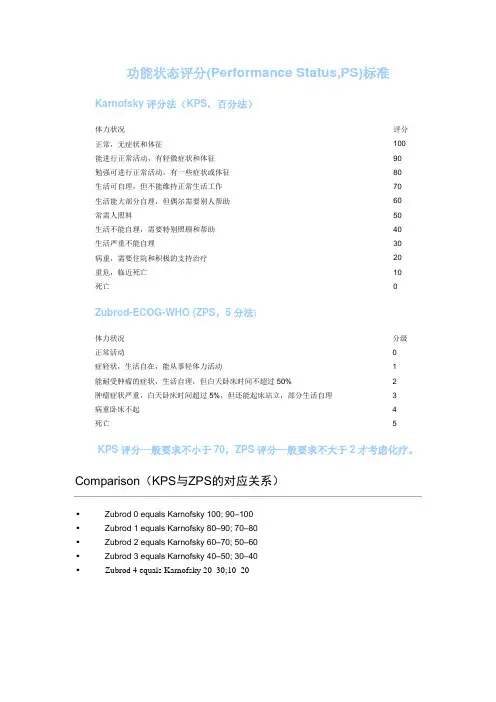
功能状态评分(Performance Status,PS)标准 Karnofsky评分法(KPS,百分法) 体力状况 评分 正常,无症状和体征 100 能进行正常活动,有轻微症状和体征 90 勉强可进行正常活动,有一些症状或体征 80 生活可自理,但不能维持正常生活工作 70 生活能大部分自理,但偶尔需要别人帮助 60 常需人照料 50 生活不能自理,需要特别照顾和帮助 40 生活严重不能自理 30 病重,需要住院和积极的支持治疗 20 重危,临近死亡 10 死亡 0
Zubrod-ECOG-WHO (ZPS,5分法)
体力状况 分级 正常活动 0 症轻状,生活自在,能从事轻体力活动 1 能耐受肿瘤的症状,生活自理,但白天卧床时间不超过50% 2 肿瘤症状严重,白天卧床时间超过5%,但还能起床站立,部分生活自理 3 病重卧床不起 4 死亡 5
KPS评分一般要求不小于70,ZPS评分一般要求不大于2才考虑化疗。
Comparison(KPS与ZPS的对应关系) Zubrod 0 equals Karnofsky 100; 90–100 Zubrod 1 equals Karnofsky 80–90; 70–80 Zubrod 2 equals Karnofsky 60–70; 50–60 Zubrod 3 equals Karnofsky 40–50; 30–40 Zubrod 4 equals Karnofsky 20–30;10–20 Performance status(PS) In medicine (oncology and other fields), performance status is an attempt to quantify cancer patients' general well-being and activities of daily life. This measure is used to determine whether they can receive chemotherapy, whether dose adjustment is necessary, and as a measure for the required intensity of palliative care. It is also used inoncological randomized controlled trials as a measure of quality of life.
Scoring systems
There are various scoring systems. The most generally used are the Karnofsky score and the Zubrod score, the latter being used in publications by the WHO. For children, theLansky score is used.
Parallel scoring systems include the Global Assessment of Functioning (GAF) score, which has been incorporated as the fifth axis of the Diagnostic and Statistical Manual (DSM) of psychiatry.
Karnofsky scoring
The Karnofsky score runs from 100 to 0, where 100 is "perfect" health and 0 is death. Although practitioners occasionally assign performance scores in between standard intervals of 10, there is no substantiated rationale for this and prognostication is not improved. This scoring system is named after Dr David A. Karnofsky, who described the scale with Dr Joseph H. Burchenal in 1949.
100% – normal, no complaints, no signs of disease 90% – capable of normal activity, few symptoms or signs of disease 80% – normal activity with some difficulty, some symptoms or signs 70% – caring for self, not capable of normal activity or work 60% – requiring some help, can take care of most personal requirements 50% – requires help often, requires frequent medical care 40% – disabled, requires special care and help 30% – severely disabled, hospital admission indicated but no risk of death 20% – very ill, urgently requiring admission, requires supportive measures or treatment 10% – moribund, rapidly progressive fatal disease processes 0% – death.
ECOG/WHO/Zubrod score
The ECOG score (published by Oken et al. in 1982), also called the WHO or Zubrod score (after C. Gordon Zubrod), runs from 0 to 5, with 0 denoting perfect health and 5 death: Its advantage over the Karnofsky scale lies in its simplicity. 0 – Asymptomatic (Fully active, able to carry on all predisease activities without restriction) 1 – Symptomatic but completely ambulatory (Restricted in physically strenuous activity but ambulatory and able to carry out work of a light or sedentary nature. For example, light housework, office work) 2 – Symptomatic, <50% in bed during the day (Ambulatory and capable of all self care but unable to carry out any work activities. Up and about more than 50% of waking hours) 3 – Symptomatic, >50% in bed, but not bedbound (Capable of only limited self-care, confined to bed or chair 50% or more of waking hours) 4 – Bedbound (Completely disabled. Cannot carry on any self-care. Totally confined to bed or chair) 5 – Death
Lansky score
Children, who might have more trouble expressing their experienced quality of life, require a somewhat more observational scoring system suggested and validated by Lansky et al. in 1987:
100 – fully active, normal 90 – minor restrictions in strenuous physical activity 80 – active, but tired more quickly 70 – greater restriction of play and less time spent in play activity 60 – up and around, but active play minimal; keeps busy by being involved in quieter activities 50 – lying around much of the day, but gets dressed; no active playing participates in all quiet play and activities 40 – mainly in bed; participates in quiet activities 30 – bedbound; needing assistance even for quiet play 20 – sleeping often; play entirely limited to very passive activities 10 – doesn't play; does not get out of bed 0 – unresponsive