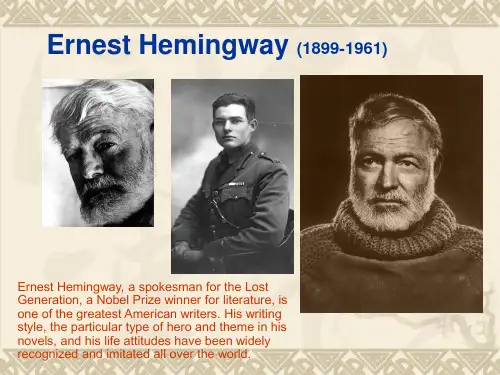
Ernest Hemingway
- 格式:ppt
- 大小:1.58 MB
- 文档页数:20


美国文学课课件_海明威_英文简介Ernest_HemingwaErnestHemingway1899-19611899-1961He started his career as a writer in a newspaper office atthe age of seventeenAfter the United States entered the First World War, hejoined a volunteer ambulance unit in the Italian armyServing at the front, he was wounded, was decorated by the Italian Government, and spent considerable time in hospitalsAfter his return to the United States, he became areporter for Canadian and American newspapers andwas soon sent back to Europe to cover such events as the Greek RevolutionIn Europe in the 1920's ,Ernest learned from avant-garde writers like GertrudeStein and Ezra Poundtheir literary sparenessand compressionHemingway in ItalyDuring the twenties, He became a member of thegroup of expatriate Americans in Paris, which hedescribed in his first novel, The Sun Also Rises 1926Hemingway used his experiences as a reporter during the civil war in Spain as the background for his mostambitious novel, For Whom the Bell Tolls 1940Among his later works, the most outstanding is theshort novel, The Old Man and the Sea 1952, thestory of an old fisherman's journey, his long andlonely struggle with a fish and the sea, and his victory in defeat.Hemingway - himself a great sportsman - liked to portray soldiers, hunters, bullfighters - tough, attimes primitive people whose courage and honestyare set against the brutal ways of modern society,and who in this confrontation lose hope and faithHis straightforward prose, his spare dialogue, andhis predilection for understatement areparticularly effective in his short stories, some ofwhich are collected in Men Without Women 1927and The Fifth Column and the First Forty-NineStories 1938. Main worksThe Sun Also Rises 1926A Farewell to Arms 1929For Whom the Bell Tolls1940The Old Man and the Sea1952Ernest Hemingway Home, Key West, Florida恩斯特海明威 ? 美 ? 作家珍妮福 ? 那在法 ? 巴黎的合影Lost GenerationGroup of U.S. writers who came of age duringWorld War I and established their reputations inthe 1920s; more broadly, the entire post ? WorldWar I American generation. The term wascoined by Gertrude Stein in a remark to ErnestHemingway. The writers considered themselves"lost" because their inherited values could notoperate in the postwar world and they feltspiritually alienated from a country theyconsidered hopelessly provincial andemotionally barren. The term embracesHemingway, F. Scott Fitzgerald, John DosPassos, E.E. Cummings, Archibald MacLeish,and Hart Crane, among others. “Lost” GenerationWorld WarI seemed to have destroyedthe idea that if you acted virtuously, goodthings would happen. Many good, youngmen went to war and died, or returnedhome either physically or mentallywounded for most, both, and their faith inthe moral guideposts that had earlier giventhem hope, were no longer validtheywere "Lost."? These literary figures also criticized American culture in creative fictional storieswhich had the themes of self-exile,indulgence care-free living and spiritualalienation? For example, Fitzgerald's This Side ofParadise shows the young generation of the1920's masking their general depressionbehind the forced exuberance of the JazzAge. Another of Fitzgerald's novels, TheGreat Gatsby does the same where theillusion of happiness hides a sad lonelinessfor the main characters. Who are involved in the Lost Generation?Ernest HemingwayF. Scott FitzgeraldJohn Dos PassosGertrude SteinT. S. EliotEzra Pound Two Types of Hemingway’sCharactersOne of the foremost authors of the era between the two world wars, Hemingway in his earlyworks depicted the lives of two types of people? One type consisted of men and women deprived,by World War I, of faith in the moral values inwhich they had believed, and who lived withcynical disregard for anything but their ownemotional needs? The other type were men of simple characterand primitive emotions, such as prizefightersand bullfighters. Hemingway’s StyleHemingway's novels pioneered a new style ofwriting which many generations after tried toimitate. Hemingway did away with the floridprose of the 19th century Victorian era andreplaced it with a lean, clear prose based onaction. H also employed a technique by whichhe left out essential information of the story inthe belief that omission can sometimesstrengthen the plot of the novel. The novelsproduced by the writers of the Lost Generationgive insight to the lifestyles that people leadduring the 1920's in America, and the literaryworks of these writers were innovative for theirtime and have influenced many futuregenerations in their styles of writing.Writing StyleJournalistic, lean, simple, short sentences;hardly any adjectivesPrinciple of iceberg7/8 under for every 1/8showing?forces readers to “readbetween the lines”; also called “hard-boiled” styleCritical acclaim-Nobel Prize in 1954Writing StyleLiterary techniquesFlashbackVivid imageryUnique symbolismUnique SymbolismLightwarmth, security, order/balanceWetnessevil, disaster, impending doomLandscapesHighlandsclear, clean, peaceful,orderlyLowlandsevil, chaos,dirtThe Hemingway’s “Code”A man can be destroyed, but notnecessarily defeated Man must face all life struggles withcourage, intensity, honesty, and grace The reward is dignity Loss of hope and faith equals defeat.The Hemingway’s “Code” cont’dConcept of “nada” or “nothingness”: The outcome of life is death, with no lifeafter deaththe struggle is the only thing th at matters“we are all losers,” as the outcome of lifeis death.The Hemingway’s “Code” cont’dNotable Characters-all “manly men” whoact “naturally” as nature intended them to BullfightersBoxersSoldiersHunters FishermenHero ArchetypesTutor: Manly man who teaches the “code” Respects opponent simple and confident expert at his trade always calm Hero Archetypes cont’dTyro:Student of the “code”ConfusedWounded mentally/physically InsomniacResembles HemingwayFears “nada”/”nothingness”Hero Archetypes cont’dHeroin e “Bitch”:Tyro’s womanGreedyUnloving & unkind towards tyroSarcastic and opinionatedpromiscuous-enjoys “wounding” tyroGertrude Stein 1 95 4 年获诺贝尔文学奖海明威英勇地脱离了早期“残暴、犬儒和冷漠”的阶段 , 充满“对危险和冒险的刚毅热爱” , 且具有“对现代叙事艺术强而有力、屡创新格的掌握能力”。
Ernest Hemingway1899-1961, American novelist and short-story writer, one of the great American writers of the 20th cent.The son of a country doctor, Hemingway worked as a reporter for the Kansas City Star after graduating from high school in 1917.During World War I he served as an ambulance driver in France and in the Italian infantry and was wounded just before his 19th birthday. Later, while working in Paris as a correspondent for the Toronto Star, he became involved with the expatriate literary and artistic circle surrounding Gertrude Stein.During the Spanish Civil War, Hemingway served as a correspondent on the loyalist side. He fought in World War II and then settled in Cuba in 1945. In 1954, Hemingway was awarded the Nobel Prize for Literature.After his expulsion from Cuba by the Castro regime, he moved to Idaho. He was increasingly plagued by ill health and mental problems, and in July, 1961, he committed suicide by shooting himself.Ernest Miller Hemingway (July 21, 1899 – July 2, 1961) was an American writer and journalist. He was part of the 1920s expatriate community in Paris, and one of the veterans of World War I later known as "the Lost Generation." He received the Pulitzer Prize in 1953 for The Old Man and the Sea, and the Nobel Prize in Literature in 1954.Hemingway's distinctive writing style is characterized by economy and understatement, and had a significant influence on the development of twentieth-century fiction writing. His protagonists are typically stoical men who exhibit an ideal described as "grace under pressure." Many of his works are now considered classics of American literature.Hemingway's fiction usually focuses on people living essential, dangerous lives, soldiers, fishermen, athletes, bullfighters,who meet the pain and difficulty of their existence with stoic courage. His celebrated literary style, influenced by Ezra Pound and Gertrude Stein , is direct, terse, and often monotonous, yet particularly suited to his elemental subject matter.Hemingway's first books, Three Stories and Ten Poems (1923), In Our Time (short stories, 1924), and The Torrents of Spring (a novel, 1926), attracted attention primarily because of his literary style. With the publication of The Sun Also Rises (1926), he was recognized as the spokesman of the “lost generation” (so called by Gertrude Stein). The novel concerns a group of psychologically bruised, disillusioned expatriates living in postwar Paris, who take psychic refuge in such immediate physical activities as eating, drinking, traveling, brawling, and lovemaking.His next important novel, A Farewell to Arms (1929), tells of a tragic wartime love affair between an ambulance driver and an English nurse. Hemingway also published such volumes of short stories as Men without Women (1927) and Winner Take Nothing (1933), as well as The Fifth Column, a play. His First Forty-nine Stories (1938) includes such famous short stories as “The Killers,” “The Undefeated,” and “The Snows of Kilimanjaro.” Hemingway's nonfiction works, Death in the Afternoon (1932), about bullfighting, and Green Hills of Africa (1935), about big-game hunting, glorify virility, bravery, and the virtue of a primal challenge to life.From his experience in the Spanish Civil War came Hemingway's great novel, For Whom the Bell Tolls (1940), which, in detailing an incident in the war, argues for human brotherhood. His novella The Old Man and the Sea (1952) celebrates the indomitable courage of an aged Cuban fisherman. Among Hemingway's other works are the novels To Have and Have Not (1937) and Across the River and into the Trees (1950); he also edited an anthology of stories, Men at War (1942). Posthumous publications include A Moveable Feast (1964), a memoir of Paris in the 1920s; the novels Islands in the Stream (1970) and True at First Light (1999), a safari saga begun in 1954 and edited by his son Patrick; and The Nick Adams Stories (1972), a collection that includes previously unpublished piecesErnest Hemingway (1899-1961), born in Oak Park, Illinois, started his career as a writer in a newspaper office in Kansas City at the age of seventeen. After the United States entered the First World War, he joined a volunteer ambulance unit in the Italian army. Serving at the front, he was wounded, was decorated by the Italian Government, and spent considerable time in hospitals. After his return to the United States, hebecame a reporter for Canadian and American newspapers and was soon sent back to Europe to cover such events as the Greek Revolution.During the twenties, Hemingway became a member of the group of expatriate Americans in Paris, which he described in his first important work, The Sun Also Rises (1926). Equally successful was A Farewell to Arms (1929), the study of an American ambulance officer's disillusionment in the war and his role as a deserter. Hemingway used his experiences as a reporter during the civil war in Spain as the background for his most ambitious novel, For Whom the Bell Tolls (1940). Among his later works, the most outstanding is the short novel, The Old Man and the Sea (1952), the story of an old fisherman's journey, his long and lonely struggle with a fish and the sea, and his victory in defeat.Hemingway - himself a great sportsman - liked to portray soldiers, hunters, bullfighters - tough, at times primitive people whose courage and honesty are set against the brutal ways of modern society, and who in this confrontation lose hope and faith. His straightforward prose, his spare dialogue, and his predilection for understatement are particularly effective in his short stories, some of which are collected in Men Without Women (1927) and The Fifth Column and the First Forty-Nine Stories (1938). Hemingway died in Idaho in 1961.。