被动语态讲解及练习汇总
- 格式:docx
- 大小:23.61 KB
- 文档页数:7
1
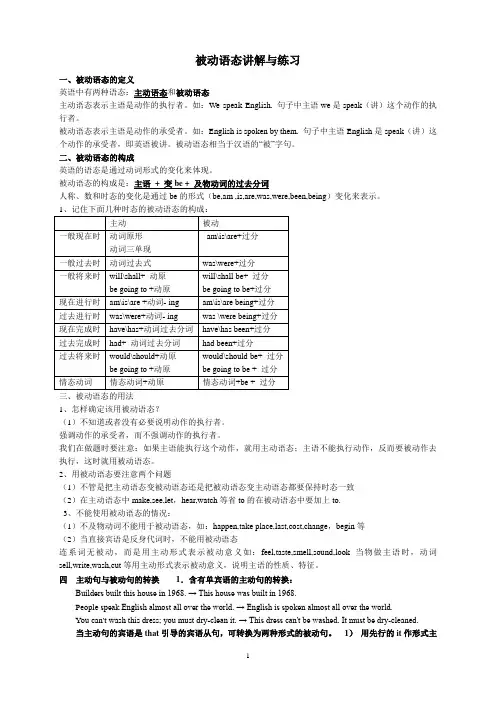
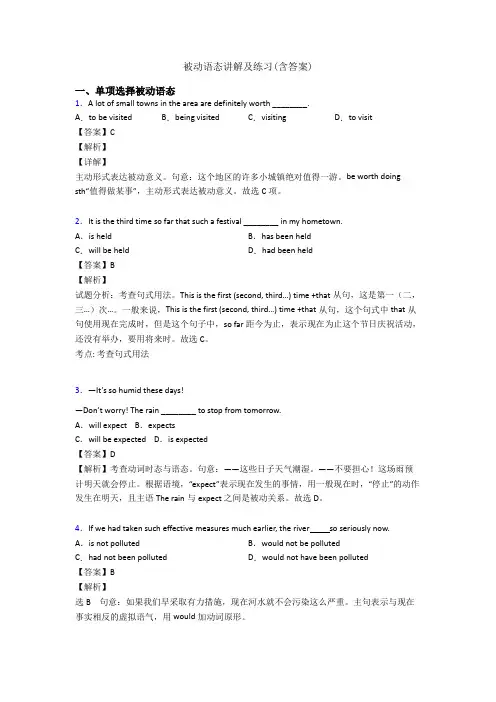
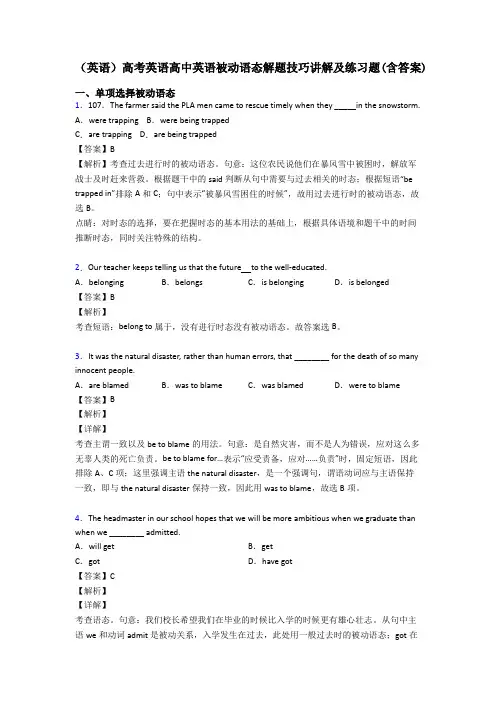
被动语态(Passive Voice )
【语态】(Voice)(主动语态和被动语态)
4、被动语态的变化步骤:
(1) 划分主语、谓语和宾语
(2) 将主动语态的宾语变成被动语态的主语
(3) 将主动语态的动词变成 be+p.p.形式(要保持原来的时态形式)
(注意动词的时态形式和主语的 单数和复数形式)
(4) 将主动语态的主语变成“ by+宾格”结构(可以省略)
e.g. (1) People n amed the two pan das “ Tuan tua n "and “ Yuany uan'.
(2) We will finish the work in two days.
(3) We must p rotect forests.
(4) I have kept the dog for two years.
*(5)Did the dog eat the meat? ...............
*(6)Who has take the books away?
Keys(参考答案):
(1) The two pan das were n amed “ Tuan tua n "and “ Yuany uan' (by peopi e).
(2) The work will be fini shed (by us) in two days.
(3) Forests must be p rotected (by us).
(4) The dog has bee n kep t (by me) for two days.
(5) Was the meat eate n by the dog? 2、被动语态的动词特征:助动词be+及物动词的过去分词(简称:be + p.p.), 变否疑。
3、 被动语态的时态:
(1) 一般现在时的被动语态 : is/am/are + p.p. 否定:isn ‘ t/am not/aren ‘ t
+p.p.
(2) 一般过去时的被动语态 : was/were + p.p. 否定: wasn ‘ t/weren ‘ t + p.p.
(3) 一般将来时的被动语态 : will+ be + p.p. 否定: won’ t be +p.p.
(4)情态动词的被动语态:
must/ca n/may+ be + p.p.
否定: mustn ‘ t/can ‘ t/may not + be +p.p.
(5)现在完成时的被动语态 : have/has+bee n+p.p. 否定:have n't/has n't+bee n + p.p.
(说明:以上5种为必须要掌握的形式, 以下 3种为了解的形式。)
(6)现在进行时的被动语态:
is/am/are + being + p.p.
否定: isn ' t/am not/aren ' t + being + p.p.
(7)过去完成时的被动语态;
had + been + p.p.否定:hadn ' t + been + p.p.
(8)过去将来时的被动语态: would + be + p.p.否定: wouldn ' t + be + p.p.
e.g. , (1) The exercise must (fini sh) today.
(2) Football (play) in 1 the world.
(3) My wallet (steal) yesterday.
⑷ The bridge (build) now.
(5) The story (read) by me for three weeks. (1) 主动语态:动作的执行者作主语。
(2) 被动语态:动作的承受者作主语。 1、语态的分类: 2
(6) Who(m) have the books bee n take n away by? 3
5、不用被动语态动词:
(1) have 有
(2) look,sound,smell,taste 等连系动词
(3) take place /happen
(4) get to/arrive(at/in)/reach
(5)
(6)
(7)
(8)到达
rise 升起, 上升 ring( 铃响 )
begin/start 开始 lie
躺 4
※^ The book sells well.( 这本卖得好)※^ The meat cooks well.
(8) return ( 回来,回归—不用被动, 归还 —可用被动语态 )
(9) leave (离开—不用被动语态, 留下/ 遗忘—可用被动语态 )
(1) _________ The idea (sound) great. Let ' s go together.
(2) The story ______ (happen) in USA ten years ago.
(3) The Olympics _______ (take place) in Beijing in 2008.
(4) The kind of bicycle ____ (sell) well.
Keys( 参考答案 ): (1)sounds (2)happened (3)took place
6、常用被动语态:
(1) be located in
(3)be called
(5) be made up of
(7) be invited to do sth
e.g. (1)The streets _____
heavily last night.
homework.
A. stay, do B.to stay, do
Keys( 参考答案 ):
(1) People were made to leave their home (by floods).
(2) D
8、 动词后面跟双宾语:
( 人在物前不用介词,物在人前要用介词 要么物)变成被动语态的主语 注意 :make/buy/draw 常与 for 连用 e.g. make sth for sb/buy sth for sb
(1) Uncle Li gave us a big dinner yesterday.
We _____ _____ a big dinner _____ Uncle Li yesterday.
A big dinner _______________________ us ____ Uncle Li yesterday.
(2) Dad will buy me a present.
I _____ _______ _______ a present ____
A present _____ _____ ____ _____ me
Keys( 参考答案 ):
(1) were given, by ; was given to, by
(2) will be bought, by ; will be bought for, by e.g.
(4)sells
(2)be covered with
( 4) be made of(in/from)
(6)be asked to do sth
(8)be used for doing sth/to do sth
(cover) with snow because it _________ (snow)
(2) We ____ (tell) to come to school yesterday.
(3) _________________ Many friends (invite) to my birthday part
because it is my
birthday tomorrow.
Keys( 参考答案 ):
(1)was covered, snowed (2) were told (3) were invited
7、 动词不定式的省 to 形式 的被动语态:(变被动时,要还原 ※ make
sb do sth —be made to do sth )
※ see sb do sth/watch sb do sth/hear sb do sth/notice sb do sth
(1) Floods made people leave their home.( 被动语态 to )
e.g. )
we were made our
C.to stay, to do D.stay, to do
to或for)-只需将其中的一个宾语(要么人,
e.g.
Dad. Dad. 5
9、“动词 +副词”或“动词 +介词“结构
在变成被动语态后,介词或副词不能漏掉
(1)We must look after our eyes.
(2)How did you deal with the dog?
Keys( 参考答案 ):
(1) Our eyes must be looked after by us.
(2) How was the dog dealt with by you?
10、同步练习
被动语态练习
I. 选择最佳答案 :
) 1. English
at the corner of the street.
A. will be published
C. is being published D. has been published
) 12. The sports meeting be held until next week. A. speaks B. are spoken C. is speaking D. is spoken
) 2. This popular song by us after class.
A. often sings B. often sang C. is often sang D. is often sung
) 3. This kind of bike in Germany.
A. makes B. made C. is making D. is made
) 4. New computers in our school.
A. is used B. are using C. are used D. have used
) 5. Our flat must clean.
A. keep B. be kept C. to be kept D. to keep
A. is building
) 7. The key
A. was left
) 8. Doctors
A. need
) 9. His new book B. is being built C. been built
on the sofa when I left.
B. will be left C. is left
all over the world.
B. are needing C. are needed