
2014年12月四级真题(第3套)【声音字幕同步PPT】
- 格式:pptx
- 大小:19.14 MB
- 文档页数:83


2014年12月大学英语四级考试试卷真题(汇总版)来源:文都教育PartⅡListening Comprehension(30minutes)Section ADirections:In this section,you will hear8short conversations and2long conversations.At the end of each conversation,one or more questions will be asked about what was said.Both the conversation and the questions will be spoken only once.After each question there will be a pause. During the pause,you must read the four choices marked A),B),C)and D),and decide which is the best answer.Then mark the corresponding letter on Answer Sheet1with a single line through the centre.注意:此部分试题请在答题卡1上作答。
1.A)She will go purchase the gift herself.B)The gift should not be too expensive.C)The man is not good at balancing his budget.D)They are going to Jane’s house-warming party.【答案】B)The gift should not be too expensive.2.A)It takes patience to go through the statistics.B)He has prepared the statistics for the woman.C)The woman should take a course in statistics.D)He is quite willing to give the woman a hand.【答案】D)He is quite willing to give the woman a hand.3.A)The man wants to make some changes in the scripts.B)The woman does not take the recording seriously.C)They cannot begin their recording right away.D)Page55is missing from the woman’s scripts.【答案】C)They cannot begin their recording right away.4.A)A significant event in July.B)Preparations for a wedding.C)The date of Carl’s wedding.D)The birthday of Carl’s bride.【答案】B)Preparations for a wedding.5.A)The man was in charge of scheduling meetings.B)The man was absent from the weekly meeting.C)The woman was annoyed at the man’s excuse.D)The woman forgot to tell the man in advance.【答案】C)The woman was annoyed at the man’s excuse.6.A)The woman is a marvelous cook.B)The man cannot wait for his meal.C)The woman has just bought an oven.D)The man has to leave in half an hour.7.A)Whether the man can keep his job.B)Where the man got the bad news.C)What items sell well in the store.D)How she can best help the man.8.A)The woman can sign up for a swimming class.B)He would like to teach the woman how to swim.C)The woman has the potential to swim like a fish.D)He works in the physical education department.Questions9to11are based on the conversation you have just heard.9.A)He is a wonderful lecturer.B)He is a diplomat.C)He loves classical music.D)He teaches in a law school.【答案】B)He is a diplomat.10.A)Attended a dance.B)Went to see a play.C)Took some photos.D)Watched a soccer game.【答案】D)Watched a soccer game.11.A)She decided to get married in three years.B)She insisted that Eric pursue graduate studies.C)Her father said she could marry Eric right away.D)Her mother objected to Eric’s flying lessons.【答案】C)Her father said she could marry Eric right away. Questions12to15are based on the conversation you have just heard.12.A)Teacher.B)Journalist.C)Editor.D)Typist.【答案】A)Teacher.13.A)The beautiful Amazon rainforests.B)A new railway under construction.C)Some newly discovered scenic spot.D)Big changes in the Amazon valley.【答案】C)Some newly discovered scenic spot.14.A)In news weeklies.B)In a local evening paper.C)In newspapers’Sunday editions.D)In overseas editions of U.S.magazines.【答案】C)In newspapers’Sunday editions.15.A)To become a professional writer.B)To be employed by a newspaper.C)To get her life story published soon.D)To sell her articles to a news service.【答案】D)To sell her articles to a news service.【短对话原文】1.M:take a look at this cater.Maybe we can find some gifts for Jean’s new house.W:Ok,but remember we can afford a lot.Q:what does the woman mean?2.W:I am absolutely going nowhere about this statistics.M:How about going through them with you?Q:what does the man mean?3.M:are you just starting the record,aren’t you?Let’s begin on Page55.W:Sorry.I am afraid I can begin right now.Q:What mean from the conversation?4.W:remember.Carl’s arriving is at226W:thanks to reminding me.I thought it would be sometime in July.Q:what are the speakers talking about?5.M:please excuse me for not attending the meeting yesterday.I am afraid I forgot to check the schedule.W:that’s all right.We have to rearrange the meeting at weekend.And everything went wrong.Q:what does it mean from the conversation.6.W:I didn’t fall sleep at least to5tomorrow.Q:what do we learn from the conversation?7.,M:I got some bad news today.The star we are in is going to fallW:I am going to let you go.Q:What does the woman want to know?8W:what’s wrong?You smell like a fish.M:......Q:what’s man mean?【长对话原文】Conversation1M:That’s Marria’s families and we want to be engaged.W:It’s wonderful,Erik!Congratulations!M:I really like her families,too,very nice.Ms Comona speaks four languages and Mr. Comona a diplomat.In fact,he gives the speech at the Saturday morning.W:OH,that’s was N’s father?I heard the speech.M:You did?W:Well,I heard part of it and listened to it for ten minutes,and then I fell asleep.I saw it was in class.Anyway,tell me about your weekend.M:Saturday evening we saw a play.And Sunday afternoon we saw the soccer game.Then Sunday night we all went out for dinner.Marria,her parents,and me.That was the first chance we had to talk.W:Would you know this?M:That’s first I was.We didn’t say ona told some good stories about his experiences as a diplomat and he asked about my hobbies.W:And what did you say?M:Well,I didn’t tell him about my flying lessons.I told him about my chess play and my classical music collection.W:Good idea!Her parents really approval of you.Don’t they?M:I guess so.Marria called this morning and said,”My father told me he’ll like you sunny right now”W:That was great.M:Not exactly.I want to get married after I graduated school in about three years.Q9:what does the conversation about Marria’s father?Q10:What does Marria and Erik do last Sunday afternoon?Q11:What do we learn from Marria’s phone call this morning?Conversation2M:You’re going to wear out computer’s keyboard.W:Oh,hi!M:Do you have any idea what time it is?W:About ten or ten thirty?M:It’s merely midnight.W:Really?I didn’t know it was so late.M:Don’t you have an early class to teach tomorrow morning?W:Yes,at seven o’clock,my computer class.The students go to work right after their lesson.M:Then you ought to go to bed.What are you writing anyway?W:An article,I hope I can sell.M:Oh,another view of newspaper pieces.What’s this one about?W:Do you remember the trip I took last month?M:The one up to the Amazon?W:Well,that’s what I’m writing about.The new high-way and the changes is making in the Amazon valley.W:It should be interesting.W:It is.I guess that’s why I forgot all about the time.M:How many articles have you solve now?W:About a dozen so far.M:What kind of newspapers by them?W:The paper is carrying a lot of foreign news.They usually appear in the big Sunday editions where they need a lot background stories to help develop the space between the ads.M:Is there any future in it?W:I hope so.There’s a chance I may sell this article to a news service.M:Then your papers will be published in several papers winter.W:that’s the idea.And they might even be able to do other stories the on a regular basis.M:That would be great.Q12:what is the woman’s occupation?Q13:what is the woman writing about?Q14:where did the woman’s articles usually appear?Q15:what does the woman expect?【短文理解原文】Passage1Body language,especially gestures,varies among cultures.For example,a node of the head means“yes”to most of us.But in Bulgaria and Greece a node means“no”and a shake of the head means“yes”.Likewise,a sign for OK,forming a circle with our forefinger and thumb,means zero in France and money in Japan.Waving or pointing to an Arab business person would be considered rude because that is how Arabs call their dogs over.Folded arms signal pride in Finland,but disrespect in Fiji.The number of bows that the Japanese exchange on greeting each other,as well as the length and the depth of the bows,signals the social status each party feels towards each other.Italians might think your bored unless you use a lot of gestures during discussions.Many American men sit with their legs crossed with one ankle resting over the opposite knee.However,this would be considered an insult in Muslim countries,where one will never show the sole of the foot to a gust.Likewise,Americans consider eye contact very important, often not trusting someone who is afraid to look at you in the eye.But in Japan and many Latin American countries,keeping the eyes lowered is a sign of respect.To look apart in the eye is considered a sign of ill breeding and is felt to be annoying.Q16:What gesture do Bulgarians and Greeks use to express negative responses?Q17:What is likely to offend Arab business people?Q18:What is considered impolite in Muslim countries?Passage1New Yorkers,albeit many of them grudgingly,are gradually getting used to more pedaling passengers on those blazing blue Citi Bikes.But what about local bike shops?Is Citi Bike rolling up riders at their expense?At Gotham Bikes in Tribeca,a manager who gave his name as“Ben W.”said the shop has seen an increase in its overall sales due to the bike-share program.“It’s getting more people on the road,more people learning about the sport and getting involved,”he said.An employee at Danny’s Cycles in Gramercy said Citi Bike is a good option for people to ease into biking in a city famed for its vehicular congestion and aggressive drivers.“They can try out a bike without committing to buying one,”James Ryan said.“It makes a more comfortable biking environment in the city because there are a lot more bikes,too.”Business at Danny’s Cycles has increased as well since the advent of bike-share.“A lot of people come in for bike gear,and we’ve sold a lot of helmets,”he noted.Rentals are not a big part of the business at either Gotham Bikes or Danny’s Cycles.But for Frank’s Bike Shop,a small business that has been at its current Lower East Side location on Grand St.since1976,the bike-share program has been bad news.Owner Frank Arroyo said that his rental business has decreased by90percent since the Citi Bikes were rolled out last month.Arroyo’s main rental customers are European tourists,a demographic that has since been drawn away by Citi Bikes.Initially,a bike-share station was sited a few doors away from Frank’s Bike Shop on the corner of Grand and Henry Sts.But a petition to relocate the bike station gathered more than1,000signatures.The Citi Bike dock was eventually removed—but only temporarily,according to the Citi Bike Twitter account,for utility construction in the street.“I was grateful,and it was quite an honor to see how many people responded on my behalf,”Arroyo said of the petition effort.“It was really nice to see that people care.But they have flooded the place with them,”he said of the Department of Transportation,which installs the bike racks.Removing one station does little since the area is overloaded with Citi Bike stations,said Arroyo.“If you put it in front of a hotel,customers are going to walk of the hotel and use it,”he said.However,Ben said the bike-share is good for bike sales at his shop.“People have used the bike-share and realized how great it is to bike in the city,then decide that they want something nicer for themselves,”he noted.Christian Farrell of Waterfront Bicycle Shop,on West St.just north of Christopher St.,said initially he was concerned about bike-share,though,he admitted,“I was happy to see people on bikes.”Consisting of equal parts tourists and locals,his customers get a better rental deal at his shop because,despite charging only$10for a daily rental,the bike-share program requires cyclists to check their bikes in at a bike station every half hour.His store,on the other hand,charges$10for the first hour,$5for the second,and$2.50per hour after that.“Six hours with Waterfront Bicycle Shop will cost a customer$25,”he said.“With Citi Bike, a six-hour rental will cost$126[if the rider doesn’t re-dock his or her bike at a station every half hour].Our rentals always include a helmet,a basket and a lock.”Several dozen rental bikes were lined up on Weehawken st Sunday behind the store. Benny,who was watching over them,said another advantage over the Citi Bikes is that Waterfront’s bikes are all in good working order.Farrell’s early concerns were echoed by Andrew Crooks,owner of NYCVelo,at64Second Ave.“It seemed like a great idea,but one that would be difficult to implement,”Crooks said of Citi Bike.He said he worried about inexperienced riders’lack of awareness of biking rules and backlash from non-cyclists.However,he said,it’s still too early to tell if his business has been impacted.The actual Citi Bikes themselves have been criticized as“heavy,”“clunky,”even“ugly.”In comparison,Crooks said NYC Velo has bikes that are“lighter,faster and tend to be more comfortable.”Farrell of Waterfront also said his bikes are of“better quality”than the bike-share two-wheelers.While it’s possible bike-share will cause a drop in business in the long run,Crooks allowed that the idea,as a whole,is good for the city.[原文解读]该文节选自The Villager,原题目为Bike store owners put their spin on new bike-share,题材为议论文。

大学英语四级考试COLLEGE ENGLISH TEST—Band Four—2024年12月第3套(附答案)敬告考生:1.所有题目必须在答题卡上规定位置作答,在试题册上或答题卡上非规定位置的作答一律无效。
2.请在规定时间内在答题卡指定位置依次完成作文、听力、阅读、翻译各部分考试,作答作文期间不得翻阅该试题册。
听力录音播放完毕后,请立即停止作答,监考员将立即收回答题卡1,得到监考员指令后方可继续作答。
3.作文题内容印在试题册背面,作文题及其他主观题必须用黑色签字笔在答题卡指定区域内作答。
4.选择题均为单选题,错选、不选或多选将不得分,作答时必须使用HB-2B铅笔在答题卡上相应位置填涂,修改时须用橡皮擦净。
Part Ⅰ Writing (30 minutes)(请于正式开考后半小时内完成该部分,之后将进行听力考试)Directions : Suppose the university newspaper is inviting submissions from the students for its coming edition on how to enrich students' knowledge of traditional Chinese culture.You are now to write an essay for submission. You will have 30 minutes to write theessay. You should write at least 120 words but no more than 180 words.请用黑色签字笔在答题卡1指定区域内作答作文题,在试题册上的作答无效!注:每次四级考试只出两套听力,请参照2024年12月第1套卷和第2套卷的听力。
Part Ⅰ Listening Comprehension (25 minutes)Section ADirections: In this section, you will hear three news reports. At the end of each news report, you will hear two or three questions. Both the news report and the questions will be spokenonly once. After you hear a question, you must choose the best answer from the fourchoices marked A),B),C) and D). Then mark the corresponding letter on Answer Sheet1 with a single line through the centre.Questions 1 and 2 are based on the news report you have just heard.1. A) They will see a 27% higher price to buy natural gasB) They will have insufficient heating oil to keep warm.C) They will have a costly bill to pay to heat their homes.D) They will experience the coldest winter in four decades.2. A) Provided additional funding to Low Income Home Energy Assistance Program.B) Assured U.S. citizens of an increase in energy supplies by the end of this year.C) Predicted a 10% jump in heating bills for most U.S. households this winter.D) Decided on this year's energy assistance package of $ 8 billion in total.Questions 3 and 4 are based on the news report you have just heard.3. A) They care less about their diet now than before.B) They may lack adequate knowledge of healthy food.C) They may hold too optimistic a view about their diet.D) They pay insufficient attention to their choice of food.4. A) Those who finished 24-hour food questionnaires.B) Those who fully understood the rating scale.C) Those who cared about food quality.D) Those who rated their diet as poor.Questions 5 to 7 are based on the news report you have just heard.5. A) They experienced a heartbreaking moment.B) They gathered together to rescue an elephant.C) They heard a noise from the bottom of a well.D) They found an elephant wandering around a well.6. A) To borrow their crane.B) To ask them for help.C) To report the strange noise.D) To get food for the elephant.7. A) The elephant was able to return to the jungle.B) The army officers were examined for injuries.C) The army officers were rewarded for their rescue efforts.D) The elephant was given medical treatment for many days.Section BDirections: In this section, you will hear two long conversations. At the end of each conversation,you will hear four questions. Both the conversation and the questions will be spokenonly once. After you hear a question, you must choose the best answer from the fourchoices marked A),B),C) and D). Then mark the corresponding letter on Answer Sheet1 with a single line through the centre.Questions 8 to 11 are based on the conversation you have just heard.8. A) He found it had caused him much inconvenience.B) It led him to spend more money than necessary.C) It was much less secure than paying with cash.D) He wanted to be less dependent on his phone.9. A) Living beyond her means.B) Lack of budgeting strategies.C) Fashion addiction.D) Impulse purchasing.10. A) Eat healthier food with less money.B) Order food like burgers and chips.C) Avoid getting addicted to junk food.D) Pay either in cash or with his phone.11.A) Making a shopping list.B) Sticking to his budget.C) Withdrawing cash only once a month.D) Thinking twice before buying something.Questions 12 to 15 are based on the conversation you have just heard.12. A) He does not enjoy any ball games.B) He has to prepare for the future.C) He has breathing problems.D) He is not up to anything challenging.13.A) Soccer.B) Badminton.C) V olleyball.D) Basketball.14. A) The possibilities of joining the school sports team.B) The opportunities of winning some championships.C) The chances of getting an athletic scholarship later on.D) The odds of becoming a professional sportsman someday.15.A) It differs entirely from indoor volleyball.B) It appeals to both schoolgirls and schoolboys.C) It is less popular than indoor sports in the country.D) It is completely different from other outdoor games.Section CDirections:In this section, you will hear three passages. At the end of each passage, you will hear three or four questions. Both the passage and the questions will be spoken only once.After you hear a question, you must choose the best answer from the four choicesmarked A),B),C) and D). Then mark the corresponding letter on Answer Sheet 1 with asingle line through the centre.Questions 16 to 18 are based on the passage you have just heard.16.A) It usually requires years of preparations.B) It does a lot of harm to the environment.C) It often burns over three hundred tonnes of refined fuel.D) It proves to be the most complicated stage of space missions.17.A) They are burnt up in outer space.B) They are guided back to Earth.C) They are reused up to 100 timesD) They are treated as expendable.18. A) New technologies for bringing back space vehicles for recyclingB) The technology for meeting the needs of commercial space travel.C) Many of the technologies to limit the impact of space travel on Earth.D) The technology for effectively protecting ozone from being destroyed.Questions 19 to 21 are based on the passage you have just heard.19. A) It can help unskilled readers feel more secure.B) It can encourage reluctant readers to read aloud.C) It can strengthen children's confidence in others.D) It can boost children's interest in communication.20. A) By motivating children to find out about their favourite pets.B) By taking children to the library to borrow books on animals.C) By allowing children to surf the internet about pets by themselves.D) By showing children how to acquire knowledge about healthy pets.21. A) By learning that raising pets can do much goodB) By watching how healthy pets are brought up.C) By hearing about their peers' passion for pets.D) By visiting friends who have household pets.Questions 22 to 25 are based on the passage you have just heard.22. A) Send would-be students a packet of information.B) Update regularly all information on their websites.C) Inform prospective students of their yearly enrollment.D) Answer questions raised by applicants and their parents.23.A) Oversee private institutions directly.B) Follow other states' example.C) Supervise all schools consistently.D) Regulate public institutions by law.24. A) They are resourceful.B) They are competitive.C) They provide the best opportunity to realize one's dream.D) They appeal most to students from other states in the U.S.25. A) Some students waste much time surfing the net.B) Students may need to visit too many websites.C) Students have to search for the information.D) Some students may lack adequate access.Part ⅢReading Comprehension (40 minutes)Section ADirections :In this section, there is a passage with ten blanks. You are required to select one word for each blank from a list of choices given in a word bank following the passage. Readthe passage through carefully before making your choices. Each choice in the bank isidentified by a letter. Please mark the corresponding letter for each item on AnswerSheet 2 with a single line through the centre. You may not use any of the words in thebank more than once.Super realistic masks are made from flexible materials such as silicone and are designed to imitate real human faces -down to every last detail.In a study by the Universities of York and Kyoto, researchers asked participants to look at pairs of photographs and decide which showed a 26 face and which showed a person wearing a mask.Surprisingly, participants made the wrong call in one -in -five cases.The 20% error rate 27 in the study likely underestimates the extent to which people would struggle to tell an 28 face from the real thing outside of the lab.The researchers collected data from participants from both the UK and Japan to 29 any differences according to race. When trial participants were asked to choose between photographs of faces of a different race from theirs, response times were slower and selections were 5% less 30.There are now dozens of criminal cases in which offenders have 31 themselves off as people of a different age, race or gender, sending police investigations down the wrong path.In one recent case, an international gang used an 32 realistic mask to pose as a French minister, 33 business executives out of millions of pounds.Dr. Jet Sanders, who worked on the study while a PhD student at the University of York, said: "Failure to detect synthetic faces may have important implications for security and crime prevention as super realistic masks may 34 the key characteristics of a person's appearance to be 35 identified."Section BDirections : In this section, you are going to read a passage with ten statements attached to it. Eachstatement contains information given in one of the paragraphs. Identify the paragraph from which the information is derived. You may choose a paragraph more than once. Each paragraph is marked with a letter. Answer the questions by markingthecorresponding letter on Answer Sheet 2.Stop thinking and start doingA) Most people have a dream in life, a vision of who or what they'd like to be in the future. At a minimum, everyone has interests and values that determine what they want out of their lives. Even so, trying to set achievable goals that you'll work for over the course of many years can be extremely challenging. It can be hard to know where to even begin, and the things you hope to achieve may seem impossible. But, if you're well prepared you may be able to set goals for your life that are just as fulfilling to work toward as to achieve.B) We all have goals that we want to achieve in our lives. These goals may include learning a newlanguage, eating healthier and losing weight, becoming a better parent, saving more money, and so on. It can be easy to assume that the gap between where you are now and where you want to be in the future is caused by a lack of knowledge. This is why we buy courses on how to start a business or how to lose weight fast or how to learn a new language in three months. We assume that if we knew about a better strategy, then we would get better results. We believe that a new result requires new knowledge.C) What I'm starting to realize, however, is that new knowledge does not necessarily drive newresults. In fact, learning something new can actually be a waste of time if your goal is to make progress and not simply gain additional knowledge.D) It all comes down to the difference between learning and practicing. Thomas Sterner, in his bookThe Practicing Mind, explains the key difference between practicing and learning. He says: “When we practice something, we are involved in the deliberate repetition of a process with the intention of reaching a specific goal." Here the words " deliberate" and "intention" are key, because they define the difference between actively practicing something and passively learning it.E) Learning something new and practicing something new may seem very similar, but these twomethods can have profoundly different results. Here are some additional ways to think about the difference. Let's say your goal is to get stronger and more fit. You can research the best instructions on weight lifting technique, but the only way to build strength is to practice lifting weights. Let's say your goal is to grow your startup. You can learn about the best way to make a sales pitch, but the only way to actually land customers is to practice making sales calls. Let'ssay your goal is to write a book. You can talk to a best-selling author about writing, but the only way to become a better writer is to practice publishing consistently.F) Passive learning creates knowledge. Active practice creates skill. Let's consider a couple morereasons to prioritize active practice over passive learning. First, passive learning can be a stick that supports inaction. In many cases, learing is actually a way to avoid taking action on the goals and interests that we say are important to us. For example, let's say you want to learn a foreign language. Reading a book on how to learn a foreign language quickly allows you to feel like you are making progress ("Hey, I'm figuring out the best way to do this!"). Of course, you're not actually practicing the action that would deliver your desired outcome (speaking the foreign language).G) In situations like this one, we often claim that we are preparing or researching the best method,but these rationalizations allow us to feel like we are moving forward when we are merely spinning our wheels. We make the mistake of being in motion rather than taking action.Learning is valuable until it becomes a form of procrastination(拖延).H) Another point to consider is that practice is learning, but learning is not practice. Passivelearning is not a form of practice because although you gain new knowledge, you are not discovering how to apply that knowledge. Active practice, meanwhile, is one of the greatest forms of learning because the mistakes you make while practicing reveal important insights.I) Even more importantly, practice is the only way to make a meaningful contribution with yourknowledge. You can watch an online course about how to build a business or read an article about a terrible disaster in a developing nation, but that knowledge is unproductive unless you actually launch your business or donate to those in need. Learning by itself can be valuable for you, but if you want to be valuable to others, then you have to express your knowledge in some way.J) The last important point to consider is that practice focuses your energy on the process. Thomas Sterner once said, "Progress is a natural result of staying focused on the process of doing anything." The state of your life right now is a result of the habits and beliefs that you have been practicing each day. When you realize this and begin to direct your focus toward practicing better habits day-in and day-out, continual progress will be the logical outcome. It is not the things we learn nor the dreams we visualize that determine our results, but rather the habits that we practice each day. Fall in love with boredom and focus your energy on the process, not theproduct.K) What does this all mean? Is passive learning useless? Of course not. In many cases, learning for the sake of learning can be a beautiful thing. Not to mention that soaking up new information can help you make more informed decisions when you do decide to take action. That said, the main point of this article is that learning by itself does not lead to progress. We often hide behind information and use learning as an excuse to delay the more difficult and more important choice of actually doing something. Spend less time passively learning and more time actively practicing. Stop thinking and start doing.36. Acquisition of new knowledge may not guarantee the progress that you aim to make.37. Your current situation in life is built on the beliefs and habits you have been practicing daily.38. Knowing the best way to learn a foreign language will not enable you to speak it without actualpractice.39. People may find it demanding to create a goal which will take a long time to achieve.40. Learning and practicing seem to be very much alike, but the two processes can lead to quitedifferent outcomes.41. Absorbing new information is helpful in making better decisions prior to action.42. Sometimes we may feel like we are making progress by doing some research or makingpreparations, but actually we are staying at the starting point.43. We are inclined to think that a lack of knowledge prevents us from advancing to a better future.44. Learning can benefit you by itself, but only practice can turn what you learn into meaningfulcontributions.45. Practice involves repeating a process intentionally to attain a particular objective.Section CDirections: There are 2 passages in this section. Each passage is followed by some questions or unfinished statements. For each of them there are four choices marked A), B), C) andD). You should decide on the best choice and mark the corresponding letter on AnswerSheet 2 with a single line through the centre.Passage OneQuestions 46 to 50 are based on the following passage.Research in human-vehicle interaction has shown even systems designed to automate drivingare far from being error-proof. Recent evidence points to drivers' limited understanding of what these systems can and cannot do as a contributing factor to system misuse. A recent study tackles the issue of over-trusting drivers and the resulting system misuse from a legal viewpoint. It looks at what the manufacturers of self-driving cars should legally do to ensure that drivers understand how to use the vehicles appropriately.One solution suggested in the study involves requiring buyers to sign end-user license agreements (EULAs),similar to the terms and conditions that require agreement when using new software products. But this is far from ideal. The agreement may not provide enough information to the driver, leading to confusion about the nature of the requests for agreement and their implications. Further, most end users don't read EULAs. A 2017 study shows 91 percent of people agree to them without reading. Among young people, 97 percent agree without reviewing the terms.The issue is that, unlike using a smartphone app, operating a car has serious safety risks, whether the driver is human or software. And human drivers need to consent to take responsibility for the outcomes of the software and hardware."Warning fatigue" and distracted driving are also causes for concern. For example, a driver, annoyed after receiving continuous warnings, could decide to just ignore the message. Or, if the message is presented while the vehicle is in motion, it could represent a distraction. Given these limitations and concerns, even if this mode of obtaining consent is to move forward, it likely won't fully protect automakers from their legal liability should the system malfunction(发生故障)or an accident occur.Driver training for self-driving vehicles can help ensure that drivers fully understand system capabilities and limitations. This needs to occur beyond the vehicle purchase. Recent evidence shows even relying on the information provided by the seller is not going to answer many questions. All of this considered, the road forward for self-driving cars is not going to be a smooth ride after all.46. What do we learn from research in human-vehicle interaction?A) Automatic driving systems are by no means immune to errors.B) Driverless vehicles are likely to be misused by some people.C) Self-driving car manufacturers are not aware of the legal matters involved.D) There is a long way to go before humans can interact with driverless vehicles.47. What is the problem with requiring buyers to sign end-user license agreements?A) End users, young and old alike, find the terms complex to interpret.B) Most end users sign them without bothering to read the terms.C) Many people are often confused by the wording of the terms.D) Most end users do not understand the terms after reading them through48. What would drivers do when they suffer from "warning fatigue"?A) Waste no time keeping the car moving.B) Rest a while to avoid fatigue driving.C) Take no action despite repeated warnings.D) Take note of the message though fatigued.49. What does the author think of continuing to ask buyers to sign end-user license agreements?A) It will probably not guarantee the safety of drivers in case of accidents.B) It likely won't ensure that the automatic driving system functions properly.C) It likely won't fully protect automakers against accusations of deliberate cheating.D) It will probably not provide manufacturers adequate protection from legal responsibilities.50. What should be done to help drivers fully understand system capabilities and limitations?A) Training them to be experts in vehicle automation.B) Familiarizing them with the systems through training.C) Broadening their knowledge of accident-prevention mechanisms.D) Facilitating their access to the information provided by the seller.Passage TwoQuestions 51 to 55 are based on the following passage.Do you ever blend up a protein drink for breakfast, or grab a protein bar following an afternoon workout? If so, you are likely among the millions of people in search of more protein-rich diets.Protein-enriched products are found everywhere. But contrary to all the publicity that everyone needs more protein, most Americans get twice as much as they need.Many of us living in the most developed countries are buying into a myth of protein deficiency created by food companies and self-identified health experts. Global retail sales of protein supplement products reached an astonishing US$ 18.9 billion in 2020.But are we really in need of more protein? Physicians in the U.S. have never actually examined a patient with protein deficiency because simply by eating an adequate number of daily calories weare also most likely getting enough protein.In fact, Americans currently consume almost twice the National Academy of Medicine's recommended daily intake of protein although the most desirable protein intake may vary depending on age and activity level.For example, if you're a dedicated athlete you might need to consume higher quantities of protein. Generally, though, a 140-pound person should not exceed 120 grams of protein per day, particularly because a high protein diet can strain kidney and liver function and increase risks of developing heart disease and cancer.While fats and sugar have taken the beating in turns since over a century ago, protein has managed to remain our red-hot favorite.In the 1970s through the 1990s, protein products remained visible but moved back somewhat with the dietary spotlight firmly fixed on low-calorie, low-fat, sugar-free snack foods and beverages following the publication of studies linking sugar and saturated(饱和的)fat consumption to heart disease.Later research in 2003, however, suggested high-protein diets could aid in weight loss, and protein quickly regained its former nutrient-superstar status.Now most people living in high-income nations are consuming enough protein. When we replace meals with a protein bar or drink, we also risk missing out on the rich sources of antioxidants(抗氧化剂), vitamins and many other benefits of real food.51. What do we learn about publicity over protein in America?A) It has helped to create the myth of protein deficiency.B) It has helped Americans in search of protein-rich diets.C) It has raised a lot of health concerns among the public.D) It has been funded by food companies and health experts.52. Why have physicians in the U.S. never actually examined a patient with protein deficiency?A) Americans can purchase many kinds of protein-rich foods everywhere.B) Americans can absorb the number of calories recommended by food experts.C) Americans can get sufficient protein just by cating adequate foods daily.D) Americans can rely on food supplements to prevent protein deficiency.53. What should people take into consideration in deciding on the most preferable protein intake?A) How healthy they are and what food they eatB) How old they are and what activities they do.C) How much protein they consume and what their body weight is.D) How serious their protein deficiency is and what remedies they use.54. What foods have been largely out of favor for more than a century?A) Sugar-free snacks.B) Protein-rich foods.C) Both red and white meats.D) Sugary and fatty foods.55. What does the author imply people in developed countries should do to keep healthy?A) Enjoy natural food.B) Eat vegetarian diets.C) Consume enough protein daily.D) Replace meals with protein bars.Part IV Translation (30 minutes)Directions:For this part, you are allowed 30 minutes to translate a passage from Chinese into English. You should write your answer on Answer Sheet 2.中国政府十分重视环境保护。
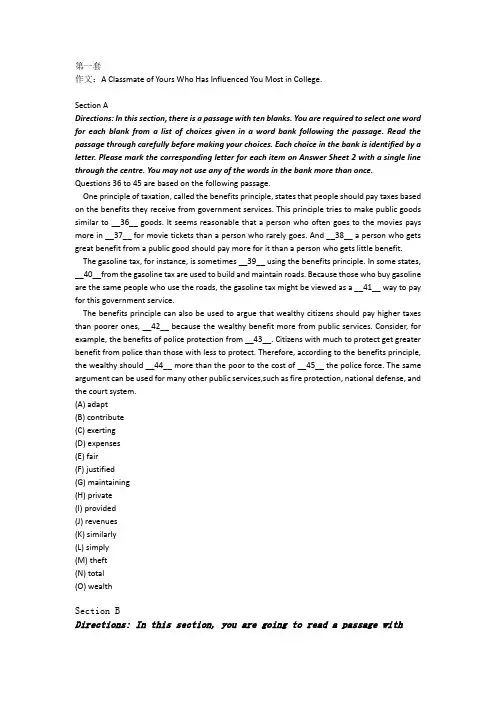
第一套作文:A Classmate of Yours Who Has Influenced You Most in College.Section ADirections: In this section, there is a passage with ten blanks. You are required to select one word for each blank from a list of choices given in a word bank following the passage. Read the passage through carefully before making your choices. Each choice in the bank is identified by a letter. Please mark the corresponding letter for each item on Answer Sheet 2 with a single line through the centre. You may not use any of the words in the bank more than once.Questions 36 to 45 are based on the following passage.One principle of taxation, called the benefits principle, states that people should pay taxes based on the benefits they receive from government services. This principle tries to make public goods similar to __36__ goods. It seems reasonable that a person who often goes to the movies pays more in __37__ for movie tickets than a person who rarely goes. And __38__ a person who gets great benefit from a public good should pay more for it than a person who gets little benefit. The gasoline tax, for instance, is sometimes __39__ using the benefits principle. In some states, __40__from the gasoline tax are used to build and maintain roads. Because those who buy gasoline are the same people who use the roads, the gasoline tax might be viewed as a __41__ way to pay for this government service.The benefits principle can also be used to argue that wealthy citizens should pay higher taxes than poorer ones, __42__ because the wealthy benefit more from public services. Consider, for example, the benefits of police protection from __43__. Citizens with much to protect get greater benefit from police than those with less to protect. Therefore, according to the benefits principle, the wealthy should __44__ more than the poor to the cost of __45__ the police force. The same argument can be used for many other public services,such as fire protection, national defense, and the court system.(A) adapt(B) contribute(C) exerting(D) expenses(E) fair(F) justified(G) maintaining(H) private(I) provided(J) revenues(K) similarly(L) simply(M) theft(N) total(O) wealthSection BDirections: In this section, you are going to read a passage with tenstatements attached to it. Each statement contains information given in one of the paragraphs. Identify the paragraph from which the information is derived. You may choose a paragraph more than once. Each paragraph is marked with a letter.Growing Up Colored[A] You wouldn't know Piedmont anymore—my Piedmont, I mean—the town in West Virginia where I learned to be a colored boy.[B] The 1950s in Piedmont was a time to remember, or at least to me. People were always proud to be from Piedmont—lying at the foot of a mountain, on the banks of the mighty Potomac. We knew God gave America no more beautiful location. I never knew colored people anywhere who were crazier about mountains and water, flowers and trees, fishing and hunting. For as long as anyone could remember, we could outhunt, outshoot, and outswim the white boys in the valley.[C] The social structure of Piedmont was something we knew like the back of our hands. It was an immigrant town; white Piedmont was Italian and Irish, with a handful of wealthy WASPs (盎格鲁撒克逊裔的白人新教徒) on East Hampshire Street, and "ethnic" neighborhoods of working-class people everywhere else, colored and white.[D] For as long as anyone can remember, Piedmont's character has been completely bound up with the Westvaco paper mill: its prosperous past and doubtful future. At first glance, the town is a typical dying mill center. Many once beautiful buildings stand empty, evidencing a bygone time of spirit and pride. The big houses on East Hampshire Street are no longer proud, as they were when I was a kid.[E] Like the Italians and the Irish, most of the colored people migrated to Piedmont at the turn of the 20th century to work at the paper mill, which opened in 1888. All the colored men at the paper mill worked on "the platform"—loading paper into trucks until the craft unions were finally integrated in 1968. Loading is what Daddy did every working day of his life. That's what almost every colored grown-up I knew did.[F] Colored people lived in three neighborhoods that were clearly separated. Welcome to the Colored Zone, a large stretched banner could have said. And it felt good in there, like walking around your house in bare feet and underwear, or snoring right out loud on the couch in front of the TV—enveloped by the comforts of home, the warmth of those you love.[G] Of course, the colored world was not so much a neighborhood as a condition of existence. And though our own world was seeminglyself-contained, it impacted on the white world of Piedmont in almost every direction. Certainly, the borders of our world seemed to be impacted on when some white man or woman showed up where he or she did not belong, such as at the black Legion Hall. Our space was violated when one of them showed up at a dance or a party. The rhythms would be off. The music would sound not quite right: attempts to pat the beat off just so. Everybodywould leave early.[H] Before 1955, most white people were just shadowy presences in our world, vague figures of power like remote bosses at the mill or tellers at the bank. There were exceptions, of course, the white people who would come into our world in ritualized, everyday ways we all understood. Mr. Mail Man, Mr. Insurance Man, Mr. White-and-Chocolate Milk Man, Mr. Landlord Man, Mr. Police Man: we called white people by their trade, like characters in a mystery play. Mr. Insurance Man would come by every other week to collect premiums on college or death policies, sometimes 50 cents or less.[I] "It's no disgrace to be colored," the black entertainer Bert Williams famously observed early in the century, "but it is awfully inconvenient." For most of my childhood, we couldn't cat in restaurants or sleep in hotels, we couldn't use certain bathrooms or try on clothes in stores. Mama insisted that we dress up when we went to shop. She was carefully dressed when she went to clothing stores, and wore white pads called shields under her arms so her dress or blouse would show no sweat. "We'd like to try this on," she'd say carefully, uttering her words precisely and properly. "We don't buy clothes we can't try on," she'd say when they declined, and we'd walk out in Mama's dignified (有尊严的) manner. She preferred to shop where we had an account and where everyone knew who she was.[J] At the Cut-Rate Drug Store, no one colored was allowed to sit down at the counter or tables, with one exception: my father. I don't know for certain why Carl Dadisman, the owner, wouldn't stop Daddy from sitting down. But I believe it was in part because Daddy was so light-colored, and in part because, during his shift at the phone company, he picked up orders for food and coffee for the operators. Colored people were supposed to stand at the counter, get their food to go, and leave. Even when Young Doc Bess would set up the basketball team with free Cokes after one of many victories, the colored players had to stand around and drink out of paper cups while the white players and cheerleaders sat down in comfortable chairs and drank out of glasses.[K] I couldn't have been much older than five or six as I sat with my father at the Cut-Rate one afternoon, enjoying two scoops of caramel ice cream. Mr. Wilson, a stony-faced, brooding Irishman, walked by. "Hello, Mr. Wilson," my father said."Hello, George."[L] I was genuinely puzzled. Mr. Wilson must have confused my father with somebody else, but who? There weren't any Georges among the colored people in Piedmont. "Why don't you tell him your name, Daddy?" I asked loudly. "Your name isn't George.""He knows my name, boy," my father said after a long pause. "He calls all colored people George."[M] I knew we wouldn't talk about it again; even at that age, 1 was given to understand that there were some subjects it didn't do to worry to death about. Now that I have children, I realize that what distressed my father wasn't so much the Mr. Wilsons of the world as the painful obligation to explain the racial facts of life to someone who hadn't quite learned them yet. Maybe Mr. Wilson couldn't hurt my father by calling him George; but I hurt him by asking to know why.46 . The author felt as a boy that his life in a separated neighborhood was casual and cozy.47 . There is every sign of decline at the paper mill now.48 . One reason the author's father could sit and eat at the drug store was that he didn't look that dark.49 . Piedmont was a town of immigrants from different parts of the world.50 . In spite of the awful inconveniences caused by racial prejudice, the author's family managed to live a life of dignity.51 . The author later realized he had caused great distress to his father by asking why he was wrongly addressed.52 . The author took pride in being from Piedmont because of its natural beauty.53 . Colored people called white people by the business they did.54 . Colored people who lived in Piedmont did heavy manual jobs at the paper mill.55 . The colored people felt uneasy at the presence of the whites in their neighborhood.Section CDirections: There are 2 passages in this section. Each passage is followed by some questions or unfinished statements. For each of them there are four choices marked A), B), C) and D). You should decide on the best choice. Passage OneQuestions 56 to 60 are based on the following passage.Children are a delight. They are our future. But sadly, hiring someone to take care of them while you go to work is getting more expensive by the year.Earlier this month, it was reported that the cost of enrolling an infant or small kid at a childcare center rose 3% in 2012, faster than the overall cost of living. There are now large strips of the country where daycare for an infant costs more than a tenth of the average married couple's income.This is not necessarily a new trend, but it is a somewhat puzzling one. The price of professional childcare has been rising since the 1980s. Yet during that time, pay for professional childcare workers has stood still. Actually caregivers make less today, in real terms, than they didin 1990. Considering that labor costs are responsible for up to 80% of a daycare center's expenses, one would expect flat wages to have meant flat prices.So who's to blame for higher childcare costs?Childcare is a carefully regulated industry. States lay down rules about how many children each employee is allowed to watch over, the space care centers need per child, and other minute details. And the stricter the regulations, the higher the costs. If it has to hire a caregiver for every two children, it can't really achieve any economies of scale on labor to save money when other expenses go up. In Massachusetts, where childcare centers must hire one teacher for every three infants, the price of care averaged more than $16,000 per year. In Mississippi, where centers must hire one teacher for every five infants, the price of care averaged less than $5,000.Unfortunately, I don't have all the daycare-center regulations handy. But I wouldn't be surprised if as the rules have become more elaborate, prices have risen. The tradeoff (交换) might be worth it in some cases; after all, the health and safety of children should probably come before cheap service. But certainly, it doesn't seem to be an accident that some of the cheapest daycare available is in the least regulated South.56 . What problem do parents of small kids have to face?∙ A The ever-rising childcare prices.∙ B The budgeting of family expenses.∙ C The balance between work and family.∙ D The selection of a good daycare center.57 . What does the author feel puzzled about?∙ A Why the prices of childcare vary greatly from state to state.∙ B Why increased childcare prices have not led to better service.∙ C Why childcare workers' pay has not increased with the rising childcare costs.∙ D Why there is a severe shortage of childcare professional in a number of states.58 . What prevent childcare centers from saving money?∙ A Steady increase in labor costs.∙ B Strict government regulations.∙ C Lack of support from the state.∙ D High administrative expenses.59 . Why is the average cost of childcare in Mississippi much lower than in Massachusetts?∙ A The overall quality of service is not as good.∙ B Payments for caregivers there are not as high.∙ C Living expenses there are comparatively low.∙ D Each teacher is allowed to care for more kids.60 . What is the author's view on daycare service?∙ A Caregivers should receive regular professional training.∙ B Less elaborate rules about childcare might lower costs.∙ C It is crucial to strike a balance between quality and costs.∙ D It is better for different states to learn from each other.Passage TwoQuestions 61 to 65 are based on the following passage.Alex Pang's amusing new book The Distraction Addiction addresses those of us who feel panic without a cellphone or computer. And that, he claims, is pretty much all of us. When we're not online, where we spend four months annually, we're engaged in the stressful work of trying to get online.The Distraction Addiction is not framed as a self-help book. It's a thoughtful examination of the danger of our computing overdose and a historical overview of how technological advances change consciousness.A "professional futurist", Pang urges an approach which he calls "contemplative (沉思的) computing." He asks that you pay full attention to "how your mind and body interact with computers and how your attention and creativity are influenced by technology."Pang's first job is to free you from common misconception that doing two things at once allows you to get more done. What is commonly called multitasking is, in fact, switch-tasking, and its harmful effects on productivity are well documented. Pang doesn't advocate returning to a pre-Internet world. Instead, he asks you to "take a more ecological (生态的) view of your relationships with technologies and look for ways devices or media may be making specific tasks easier or faster but at the same time making your work and life harder."The Distraction Addiction is particularly fascinating on how technologies have changed certain field of labor—often for the worse. For architects, computer-aided design has become essential but in some ways has cheapened the design process. As one architect puts it, "Architecture is first and foremost about thinking and drawing is a more productive way of thinking" than computer-aided design. Somewhat less amusing are Pang's solutions for kicking the Internet habit. He recommends the usual behavior-modification approaches, familiar to anyone who hascompleted a quit-smoking program. Keep logs to study your online profile and decide what you can knock out, download a program like Freedom that locks you out of your browser, or take a "digital Sabbath (安息日)" ; "Unless you're a reporter or emergency-department doctor, you'll discover that your world doesn't fall apart when you go offline."61 . Alex Pang's new book is aimed for readers who ________.∙ A find their work online too stressful∙ B go online mainly for entertainment∙ C are fearful about using the cellphone or computer∙ D can hardly tear themselves away from the Internet62 . What does Alex Pang try to do in his new book?∙ A Offer advice on how to use the Internet effectively.∙ B Warn people of the possible dangers of Internet use.∙ C Predict the trend of future technological development.∙ D xamine the influence of technology on the human mind.63 . What is the common view on multitasking?∙ A It enables people to work more efficiently.∙ B It is in a way quite similar to switch-tasking.∙ C It makes people's work and life even harder.∙ D It distracts people's attention from useful work.64 . What does the author think of computer-aided design?∙ A It considerably cuts down the cost of building design.∙ B It somewhat restrains architects' productive thinking.∙ C It is indispensable in architects' work process.∙ D It can free architects from laborious drawing.65 . What is Ales Pang's recommendation for Internet users?∙ A They use the Internet as little as possible.∙ B They keep a record of their computer use time.∙ C They exercise self-control over their time online.∙ D They entertain themselves online on off-days only.第二套作文:A Course That Has Impressed You Most in College.Section ADirections: In this section, there is a passage with ten blanks. You are required to select one word for each blank from a list of choices given in a word bank following the passage. Read the passage through carefully before making your choices. Each choice in the bank is identified by a letter. Please mark the corresponding letter for each item on Answer Sheet 2 with a single line through the centre. You may not use any of the words in the bank more than once.Questions 36 to 45 are based on the following passage.As an Alaskan fisherman, Timothy June, 54, used to think that he was safe from industrial pollutants(污染物) at his home in Haines—a town with a population of 2,400 people and 4,000 eagles, with 8 million acres of protected wild land nearby. But in early 2007, June agreed to take part in a __36__ of 35 Americans from seven states. It was a biomonitoring project, in which people's blood and urine(尿) were tested for __37__ of chemicals—in this case, three potentially dangerous classes of compounds found in common household __38__ like face cream, tin cans,and shower curtains. The results—__39__ in November in a report called "Is It in Us?" by an environmental group—were rather worrying . Every one of the participants, __40__ from an Illinois State senator to a Massachusetts minister, tested positive for all three classes of pollutants. And while the __41__ presence of these chemicals does not __42__ indicate a health risk, the fact that typical Americans carry these chemicals at all __43__ June and his fellow participants.Clearly, there are chemicals in our bodies that don't __44__ there. A large, ongoing study conducted by the Centers for Disease Control and Prevention has found 148 chemicals in Americans of all ages. And in 2005, the Environmental Working Group found an __45__ of 200 chemicals in the blood of 10 new-borns. "Our babiesare being born pre-polluted." says Sharyle Patton of Commonweal, which cosponsored "Is it in Us?" "This is going to be the next big environmental issue after climate change."(A) analyses(B) average(C) belong(D) demonstrated(E) excess(F) extending(G) habitually(H) necessarily(I) products(J) ranging(K) released(L) shocked(M) simple(N) survey(O) tracesSection BDirections: In this section, you are going to read a passage with ten statements attached to it. Each statement contains information given in one of the paragraphs. Identify the paragraph from which the informationis derived. You may choose a paragraph more than once. Each paragraph is marked with a letter. Answer the questions by marking the corresponding letter on Answer Sheet 2.In Hard Economy for All Ages. Older Isn't Better...It's Brutal A) Young graduates are in debt, out of work and on their parents' couches. People in their 30s and 40s can't afford to buy homes or have children. Retirees are earning near-zero interest on their savings.B) In the current listless (缺乏活力) economy, every generation has a claim to having been most injured. But the Labor Department's latest jobs reports and other recent data present a strong case for crowning baby boomers (二战后生育高峰期出生的人) as the greatest victims of the recession and its dreadful consequences.C) These Americans in their 50s and early 60s—those near retirement age who do not yet have access to Medicare and Social Security—have lost the most earnings power of any age group, with their household incomes 10 percent below what they made when the recovery began three years ago, according to Sentier Research, a data analysis company. Their retirement savings and home values fell sharply at the worst possible time: just before they needed to cash out. They are supporting both aged parents and unemployed young-adult children, earning them the unlucky nickname "Generation Squeeze."D) New research suggests that they may die sooner, because their health, income security and mental well-being were battered (重创) by recession at a crucial time in their lives. A recent study by economists at Wellesley College found that people who lost their jobs in the few years before becoming qualified for Social Security lost up to three years from their life expectancy (预期寿命), largely because they no longer had access to affordable health care.E) Unemployment rates for Americans nearing retirement are far lower than those for young people, who are recently out of school, with fewer skills and a shorter work history. But once out of a job, older workers have a much harder time finding another one. Over the last year, the average duration of unemployment for older people was 53 weeks, compared with 19 weeks for teenagers, according to the Labor Department's jobs report released on Friday.F) The lengthy process is partly because older workers are more likely to have been laid off from industries that are downsizing, like manufacturing. Compared with the rest of the population, older people are also more likely to own their own homes and be less mobile than renters, who can move to new job markets.G) Older workers are more likely to have a disability of some sort, perhaps limiting the range of jobs that offer realistic choices. They may also be less inclined, at least initially, to take jobs that pay far less than their old positions.H) Displaced boomers also believe they are victims of age discrimination, because employers can easily find a young, energetic worker who will accept lower pay and who can potentially stick around for decades rather than a few years.I) In a survey by the center of older workers who were laid off during the recession, just one in six had found another job, and half of that group had accepted pay cuts. 14% of the re-employed said the pay in their new job was less than half what they earned in their previous job. "I just say to myself: 'Why me? What have 1 done to deserve this?'" said John Agati, 56, whose last full-time job, as a product developer, ended four years ago when his employer went out of business. That position paid $90,000, and his resume lists jobs at companies like American Express, Disney and USA Networks. Since being laid off, though, he has worked a series of part-time, low-wage, temporary positions, including selling shoes at Lord & Taylor and making sales calls for a car company.J) The last few years have taken a toll not only on his family's finances, but also on his feelings of self-worth. "You just get sad," Mr. Agati said. "I see people getting up in the morning, going out to their careers and going home. I just wish I was doing that. Some people don't like their jobs, or they have problems with their jobs, but at least they're working. I just wish I was in their shoes." He said he cannot afford to go back to school, as many younger people without jobs have done. Even if he could afford it, economists say it is unclear whether older workers like him benefit much from more education.K) "It just doesn't make sense to offer retraining for people 55 and older," said Daniel Hamermesh, an economics professor. "Discrimination by age, long-term unemployment, and the fact that they're now at the end of the hiring queue just don't make it sensible to invest in them." L) Many displaced older workers are taking this message to heart and leaving the labor force entirely. The share of older people applying for Social Security early rose quickly during the recession as people sought whatever income they could find. The penalty they will pay is permanent, as retirees who take benefits at age 62 will receive as much as 30% less in each month's check for the rest of their lives than they would if they had waited until full retirement age (66 for those born after 1942). M) Those not yet eligible for Social Security are increasingly applying for another, comparable kind of income support that often goes to people who expect never to work again: disability benefits. More than one in eight people in their late 50s is now on some form of federal disability insurance program, according to Mark Duggan at the University of Pennsylvania's Wharton School.N) The very oldest Americans, of course, were battered by some of the same ill winds that tormented those now nearing retirement, but at least the most senior were cushioned by a more readily available social safetynet. More important, in a statistical twist, they may have actually benefited from the financial crisis in the most fundamental way: prolonged lives.O) Death rates for people over 65 have historically fallen during recessions, according to a November 2011 study by economists at the University of California, Davis. Why? The researchers argue that weak job markets push more workers into accepting relatively undesirable work at nursing homes, leading to better care for residents.46 . Greater mobility puts younger people at an advantage in seeking new jobs.47 . Many of the older workers laid off during the recession had to accept lower pay in their new jobs.48 . Those who has their jobs shortly before retirement age live a shorter-than-average life.49 . Seniors at nursing homes could benefit from the weak job market.50 . Age discrimination in employment makes it pointless retraining older workers.51 . According to recent reports and data analyses, boomers suffer most from the weak economy.52 . Unemployed boomers are at a disadvantage in job-hunting because employers tend to hire younger workers.53 . People in their fifties and early sixties bear the heaviest family burdens.54 . People who take benefits from Social Security before official retirement age will get muchless for the rest of their lives.55 . Older workers' choice of jobs can be limited because of disability.Section CDirections: There are 2 passages in this section. Each passage is followed by some questions or unfinished statements. For each of them there are four choices marked A), B), C) and D). You should decide on the best choice and mark the corresponding letter on Answer Sheet 2 with a single line through the centre.Passage OneQuestions 56 to 60 are based on the following passage.New Yorkers are gradually getting used to more pedaling (骑车) passengers on those blazing blue Citi Bikes. But what about local bike shops? Is Citi Bike rolling up riders at their expense?At Gotham Bikes in Tribeca, a manager W. Ben said the shop has seen an increase in its overall sales due to the bike-share program. "It's getting more people on the road" he said. James Ryan, an employee at Danny's Cycles in Gramercy also said Citi Bike is a good option for people。