
A Lattice Evaluation of the Deep-Inelastic Structure Functions of the Nucleon
- 格式:pdf
- 大小:216.58 KB
- 文档页数:11
e
p
-
l
a
t
/
9
5
0
9
0
7
9
2
5
S
e
p
1
9
9
5
m
eff
N
t
Z
µ
2
µ
2
Z
u
d
d
u
u
d
1/κ
1/κ
1/κ
∆q
d
u
1/κ
e
p
-
l
a
t
/
9
5
0
9
0
7
9
2
5
S
e
p
1
9
9
5
m
eff
N
t
Z
µ
2
µ
2
Z
u
d
d
u
u
d
1/κ
1/κ
1/κ
∆q
d
u
1/κ

X 射线晶体学作业参考答案第三章:晶体结构与空间点阵1. 六角晶系的晶面指数一般写成四个(h k -h-k l ),但在衍射的计算和处理软件中,仍然用三个基矢(hkl )。
计算出六角晶系的倒格基矢,并写出六角晶系的两个晶面之间的夹角的表达式。
已知六角晶系的基矢为解:根据倒格子的定义式,计算可得:()k a c j ac b j i ac a 2***323Ω=Ω=+Ω=πππ 任意两个晶面(hkl)和(h ’k ’l ’)的晶面夹角θ是: ()()()()22222222222222222222222222'''''''3''''434'3)''(2)''(4'3''''434'3)'2')(2('3arccos l a k k h h c l a k hk h c ll a k h hk c kk hh c l a k k h h c l a k hk h c ll a k h k h c hh c G G G G l k h hkl l k h hkl +++⨯+++++++=+++⨯+++++++=⎪⎪⎪⎭⎫ ⎝⎛∙= θ2. 分别以晶格常数为单位和以实际大小写出SrTiO 3晶胞中各离子的坐标,并计算SrTiO3的质量密度和电子数密度。
解:Sr 原子量87.62,电子数38;Ti 原子量47.9,电子数22;O 原子量15.999,电子数8 (数据取自国际衍射数据中心)。
质量密度:kc c j i a b ia a =+-==)2321(电子数密度:3.*为什么位错不能终止于晶体内部?请说明原因。
答:作为一维缺陷的位错如果终止在晶体内部,则必然在遭到破坏的方向上产生连带的破坏,因此一根位错线不能终止于晶体内部,而只能露头于晶体表面(包括晶界),同时Burgers vector 的封闭性(守恒)也要求位错不能终止在晶体内部。
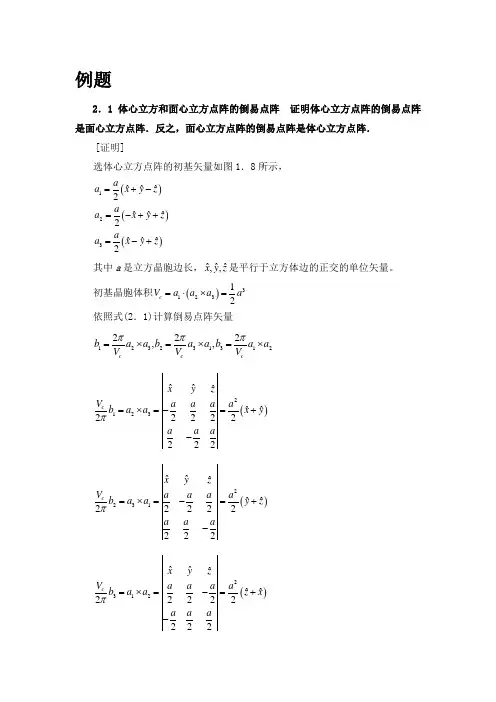
例题2.1体心立方和面心立方点阵的倒易点阵 证明体心立方点阵的倒易点阵是面心立方点阵.反之,面心立方点阵的倒易点阵是体心立方点阵. [证明]选体心立方点阵的初基矢量如图1.8所示,()1ˆˆˆ2aa x y z =+- ()2ˆˆˆ2aa x y z =-++ ()3ˆˆˆ2aa x y z =-+ 其中a 是立方晶胞边长,ˆˆˆ,,xy z 是平行于立方体边的正交的单位矢量。
初基晶胞体积()312312c V a a a a =⋅⨯=依照式(2.1)计算倒易点阵矢量123231312222,,c c cb a a b a a b a a V V V πππ=⨯=⨯=⨯ ()2123ˆˆˆˆˆ22222222c x y zV a a a a b a a xy a a a π=⨯=-=+- ()2231ˆˆˆˆˆ22222222c xy z V a a a a b a a yz a a a π=⨯=-=+- ()2312ˆˆˆˆˆ22222222c xy zV a a a a b a a zx a a a π=⨯=-=+-于是有:()()()123222ˆˆˆˆˆˆ,,b x y b y z b z x a a aπππ=+=+=+ 显然123,,b b b 正是面心立方点阵的初基矢量,故体心立方点阵的倒易点阵是面心立方点阵,立方晶胞边长是4a π.同理,对面心立方点阵写出初基矢量()1ˆˆ2aa x y =+ ()2ˆˆ2aa y z =+ ()3ˆˆ2aa z x =+ 如下图。
初基晶胞体积()312314c V a a a a =⋅⨯=。
依照式(2.1)计算倒易点阵矢量()()()123222ˆˆˆˆˆˆˆˆˆ,,b x y z b x y z b x y z a a aπππ=+-=-++=-+ 显然,123,,b b b 正是体心立方点阵的初基矢量,故面心立方点阵的倒易点阵为体心立方点阵,其立方晶胞边长是4a π.2.2 (a) 证明倒易点阵初基晶胞的体积是()32/c V π,那个地址c V 是晶体点阵初基晶胞的体积;(b) 证明倒易点阵的倒易点阵是晶体点阵自身.[证明](a) 倒易点阵初基晶胞体积为()123b b b ⋅⨯,现计算()123b b b ⋅⨯.由式(2.1)知,123231312222,,c c cb a a b a a b a a V V V πππ=⨯=⨯=⨯ 此处()123c V a a a =⋅⨯ 而()()()(){}222331123121311222c c b b a a a a a a a a a a a a V V ππ⎛⎫⎛⎫⨯=⨯⨯⨯=⨯⋅-⨯⋅⎡⎤⎡⎤ ⎪ ⎪⎣⎦⎣⎦⎝⎭⎝⎭那个地址引用了公式:()()()()A B C D A B D C A B C D ⨯⨯⨯=⨯⋅-⨯⋅⎡⎤⎡⎤⎣⎦⎣⎦。
1/4波片quarter-wave plateCG矢量耦合系数Clebsch-Gordan vector coupling coefficient; 简称“CG[矢耦]系数”。
X射线摄谱仪X-ray spectrographX射线衍射X-ray diffractionX射线衍射仪X-ray diffractometer[玻耳兹曼]H定理[Boltzmann] H-theorem[玻耳兹曼]H函数[Boltzmann] H-function[彻]体力body force[冲]击波shock wave[冲]击波前shock front[狄拉克]δ函数[Dirac] δ-function[第二类]拉格朗日方程Lagrange equation[电]极化强度[electric] polarization[反射]镜mirror[光]谱线spectral line[光]谱仪spectrometer[光]照度illuminance[光学]测角计[optical] goniometer[核]同质异能素[nuclear] isomer[化学]平衡常量[chemical] equilibrium constant[基]元电荷elementary charge[激光]散斑speckle[吉布斯]相律[Gibbs] phase rule[可]变形体deformable body[克劳修斯-]克拉珀龙方程[Clausius-] Clapeyron equation[量子]态[quantum] state[麦克斯韦-]玻耳兹曼分布[Maxwell-]Boltzmann distribution[麦克斯韦-]玻耳兹曼统计法[Maxwell-]Boltzmann statistics[普适]气体常量[universal] gas constant[气]泡室bubble chamber[热]对流[heat] convection[热力学]过程[thermodynamic] process[热力学]力[thermodynamic] force[热力学]流[thermodynamic] flux[热力学]循环[thermodynamic] cycle[事件]间隔interval of events[微观粒子]全同性原理identity principle [of microparticles][物]态参量state parameter, state property[相]互作用interaction[相]互作用绘景interaction picture[相]互作用能interaction energy[旋光]糖量计saccharimeter[指]北极north pole, N pole[指]南极south pole, S pole[主]光轴[principal] optical axis[转动]瞬心instantaneous centre [of rotation][转动]瞬轴instantaneous axis [of rotation]t 分布student's t distributiont 检验student's t testK俘获K-captureS矩阵S-matrixWKB近似WKB approximationX射线X-rayΓ空间Γ-spaceα粒子α-particleα射线α-rayα衰变α-decayβ射线β-rayβ衰变β-decayγ矩阵γ-matrixγ射线γ-rayγ衰变γ-decayλ相变λ-transitionμ空间μ-spaceχ 分布chi square distributionχ 检验chi square test阿贝不变量Abbe invariant阿贝成象原理Abbe principle of image formation阿贝折射计Abbe refractometer阿贝正弦条件Abbe sine condition阿伏伽德罗常量Avogadro constant阿伏伽德罗定律Avogadro law阿基米德原理Archimedes principle阿特伍德机Atwood machine艾里斑Airy disk爱因斯坦-斯莫卢霍夫斯基理论Einstein-Smoluchowski theory 爱因斯坦场方程Einstein field equation爱因斯坦等效原理Einstein equivalence principle爱因斯坦关系Einstein relation爱因斯坦求和约定Einstein summation convention爱因斯坦同步Einstein synchronization爱因斯坦系数Einstein coefficient安[培]匝数ampere-turns安培[分子电流]假说Ampere hypothesis安培定律Ampere law安培环路定理Ampere circuital theorem安培计ammeter安培力Ampere force安培天平Ampere balance昂萨格倒易关系Onsager reciprocal relation凹面光栅concave grating凹面镜concave mirror凹透镜concave lens奥温电桥Owen bridge巴比涅补偿器Babinet compensator巴耳末系Balmer series白光white light摆pendulum板极plate伴线satellite line半波片halfwave plate半波损失half-wave loss半波天线half-wave antenna半导体semiconductor半导体激光器semiconductor laser半衰期half life period半透[明]膜semi-transparent film半影penumbra半周期带half-period zone傍轴近似paraxial approximation傍轴区paraxial region傍轴条件paraxial condition薄膜干涉film interference薄膜光学film optics薄透镜thin lens保守力conservative force保守系conservative system饱和saturation饱和磁化强度saturation magnetization本底background本体瞬心迹polhode本影umbra本征函数eigenfunction本征频率eigenfrequency本征矢[量] eigenvector本征振荡eigen oscillation本征振动eigenvibration本征值eigenvalue本征值方程eigenvalue equation比长仪comparator比荷specific charge; 又称“荷质比(charge-mass ratio)”。
a r X i v :h e p -p h /9711228v 1 4 N o v 1997hep-ph/9711228October 1997O (α)QED Corrections to Polarized Elastic µe and Deep Inelastic lN ScatteringDima Bardin a,b,c ,Johannes Bl¨u mlein a ,Penka Christova a,d ,and Lida Kalinovskaya a,caDESY–Zeuthen,Platanenallee 6,D–15735Zeuthen,GermanybINFN,Sezione di Torino,Torino,ItalycJINR,ul.Joliot-Curie 6,RU–141980Dubna,RussiadBishop Konstantin Preslavsky University of Shoumen,9700Shoumen,BulgariaAbstractTwo computer codes relevant for the description of deep inelastic scattering offpolarized targets are discussed.The code µe la deals with radiative corrections to elastic µe scattering,one method applied for muon beam polarimetry.The code HECTOR allows to calculate both the radiative corrections for unpolarized and polarized deep inelastic scattering,including higher order QED corrections.1IntroductionThe exact knowledge of QED,QCD,and electroweak (EW)radiative corrections (RC)to the deep inelastic scattering (DIS)processes is necessary for a precise determination of the nucleon structure functions.The present and forthcoming high statistics measurements of polarized structure functions in the SLAC experiments,by HERMES,and later by COMPASS require the knowledge of the RC to the DIS polarized cross-sections at the percent level.Several codes based on different approaches for the calculation of the RC to DIS experiments,mainly for non-polarized DIS,were developped and thoroughly compared in the past,cf.[1].Later on the radiative corrections for a vast amount of experimentally relevant sets of kinematic variables were calculated [2],including also semi-inclusive situations as the RC’s in the case of tagged photons [3].Furthermore the radiative corrections to elastic µ-e scattering,a process to monitor (polarized)muon beams,were calculated [4].The corresponding codes are :•HECTOR 1.00,(1994-1995)[5],by the Dubna-Zeuthen Group.It calculates QED,QCD and EW corrections for variety of measuremets for unpolarized DIS.•µe la 1.00,(March 1996)[4],calculates O (α)QED correction for polarized µe elastic scattering.•HECTOR1.11,(1996)extends HECTOR1.00including the radiative corrections for polarized DIS[6],and for DIS with tagged photons[3].The beta-version of the code is available from http://www.ifh.de/.2The Programµe laMuon beams may be monitored using the processes ofµdecay andµe scattering in case of atomic targets.Both processes were used by the SMC experiment.Similar techniques will be used by the COMPASS experiment.For the cross section measurement the radiative corrections to these processes have to be known at high precision.For this purpose a renewed calculation of the radiative corrections toσ(µe→µe)was performed[4].The differential cross-section of polarized elasticµe scattering in the Born approximation reads,cf.[7],dσBORNm e Eµ (Y−y)2(1−P e Pµ) ,(1)where y=yµ=1−E′µ/Eµ=E′e/Eµ=y e,Y=(1+mµ/2/Eµ)−1=y max,mµ,m e–muon and electron masses,Eµ,E′µ,E′e the energies of the incoming and outgoing muon,and outgoing electron respectively,in the laboratory frame.Pµand P e denote the longitudinal polarizations of muon beam and electron target.At Born level yµand y e agree.However,both quantities are different under inclusion of radiative corrections due to bremsstrahlung.The correction factors may be rather different depending on which variables(yµor y e)are used.In the SMC analysis the yµ-distribution was used to measure the electron spin-flip asymmetry A expµe.Since previous calculations,[8,9],referred to y e,and only ref.[9]took polarizations into account,a new calculation was performed,including the complete O(α)QED correction for the yµ-distribution,longitudinal polarizations for both leptons,theµ-mass effects,and neglecting m e wherever possible.Furthermore the present calculation allows for cuts on the electron re-coil energy(35GeV),the energy balance(40GeV),and angular cuts for both outgoing leptons (1mrad).The default values are given in parentheses.Up to order O(α3),14Feynman graphs contribute to the cross-section forµ-e scattering, which may be subdivided into12=2×6pieces,which are separately gauge invariantdσQEDdyµ.(2) One may express(2)also asdσQEDdyµ+P e Pµdσpol kk=1−Born cross-section,k=b;2−RC for the muonic current:vertex+bremsstrahlung,k=µµ;3−amm contribution from muonic current,k=amm;4−RC for the electronic current:vertex+bremsstrahlung,k=ee;5−µe interference:two-photon exchange+muon-electron bremsstrahlung interference,k=µe;6−vacuum polarization correction,runningα,k=vp.The FORTRAN code for the scattering cross section(2)µe la was used in a recent analysis of the SMC collaboration.The RC,δA yµ,to the asymmetry A QEDµeshown infigures1and2is defined asδA yµ=A QEDµedσunpol.(4)The results may be summarized as follows.The O(α)QED RC to polarized elasticµe scattering were calculated for thefirst time using the variable yµ.A rather general FORTRAN codeµe la for this process was created allowing for the inclusion of kinematic cuts.Since under the conditions of the SMC experiment the corrections turn out to be small our calculation justifies their neglection. 3Program HECTOR3.1Different approaches to RC for DISThe radiative corrections to deep inelastic scattering are treated using two basic approaches. One possibility consists in generating events on the basis of matrix elements including the RC’s. This approach is suited for detector simulations,but requests a very hughe number of events to obtain the corrections at a high precision.Alternatively,semi-analytic codes allow a fast and very precise evaluation,even including a series of basic cuts andflexible adjustment to specific phase space requirements,which may be caused by the way kinematic variables are experimentally measured,cf.[2,5].Recently,a third approach,the so-called deterministic approach,was followed,cf.[10].It treats the RC’s completely exclusively combining features of fast computing with the possibility to apply any cuts.Some elements of this approach were used inµe la and in the branch of HECTOR1.11,in which DIS with tagged photons is calculated.Concerning the theoretical treatment three approaches are in use to calculate the radiative corrections:1)the model-independent approach(MI);2)the leading-log approximation(LLA); and3)an approach based on the quark-parton model(QPM)in evaluating the radiative correc-tions to the scattering cross-section.In the model-independent approach the QED corrections are only evaluated for the leptonic tensor.Strictly it applies only for neutral current processes.The hadronic tensor can be dealt with in its most general form on the Lorentz-level.Both lepton-hadron corrections as well as pure hadronic corrections are neglected.This is justified in a series of cases in which these corrections turn out to be very small.The leading logarithmic approximation is one of the semi-analytic treatments in which the different collinear singularities of O((αln(Q2/m2l))n)are evaluated and other corrections are neglected.The QPM-approach deals with the full set of diagrams on the quark level.Within this method,any corrections(lepton-hadron interference, EW)can be included.However,it has limited precision too,now due to use of QPM-model itself. Details on the realization of these approaches within the code HECTOR are given in ref.[5,11].3.2O (α)QED Corrections for Polarized Deep Inelastic ScatteringTo introduce basic notation,we show the Born diagramr rr r j r r r r l ∓( k 1,m )l ∓( k 2,m )X ( p ′,M h )p ( p ,M )γ,Z ¨¨¨¨B ¨¨¨¨£¢ ¡£¢ ¡£¢ ¡£¢ ¡£¢ ¡£¢ ¡£¢ ¡£¢ ¡£¢ ¡£¢ ¡z r r r r r r r r r r r r r rr ¨¨¨¨B ¨¨¨¨r r r r j r r r r and the Born cross-section,which is presented as the product of the leptonic and hadronic tensordσBorn =2πα2p.k 1,x =Q 2q 2F 1(x,Q 2)+p µ p ν2p.qF 3(x,Q 2)+ie µνλσq λs σ(p.q )2G 2(x,Q 2)+p µ s ν+ s µ p νp.q1(p.q )2G 4(x,Q 2)+−g µν+q µq νp.qG 5(x,Q 2),(8)wherep µ=p µ−p.qq 2q µ,and s is the four vector of nucleon polarization,which is given by s =λp M (0, n )in the nucleonrest frame.The combined structure functions in eq.(8)F1,2(x,Q2)=Q2e Fγγ1,2(x,Q2)+2|Q e|(v l−p eλl a l)χ(Q2)FγZ1,2(x,Q2)+ v2l+a2l−2p eλl v l a l χ2(Q2)F ZZ1,2(x,Q2),F3(x,Q2)=2|Q e|(p e a l−λl v l)χ(Q2)FγZ3(x,Q2),+ 2p e v l a l−λl v2l+a2l χ2(Q2)F ZZ3(x,Q2),G1,2(x,Q2)=−Q2eλl gγγ1,2(x,Q2)+2|Q e|(p e a l−λl v l)χ(Q2)gγZ1,2(x,Q2),+ 2p e v l a l−λl v2l+a2l χ2(Q2)g ZZ1,2(x,Q2),G3,4,5(x,Q2)=2|Q e|(v l−p eλl a l)χ(Q2)gγZ3,4,5(x,Q2),+ v2l+a2l−2p eλl v l a l χ2(Q2)g ZZ3,4,5(x,Q2),(9) are expressed via the hadronic structure functions,the Z-boson-lepton couplings v l,a l,and the ratio of the propagators for the photon and Z-bosonχ(Q2)=Gµ2M2ZQ2+M2Z.(10)Furthermore we use the parameter p e for which p e=1for a scattered lepton and p e=−1for a scattered antilepton.The hadronic structure functions can be expressed in terms of parton densities accounting for the twist-2contributions only,see[12].Here,a series of relations between the different structure functions are used in leading order QCD.The DIS cross-section on the Born-leveld2σBorndxdy +d2σpol Borndxdy =2πα2S ,S U3(y,Q2)=x 1−(1−y)2 ,(13) and the polarized partdσpol BornQ4λp N f p S5i=1S p gi(x,y)G i(x,Q2).(14)Here,S p gi(x,y)are functions,similar to(13),and may be found in[6].Furthermore we used the abbrevationsf L=1, n L=λp N k 12πSy 1−y−M2xy2π1−yThe O(α)DIS cross-section readsd2σQED,1πδVRd2σBorndx l dy l=d2σunpolQED,1dx l dy l.(16)All partial cross-sections have a form similar to the Born cross-section and are expressed in terms of kinematic functions and combinations of structure functions.In the O(α)approximation the measured cross-section,σrad,is define asd2σraddx l dy l +d2σQED,1dx l dy l+d2σpol radd2σBorn−1.(18)The radiative corrections calculated for leptonic variables grow towards high y and smaller values of x.Thefigures compare the results obtained in LLA,accounting for initial(i)andfinal state (f)radiation,as well as the Compton contribution(c2)with the result of the complete calculation of the leptonic corrections.In most of the phase space the LLA correction provides an excellent description,except of extreme kinematic ranges.A comparison of the radiative corrections for polarized deep inelastic scattering between the codes HECTOR and POLRAD[17]was carried out.It had to be performed under simplified conditions due to the restrictions of POLRAD.Corresponding results may be found in[11,13,14].3.3ConclusionsFor the evaluation of the QED radiative corrections to deep inelastic scattering of polarized targets two codes HECTOR and POLRAD exist.The code HECTOR allows a completely general study of the radiative corrections in the model independent approach in O(α)for neutral current reac-tions including Z-boson exchange.Furthermore,the LLA corrections are available in1st and2nd order,including soft-photon resummation and for charged current reactions.POLRAD contains a branch which may be used for some semi-inclusive DIS processes.The initial state radia-tive corrections(to2nd order in LLA+soft photon exponentiation)to these(and many more processes)can be calculated in detail with the code HECTOR,if the corresponding user-supplied routine USRBRN is used together with this package.This applies both for neutral and charged current processes as well as a large variety of different measurements of kinematic variables. Aside the leptonic corrections,which were studied in detail already,further investigations may concern QED corrections to the hadronic tensor as well as the interference terms. References[1]Proceedings of the Workshop on Physics at HERA,1991Hamburg(DESY,Hamburg,1992),W.Buchm¨u ller and G.Ingelman(eds.).[2]J.Bl¨u mlein,Z.Phys.C65(1995)293.[3]D.Bardin,L.Kalinovskaya and T.Riemann,DESY96–213,Z.Phys.C in print.[4]D.Bardin and L.Kalinovskaya,µe la,version1.00,March1996.The source code is availablefrom http://www.ifh.de/~bardin.[5]A.Arbuzov,D.Bardin,J.Bl¨u mlein,L.Kalinovskaya and T.Riemann,Comput.Phys.Commun.94(1996)128,hep-ph/9510410[6]D.Bardin,J.Bl¨u mlein,P.Christova and L.Kalinovskaya,DESY96–189,hep-ph/9612435,Nucl.Phys.B in print.[7]SMC collaboration,D.Adams et al.,Phys.Lett.B396(1997)338;Phys.Rev.D56(1997)5330,and references therein.[8]A.I.Nikischov,Sov.J.Exp.Theor.Phys.Lett.9(1960)757;P.van Nieuwenhuizen,Nucl.Phys.B28(1971)429;D.Bardin and N.Shumeiko,Nucl.Phys.B127(1977)242.[9]T.V.Kukhto,N.M.Shumeiko and S.I.Timoshin,J.Phys.G13(1987)725.[10]G.Passarino,mun.97(1996)261.[11]D.Bardin,J.Bl¨u mlein,P.Christova,L.Kalinovskaya,and T.Riemann,Acta Phys.PolonicaB28(1997)511.[12]J.Bl¨u mlein and N.Kochelev,Phys.Lett.B381(1996)296;Nucl.Phys.B498(1997)285.[13]D.Bardin,J.Bl¨u mlein,P.Christova and L.Kalinovskaya,Preprint DESY96–198,hep-ph/9609399,in:Proceedings of the Workshop‘Future Physics at HERA’,G.Ingelman,A.De Roeck,R.Klanner(eds.),Vol.1,p.13;hep-ph/9609399.[14]D.Bardin,Contribution to the Proceedings of the International Conference on High EnergyPhysics,Warsaw,August1996.[15]M.Gl¨u ck,E.Reya,M.Stratmann and W.Vogelsang,Phys.Rev.D53(1996)4775.[16]S.Wandzura and F.Wilczek,Phys.Lett.B72(1977)195.[17]I.Akushevich,A.Il’ichev,N.Shumeiko,A.Soroko and A.Tolkachev,hep-ph/9706516.-20-18-16-14-12-10-8-6-4-200.10.20.30.40.50.60.70.80.91elaFigure 1:The QED radiative corrections to asymmetry without experimental cuts.-1-0.8-0.6-0.4-0.200.20.40.60.810.10.20.30.40.50.60.70.80.91elaFigure 2:The QED radiative corrections to asymmetry with experimental cuts.-50-40-30-20-100102030405000.10.20.30.40.50.60.70.80.91HectorFigure 3:A comparison of complete and LLA RC’s in the kinematic regime of HERMES for neutral current longitudinally polarized DIS in leptonic variables.The polarized parton densities [15]are used.The structure function g 2is calculated using the Wandzura–Wilczek relation.c 2stands for the Compton contribution,see [6]for details.-20-100102030405000.10.20.30.40.50.60.70.80.91HectorFigure 4:The same as in fig.3,but for energies in the range of the SMC-experiment.-20-10010203040500.10.20.30.40.50.60.70.80.91HectorFigure 5:The same as in fig.4for x =10−3.-200-150-100-5005010015020000.10.20.30.40.50.60.70.80.91HectorFigure 6:A comparison of complete and LLA RC’s at HERA collider kinematic regime for neutral current deep inelastic scattering offa longitudinally polarized target measuring the kinematic variables at the leptonic vertex.。