
英语词汇学--词义的变化
- 格式:ppt
- 大小:2.25 MB
- 文档页数:123


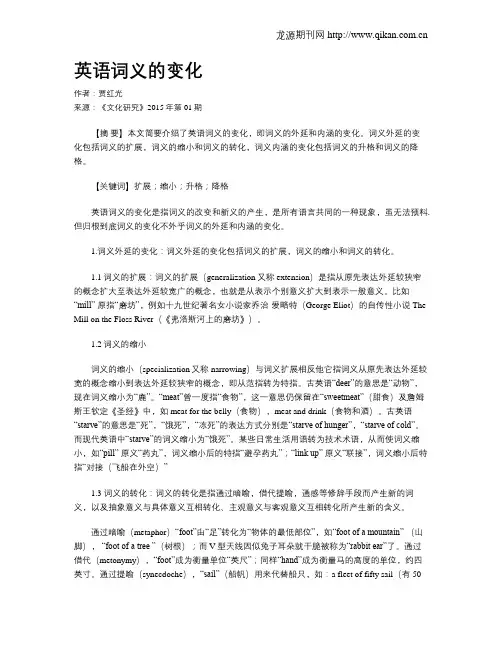
英语词义的变化作者:贾红光来源:《文化研究》2015年第01期【摘要】本文简要介绍了英语词义的变化,即词义的外延和内涵的变化。
词义外延的变化包括词义的扩展,词义的缩小和词义的转化,词义内涵的变化包括词义的升格和词义的降格。
【关键词】扩展;缩小;升格;降格英语词义的变化是指词义的改变和新义的产生,是所有语言共同的一种现象,虽无法预料.但归根到底词义的变化不外乎词义的外延和内涵的变化。
1.词义外延的变化:词义外延的变化包括词义的扩展,词义的缩小和词义的转化。
1.1词义的扩展:词义的扩展(generalization又称extension)是指从原先表达外延较狭窄的概念扩大至表达外延较宽广的概念,也就是从表示个别意义扩大到表示一般意义。
比如“mill” 原指“磨坊”,例如十九世纪著名女小说家乔治·爱略特(George Eliot)的自传性小说The Mill on the Floss River(《弗洛斯河上的磨坊》)。
1.2词义的缩小词义的缩小(specialization又称narrowing)与词义扩展相反他它指词义从原先表达外延较宽的概念缩小到表达外延较狭窄的概念,即从范指转为特指。
古英语“deer”的意思是“动物”,现在词义缩小为“鹿”。
“meat”曾一度指“食物”,这一意思仍保留在“sweetmeat”(甜食)及詹姆斯王钦定《圣经》中,如meat for the belly(食物),meat and drink(食物和酒)。
古英语“starve”的意思是“死”,“饿死”,“冻死”的表达方式分别是“starve of hunger”,“starve of cold”。
而现代英语中“starve”的词义缩小为“饿死”。
某些日常生活用语转为技术术语,从而使词义缩小,如“pill” 原义“药丸”,词义缩小后的特指“避孕药丸”;“link up” 原义“联接”,词义缩小后特指“对接(飞船在外空)”1.3 词义的转化:词义的转化是指通过暗喻,借代提喻,通感等修辞手段而产生新的词义,以及抽象意义与具体意义互相转化、主观意义与客观意义互相转化所产生新的含义。

英语词汇的语义演变
英语词汇的语义演变
英语词汇的语义演变是指单词的词义随着时间的推移而发生变化的过程。
这种变化可能是缓慢而渐进的,也可能是突然而剧烈的。
这种语义演变通常是由于社会、文化、科技等方面的变化引起的。
例如,一些词汇可能会因为技术进步而出现新的意义,或者因为社会观念的变化而失去原有的含义。
举个例子,英语单词"gay"最初的意思是"快乐的",但随着时间的推移,这个词的含义逐渐演变,变成了指代同性恋者的术语。
这种转变是由于同性恋者的权利运动和社会观念的变化所引起的。
另外一个例子是英语单词"nice"。
最初的含义是"愚蠢的",但后来这个词的含义发生了转变,变成了"友好的"或"令人愉悦的"。
这种变化可能是由于词语在使用过程中受到了赞赏而逐渐演变成了褒义词。
总之,英语单词的语义演变是一个复杂的过程,需要考虑到多种社会、文化和历史因素。
了解这些演变过程有助于我们更好地理解英语词汇的含义和使用。

英语词汇学论文---词义的变化The Causes of Changes in Word Meaning Abstract:Key words: historical; social; psychological; linguistic; semanticDo you know when Juliet tells Romeo, “I am too fond”, she is not claiming she likes Romeo too much? She means “I am too foolish” Do you know when Horatio says to Hamlet, “Season your admiration for a while…”, he is not telling Hamlet “to increase his respect( the current meaning of admiration) for something”?In fact, he means “ to moderate his astonishment.”Don?t be surprised, because, as Quirk asserts, almost every word we use today has slightly different meaning from the one is had a century ago; and a century ago it had a slight different meaning from the one it had a century before that. When a word loses its old meaning and comes to refer to something altogether different, the result is a change of word meaning.As nonnative English learners, learning the causes of changes in word meaning can help us deepen the understanding of the meaning of lexicology, vocabulary, semantic field and culture background. By learning this, we can use vocabulary in a more precise way and avoid mistake or embarrassment when communicating with native speakers.The causes of changes in word meaning can be divided into linguistic cause and extra-linguistic cause. Extra-linguistic cause can also divide into historical cause, social cause and psychology cause.Linguistic causeChange of meaning is frequently brought about by two tendencies in a linguistic system: towards ellipsis and towardsanalogy. Some linguists think foreign influence should subordinate linguistic cause.Ellipsis occurs when a phrase is shortened to one word which retains the meaning of the whole, so it often occurs in habitual collocations, such as adjective + noun or attributive noun + noun. Private, daily, duplicate are all adjectives, but they are used as nouns. Private means a soldier of the lowest rank, daily means daily newspaper, and duplicate means duplicate copy. Under such circumstances, whatever is left, whether a noun or an adjective, is all used as a noun assuming the original meaning. Naturally, the association became so close that the first element could alone carry the meaning of the whole phrase.Besides, there is a change of grammatical function as well, as when adjectives assumethe roles of nouns. Unlike the above examples, whose sense of one word has been transferred to another simple because the two occur together habitually, in some cases, it is the second or “headword”of the phrase that remains. For example, (stream) engine, (coal) gas and (light) bulb.The analogical tendency means new meanings developed in one part of speech are passed on to other parts of speech from the same lexical bas e. Fortuitous formerly denoted …happening by chance?, …accidental?, and later took on the meaning …fortunate?probably by analogy because the two words look similar in shape. Another interesting example is fruition, originally from a Latin word fruitio meaning enjoyment. But now, its meaning is given as “fulfillment of (plans, desired results, aims, etc.),”possibly from connection with the word fruit.Foreign influencesA particularly important cause of change of meaning inwords has been the influence of foreign words. For example, the native word stool originally meant any kind of seat for one person, and could even be used for a king?s seat. It got its humble meaning because the French word chair was adopted to denote a more comfortable piece of furniture. Other example is dream. Dream meant “joy” in OE; it gets its modern sense from the related Scandinavian word draumr.Historical causeIt often happens that though a word retains its original form, its meaning has changed because the object which it denotes has changed. This is the historical cause of semantic change.The well-known semanticist Ullmann notes, “It often happens that language is more conservative than civilization, material as well as moral. Objects, institutions, ideas, scientific concepts change in the course of time; yet in many cases the name is retained and thus helps to ensure a sense of tradition and continuity.”(Ullmann 1997:198)Indeed, it often happens that a word is retained for a name though the meaning has changed because the referent has changed. Take pen for example, it donated …feather?, which was used in the West as pen in old times. Now, the time when …feather? served as pen is long gone, and people are using hall-point pens and fountain pens, yet the name is still kept. This change has also occurred to computer, which designated a …person who computes? in the past. At present, when we talk about computer, people, people would think of an …electronic machine? rather than a person.There are also many scientific concepts which have retained their original forms, although their meanings have changed as a result of new scientific discoveries and increased knowledge. Forinstance, before Copernicus, the sun was thought to be …the luminous celestial body that in the Plolemaic system is one of the seven planets revolving around the earth? and this meaning is retained in “The sun rises and sets.”The Copernician theory tried to change the historical point of view and now everyone knows that the sun is a …star around which the earth a nd other planets revolve…?Social causeWe are going to discuss social cause of the changes of words?meanings in five aspects.A. Social developmentChange in word meaning resulting from a constant verbal traffic between common word and various technical words is referred to as social cause of semantic change. (Ullmann 1997:199-200) As a result, some technical words have lost their specialized meanings and have come to be used in more general senses, which connect with electricity, physics, chemistry, medicine, mathematics, etc. For instance, feedback means “response” in common use, as in “The teacher likes to have feedback from his students.”Dimension: as a common word, it means “extent in a particular aspect”, as in “This problem has a new dimension.”B. Social environmentBig events in society will change the meaning of some words. The simple words cold and hot have changed their meanings in the field of politics, as in “cold war” and “hot war”. In England, Abdication can mean King Edward VIII abdicated for marrying a divorced American woman, Ms Simpson. In these cases, nonnative speakers should try to memorize.C. Social classVillain means bad people, but its original meaning is villager.Because the aristocrat looks down upon the low social status villagers, the meaning of villain changed. It is a kind of degeneration of meaning. More examples are clown, boor, knave, and churl. Thus, if a word has something to do with low social status, it will have derogatory sense, vice versa.D National sentimentNational sentiment influences the meaning of word deeply. In English, some bad things will have connection with other nations. For instance, to take French leave means leaving without saying goodbye. Italian hand means interfere. Spanish athlete means a person who says nonsense.The most obvious nation, to which English shows great prejudice, is Netherlands, because these two countries always fought each other in 17century. Dutch act means commit suicide. Dutch comfort means comfort of no help. Dutch widow means prostitute. Dutch uncle means strict critic. Dutch treat means a party that you should pay for yourself. Dutch bargain means a deal made when you are drunk. I amDutched means I am cheated. Double Dutch means words that are rather baffling. I’m a Dutch man if …E. SexismThere are some words with sexism in English, but the number is minor. For example, “Man is a rational animal; men are born equal.”The man in there refers to human being. Recent years, thanks to feminist movement, more and more words are created to refer to women, such as businessperson, draftsperson, poetess, heroine, spokeswoman etc.Psychological causePsychological cause is also constantly at work in bringing about changes in word meaning. Psychological factors play abasic part in meaning change, which leads to the elevation or degradation of word meanings. It takes three forms: euphemism, grandiloquence and cynicism.A.EuphemismPeople change word-meaning owing to various psychological motives: love, respect, courtesy, suspicion, pessimism, irony, contempt, hatred, etc. People tend to use mild, agreeable language when speaking of an unpleasant or embarrassing fact and taboo subjects.Death and things related to death are one of the most common objects of euphemism. “To pass away,”“to brea the one?s last,”“to cease to think,”“to fall asleep,”“to kick the bucket,”“to be no more,”“to go west,” all refer to death.Toilet is another example. Rest room, lounge, convenience, comfort station and powder room are just some of its euphemism. Pregnant can be said “big,”“big with child,”“expectant,”“heavy with child,”“laden,”“anticipating,”“in the family way,”and “in an interesting condition.”B.GrandiloquenceGrandiloquence refers to the use of long, important-sounding words for effect. The desire to upgrade or raise the social status of a position, occupation, or institution by changing its common name to one felt to confer greater dignity or importance is another psychological factor in the change of word meaning.In American English, there are so many words of grandiloquence used in unpopular jobs. Garbage collector is sanitation engineer, servant is domestic engineer, mortician is funeral director and gardener is landscape architect.In a sense, grandiloquence is a form of euphemism, too. So some linguists consider grandiloquence subordinate the Euphemism.C.CynicismCynicism is the desire to sneer and to be sarcastic. For instance, the word pious may mean “hypocritically virtuous” in addition to its primary meaning, “having, showing deep devotion to religion.” The present meaning of sanctimonious is “pretending to be very holy or pious”, while it once meant “devout, holy or sacred”. Fanatic, a Latin synonym for enthusiastic, means “unreasonably enthusiastic, almost approaching to madness.”ConclusionChange in word meaning is commonplace and fundamental in a living language, for it is one of the simplest and most convenient ways of meeting peoples? need for new manes to refer to new things, ideas, processes, etc. Broadly speaking, change of meaning refers to the alteration of the meaning of existing words, as well as the addiction of new meaning to established words.The causes of semantic change are historical, social, psychological or purely linguistic. As nonnative English learners, we need to pay more attention to the changes of word meanings, for we are not familiar with their own history, their culture background and psychological situation. Only by learning these causes can we get a better understanding of lexicology, vocabulary, semantic field and context. Only by learning these causes can we know which words should be used and which words should be avoided, so that we can express our meaning more specific in communication with others.Bibliography:Jackson Howard (2000), Words, Meaning and V ocabulary, Trowbridge: The Cromwell PressJavier E Diaz Verd (2004), Lexicography, Semantics and Lexicology in English Historical Linguistics, Netherlands: Rodopi 汪榕培(2000),《英语词汇学研究》,上海:上海外语教育出版社汪榕培& 卢晓娟(2006),《英语词汇学教程》,上海:上海外语教育出版社杨艳华& 张树凡(2007),《现代英语词汇学》,:冶金工业出版社张维友(1997),《英语词汇学教程》,武汉:华中师范大学出版社张韵斐(2012),《现代英语词汇学概论》,北京:北京师范大学出版社。