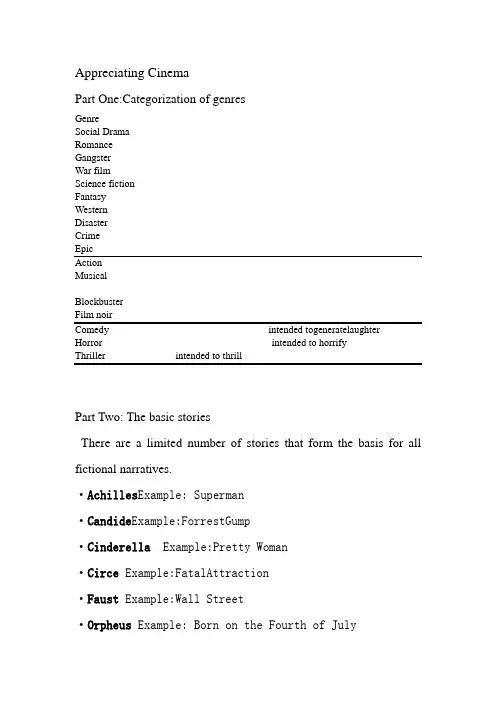
Appreciating CinemaPart One:Categorization of genresGenreSocial DramaRomanceGangsterWar filmScience fictionFantasyWesternDisasterCrimeEpicActionMusical_____________________________________________________________________ BlockbusterFilm noirComedy intended togeneratelaughterHorror intended to horrifyThriller intended to thrillPart Two: The basic storiesThere are a limited number of stories that form the basis for all fictional narratives.·Achilles Example: Superman·Candide Example:ForrestGump·Cinderella Example:Pretty Woman·Circe Example:FatalAttraction·Faust Example:Wall Street·Orpheus Example: Born on the Fourth of July·Romeo and Juliet Example: Shakespeare in Love, Ghost ·Tristan The Graduate·The Wandering Jew Example: The English PatientPart Three:The Classic Three-Act Linear Structure(经典三幕式直线结构)The majority of Hollywood films employs the classic three-act linear structure(or a variation of it). The three-act structure implies that the film can be divided into three acts.Act 1 would normally be expected to occupy the first quarter of the film; Act 2 would occupy the next half; and Act 3 would occupy the final quarter.Each act has a different function. For a typical two—hour Hollywood film, the act divisions would be as follows.Act Time FunctionAct 1 0-30 minutes set-upAct 2 30-90 minutes development (conflictandconfrontation) Act 3 90-120 minutes resolution and denouncement(结局)Part Four: Alternative Narrative Structures·Episodic Structure章回式结构Episodic narratives follow the protagonist through a series of potentially unrelated adventures. As in thethree-act structure, there are definite turning points at which the fortunes of the protagonist turn from good to bad or vice versa; however, unlike the three-act structure, the number of such turning points is not limited. ·Hero’s Journey Structure英雄旅程结构The hero’s journey narrative forms the underlying narrative structure of many myths and legends; and it is also to be found in many successful Hollywood films. The narrative occurs in a number of stages, which can be simplified as follows:1.Call to adventure2.Journey through unfamiliar World3.Supreme ordeal4.Reward5.Return and reintegration into societyPart Five: SubplotMost Hollywood films have one or more subplots. Subplots are additional stories(secondary plots) that are linked to the main plot and have an influence upon it;they don’t require separate protagonists, but they do require separate actions.The relationship between the main plot and the subplotscan take any one of four forms. These are: ·Complementary·Contradictory·Setup·ComplicatingPart Six: Symbols and MotifsA symbol is something that stands for or suggests something else, usually on account of a relationship, association, convention or resemblance. A motif is a recurring feature or idea related to the theme of the film; frequently it will be a recurring symbol.Question:Symbols may have different meanings in China and the West. List some of the differencesDifferent symbolic values of colors, animals, and number symbols used in the Western cultural tradition alongside their possible meanings and their different symbolic values in the Chinese cultural tradition.Symbol Meaning in the West Meaning in ChinaRed anger, sexuality, passion good fortune, happiness,prosperityWhite purity deathGreen envy, inexperience;the peace; the environment environmentYellow royal power and authorityOwl wisdom bad luckLion majesty, strength, braveryDragon evil majesty, success,goodfortunePhoenix rebirth, resurrection good fortune,precious Turtle slowness longevityPeacock arrogance, vanity good fortune3the Trinity( God, Christ, the Holy Ghost)13Bad luck666 the Devil good luck8 wealth4 deathPartSeven: Identifying ThemeIn practical terms, how does one identify and interpret the theme of the film? Since theme is a complicated and variable phenomenonand can be expressed in so many forms, it isimpossible to give a step-by-step guide. However, it is still possible to outline some basic approaches:·The Title of the FilmFilms will commonly use titles to point out their themes. ·Names of CharactersScriptwriters may use the names of their characters to suggest both something about the characters themselves, and also something about the overall theme of the film. ·SymbolismSymbols, motifs, and symbolic settings may indicate the theme of the film.·Character ConflictThe theme may emerge from the conflict between characters, especially when the characters are representative of deeper values and attitudes.·Speeches and DialogueSpeeches may also indicate the themes of a film. In About a Boy, for example, the protagonist describes his theory of “island living”( i.e.a radically independent lifestyle) in a speech addressed directly to the audience. In fact, this leads directly to the theme:Absolute independence is an undesirable state.·SubplotsThe main plot carries the main burden of the narrative. The subplot, on the other hand, can be used more flexibly to explore the thematic implications of the film.·Social ContextThemes can emerge from the interaction of a film’s subject matter and its social context.Take Forrest Gump as example·Episodic Structure and Repetition(章回式结构和循环)The narrative structure of Forrest Gump is basically episodic: that is, it is made up of separate, loosely connected situations that occur in the life of the protagonist.What holds together the narrative is not the plot but the figure of Gump himself.Accompanying this episodic structure is a pattern of repetitions. The scenein which Gump is bulliedby boys from his hometown is repeated a littlelater in his life, as is Jenny’s famous exhortation(告诫) to Forrest(Run, Forrest! Run). The act of getting on theschool bus to find no one willing to offer a seat is also repeated when Gump sets off for Vietnam. Gump’s meetings with American presidents occur time after time, as do reports of assassinations of prominent figures in recenthistory. Perhaps the most profound repetition, though, is the birth of the young Forrest Gump and his own first trip on the school bus: This time the repetition is accompanied by a change for the better, as the young Gump has all the charm of his father with none of the stupidity. The overall effect of these repetitions is to create an sense of circularity---the reassuring feeling that history repeats itself.Plot and SubplotForrest Gump is something of an exception because the story of Gump’s life and the plot of the film are almost identical. That is to say, the main plot is , essentially, nothing more than the story of Gump’s life: Gump is born, goes to school, goes to college, goes to Vietnam, comes home and sets up a shrimping business, meets Jenny again, runs across the country, etc.The subplot, which deals largely with Jenny’s life story,is radically different. It gives a lot of clues as to what has happened to Jenny during the course of her life, but very little of this is actually shown. We infer that she has caught AIDS , but none of this information is part of the subplot itself. Exercise Use your knowledge of the different kinds of subplot to categorize the Jenny subplot.The Jenny subplot can be categorized as both: ·Complicating: Jenny is Gump’s love interest, and so is adriving force in the main plot. ·Contradictory: Jenny’s underlying motivation(intellectualcuriosity) and attitude to life(experimental)are opposite to those of GumpVogler’s Seven Character ArchetypesChristopher Vogler, formerly story analyst at Disney and nowdirector of Development at Fox 2000 publisheda book, The Writer’s Journey: MythicStructure for Storytellers and Screenwriters,which has been called “the current industrybible”.Vogler argues that there are seven basic character functions:hero, mentor(导师), threshhold guardian(关卡守卫者), herald(信使), shapeshift(变化者), shadow(影子), and trickster(骗子,魔术师).These characters functions are reallybest thought of as character archetypes: thatis , they are mythological types to whichhumans respond on a deep instinctive levelbecause they represent the basic unchangingfeatures of human experiences.HeroMentor:Threshhold GuardianHeraldShapeshiftShadowTricksterThe Devil Wears Prada comedygenre ComedyThe Devil Wears Prada is a 2006 comedy-drama film, a loose screen adaptation of Lauren Weisberger's 2003 novel of the same name.Answer the following questionsa) Why does Miranda decide to hire Andrea Sachs,a girl who lacks styleand seems not to fit in there? B/c Andrea is different from the girlsMiranda always hires who are stylish,slender and worship themagazine, but turn out to be disappointing and stupid.b) What is Andrea’sattitude towards her job as Miranda’s assistant atRunway?At first ,she does not take the job seriously. Then sherealizes that if she wants to survive Miranda at Runway, she mustchange her attitude..She starts to respect Miranda’s style and putsforth her best efforts in the jobs.c) What is the reason for Andrea to leave Miranda and the Runway?Because Andrea learns that life is made of choices.She does not wantto live the way Miranda lives and then she chooses to pursue her ownlifestyle.Character AnalysisMiranda Priestly: demanding, a dragon lady, powerful, bossy, merciless,sophisticated, career-obsessedAndrea Sachs: naïve, idealistic, smart, perceptiveFashion runs through the movie as the overriding factor. A fashion magazine and its editor-in-chief provide the movie with the fundamental storyline.The cardinal rule dominating the fashion realm is “thinness”, which is ingeniously revealed in The Devil Wears Prada. Behind this obsession with one’s body image lies a pervasive problem of anorexia( ie, loss of the wish to eat)-------- one of the main types of eating disorders.Cast•Anne Hathaway as Andrea "Andy" Sachs:•Meryl Streep as Miranda Priestly:•Emily Blunt as Emily Charlton:•Stanley Tucci as Nigel:•Simon Baker as Christian Thompson:•Adrian Grenier as Nate Cooper: Andrea's boyfriend•Tracie Thoms as Lily: Andrea's close friend, who runs an art gallery.•Rich Sommer as Doug: A college friend of AndreaMemorable Lines1.Fashion is not about utility. An accesory is merely a piece of iconography used to express individual identity.2.For 72 years, Runway has been more than a magazine. It has been a beacon of elegance and grace. Miranda Priestly is the finest possible guardian of that beacon. Setting a standard that inspires people across the globe. About a BoyCharacter AnalysisWill Freeman( a bachelor in his thirties): a loner, a slacker(懒惰的人),selfish,self-centered, shallow, cool, trendyMarcus(a 12-year-old boy): a misfit(不适应环境的人), weird, gloomy, Fiona(Marcus’ mother): a hippie, depressed, near-hystericalAnswer the following questions1.What , according to Will, makes it possible for modern people to leada comfortable island life?2.why does Will refuse to be the godfather for Imogen?3.Why does Will see single mothers as perfect prey?4.How does Marcus feel after his mother’s suicide attempt?5.Why does Marcus decide to sing a song in the school auditorium? Answers1.According to Will, with the right supplies such as TV, CDs, DVDs,videos, home espresso makers and more importantly, the right attitude, everyone in the modern society can be an attractive island.2.He thinks he is a careless man and he will drop Imogen on her head(在头上洒水施洗礼)at her christening and forget all her birthdays. But deep down, he refuses to be Imogen’s godfather because he does not want to take any responsibility.3.They will think Will is a wonderful guy simply by comparison to the“bastard father” of their children. What’s more, Will can have brief affairs with them without a commitment. They are easy to dump. 4.He feels worried about his mother and afraid that she will commitsuicide again. He realizes that two in a family is not enough and he needs a bavkup person.5.Because his mother once tells him that when he sings he bringssunshine to her and he wants to make his mother feel better by singing.6. In the movie Will and Marcus are the two unlikely friends who have formeda close bond. Do you think that two people will develop a close friendshipdespite great difference in age?Memorable lines1.Setting: At the beginning of the movie, Will expresses his opinion that all men are islands. He believes that this is an island age and explains the reason.A hundred years ago, for instance, you had to depend on other people. No one had TV or CDs or DVDs or videos or home espresso(蒸馏咖啡)makers. As a matter of fact, they didn’t have anything cool, whereas now, you see, you can make youself a little island paradise. With the right supplies and more importantly, the right attitude, you can be sun-drenched(充满阳光的), tropical, a maganet for the young Swedish tourists2.Setting:On the dead duck day Fiona overdoses and is sent to hospital. Will drives Marcus and Suzie home from the hospital at night and he doesn’t want to experience such things again.The thing is, a person’s life is like a TV show. I was the star of the Willshow. And the Will Show wasn’t an ensemble(合奏,合唱,整体) drama. Guests came and went, but I was the regular. It came down to me and me alone.3.Setting: At the end of the movie, Will changes his attitude.Every man is an island. I stand by that. But clearly some men are part of island chains. Below the surface of the ocean they’re actually connected.Forrest GumpQuestions1. The movie begins with a feather flying in the air and ends with it, too. Whatdoes this suggest?2. How did Forrest get his name?3. How do you understand the following quotations?Life is a box of chocolates. You never know what you,ve gonna get.Stupid is as stupid does.4. Do you think everyone has his own destiny or we’re just floating aroundaccidentally on a breeze?5.How do you understand the roles of the two women---Mrs. Gump andJenny---in Forrest’s life?Blind Side dramaCast•Quinton Aaron as Michael "Big Mike" Oher•Sandra Bullock as Leigh Anne Tuohy•Tim McGraw as Sean Tuohy•Kathy Bates as Miss Sue•Lily Collins as Collins Tuohy•Jae Head as Sean "S.J." Tuohy, Jr.•Ray McKinnon as Coach Cotton•Kim Dickens as Mrs. BoswMemorable lines1.Don't use the a-word. 毫无疑问2.I got u back. 我会照顾你的3.I hear "Mrs. Tuohy" I look over my shoulder for my mother-in-law.4.--Why do u need a driver's licence when u don't even have a car?--Something to carry.With my name on it.5.You should really get to know your players. Michael scored in the 98th percentile in protective instincts. "6. Don't u dare to lie to me.别想对我撒谎!7.Courage is a hard thing to figure. You can have courage based on a dumb idea or mistake, but you're not supposed to question adults, or your coach or your teacher, because they make the rules.8.--So u want me to go to Tennessee?-- I want u to do whatever u want. It is your decision, Michael. It's ur life.My Fair LadyQuestions1.What have you learned from this movie about therelationship betweenship between pronunciationand social status? Language and identity?2.Why did Mr. Higgins want to carry out thisexperiment?Why did Eliza agree to be the subjectof this experiment?3.List some strategies that Mr. Higgins employed inhis teaching.4.Was Mr. Higgins a good teacher?Why/why not?5.Why did Eliza decide to leave Mr. Higgins?The Wizard of OzQuestions1.What is the social ideology reflected inthe film?In the film we are exposed to the socialideology that relates to the values of the 1930’s era and ofsmall town rural America. Family, home and hard work arepromoted. This was the depression and the ‘yellow brick’road symbolized gold and we all know what is found at theend of the rainbow – the pot of gold.2.What is the cultural meaning of thefilm?The cultural theme is that we must work hard, keepthe family together and in the end we will have prosperity.If we hold firmly onto our values, the family will remainstrong. This was very important during that period ofeconomic struggle.3.Give a plot summary of the film.4.Analyze the character of Dorothy. Provide examples ofher characteristics from the film.Give an analysis of theCowardly LionPhiladelphia (film) Directed by Jonathan DemmeProduced by Jonathan Demme Edward SaxonWritten by Ron NyswanerStarring Tom HanksDenzel WashingtonJason RobardsMary SteenburgenAntonio BanderasMusic by Howard ShoreCinematography Tak FujimotoEditing by Craig McKayDistributed by TriStar PicturesRelease date(s) December 24, 1993Running time 125 minutesCountry United StatesPhiladelphia is a 1993 American drama film that was one of the first mainstream Hollywood films to acknowledge HIV/AIDS, homosexuality and homophobia. It was written by Ron Nyswaner and directed by Jonathan Demme. The film stars Tom Hanks and Denzel Washington. It was inspired in part by the story of Geoffrey Bowers, an attorney who in 1987 sued the law firm Baker & McKenzie for wrongful dismissal in one of the first AIDS discrimination cases.Answer the following questions1. What makes Andrew Beckett decide to sue the law firm which he haspreviously served?2. At first glance, Miller is a w orld apart from Beckett’s interests: he is a personal injury lawyer, better known for television commercials than for legal talent, and has had conflicts with Beckett in the courtroom before(Miller lost). Why does Beckett ask Miller to represent him?3. Why does Joe Miller initially refuse to take the case?4. What finally makes Joe Miller take the case?5. What do you think of the scene where Beckett plays an aria(咏叹调)from hisfavorite opera for Miller?Answers:1. Beckett’s bosses claim he has been fired for incompetence andmisplacing an important document for an important client, but Beckett is sure that it’s because he has AIDS. He considers that he is a victim ofprejudice, and is determined to win his case even as his own life begins to fade.2. Because the law firm is so powerful and prestigious, and Beckett is a gayinfected with AIDS, no other lawyer will take the case. After many rejections, with no one else to turn to, Andrew Beckett consults Joe Miller to help him pursue litigation.(诉讼)3. Joe Miller represents the everyman who harbours homophobic tendencies.He does not like homosexuals, who make his skin crawl. He also hasextreme fear of AIDs, and can hardly keep himself from wiping his hand on his pants after shaking Beckett’s hand.4. A chain of events has turned Miller’s emotions in line with Beckett’s case.His wife has a baby, from which he has learned what birth is about, and then he has found out about death too. He comes across the ailing Beckett in the library. Seeing through the face of AIDS, he sees that there’s a dying man there. Then he has a change of heart, recognizing a hint of familiar discrimination in the way Beckett is being treated. He is essentially homophobic but he is also against prejudice. After initial reluctance, he takes the case.5. It’s a brilliant scene where Beckett tries to give a passionate translation ofthe aria “La Momma Morta” while Miller looks on in stunned silence.Miller’s isn’t an opera fan, but as the music plays and Beckett talks over it,passionately explaining his acceptance of death in the midst ofdisplaying his continuing passion for life, Miller undergoes a conversation of the soul. And finally, what Miller sees is a man who loves life and does not want to leave it.Character AnalysisAndrew Beckett: a victim of prejudice, gifted, genuine, forgiving, kindJoe Miller: honest, warm-hearted, prepared for fight for justice, relaxed, witty Charles Wheeler: elegant, smart, selfish, hypocriticalThe setting of the film Philadelphia, which concerns the struggle of an AIDS sufferer to assert his legal rights in the face of prejudice, issymbolic. Think about the (1) the literal meaning of the city’s name, and (2) the city’s role in American history, try to explain why.(1) the literal meaning of Philadelphia is the city of brotherly love. The prefix“phila-“ means “love”; it also occurs in the words “philanthropy”( love of mankind) and “philosophy” (love of wisdom). “Delphia” comes from the Greek “adelphus” meaning “brother”. This is significant because the film seeks to contrast the old ideals of America (i.e. love and tolerance) with the reality of modern prejudice( against AIDS sufferers).(2) Philadelphia was the city in which the first public reading of theDeclaration of Independence occurred. It is also the city in which theLiberty Bell is located. This is significant because the Declaration ofIndependence states America’s commitment to individual’s rights to “ life, liberty, and the pursuit of happiness”. These are precisely the rights that are denied to the protagonist of the film. The film uses this symbolicsetting to draw attention to the way that the old ideals of the AmericanRepublic are being systematically ignored in the face of the AIDS threat.。