
P2-0629-01-Exploring the Norms for UX Design of Intelligent Products
- 格式:pdf
- 大小:194.81 KB
- 文档页数:8
121Advanced Television Engineering2019/10运 行 与 维 护Operation & Maintenance
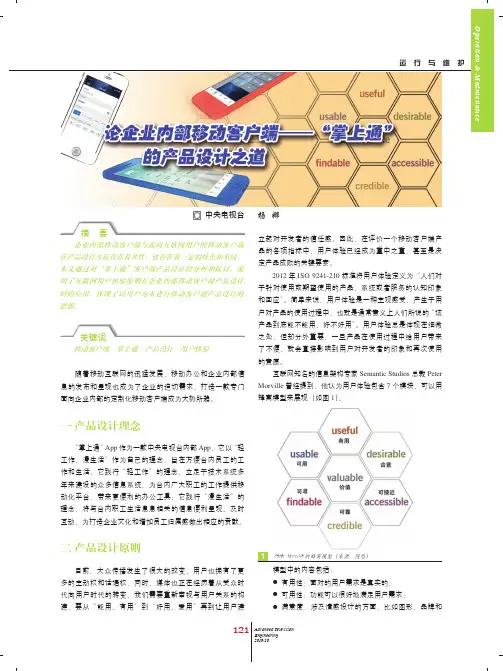
杨 娜 中央电视台摘 要企业内部移动客户端与面向互联网用户的移动客户端在产品设计方面存在着共性,也存在着一定的特色和不同,本文通过对“掌上通”客户端产品设计的分析和探讨,说明了互联网用户体验原则在企业内部移动客户端产品设计时的应用,体现了以用户为本进行移动客户端产品设计的思想。关键词移动客户端 掌上通 产品设计 用户体验 随着移动互联网的迅猛发展,移动办公和企业内部信息的发布和呈现也成为了企业的迫切需求,打造一款专门面向企业内部的定制化移动客户端成为大势所趋。一 产品设计理念“掌上通”App作为一款中央电视台内部App,它以“轻工作、漫生活”作为自己的理念,旨在方便台内员工的工作和生活。它践行“轻工作”的理念,立足于技术系统多年来建设的众多信息系统,为台内广大职工的工作提供移动化平台,带来更便利的办公工具;它践行“漫生活”的理念,将与台内职工生活息息相关的信息便利呈现、及时互动,为打造企业文化和增加员工归属感做出相应的贡献。二 产品设计原则目前,大众传播发生了很大的改变,用户也拥有了更多的主动权和话语权,同时,媒体也正在经历着从受众时代向用户时代的转变,我们需要重新审视与用户关系的构建,要从“能用、有用”到“好用、爱用”再到让用户建立起对开发者的信任感。因此,在评价一个移动客户端产品的各项指标中,用户体验已经成为重中之重,甚至是决定产品成败的关键要素。2012年ISO 9241-210标准将用户体验定义为“人们对于针对使用或期望使用的产品、系统或者服务的认知印象和回应”。简单来说,用户体验是一种主观感受,产生于用户对产品的使用过程中,也就是通常意义上人们所说的“该产品到底能不能用、好不好用”。用户体验总是体现在细微之处,但却分外重要,一旦产品在使用过程中给用户带来了不便,就会直接影响到用户对开发者的印象和再次使用的意愿。互联网知名的信息架构专家 Semantic Studios 总裁Peter Morville曾经提到,他认为用户体验包含7个模块,可以用蜂窝模型来展现(如图1)。

专题076摘要:养花是一种健康的生活方式,不仅可以舒适身心,还能改善家居环境,陪伴植物成长也是马斯洛情感需求第四层次尊重需求的象征。为了更好的迎合用户养植物的各种需求,文章对用户进行问卷调研以及深入访谈,获取用户养花过程中的痛点及需求。再基于KANO模型对需求进行分析,设计出了花悟智能智能花盆。花悟智能花盆用智能化手段区分不同类型用户,并提供针对性服务,使用户获得更好的种植体验。
关键词:智能花盆 KANO模型 交互界面 功能需求 蓝牙连接
中图分类号:TB472 文献标识码:A文章编号:1003-0069(2020)12-0076-04
Abstract:Flower culture is a healthy lifestyle,which can not only comfort the body and mind,but also improve the home environment. Accompanying plant growth is also a symbol of the fourth level of hierarchical theory of needs. In order to better meet the various needs of users to raise plants,this paper conducts a survey of users,through the analysis of users' heart and behavior of flower cultivation,to understand the pain points and needs of users. Then based on Kano model,the demand is analyzed,and the intelligent flower pot is designed. Huawu intelligent flowerpot uses intelligent means to distinguish different types of users,and provides targeted services,so that users can get a better planting experience.

Vol.12 No.1 2022 DESIGN RESEARCH
设计艺术研究71
许永生XU Yongsheng 赵秦琨ZHAO Qinkun 何静HE Jing 陈畅CHEN Chang西南交通大学,四川成都 610000(Southwest Jiaotong University,610000 Chengdu Sichuan)16
摘要:意象仿生的设计方法是智能共享按摩椅造型设计的有效途径,通过意象仿生得到的智能共享按摩椅造型方案传达出的造型意象,更加符合用户的审美习惯与心理特征,可提升用户感官体验。通过文献法、文本挖掘法、问卷调查法等挖掘智能共享按摩椅的造型意象词,总结智能共享按摩椅造型意象仿生的设计流程与方法。运用感性微分法将抽象的感性意向词进行具化,通过形态分析法建立形态分析矩阵,得到若干个智能共享按摩椅仿生设计造型创新方案,建立仿生生物与设计对象之间的联系。运用模糊综合评价法对这些方案从现代感、隐私感、休闲感以及仿生原型的相似度这4方面综合评价,从中选出得分较高的方案,设计方案造型意象传达出仿生原型蜗牛的形态特征,验证了意象仿生设计方法的有效性,为优选方案提供了的理论依据。关键词:仿生设计;智能家具;意象仿生;感性微分法;形态分析法;模糊综合评价法Abstract: The design method of imagery bionics is an effective way to design the shape of the intelligent shared massage chair. The imagery conveyed by the intelligent shared massage chair modeling scheme obtained through imagery bionics is more in line with the user's aesthetic habits and psychological characteristics and enhances the sensory experience. Through literature method, text mining method, questionnaire survey method,etc.,the modeling images are excavated and the design process and method are summarized. The perceptual differentiation method is used to realize the abstract perceptual intention words, and the morphological analysis matrix is established through the morphological analysis method. Several innovative schemes of the bionic design modeling of the intelligent shared massage chair are obtained and the connection between the bionic creature and the design object is established. The fuzzy comprehensive evaluation method is used to comprehensively evaluate these plans from the four aspects of modernity, privacy,leisure and the similarity of the bionic prototype so as to select the high-scoring plan from them. The design image of the design scheme conveys the morphological characteristics of the bionic prototype snail which verifi es the effectiveness of the image bionic design metho and provides a theoretical basis for the optimal scheme.

Moderators’ Report/ Principal Moderator Feedback Summer 2016 Pearson Edexcel GCE in Engineering (6933) Unit 3: Principles of Design, Planning and Prototyping
Edexcel and BTEC Qualifications Edexcel and BTEC qualifications are awarded by Pearson, the UK’s largest awarding body. We provide a wide range of qualifications including academic, vocational, occupational and specific programmes for employers. For further information visit our qualifications websites at or . Alternatively, you can get in touch with us using the details on our contact us page at /contactus. Pearson: helping people progress, everywhere Pearson aspires to be the world’s leading learning company. Our aim is to help everyone progress in their lives through education. We believe in every kind of learning, for all kinds of people, wherever they are in the world. We’ve been involved in education for over 150 years, and by working across 70 countries, in 100 languages, we have built an international reputation for our commitment to high standards and raising achievement through innovation in education. Find out more about how we can help you and your students at: /uk Summer 2016 Publications Code 6933_01_1606_ER All the material in this publication is copyright © Pearson Education Ltd 2016 Grade Boundaries Grade boundaries for this, and all other papers, can be found on the website on this link: /iwantto/Pages/grade-boundaries.aspx General comments For this unit: Principals of design, Planning and Prototyping, students are required to produce a single design and make task using titles from those published by Edexcel, or by generating their own. They must produce evidence of a solution to their selected problem in a design folder, of engineering drawings, technical specification writing, designing and developing a solution to the selected task, planning for production, manufacturing and giving an oral presentation to peers. A design folder must be submitted for moderation, which must include photographic evidence of what has been manufactured. As in previous years, some high quality, creative and well made work was seen, as well as work that was mediocre, unchallenging and not worthy of an AS qualification. All work submitted by students was potentially appropriate to the requirements of this course offering access to the full range of marks available. Although a wide range of coursework projects was undertaken, Edexcel’s approved titles such as PCB holder; mini-drill holder; TV bracket and can-crusher were ever popular. Where electronic type tasks were taken on, not many students demonstrated any detailed understanding of circuit function and it was rare to see alternative electronic solutions presented. Most electronic circuitry appeared to be taken from some technical source without any modification or further student input. Where this was the case, the level of challenge was low, limiting opportunities to score higher marks in the design section. Quite a few projects included the use of mechanisms, but the range of alternatives explored to produce linear motion from rotary motion or reciprocating / oscillating motion was limited when this would have been a fertile area of graphical exploration. A continuing problem is that when designing, students fail to explore a range of ideas in any detail, probably because they have already decided on a design proposal and any other designs are treated as superficial images to target marks. Designs were hardly ever developed through further design input, which usually consisted of construction details and working drawings of an initial idea. Most students modelled products, but often for no valid reason i.e. to test design features. Most modelling was done for simple presentation purposes. In a minority of cases students were allowed to over-use CNC machines and other CAM equipment such as laser cutters and 3D printers, which limited opportunities to demonstrate a range of other high level making skills. Marks awarded by centre assessors were generally close to Edexcel’s standards, but in some cases, especially in criterion ‘C’ marking was lenient where the evidence presented did not match the credit given. Assessment criterion (a) Despite, in the past, highlighting the use of automatically generated engineering drawings from 3D CAD sketches and consequential loss of marks. This year has once again seen an increase in this practice, limiting opportunities to score marks in the high band The point of this section is to teach students how to produce and understand engineering drawings. To this end, it is expected that students will demonstrate formal drawing skills using hand techniques, or through the use of a 2D CAD drawing package, where drawing tools are used to produce technical drawings laid out appropriately. Generating orthographic views from a 3D CAD sketch develops no understanding of layout or drawing conventions and standards. There are eight marks to award in this section, but they cannot be gained where drawings are generated automatically. Assessment criterion (b) Once again, this year saw students scoring well in ‘planning’, where the vast majority were able to present an appropriate sequence of manufacturing tasks, including projected times and deadlines. Many students presented copious amounts of planning pages, which was unnecessary as they would have gained their marks for less work, as long as it demonstrated an ability to plan for manufacturing appropriately; this could have been done by limiting planning to a major component or two. A minority of students recorded units of time in days, weeks or lessons without qualifying how long these units of time were. The best work seen in this section detailed tasks and sub-tasks and gave projected timings in hours and/or minutes. It is not expected that students should be able to predict accurately how long a task will take, but they should be aware that some processes and tasks will take longer than others to carry out. The quality of specification writing varied considerably. Better examples of specifications contained statements that were technical, measurable and justified; statements that could be used to check ongoing designs against, and to evaluate the final practical outcome. Unfortunately, a lot of specification statements were superficial, vague and non-specific, lacking technical information that could have been used as testing and evaluation data. User requirements and Performance requirements are important sub-sections of a product specification, as this is where technical and measurable statements are made, but on many occasions these areas were more or less ignored.