奥利弗。哥德史密斯
- 格式:ppt
- 大小:13.71 MB
- 文档页数:43


好奇心的名言警句1、青年的朝气倘已消失,前进不己的好奇心已衰退以后,人生就没有意义。
——穆勒2.好奇心是智慧和活力最持久、最可靠的特征之一——塞缪尔·约翰逊3、自私自利之心,是立人达人之障。
——吕坤4.求知欲、好奇心——这些是人类永恒不变的特征。
没有求知欲的地方就没有学校——苏霍姆林斯基5、君子喻于义,小人喻于利。
——孔丘(英译汉)离开这个国家去改善自己和他人的人是一位哲学家,但在盲目的好奇心驱使下,从一个国家到另一个国家的人只是一个流浪汉——奥利弗·戈德史密斯7、青年的朝气倘已消失,前进的好奇心已衰退以后,人生就没有意义。
——穆勒8.永远为他人着想,而不是为自己着想——谢觉才9、人生的价值,即以其人对于当代所做的工作为尺度。
——徐玮10.人们心中有一种根深蒂固的需求。
他们总是想感觉自己是发现者、研究者和探索者。
这种需求在儿童的精神世界中尤为强烈。
但是,如果我们不为这种需求提供营养,即我们不积极接触事实和现象,缺乏理解的乐趣,这种需求就会逐渐消失,寻求知识的兴趣就会消失——苏霍姆林斯基11、好奇心是学习者的第一美德。
——居里夫人12.如果有人不再好奇,不再感到惊讶,他就像一具行尸走肉,眼睛模糊了——爱因斯坦13、一切利己的生活,都是非理性的,动物的生活。
——列夫·托尔斯泰14.好奇是科学家无限毅力和耐心的源泉——爱因斯坦15、如烟往事俱忘却,心底无私天地宽。
——陶铸16.生命的全部意义在于对未知事物的无尽探索和更多知识的不断增长——左拉17、成功的教学所需要的不是强制,而是激发学生的欲望。
——托尔斯泰18.好奇心造就科学家和诗人——弗朗西斯19、这少女的年龄,正是一个人用愉快而得意的梦境来麻醉自己的年龄。
她时时刻刻想着爱情,那种浓厚的兴趣与好奇心,要不是因为她愚昧无知,简直不能说是无邪的了。
——罗曼·罗兰《约翰·克利斯朵夫》20.我认为我们应该做一些能够解决这些问题的事情,尽管我不知道我们能否做到。

国际理解教育国旗下演讲稿20世纪70年代末以来,随着我国改革开放大门的打开和市场经济的推行,尤其是某年我国加人世贸组织,中国便势不可挡地走向了全球化之路。
全球化并不仅仅意味着我们会接触到更多的文化,更意味着人口的迁移、经济、资源、物理环境、政治观念、科学技术、法律、健康以及国家间各种冲突的加剧。
此外,还有一些全球关注的问题,如污染、贫困、失业、恐怖主义等,需要通过相互理解和合作加以解决。
因此,国际和平与相互理解是时代的需要。
学校教育也有必要给学生提供国际理解的视角,以促使他们形成全球视野的思维框架,理解国际问题。
那么,国际视野是什么呢?奥利弗·戈德史密斯(Oliver Goldsmith)认为,国际理解是一种世界公民意识,即个人不仅是其国家的一员,而且也是世界的一员。
沃尔特·刘易斯(Walter s)博士认为,“国际理解是一种批判而客观地观察和评价世界各地的人的行为能力,而不论他们可能属于哪一种文化。
”用拉达克里希南(Radhakrishnan)博士的话来说,“曾经被海洋和大陆分割的世界今天在物理上是统一的,但是仍然存在怀疑和误解。
对我们来说,重要的不是分开生活,而是一起生活。
互相理解恐惧和焦虑、抱负和愿景,这正是我们被期望去做的。
我们不能要求种族灭绝、奴役或种族隔离,而要为种族和谐而努力。
我们不要忽视一个基本事实,那就是让我们学会生活在一个国际社会中”。
在国际理解教育中,有两个原则非常重要。
第一,要学会尊重对方文化。
了解不同的文化和国家及其状况和问题,对于国际理解至关重要。
如果每一个国家和国际问题都能被正确定位,这一点就可以得到促进。
民族的傲慢和对任何一个或多个国家的偏见都违背了国际主义精神。
如果人类要生存下去,我们必须培养国际感情。
第二,学会爱人类。
爱他人是人与生俱来的善良本性。
“自己活也要让别人活”是國际理解的根本基础,任何国家都不应认为自己比别人优越,不应因种族、信仰和肤色等原因而歧视任何人或任何民族。
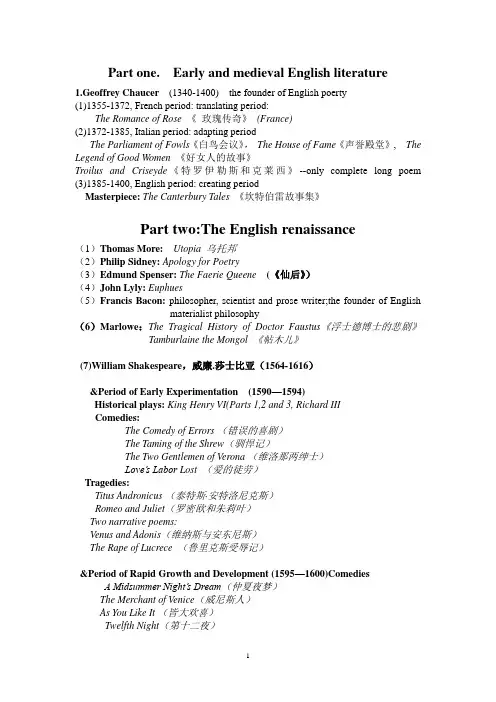
Part one. Early and medieval English literature1.Geoffrey Chaucer (1340-1400) the founder of English poerty(1)1355-1372, French period: translating period:The Romance of Rose 《玫瑰传奇》(France)(2)1372-1385, Italian period: adapting periodThe Parliament of Fowls《白鸟会议》,The House of Fame《声誉殿堂》, The Legend of Good Women 《好女人的故事》Troilus and Criseyde《特罗伊勒斯和克莱西》--only complete long poem (3)1385-1400, English period: creating periodMasterpiece:The Canterbury Tales 《坎特伯雷故事集》Part two:The English renaissance(1)Thomas More: Utopia 乌托邦(2)Philip Sidney: Apology for Poetry(3)Edmund Spenser: The Faerie Queene (《仙后》)(4)John Lyly: Euphues(5)Francis Bacon: philosopher, scientist and prose writer;the founder of Englishmaterialist philosophy(6)Marlowe:The Tragical History of Doctor Faustus《浮士德博士的悲剧》Tamburlaine the Mongol 《帖木儿》(7)William Shakespeare,威廉.莎士比亚(1564-1616)&Period of Early Experimentation (1590—1594)Historical plays:King Henry VI(Parts 1,2 and 3, Richard IIIComedies:The Comedy of Errors (错误的喜剧)The Taming of the Shrew(驯悍记)The Two Gentlemen of Verona (维洛那两绅士)Love‟s Labor Lost (爱的徒劳)Tragedies:Titus Andronicus (泰特斯·安特洛尼克斯)Romeo and Juliet(罗密欧和朱莉叶)Two narrative poems:Venus and Adonis(维纳斯与安东尼斯)The Rape of Lucrece (鲁里克斯受辱记)&Period of Rapid Growth and Development (1595—1600)ComediesA Midsummer Night‟s Dream(仲夏夜梦)The Merchant of Venice(威尼斯人)As You Like It (皆大欢喜)Twelfth Night(第十二夜)The Merry Wives of Windsor (温莎的风流妇人)Much Ado About Nothing (无事生非)Historical plays: Richard II,Henry IV (Parts 1 and 2,Henry V, King John Roman tragedy: Julius Caesar(裘利斯.凯撒)&Period of Gloom and Depression (1601—1608)Tragedies:Macbeth(麦克白)King Lear(李尔王)Hamlet ( 哈姆雷特) Othello(奥赛罗)Comedies:Troilus and Cressida (特洛伊斯与克雷西达)All‟s Well That Ends Well(终成眷属)Measure for Measure (一报还一报)Roman Tragedies:Antony and Cleopatra (安东尼与克里奥佩特拉)○4Period of Calm after Storm (1609—1612)The Winter‟s Tale(冬天的故事)Cymbeline, King of Britain (辛白林)The Tempest(暴风雨)HenryⅧ(亨利八世)(8) Ben Jonson : Senjanus CatilinePart three : the period of the English bourgeois revolution (1) John Milton(1608—1674) the Puritan poets清教徒派诗人Milton’s Works of His Early Days•Poems written in Cambridge and at Horton: 1. On the Morning of Christ‟s Nativity《基督诞生晨颂》, first important work• 2. L‟Allegro《快乐的人》Penseroso《幽思的人》• 3. Comus《科玛斯》a mask假面剧, in blank verse• 4. Lycidas《利西达斯》, expressing the pathos(哀颂)of his friend Edward Kin g’s (爱德华·金)premature(过早的)death•The early poetic works:L'Allegro, Il Penseroso, and the elegy Lycidas(1637) •The middle prose pamphlets:Defensio pro Populo Anglicano, Areopagitica•The last great poems: Paradise Lost (1667) , Paradise Regained (1671) and the poetic drama Samson Agonistes《力士参孙》(1671).(2)John Bunyan(1628—1688) the Puritan poets清教徒派诗人The Pilgrim‟s Progress 天山历途——“Vanity Fair” is a remarkable passage.(3)John Donne ——Metaphysical poets 玄学派诗人(4)John Dryden——the Cavalier poets 保皇派诗人“All for Love” “一切为了爱情”“Essay of Dramatic Poesy” “论戏剧诗”Part four : The Enlightenment century(1)The representative writer of the neo-classical school:•Addison(艾迪生)——The Spectator 旁观者Steele(斯梯尔)——the Tatler 闲谈者Pope(蒲柏)——a master in satire and heroic coupletthe Pastorals (1709)(田园诗歌)•the Essay on Criticism (1711) (论批评)The Rape of the Lock (1714)(卷发遇劫记),•Essay on Man(p137) The Dunciad(P136)(2)the representative of modern novelist in the 18th century○1Jonathan Swift(乔纳森·斯威福特)(P138):The Battle of Books A Tale of a Tub Gulliver‟s travels○2Daniel Defoe(笛福):The True-born Englishman 《纯血统英国人》The Shortest Way with the Dissenters《铲除新教徒的捷径》Hymn to the Pillory 《木枷颂》Robinson Crusoe(1719, at the age of 58, he published his Robinson Crusoe, the book which made him immortal) 《鲁滨逊漂流记》Captain Singleton (1720)《辛格顿船长》Moll Flanders (1722)《摩尔.弗兰德斯》Colonel Jacque《陆军上尉大人》○3Samuel Richardson(塞缪尔·理查逊) 1689-1761•Pamela《帕米拉》•Clarissa Harlowe 《克拉丽莎》•Sir Charles Grandison《查尔斯.格兰迪森爵士的历史》○4Henry Fielding(亨利·菲尔丁)•The History of Tom Jones, a Foundling《弃婴汤姆琼斯的故事》•Joseph Andrews《约瑟夫·安德鲁斯》•The History of Jonathan Wild the Great《伟大的乔纳森·王尔德》Amelia 《艾米莉亚》(his last novel)○5Smollett(斯摩莱特): a Scottish poet and novelist.●Roderick Random (《蓝登传》) (P172)●Peregrine Pickle《匹克尔传》(P173)●Humphry Clinker (《汉弗莱·克林克历险记》)(P173)○6Sterne(斯特恩):an Irish novelist. Sterne was a representative of sentimentalism in the 18th century.●The life and Opinions of Tristram Shandy (《项狄传》)● A Sentimental Journey (《感伤旅行》)(P175)18th Century Drama Sheridan—— The Rivals (《情敌》)(P178)The School for Scandal (《造谣学校》)(P179)Samuel Johnson (塞缪尔·约翰逊)The Preface to Shakespeare (《莎士比亚戏剧集序言》)Lives of Poets 《英国诗人传》(P181)Oliver Goldsmith(奥利弗.戈德史密斯)A. Poems:The Traveller (1764)The Deserted Village (1770) (《荒村》) (P184)B. Novel:The Vicar of Wakefield (1766), (《威克菲尔德牧师传》)(P187)C. Comedies:The Good-Natured Man (1768)(《好心人》)(P 187)She Stoops to Conquer (1773).(《屈身求爱》)(P188)D. Essay: The Citizen of the World (《世界公民》)(P187)1. William Blake: 威廉·布莱克Song of Innocence and Songs of Experience 天真之歌和经验之歌Poetical Sketches 素描诗集(P195) The Tiger 老虎2. Robert Burns:罗伯特·彭斯(1759—1796)A Red Red Rose《一朵红红的玫瑰》, Auld Lang Syne.《友谊地久天长》3.Edward Gibbon:“The Decline and Fall of the Roman Empire”(《罗马帝国衰亡史》)4.Thomas Gray:“Elegy Written in a Country Churchyard”《墓园挽诗》Part five : romanticism in EnglandPoetry: (1) the elder generation escapist romanticistsWordsworth, Coleridge, Southey,(2) younger generation active romanticistsByron, Shelly and KeatsProse: Lamb, Hazlitt, De Quincey and HuntNovels: Walter Scott, historical novelistPeriodicals 期刊杂志: 1)The Edinburgh Review 2)Quarterly Review 3)Blackwood‟s Edinburgh Magazine4)The Examiner(1)William Wordsworth(威廉.华兹华斯)Lyrical Ballads 《抒情歌谣集》1798“The Rime of the Ancient Mariner” (“古舟子咏”; “老水手之行”)Poetry takes its originFrom emotion recollected tranquility.诗歌源于平静中重新积聚起来的情感。