
跨文化交际Nonverbal language time space
- 格式:pptx
- 大小:3.26 MB
- 文档页数:44
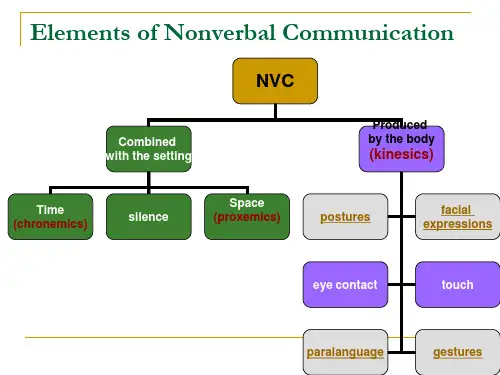

1 跨文化交际
一、课程基本信息
1、课程中、英文名称:跨化交文际、Cross-cultural Communication
2、课程类别:专业专选课程
3、课程学时:18学时
4、学 分:2分
二、课程的目的与任务:
跨文化交际作为一门学科涉及到文化和交际的各个层面,包括语言交际、非语言交际、人们之间的相互交往,以及不同文化之间的观念和信仰等。该课程的目的在于通过不同文化差异的比较研究,分析跨文化交际案例,提高学生对文化差异的敏感性,提高不同文化语境中语言交际的能力,从而更好地适应不同文化环境。使学生了解其他文化的社会文化习俗和价值观念;在语言学习的同时,更多关注相关国家的文化,特别是通过与本族文化的对比,提高跨文化交际能力,以适应社会发展和国际交流的需要,增加跨文化交际意识,并最终形成跨文化交际能力。
三、课程的重点和基本要求:
(一)课程的重点
本课程教学的重点是增强学生对跨文化交际中文化差异的敏感性,帮助学员解决在跨文化交际中因文化的差异而产生的种种问题。通过典型实力分析,模拟交流联系,交际失误分析,英汉双向练习等多种形式,使学生认识语言,文化和交际三者之间的关系,加深对对象国文化的了解,掌握在处理跨文化交际中一些微妙问题时所需要的基本知识和技巧,提高跨文化交流的质量。
(二).基本要求:
1、了解跨文化交际研究的范围和目前发展的动向。
2、掌握跨文化交际研究的基本方法,并运用来解决一些实际问题。
3、奠定向该学科研究纵深发展的理论基础。 四、教学内容及要求
本课程以语言学习为前提,强调在语言学习的过程中提高利用外语进行跨文化交际的能力,通过对交际与语言,语言与文化,文化与价值观的学习和讨论,提高跨文化交际意识;通过对文化现象的思考和讨论,反思语言学习过程,增加对文化差异的敏感性;通过课堂活动和案例学习,提高跨文化交际意识和能力,达到有效交流的目的。
1.通过学习,学生能够了解语言及非语言交际在跨文化交际中的重要作用及应用规则。 2 2.学生应主要注重日常交际的模式化习得;理解中西方谈话风格、行为习惯、思维方式的不同以及克服障碍所需的沟通和理解。同时,着重掌握中西方世界观在自然、知识、社会、时间及交际等认识方面上的差异性和互补性,增进中西方文化的交流与融合,培养自身的跨文化人格。
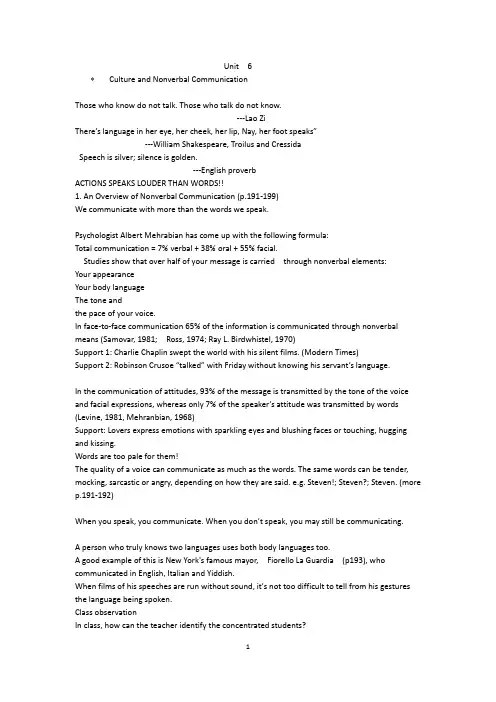
1 Unit 6 Culture and Nonverbal Communication Those who know do not talk. Those who talk do not know. ---Lao Zi There’s language in her eye, her cheek, her lip, Nay, her foot speaks” ---William Shakespeare, Troilus and Cressida Speech is silver; silence is golden. ---English proverb ACTIONS SPEAKS LOUDER THAN WORDS!! 1. An Overview of Nonverbal Communication (p.191-199) We communicate with more than the words we speak. Psychologist Albert Mehrabian has come up with the following formula: Total communication = 7% verbal + 38% oral + 55% facial. Studies show that over half of your message is carried through nonverbal elements: Your appearance Your body language The tone and the pace of your voice. In face-to-face communication 65% of the information is communicated through nonverbal means (Samovar, 1981; Ross, 1974; Ray L. Birdwhistel, 1970) Support 1: Charlie Chaplin swept the world with his silent films. (Modern Times) Support 2: Robinson Crusoe “talked” with Friday without knowing his servant’s language. In the communication of attitudes, 93% of the message is transmitted by the tone of the voice and facial expressions, whereas only 7% of the speaker’s attitude was transmitted by words (Levine, 1981, Mehranbian, 1968) Support: Lovers express emotions with sparkling eyes and blushing faces or touching, hugging and kissing. Words are too pale for them! The quality of a voice can communicate as much as the words. The same words can be tender, mocking, sarcastic or angry, depending on how they are said. e.g. Steven!; Steven?; Steven. (more p.191-192) When you speak, you communicate. When you don’t speak, you may still be communicating. A person who truly knows two languages uses both body languages too. A good example of this is New York's famous mayor, Fiorello La Guardia (p193), who communicated in English, Italian and Yiddish. When films of his speeches are run without sound, it's not too difficult to tell from his gestures the language being spoken. Class observation In class, how can the teacher identify the concentrated students? 2 They may show an interested look, wear a smile, make some notes or keep their eyes on the teacher. On the other hand, how can the teacher know the students are not interested in her class? They may consciously or unconsciously twist the body, bury the head, avoid the teacher’s eyes, wear a blank expression, knit the eyebrows or bite the pen. 2. What is nonverbal communication? Nonverbal communication involves all nonverbal stimuli in a communication setting that are generated by both the source (speaker) and his or her use of the environment and that have potential message value for the source or receiver (listener). --- (Larry A. Samovar, 1998) In other words, it is communication without words. 2. What is nonverbal communication? It refers to communication through a whole variety of different types of signal come into play, including: the way we move, the gestures we employ, the posture we adopt, the facial expression we wear, the direction of our gaze, to the extent to which we touch and the distance we stand from each other. Classification Body language/Kinesics(体态语/身势语): posture, head movement, facial expressions, eye behavior, gestures, handshaking, arm movement, leg movement, kiss, hug, touch etc. Paralanguage( 副语言): sound, pitch, tempo of speech, tone, volume, pause, silence, turn-taking etc. Classification Object language ( 客体语、物体语) : clothing, personal artifacts (adornment, jewelry, perfume, personal gear etc.) , hair, furniture, 3 vehicle etc. Environmental language(环境语): time language/chronemics , spatial language/ proxemics (interpersonal distance), space, seating, territoriality, color, light, signs and symbols, architecture etc. Body language/Kinesics The study of how movement communicates is called Kinesics. Kinesic behavior refers to communication through body movements like posture, head movement, facial expressions, eye behavior, gestures, handshaking, arm movement, leg movement etc. Posture ---bow Posture and sitting habits offer insight into a culture’s deep structure. In many Asian cultures, the bow is much more than a greeting. It signifies that culture’s concern with status and rank. In Japan, for example, low posture is an indicator of respect. Although it appears simple to the outsider, the bowing ritual is actually rather complicated. ---Bow in Japan The person who occupies the lower station begins the bow, and his or her bow must be deeper than the other person’s. The superior, on the other hand, determines when the bowing is to end. When the participants are of equal rank, they begin the bow in the same manner and end at the same time. ---Wai in Thailand The Thai people use a similar movement called the wai. The wai movement---which is made by pressing both hands close together in front of one’s body, with the fingertips reaching to about neck level---is used to show respect. The lower the head comes to the hands, the more respect is shown. ---Crossing legs (1) The manner in which we sit also can communicate a message. In U.S.: normal to cross legs while seated; women cross at the angle while men cross with angle on the knee; Middle East: crossing the leg with angle on the knee is inappropriate; ---Crossing legs (2) In Ghana and in Turkey, sitting with one’s legs crossed is extremely offensive; People in Thailand believe that because the bottoms of the feet are the lowest part of the body, they should never be pointed in the direction of another person; In fact, for the Thai, the feet take on so much significance that people avoid stomping with them. ---Slouching In US, where being casual and friendly is valued, people often fall into chairs or slouch when they stand. In many countries, such as Germany and Sweden, where lifestyles tend to be more formal, slouching is considered a sign of rudeness and poor manners. ---Feet on desk In U.S. and Britain: lean back in the chair and put feet on the desk to convey a relaxed and

1
Intercultural communication in English
1. Globalization (what & why)
1) Dictionary: to organize or establish worldwide
2) Wiki: Globalization refers to the increasingly global relationships of culture, people and
economic activity.
3) Globalization refers to the establishment of a world economy, in which national borders are
becoming less and less important as transnational corporations, existing everywhere and
nowhere, do business in a global market.
4) Globalization refers to “time-spaces compression”. That is, the way in which the world
appears to be getting smaller. (Reasons: the increasing global mobility of people; the impact
of new electronic media on human communications)
5) At the same time, people all over the world are faced with the same environmental issues
that affect all cultures.
6) Global instability stems from clashes between cultures as humankind creates
1、 文化:culture
It is that complex whole which includes knowledge, belief, art, morals, law, custom,
and any other capabilities and habits acquired by man as a member of society.
The Characteristics of Culture:
Learned、transmitted、Subject to change、unconscious、integrated、symbolic、adaptive.
2、 跨文化交际: intercultural communication
Intercultural communication means the communication between people from different
cultural backgrounds. It is communication between people whose cultural perceptions
and symbol systems are distinct enough to alter the communication event.
3、高语境文化:High-Context Cultures
①Infer information from message context, rather than from content.
②Prefer indirectness, politeness and ambiguity.
③Convey little information explicitly.
④Rely heavily on nonverbal signs.
4、价值观:Values
A standard by which members of culture define what is desirable or undesirable、good