
口译课件2
- 格式:ppt
- 大小:911.50 KB
- 文档页数:75


实用英语口译教程课件
Practical English Interpreting Course Materials.
English Answers:
Introduction to Interpreting.
What is interpreting?
English interpreting is the act of conveying spoken or
written information from one language into another in a way
that is both accurate and understandable to the audience.
It is a highly specialized skill that requires a strong
command of both the source and target languages, as well as
a deep understanding of the cultural context of both
languages.
Types of interpreting.
There are two main types of interpreting: consecutive and simultaneous.
Consecutive interpreting is a type of interpreting in
which the interpreter listens to a speaker for a period of
time, takes notes, and then delivers the interpretation to
the audience in the target language.

第 1 页 共 12 页
出师表教学课件
(实用版)
编制人:__________________
审核人:__________________
审批人:__________________
编制单位:__________________
编制时间:____年____月____日
序言
下载提示:该文档是本店铺精心编制而成的,希望大家下载后,能够帮助大家解决实际问题。文档下载后可定制修改,请根据实际需要进行调整和使用,谢谢!
并且,本店铺为大家提供各种类型的实用资料,如试题资料、作文大全、语文资料、公文资料、素材资料、古诗文、教案大全、近义词、反义词、其他资料等等,想了解不同资料格式和写法,敬请关注!
Download tips: This document is carefully compiled by this editor.
I hope that after you download it, it can help you solve practical problems.
The document can be customized and modified after downloading, please
adjust and use it according to actual needs, thank you!
In addition, this store provides you with various types of practical
materials, such as test questions, composition encyclopedia, Chinese
materials, official documents, material materials, ancient poetry,
teaching plan encyclopedia, synonyms, antonyms, and other materials. If
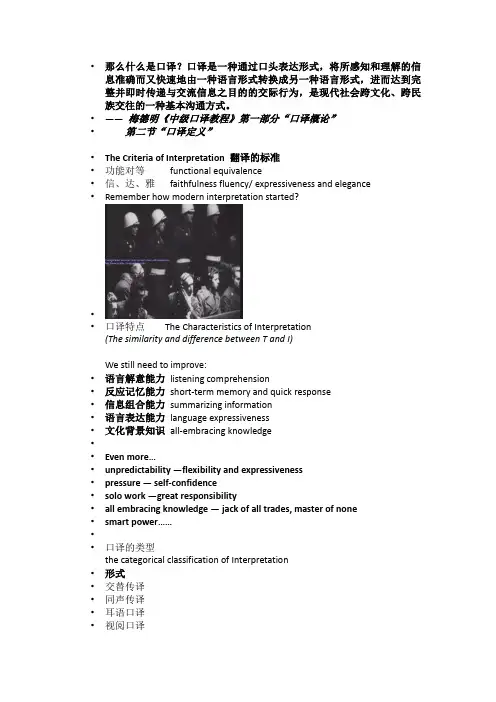
• 那么什么是口译?口译是一种通过口头表达形式,将所感知和理解的信息准确而又快速地由一种语言形式转换成另一种语言形式,进而达到完整并即时传递与交流信息之目的的交际行为,是现代社会跨文化、跨民族交往的一种基本沟通方式。
• —— 梅德明《中级口译教程》第一部分“口译概论”
• 第二节“口译定义”
• The Criteria of Interpretation 翻译的标准
• 功能对等 functional equivalence
• 信、达、雅 faithfulness fluency/ expressiveness and elegance
• Remember how modern interpretation started?
•
• 口译特点 The Characteristics of Interpretation
(The similarity and difference between T and I)
We still need to improve:
• 语言解意能力 listening comprehension
• 反应记忆能力 short-term memory and quick response
• 信息组合能力 summarizing information
• 语言表达能力 language expressiveness
• 文化背景知识 all-embracing knowledge
•
• Even more…
• unpredictability —flexibility and expressiveness
• pressure — self-confidence
• solo work —great responsibility
• all embracing knowledge — jack of all trades, master of none

滨 州 医 学 院 教 案
(理论课用)
课程名称 内科护理学 授课教师 职称
授课对象 护理学 专业 年级 1、2 班(组)
授课时间 计划学时 3
授课课题:
第八节 肝硬化(cirrhosis of liver)
教学目的与要求:
1、掌握肝硬化失代偿期的临床特点和并发症
2、熟悉肝硬化患者可能存在的主要护理诊断/问题,并能制订合理的护理措施。
3、了解肝硬化的病因和发病机制
4、、能够运用沟通技巧对肝硬化患者及家属正确进行健康指导
教学重点、难点:
重点:1、肝硬化的临床特点和并发症;2、针对肝硬化患者存在的两个主要护理问题所采取的护理措施;
难点:肝硬化的病理生理过程和肝硬化腹水的产生机制
教学法:
讲授法
教学手段、用具:
手段:多媒体辅助教学、板书
用具:多媒体教学设备、课件、板书用具等
教材:《内科护理学》第四版,尤黎明主编,人民卫生出版社。
教学内容提要、步骤及时间分配:
1、定 义 5分钟
2、病 因 15分钟
3、发病机理 10分钟
4、临床表现 30分钟
5、并发症 15分钟
6、辅助检查 15分钟
7、诊断 5分钟
8、治疗 15分钟
9、预后 5分钟
10、护理 35分钟
思考题: 1、简述肝硬化失代偿期的临床特点
2、列举肝硬化的并发症
3、结合病例制定肝硬化腹水病人的护理计划
参考书:1、叶任高 主编《内科学》第六版,北京:人民卫生出版社
2、陈灏珠 主编《.实用内科学》第12版,北京:人民卫生出版社.2005