
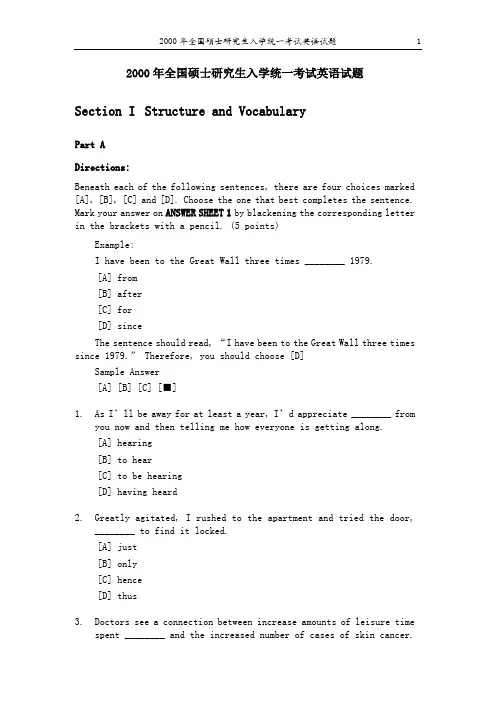
2000年全国硕士研究生入学统一考试英语试题
- 格式:doc
- 大小:218.50 KB
- 文档页数:23

2024年全国硕士研究生入学统一考试英语(一)试题Section I Use of EnglishDirections:Read the following text.Choose the best word(s)for each numbered blank and mark A,B,C or D ontheANSWER SHEET.(10points)There's nothing more welcoming than a door opening for you.the need to be touched to open orclose,automatic doors are essential in2disabled access to buildings and helping provide general3to commercial buildings.Self-sliding doors began to emerge as a commercial product in1960after being invented six years4by Americans Dee Horton and Lew Hewitl.They5as a novelty feature,but as their use has grown,their6have extended within our technologically advanced world. Particularly7in busy locations or during times of emergency,the doors8Crowd management by reducing the obstacles put in people's way.9making access both in and out of buildings easier for people,the difference in the way many of these doors open helps reduce the total area10by them.Automatic doors often open to the side,with the panels sliding across one another.Replacing swing doors,these11smaller buildings to maximise the usable space inside without having to12the way for a large, sticking-out door.There are many different types of automatic door,with each13specific signals to tell them when to open.14these methods differ,the main15remain the same.Each automatic door system16the light,sound weight or movement in their vicinityas a signal to open.Sensor typesare chosen to17the different environments they are needed in. 18a busy street might not19a motion-sensored door,as itwould constantly be opening for passers-by.A pressure sensitive mat would be more20tolimit the surveyed area.1.[A]Through[B]Despite[C]Besides[D]Without2.[A]revealing[B]demanding[C]improving[D]tracing3.[A]experience[B]convenience[C]guidance[D]reference4.[A]previously[B]temporarily[C]successively[D]eventually5.[A]held on[B]started out[C]settled down[D]went by6.[A]relations[B]volumes[C]benefits[D]sources7.[A]useful[B]simple[C]flexible[D]stable8.[A]call for[B]yield to[C]insist on[D]act as9.[A]As well as[B]In terms of[C]Thanksto[D]Rather than10.[A]connected[B]shared[C]represented[D]occupied11.[A]allow[B]expect[C]require[D]direct12.[A]adopt[B]lead[C]clear D]change13.[A]adapting to[B]deriving from[C]relying on[D]pointing at14.[A]Once[B]Since[C]Unless[D]Although15.[A]records[B]positions[C]principles D]reasons16.[A]controls[B]analyses[C]produces[D]mixes17.[A]decorate[B]compare[C]protect[D]complement18.[A]In conclusion[B]By contrast[C]For example D]Aboveall19.[A]identify[B]suit[C]secure[DJinclude20.[A]appropriate[B]obvious[C]impressive[D]delicateSection II Reading ComprehensionPartADirections:Read the following four texts.Answer the questions below each text by choosing A,B,C or D. Mark your answers on the ANSWER SHEET.(40points)Text1Nearly2000years ago,as the Romans began topull out of Scotland,they left behind a curious treasure:10tons of nails,nearly a million of the things.The nail hoard was discovered in 1960in a four-metre-deep pit covered bytwo metresof gravel.Why had the Romans buried a million nails?Thelikely explanation is that the withdrawal was rushed,and they didn't want the localCaledonians getting their hands on10tons of weapon-grade iron.The Romans buried thenails so deep that they would not be discovered for almost two millennia.Later civilisations would value the skilled blacksmith's labour in a nail even more than the raw material.As RomaAgrawal explains in her new delightful bookNuts and Bolts,early17th-century Virginians would sometimes bum down their homes if they were planning to relocate. This was an attempt to recover the valuable nails,which could be reused after siting the ashes The idea that one mightbum down an entire house just to reclaim the nails underlines how scarce, costly and valuablethesimple-seeming technology was.The price of nails fell by90%between the late1700sand mid-1900s,as economist Daniel Sichel points out in a research paper.Accordingto Sichel,although the falling price of nails was driven partly by cheaper ironand cheaperenergy,most of the credit goes to nail manufactures who simply found more efficient ways to turn steel into nails.Nails themselves have changed over the years,but Sichel studied them because they haven't changedmuch.Roman lamps and Roman chariots are very different from LED strips and sports cars,but Roman nails are still clearly nails.It would be absurd to try to track the changing price of sports carssince1695,but to ask the same question of nails makes perfect sense.I makeno apology for being obsessedby a particular feature of these objects:their price.I am an economist,after all.Afterwriting two books about the history of inventions,one thing Ive leamt is that while it is the enchantingly sophisticated technologies that get all the hype,it's thecheap technologies that change the world.The Gutenberg printing press transformed civilisation not by changing the natureof writing but by changing its cost-and it would have achieved little without a parallel collapse in the price of surfaces to write on,thanks to an often-overlooked technology called paper.Solar panels had few niche uses until they became cheap;now they aretransforming the global energy system21.The Romans buried the nails probably for the sake of[A]saving them for future use[B]keeping them from rusting[C]letting them grow in value[D]hiding themfrom the locals22.The example of early17th-century Virginians is used to[A]highlight the thriftiness of early American colonists[B]illustrate the high statusof blacksmihs in that period[C]contrastthe attitudes of different civilisations towardnailsD]show the preciousness of nail-making technology at that time23.What played the major role in lowering the price of nails after the late1700s?[A]Increased productivity.[B]Wider use of new energies.[C]Fiercer market competition.[D]Reduced costof raw materials.24.It can be leamed from Paragraph5that nails[A]have undergone many technological improvements[B]haveremained basically thesamesince Roman times[C]are less studied than other everydayproducts[D]areone of the world's most significant inventions25.Whichof the following best summarises the last two paragraphs?[A]Cheaptechnologies bring about revolutionary change.[B]Technological innovation is integral to economic success.[C]Technology definespeople's understanding of the world.[D]Sophisticated technologies develop from small inventions.Text2Parenting tips obtained from hunter-gatherers in Africa may be the key to bringing up more contented children,researchers have suggested.Theidea is based on studiesof communities such as the Kung of Botswana,where each child is cared for by many adults.Kung children as young as four will help to look after younger ones and*baby-wearing",in which infants are carried in slings,isconsidered the nom.According to Dr Nikhil Chaudhary,an evolutionary anthropologist at Cambridge University, these practices,Known as alloparenting,could lead to less anxietyfor children and parents.Dr Annie Swanepoel,a child psychiatrist,believes that there are ways to incorporate them into western life.In Germany,one scheme has paired an old people's homewith a nursery.The residents help tolook after the children,an arangementakin to alloparenting.Another measure could be encouraging friendships between children indifferent school years to miror the unsupervised mixed-age playgroups in hunter-gatherer communities.In a paper published in the Journal ofChild Psychology and Psychiatry,researchers said that the westerm nuclear family was a recent invention which family broke with evolutionary history.This abrupt shift to an“intensive mothering narrative”,which suggests that mothers should manage childcare alone,was likely to have been harmful.“Such naratives can lead to matemal exhaustion and have dangerous consequences,"theywrote.By contrast,in hunter-gatherer societies adults other than the parents can provide almost half of a child's care.One previous study looked at the Efépeople of the Democratic Republic of Congo.It found that infants had an average of14alloparents a day by the time they were18 weeksold and were passed between caregivers eight times an hour.Chaudhary said that parentsnow had less childcare support from family and social networks than during most of humans'evolutionary history,but introducing additional caregivers could reduce stress and matermal depression,which could have a“knock-on”benefit to a child's wellbeing.An infant bom to a hunter-gatherer society could have more than ten caregivers-this contrasts starkly to nursery settings in the UK where regulations call for a ratio of one carer to four children aged two to threeWhile hunter-gatherer children leamt from observation and imitation in mixed-age playgroups,researchers said that western“instructive teaching”,wherepupils are asked to sit still, may contribute to conditions such as attention deficit hyperactivity disorder.Chaudhary said that Britain should explore thepossibility that older siblings helping their parents“might also enhance their own socialdevelopment.”26.Accordingto the first two paragraph,alloparenting refers to the practice of[A]sharing child careamong community members[B]assigning babies to specific adult caregivers[C]teaching parenting detailsto older children[D]carrying infants around by their parent27.The scheme in Germanyis mentioned to illustrate[A]an attempt to facilitate intergenerational communication[B]an approach to integrating alloparenting into western culture[C]the conventional parenting style in western culture[D]the differences between westem African ways of living28.According toParagraph4,the“"intensive mothering narrative”[A]alleviateparenting pressure[B]considerate family relationships[C]results inthe child-centered family[D]departs from the course of evolution29.According to paragraph6,what can we leam about nursery in theUK?[A]They tend to fall short of official requirements.[B]They have difficulty finding enough caregivers[C]They ought to improve their carer-to-childratio.[D]They should try to prevent parental depression.30.Which of the following would be the best title?[A]Instructive teaching a dilemma for anxious parents[B]For a happier family,leam from the hunter-gatherers[C]Mix-aged playgroup,abetter choice for lonelychildren[D]Tracing the history of parenting:from Africa to EuropeText3Rutkowski is aPolish digital artistwhouses classical painting styles tocreatedreamy fantasy landscapes.He has made illustrations for games such as Sony's Horizon Forbidden West, Ubisoft's Anno,Dungeons&Dragons,and Magic:The Gathering.And he's become a sudden hit in the new world of text-to-image AI generation.His distinctive style is now one of the most commonly used prompts in the new open-source AI art generator Stable Diffusion,which was launched late last month.The tool,along with other popular image-generation AI models,allows anyone to create impressive images based on text prompts.For example,type in“Wizard with sword and a glowing orb of magic fire fights afierce dragon Greg Rutkowski,"and the system will produce something that looks not a million miles away from works in Rutkowski's style.But these open-source programs are built by scraping images from the Intemet,oftenwithout permission andproper attribution to artistsAs a result,they are raising tricky questions about ethics and copyright.And artists like Rutkowski have had enough.According to the website Lexica,which tracks over10million images and prompts generated by Stable Diffusion,Rutkowski's name has been used as a prompt around93,000times.Some of the world's most famous artists,such as Michelangelo,Pablo Picasso,and Leonardo da Vinci, brought up around2,000prompts each or less.Rutkowski's name also features as a prompt thousands of times in theDiscord of another text-to-image generator,Midjourney.Rutkowski was initially surprised but thought it might be a good way to reach new audiences.Then he tried searching for hisname to see if a piece he had worked on had been published.The online search brought backwork that had his name attached to it butwasn't his.“It'sbeen just a month.What about in a year?I probably won't be able to find my work out therebecause[the intermet]willbe floodedwithAI art,“Rutkowski says.“"That's concerning.”There is a coalition growing within artist industries to figure out how to tackle or mitigate this,"says Ortiz.Thegroup is in its earlydays of mobilization,which could involve pushing for new policies or regulation.One suggestion is that AI models could be trained on images in the public domain,and AI companies could forgepartnerships with museums and artists,Ortiz says.31.What can be leamed about Rutkowski from the first two paragraphs?[A]He is enthusiastic about AI generation painting[B]He is popular with the users of an AIart generator.[C]He attracts admiration from other illustrators.[D]He specializes in classical painting digitalization.32.The problem with open-source AI art generators is that they[A]lack flexibility in responding to prompts[B]produce artworks in unpredictable styles[C]make unauthorized use of online images[D]collect user information withoutconsent33.After searching online,Rutkowski found[A]a unique way to reach audiences[B]a new method to identifyAI images[C]AI-generated work bearing his nameD]heated disputes regarding his copyright34.According to Ortiz,AI companies are advised to[A]campaign for new policies or regulations[B]offer their services to public institutions[C]strengthen their relationshipswith AI users[D]adopt a different strategy for AImodeltraining35.What is the text mainly about?[A]Artists'responses to Al art generation.[B]AI's expanded role in artistic creation.[C]Privacy issues in the application of AI.[D]Opposing views on AI development.Text4The miracle ofthe ChesapeakeBay lies not in its depths,but in the complexity of its natural construction,the interaction of fresh andsaline water and the mix of land and water.The shallows provide homesfor hundreds of species while storing floodwaters,filtering pollutants from water, and protecting nearby communities frompotentially destructive storm surges.All this was put at great risklate last month,when the US Supreme Court issued aruling in an Idaho case that provides the EPA far less authority to regulate wetlands and waterways. Specifically,a54majority decided that wetlands protected by the EPA under it Clean Water Act authority must have a“continuous surface connection”to bodies of water.This narrowing of the regulatoryscope was a victory for builders,mining operators andothercommercial interests often at odds with environmental rules.And it carries“significant repercussions for water quality and flood control throughout the US,"as Justice Brett Kavanaugh observed.In Maryland,the good news is that there are many state laws in place that provide wetlands protections.But that's a very shortsightedview,particularly whenit comes to the Chesapeake Bay. The reality is that water and the pollutants that so often come with it,don't respect state boundaries.The Chesapeake draws from a64000-square-mile watershed that extends to Virginia, Pennsylvania,New York,West Virginia,the District of Columbia and Delaware.Will thosejurisdictions extend the same protectionsnowdenied under Sackett V.EPA?Perhaps some,but all? That seems unlikelyIt is tooeasy,and misleading,to see such court rulings as merely standing up for the rights of landowners when the consequences can be so dire for their neighbors.And it's reminder thatthey EPA's involvement in the Chesapeake Bay program has long been crucial as the means to transcend the influence of deep-pocketed special interests in neighboring states.Pennsylvania farmers,to use one telling example,aren't thinking about next year's blue crab harvest in Maryland when they decide whether to spread animal waste on their fields,yet the runoff into nearby creeks can have enomous impacts downstream.And so we would also call on state lawmakers from Richmond to Albany to consider reviewing their own wetlands protections and see for themselves the enomous stakes involved. We can't offer them a trip to the Chesapeake Bay model.It's been gone since the1980s but perhaps a visit to Blackwater National WildlifeRefuge in Dorchester Countywhere American bald eaglesfly over tidal marshes so shallow you could not paddle a boat across them but teaming with aquatic life.It'sworth the scenic drive.36.The Chesapeake Bay is described in Paragraph l as[A]a value natural environment[B]acontroversial conservation area[C]a place with commercial potential[D]a headache fornearby communities37.The U.S.Supreme Court's ruling in the Idaho case[A]reinforceswater pollution control[B]weakens the EPA's regulatory power[C]will end conflicts among local residents[D]may face opposition from mining operators38.How does the author feel about the future of the Chesapeake Bay?[A]Worried.[B]Puzzled.[C]Relieved.[D]Encouraged.39.What canbe infered about the EPA's involvement in the Chesapeake Bay Program?[A]It has restored thebalance among neighboring jurisdictions.[B]It has triggered aradicalreform in commercial fisheries.[C]Ithas set a fine example of respecting state authorities.[D]It has ensured the coordination of protection efforts.40.The author holds that the state lawmakers should[A]be cautious about the influence of landowners[B]attach due importance to wetlands protections[C]recognize the need to expand wildlife refuges[D]improve the wellbeing of endangered speciesPart BDirections:Read the following comments on a report about American museums returning artifacts to their countries of origin and a list of statementssummarizing the comments.Choose thebest statement from the list A-G for eachnumbered name(41—45).There are two extra choices which youdo not need to use.Mark your answers on the ANSWER SHEET.(10points)(41)HannahSimply,there are peoplein Nigeria who cannot travel to the Smithsonian Institution to see that part of their history and culture represented by the Benin Bronzes.These should be available to them as part of their culturalheritage and historyand as a source of national pride.There is no good reason that theseartifacts should be beyond the ordinary reach of the educational objectives or inspiration ofthe generations to which they were left.They serve no purpose in a museum in the United States or elsewhere except as curious objects.They cannot be compared to works of art produced for sale which can bepassedfrom hand to hand and place to place by purchase. (42)BuckWe know very exact reproductions of artwork can be and are regularly produced.Perhaps museuns andgovernments mightexplore some rolefor the use of nearly exact reproductions as a means of resolving issues relating to returning works of art and antiquities.The context of any exhibitis more important to me than whether the object being displayed is2,000years old or2 months old.In many cases the experts have a hard time agreeing on what is the real object andwhat is a forgery.Again,the story an exhibit is trying to tell is what matters.The monetary value of theobjects on display is a distant second place in importance.(43)SaraWhen visiting the Baltimore Museum of Art,I came across a magnificent15th-century Chinesesculpture.It inspired meto leamn more about the culture that it represented.Artifacts in museumshave the power to inspire,and perhaps spark that need to leam and understand the nature of their creators.Having said that,I dofeel that whatever artifactsfind their way to public museums should,in fact,be sanctioned as having been obtained on loan,legally purchased,or obtained by treaty.Stealing artifacts from other peoples'cultures is obscene;it robs not only the physical objects,but the dignity and spirit of their creators.(44)VictorAncient art that is displaced in foreigncountries shouldbe returned...(缺失)(45)JuliaTo those of you in the comments section,by all means,who are havingstrong feeling about artifactsbeing removed from cities in the US and Britain,I would ask you to consider.(缺失)[A]It is clear thatcountries of origin have never been compensatedfor stolen artifacts[B]It is a flawed line of reasoning to argue against returning artifacts to their countries of origin.[C]Museum visitor can still leam as much from artifacts copies after the originals are retumed.[D]Reproductions,even if perfectly made,cannot take the place of the authentic objects.[E]The real value of artifacts can only be recognized in their countries of origin rather than anywhere else[F]Ways to get artifacts from other countries must be decent andlawful.[G]Concern over security is no excuse for refusing to return artifacts to their countries of origin参考答案:41.E42.C43.F44.G45.BPart CDirections;Read the following text carefully and then translate the underlined segments into Chinese.Your translation should be written clearly on the ANSWER SHEET.(10points)“Elephants never forget”—or so they say—and that piece of folklore seems to have some foundation.The African savanna elephant also known as theAfrican bush elephant,is distributed across 37African countries.(46)They sometimes travel more than sixty miles to find food or water,and arevery good at working out where other elephants are—even when they are out of ing tracking devices,researchers have shown that they have“remarkable spatial acuity”,when finding their way to waterholes,they headed off in exactly the right direction,on one occasionfrom a distance of roughly thirty miles.What is more,they almost always seem to choose the nearest water hole.(47)The researchers are convinced that the elephants always know precisely where they are in relation to all the resources they need,and can therefore take shortcuts,as well as following familiar routes.Although the cues used by African elephants for long-distance navigation are not yet understood,smell maywell play a part.Elephants are very choosy eaters,but until recently little was known about how they selected theirfood.(48)One possibility was that they merely used their eyes and tried out the plants they found,but that would probably result in a lot of wasted time and energy,not least because thein eyesight is actually not very good.(49)The volatile chemicals produced by plants can be carrieda long way,andthey are very characteristic:Each plant or tree has its own particular odor signature.What is more,they can be detected even when they are not actually visible.New research suggests that smell is a crucial factor in guiding elephants—and probably other herbivores—to thebest food resources.The researchers first established what kinds of plant the elephants preferred either to eat or avoid when foraging freely.They then set up a“food station”experiment,in which they gave elephants a series of choices based only on smell.(50)The experiment showed that elephants may well use smell to identify patches of trees that are good to eat,and secondly to assess the quality ofthe trees within each patch.Free-ranging elephants presumably also use this information to locate their preferred food.参考译文:(46)它们有时跋涉六十多英里寻找食物或水,并且非常善于寻找其他大象的位置——即使它们不在视线范围内。

2025年全国硕士研究生招生考试英语(二)(科目代码:204)Section I Use of EnglishDirections:Read the following text.Choose the best word(s)for each numbered blank and mark A,B,C or D on the ANSWER SHEET.(10points)There are many understandable reasons why you might find it difficult to ask for help when you need it.Psychologists have been interested in this1for decades,not least because people’s widespread2to ask for help has led to some high-profile failures.Asking or help takes3.It involves communicating a need on your part-there’s something you can’t do.4,you’re broadcasting your own weaknesses which can be5.You might worry about coming across as incompetent. You might have6about losing control of whatever it is you’re asking for help with.7someone starts to help,perhaps they’ll take over,or get credit for your earlier efforts.Yet another8that might be worried about is being a nuisance or9the person you go to for help.If you struggle with low self-esteem,you might find it especially difficult to10for help because you have the added worry of the other person11 your request.You might see such refusals as implying something12about the status of your relationship with them.To13these difficulties,try to remind yourself that everyone needs help sometimes.Nobody knows everything and can do everything all by themselves.And while you might14coming across as incompetent,there’s actually research that shows that advice-seekers are15as more competent,not less.Perhaps most encouraging of all is a paper from2022by researchers at Stanford University that involved a mix of contrived help-seeking interactions and asking people to16times they’d sought help in the past.The findings showed that help-seeker generally underestimate how17other people will be to help and how good it’ll make the help-giver feel(for most people,having the chance to help someone is highly18).So,bear all this in mind the next time you need to ask for help19,take care over who you ask and when you ask them.And if someone can’t help right now, avoid talking it personally.They might just be too20,or they might not feel confident about their ability to help.1.[A]illusion[B]discussion[C]tradition[D]question2.[A]reluctance[B]ambition[C]tendency[D]enthusiasm3.[A]attention[B]talent[C]courage[D]patience4.[A]At any time[B]In other words[C]By all means[D]On the contrary5.[A]unrealistic[B]deceptive[C]tiresome[D]uncomfortable6.[A]doubts[B]concerns[C]suggestions[D]secrets7.[A]Once[B]Unless[C]Although[D]Before8.[A]theory[B]choice[C]factor[D]context9.[A]overpraising[B]outperforming[C]reassessing[D]inconveniencing10.[A]reach out[B]settle down[C]turn over[D]look back11.[A]declining[B]considering[C]criticising[D]evaluating12.[A]unnecessary[B]negative[C]strange[D]impractical13.[A]explain[B]identify[C]predict[D]overcome14.[A]deny[B]forget[C]miss[D]fear15.[A]disguised[B]perceived[C]followed[D]introduced16.[A]read[B]classify[C]analyse[D]compare17.[A]brave[B]surprising[C]willing[D]demanding18.[A]relaxing[B]disappointed[C]rewarding[D]hesitant19.[A]Thus[B]Also[C]Finally[D]Instead20.[A]polite[B]proud[C]busy[D]lazySection II Reading ComprehensionPart ADirections:Read the following four texts.Answer the questions below each text by choosing A,B, C or D.Mark your answers on the ANSWER SHEET.(40points)Text1U.S.customers historically tipped people they assumed were earning most of their income via tips,such as restaurant servers earning less than the minimum wage.In the early2010s,a wide range of businesses started processing purchases with iPads and other digital payment systems.These systems prompted customers to tip for services that were not previously tipped.Today’s tip requests are often not connected to the salary and service norms that used to determine when oud how people tip.Customers in the past nearly always paid tips after receiving a service,such as at the conclusion of a restaurant meal,after getting a haircut or once a pizza was delivered.That timing could reward high-quality service and give workers an incentive to provide it.It’s becoming more common for tips to be requested beforehand.And new tipping technology may even automatically add tips.The prevalence of digital payment devices has made it easier to ask customers for a tip.That helps explain why tip requests are creeping into new kind of services.Customers now routinely see menus of suggested default options-often well above70%of what they owe.The amounts have risen from10%or less in the 1950s to15%around the year2000to20%or higher today.This increase is sometimes called tipflation---the expectation of ever-higher tip amounts.Tipping has always been a vital source of income for workers in historically tipped services,like restaurants,where the tipped minimum wage can be as low as US$2.13an hour.Tip creep and tip flation are now further supplementing the income of many low-wage service workers.Notably,tipping primarily benefits some of these workers,such as cooks and dishwashers.To ensure that all employees were paid fair wages,some restaurants banned tipping and increased prices,but this movement toward no-tipping services has largely fizzled out.21.According to paragraph1,the practice of tips in the U.S..[A]was regarded by many customers as a sign of generosity[B]was considered essential for waiters[C]was a way of rewarding diligence[D]was optional in most businessespared with tips in the past,today’s tips.[A]are paid much less frequently[B]are less often requested in advance[C]have less to do with service quality[D]contributed less to workers’income23.Tip requests are creeping into new kind of service as a result of________.[A]the advancement of technology[B]the desire for income increase[C]the diversification of business[D]the emergence of tip flation24.The movement toward to no-tipping service was intended to________.[A]promote consumption[B]guarantee income fairness[C]maintain reasonable prices[D]enrich income sources25.It can be learned from the last paragraph that tipping.[A]is becoming a burden for customers[B]helps encourage quality service[C]is vital to business development[D]reflects the need to reduce pricesText2When it was established,the National Health Service was visionary:offering high-quality,timely care to meet the dominant needs of the population it served. Nearly75years on,with the country facing very different health challenges,it is clear that model is out of date.From life expectancy to cancer and infant mortality rates,we are lagging behind many of our peers.With more than6.8million on waitlists,healthcare is becoming increasingly inaccessible for those who cannot opt to pay for private treatment;and the cost of providing healthcare is increasingly squeezing out investment in other public services.As demand for healthcare continues to grow,pressures on the workforce–which is already near breaking point–will only become more acute.The OBR now describes healthcare spending as the“largest–and most likely–source of long-term risk to fiscal sustainability”.Many of the answers to the crisis in health and care are well rehearsed.We need to be much better at reducing and diverting demand on health services,rather than simply managing it.Much more needs to be invested in communities and primary care to reduce our reliance on hospitals.And capacity in social care needs to be greater,to support the growing number of people living with long-term conditions.Yet despite two decades of strategies and a number of major health reforms,we have failed to make meaningful progress on any of these aims.That is why Reform is launching a new programme of work entitled“Reimagining health”,supported by ten former health ministers from across the three main political parties.Together,we are calling for a much more open and honest conversation about the future of health in the UK,and an“urgent rethink”of the hospital-centric model we retain.This must begin with the question of how we maximise the health of the nation, rather than“fix”the NHS.It is estimated,for example,that healthcare accounts for only about20%of health outcomes.Much more important are the places we live, work and socialise–yet there is no clear cross-government strategy for improving these social determinants of health.Worse,when policies like the national obesity strategy are scrapped,taxpayers are left with the hefty price tag of treating the illnesses,like diabetes,that result.Reform wants to ask how power and resources should be distributed in our health system.What health functions should remain at the centre,and what should be devolved to local leaders,often responsible for services that create health,and with a much better understanding of the needs of their populations?26.According to the first two paragraphs,the NHS.[A]is troubled by funding deficiencies[B]can hardly satisfy people’s needs[C]can barely retain its current employees[D]is rivalled by private medical services27.One answer to the crisis in health and care is to.[A]boost the efficiency of hospitals[B]lighten the burden on social care[C]increase resources for primary care[D]reduce the pressure on communities28.“Reimagining health”is aimed to.[A]reinforce hospital management[B]readjust healthcare regulations[C]restructure the health system[D]resume suspended health reforms29.To maximise the nation’s health,the author suggests.[A]introducing relevant taxation policies[B]paying due attention to social factors[C]reevaluating major health outcomes[D]enhancing the quality of healthcare30.It can be inferred that local leaders should.[A]exercise their power more reasonably[B]develop a stronger sense of responsibility[C]play a bigger role in then health system[D]understand people’s health needs betterText3Heat action plans,or HAPs,have been proliferating in India in the past few years.In general,a HAP spells out when and how officials should issue heat warnings and alert hospitals and other institutions.Nagpur’s plan,for instance,calls for hospitals to set aside“cold wards”in the summer for treating heatstroke patients,and advises builders to give construction laborers a break from work on very hot days.But implementation of existing HAPs has been uneven,according to a report from the Centre for Policy Research.Many lack adequate funding,it found.And their triggering thresholds often are not customized to the local climate.In some areas, high daytime temperatures alone might serve as an adequate trigger for alerts.But in other places,nighttime temperatures or humidity might be as important a gauge of risk as daytime highs.Mumbai’s April heatstroke deaths highlighted the need for more nuanced and localized warnings,researchers say.That day’s high temperature of roughly36℃was 1℃shy of the heat wave alert threshold for coastal cities set by national meteorological authorities.But the effects of the heat were amplified by humidity—an often neglected factor in heat alert systems-and the lack of shade at the late-morning outdoor ceremony.To help improve HAPs,urban planner Rajashree Kotharkar’s team is working on a model plan that outlines best practices and could be adapted to local conditions.Among other things,she says,all cities should create a vulnerability map to help focus responses on the populations most at risk.Such mapping doesn’t need to be complex,Kotharkar says.“A useful map can be created by looking at even a few key parameters.”For example, neighborhoods with a large elderly population or informal dwellings might be poorer with heat could get special warnings or be bolstered with cooling centers.The Nagpur project has already created a risk and vulnerability map,which enabled Kotharkar to tell officials which neighborhoods to focus on in the event of a heat wave this summer.HAPs shouldn’t just include short-term emergency responses,researchers say, but also recommend medium-to long-term measures that could make communities cooler.In Nagpur,for example,Kotharkar’s team has been able to advise city officials about where to plant trees to provide shade.HAPs could also guide efforts to retrofit homes or modify building regulations.“Reducing deaths in an emergency is good target to have,but it’s the lowest target,”says climate researcher Chandri Singh.31.According to Paragraph1,Nagpur’s plan proposes measures to________.[A]tackle extreme weather[B]ensure construction quality[C]monitor emergency warnings[D]address excessive workloads32.One problem with existing HAPs is that they.[A]prove too costly to be implemented[B]lack localized alert-issuing criteria[C]give delayed responses to heat waves[D]keep hospitals under great pressure33.Mumbai’s case shows that India’s heat alert systems need to.[A]include other factors besides temperature[B]take subtle weather changes into account[C]prioritize potentially disastrous heat waves[D]draw further support from local authorities34.Kotharkar holds that a vulnerability map can help.[A]prevent the harm of high humidity[B]target areas needing special attention[C]expand the Nagpur project’s coverage[D]make relief plans for heat-stricken people35.According to the last paragraph,researchers believe that HAPs should________.[A]focus more on heatstroke treatment[B]apply for more government grants[C]invite wider public participation[D]serve a broader range of purposesText4Navigating beyond the organised pavements and parts of our urban spaces, desire paths are the unofficial footprints of a community,revealing the unspoken preferences,shared shortcuts and collective choices of humans.Often appearing as trodden dirt tracks through otherwise neat green spaces,these routes of collective disobedience cut corners,bisect lawns and cross hills,representing the natural capability of people and,animals,to go from point A to point B most effectively.Urban planners interpret desire paths as more than just convenient shortcuts;they offer valuable insights into the dynamics between planning and behaviour.Navigating beyond the organised pavements and parks of our urban spaces, desire paths are the unofficial footprints of a community,revealing the unspoken preferences,shared shortcuts and collective choices of humans.Often appearing as trodden dirt tracks through otherwise neat green spaces,these routes of collective disobedience cut corners,bisect lawns and cross hills,representing the natural capability of people(and animals)to go from point A to point B most effectively.Urban planners interpret desire paths as more than just convenient shortcuts;they offer valuable insights into the dynamics between planning and behaviour.Ohio State University allowed its students to navigate the Oval,a lawn in the centre of campus,freely,then proceeded to pave the desire paths,creating a web of effective routes students had established.Yet,reluctance persists among other planners to integrate desire paths into formal plans,citing concerns about safety,environmental impact,or primarily, aesthetics.A Reddit webpage devoted to the phenomenon,boasting nearly50,000 members,showcases images of local desire paths adorned with signs instructing pedestrians to adhere to designated walkways,underscoring the rebellious nature inherent in these human-made tracks.This clash highlights an ongoing struggle between the organic,user-driven evolution of public spaces and the desire for a visually curated and controlled urban environment.The Wickquasgeck Trail is an example of a historical desire path,created by Native Americans to cross the forests of Manhattan and move between settlements quickly.This trail,when Dutch colonists arrived,was widened and made into one of the main trade roads across the island,known at the time as de Heere Straat,or Gentlemen’s Street.Following the British assumption of control in New York,the street was renamed Broadway.Notably,Broadway stands out as one of the few areas in NYC that defies the grid-based system applied to the rest of the city,cutting a diagonal across parts of the city.In online spaces,desire paths have sparked a fascination that can approach obsession,with the Reddit page serving as a hub.Contributors offer a wide array of stories,from little-known new shortcuts to long-established alternate routes.Animal desire paths,such as ducks forging trails through frozen ponds or dogs carving direct routes in gardens,highlight the adaptability of these trails in both human and animal experiences.As desire paths criss-cross through both physical and virtual landscapes,they stand as a proof of the collective insistence on forging unconventional routes and embracing the spirit of communal choice.36.According to Paragraph1,desire paths are a result of.[A]the curiosity to explore surrounding hills[B]the necessity to preserve green spaces[C]the tendency to pursue convenience[D]the wish to find comfort in solitude37.It can be inferred that Ohio State University.[A]intends to improve its desire paths[B]leads in the research on desire paths[C]guides the creation of its desire paths[D]takes a positive view of desire paths38.The images on the Reddit web page reflect.[A]conflicting opinions on the use of desire paths[B]the call to upgrade the designing of public spaces[C]the demand for proper planning of desire paths[D]growing concerns over the loss of public spaces39.The example of the Wickguasgeck Trail illustrates.[A]the growth of New York City[B]the Dutch origin of desire paths[C]the importance of urban planning[D]the recognition of desire paths40.It can be learned from the last paragraph that desire paths.[A]reveal humans’deep respect for nature[B]are crucial to humans’mental wellbeing[C]are a human imitation of animal behaviour[D]show a shared trait in humans and animalsPart BDirections:Read the following text and answer the questions by choosing the most suitable subheading from the list A-G for each numbered paragraphs(41-45).There are two extra subheadings which you do need to use.Mark your answers on the ANSWER SHEET.(10points)[A]Stay positive[B]Respect the past[C]Use channels[D]Give it time[E]Invite resistance[F]Be a salesman[G]Be humbleFive Steps to Suggesting a Change at Work That’ll Actually Get Taken Seriously Everyone wants to be that person—the one who looks at the same information as everyone else,but who sees a fresh,innovative solution.However, it takes more than simply having a good idea.How you share it is as important as the suggestion itself.Why?Because writing a new script-literally or figuratively-means that other team members will have to adapt to something new.So whether you’re suggesting a(seemingly)benign change like streamlining outdated protocol, or a bigger change like adding an hour to each workday so people can leave early on Fridays,you’re asking others to reimagine their workflow or schedule.Not to mention,if the process your scrapping is one someone else suggested,there’s the possibility of hurt feelings.To gain buy-in on an innovative,new idea,follow these steps:41________________________________________Great ideas don’t stand alone.In other words,you can’t mention your suggestion once and expect it to be adopted.To see a change,you’ll need to champion your plan and sell its merits.In addition,you need to be willing to stand up to scrutiny and criticism and be prepared to explain your innovation in different ways for various audiences.42________________________________________Sometimes it makes sense to go to your boss first.But other times,it’s useful to build a coalition among your co-workers or other stakeholders.When it works,it works great—because you’re ready for your stubborn supervisor’s pushback with answers like,“Actually,I connected with a few people in our tech department to discuss how much time these kinds of website updates would take,and they suggested they have the bandwidth.However,just be certain you can explain your end-around approach as one that built your case,rather than simply circumvented your manager.The last thing you want is for your boss to feel embarrassed he wasn’t informed—which could lead him to quash the idea before it even takes off.43________________________________________One of the biggest barriers to gaining buy-in occurs when the owner of an idea is viewed as argumentative,defensive,or close-minded.Because,let’s be honest:No one likes a know-it-all.So,if people disagree with you,don’t be indignant.Instead, listen to their concerns fully,try to understand their perspective,and include their concerns(and possible remedies)in future discussions.So,instead of saying,“Martha,our current slogan is confusing and should be updated,”you could try,“Martha raises a great point that our current slogan has a long history for our stakeholders,but I wonder if we might able to brainstorm a tagline that could build on that—and be clearer for new customers.”44________________________________________New ideas are the grandchildren of old ones.In other words,don’t throw old solutions under the bus to make your improvement stand out.Remember that in light of whatever the problem the old system solved—or,maybe,has failed to solve in recent memory—it was a great idea at the time.Appreciating the older contributions as you suggest future innovations helps bolster the credibility of your idea.45________________________________________When pitching a new idea,it’s important use the language of abundance instead of the language of deficit.Instead of saying what is wrong,broken,or suboptimal,talk about what is right,fixable,or ideal.For example,try,“I can see lots of applications for this new approach”rather than,“This innovation is the only way.”Be optimistic but realistic,and you will stand out.Section III Translation46.Directions:Translate the following text into Chinese.Write your translation on the ANSWER SHEET.(15points)You know the moment---the conversation slows,then there’s a pause.It’s awkward,and so awkward that some people will panic and say anything.Do we all find such silences so stressful?Researchers analysed the frequency and impact of gaps greater than2seconds during conversations,including an overview of previous studies which indicate that the fear of awkward silences can be so extreme that people avoid talking to strangers,even though doing so is likely to be an enjoyable experience.During conversations with short gaps,people feel more connected to their conversation partners.But such feeling of connection markedly dip when entering a long gap.Long gaps between strangers are likely to be followed by a change in topic.But the opposite seems to be true for conversations between friends.Long gaps there saw increased connection.Between friends,longer gaps seem to provide natural moments for reflection and expression.Section IV WritingPart A47.Directions:Suppose you are planning a short play based on a classic Chinese novel.Write your friend John an e-mail to.1)introduce the play and2)invite him take part in itYou should write about100words on the ANSWER SHEET.Do not use your own e“Li Ming”instead.(10points).Part B48.Directions:Write an essay based on the chart below.In your writing,you should1)interpret the chart,and2)give your comments.You should write about150words on the ANSWER SHEET.(15points)2025年全国硕士研究生入学统一考试英语(二)试题答案Section I Use of English1.[D]question2.[A]reluctance3.[C]courage4.[B]In other words5.[D]uncomfortable6.[B]concerns7.[A]Once8.[C]factor9.[D]inconveniencing10.[A]reach out11.[A]declining12.[B]negative13.[D]overcome14.[D]fear15.[B]perceived16.[A]recall17.[C]willing18.[C]rewarding19.[B]Also20.[C]busySection II Reading Comprehension Part AText121.[B]was considered essential for waiters22.[C]have less to do with service quality23.[A]the advancement of technology24.[B]guarantee income fairness25.[A]is becoming a burden for customersText226.[B]can hardly satisfy people’s needs27.[C]increase resources for primary care28.[C]restructure the health system29.[B]paying due attention to social factors30.[D]understand people’s health needs betterText331.[A]tackle extreme weather32.[B]lack localized alert-issuing criteria33.[A]include other factors besides temperature34.[B]target areas needing special attention35.[D]serve a broader range of purposesText436.[C]the tendency to pursue convenience37.[D]takes a positive view of desired path38.[A]conflicting opinions on the use of desire paths39.[D]the recognition of desire paths40.[D]show a shared trait in humans and animals Part B41.[F]Be a salesman42.[C]Use channels43.[G]Be humble44.[B]Respect the past45.[A]Stay positiveSection III Translation46.Directions:【参考译文】你知道那一刻——对话慢了下来,然后出现了停顿。

2000年考研英语text2
摘要:
1.考研英语的重要性
2.2000 年考研英语text2 的主要内容
3.文章的结构和亮点
4.对未来考研英语的展望
正文:
一、考研英语的重要性
在我国,考研英语一直是众多考生在备考过程中关注的焦点。
作为全国硕士研究生入学考试的重要组成部分,考研英语的成绩直接影响着考生能否顺利进入理想的研究生院校。
因此,对于有志于继续深造的学子来说,掌握好考研英语的重要性不言而喻。
二、2000 年考研英语text2 的主要内容
2000 年考研英语text2 是一篇关于科技革命的文章,主要讲述了科技发展给人类社会带来的巨大变革。
文章从互联网的普及、信息技术的飞速发展等方面进行了详细的阐述,并指出科技革命对于人类社会的影响是深远的。
三、文章的结构和亮点
这篇文章的结构清晰,逻辑性强。
首先,作者通过举例子引出科技革命这一主题,然后逐步分析了科技革命在各个领域的应用,最后得出结论,强调了科技革命对人类社会的重要性。
文章的亮点在于,作者运用了丰富的例子和数据,使得文章更具说服力。
四、对未来考研英语的展望
随着科技的发展,考研英语的考试形式和内容也在不断变革。
未来,我们可以预见,考研英语的阅读材料将会更加丰富多样,对考生的语言运用能力、逻辑思维能力等各方面素质的要求也将更高。
因此,对于备考考研英语的考生来说,除了掌握基本的语言知识外,还需要关注时事,提高自己的综合素质。
总之,2000 年考研英语text2 这篇文章提醒我们,科技革命已经成为人类社会发展的重要驱动力,我们应当关注其带来的变化,并努力适应新的时代。

2000年全国硕士研究生人学统一考试
数学二试题
一、填空题(本题共5小题.每小题3分.满分l5分把答案填在题中横线上)
二、选择题(本题共5小题,每小题3分,满分15分。
每小题给出的四个选项中.只有一项符合题目要求。
把所选项前的字母填在题后的括号内)
三、(本题满分5分)
四、(本题满分5分)
五、(本题满分5分)
六、(本题满分6分)
七、(本题满分7分)
八、(本题满分6分)
九、(本题满分7分)
十、(本题满分8分)
十一、(本题满分8分)
十二、(本题满分6分)
十三、(本题满分7分)
参考答案
一、填空题
1.
2.
3.
4.
5.
二、选择题1.
2.
3.
4.
5.
三、
四、
五、
六、
七、
八、
九、
十、
十一、
十二、
十三、
精品文档。