使役动词 感官动词
- 格式:docx
- 大小:22.55 KB
- 文档页数:4
感观动词和使役动词
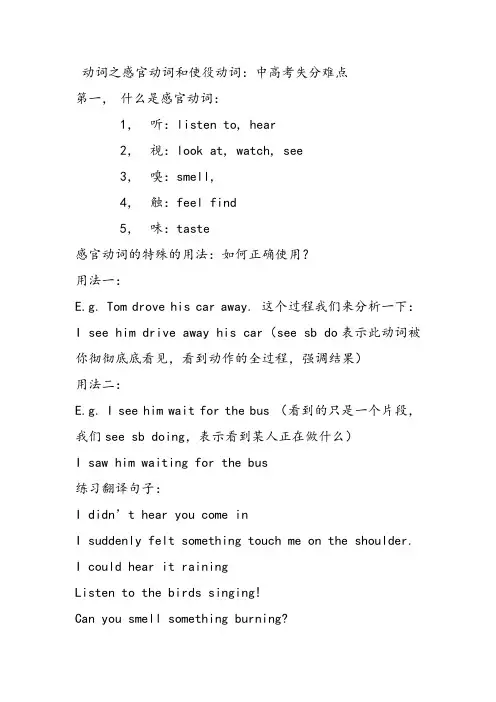
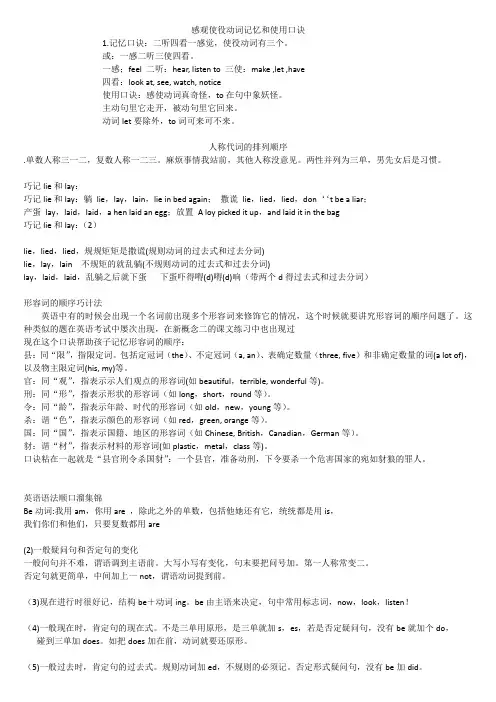
感官动词分两类see/notice/look at/watch/observe/listen to/hear/feel(Vt)/taste(Vt)/smell(Vt)
be/get/become/feel/look/sound/smell/taste/keep/stay/seem/appear/grow/turn/prove/remain/go/ru
一、see,hear,smell,taste,feel,这五个动词均可作连系动词,后面接形容词作表语,说明主语所处的状态。
其意思分别为"看/听/闻/尝/摸起来……"。
除look之外,其它几个动词英语语法书籍的主语往往是物,而不是人。
These flowers smell very sweet.这些花闻起来很香。
The tomatoes feel very soft.这些西红柿摸起来很软。
二、这些动词后面也可接介词like短语,like后面常用名词。
Her idea sounds like fun.她的主意听起来很有趣。
三、这五个感官动词也可作实义动词,除look(当"看起来……"讲时)只能作不及物动词外,其余四个既可作及物动词也可作不及物动词,此时作为实义动词讲时其主语一般为人。
She smelt the meat.她闻了闻那块肉。
I felt in my pocket for cigarettes.我用手在口袋里摸香烟。
四、taste,smell作不及物动词时,可用于"taste/smell+of+名词"结构,意为"有……味道/气味"。
The air in the room smells of earth.房间里的空气有股泥土味。
五、它们(sound除外)可以直接作名词,与have或take构成短语。
May I have a taste of the mooncakes?我可以尝一口这月饼吗?
taste有品位,味道的意思
例:I don't like the taste of the garlic.我不喜欢大蒜的味道。
She dresses in poor taste.她穿着没有品位。
look有外观,特色的意思
例:The place has a European look.此地具有欧洲特色。
feel有感觉,感受的意思
watch有手表,观察的意思
例:My watch is expensive.我的手表很贵。
六、其中look,sound,feel还能构成"look/sound/feel+as if+从句"结构,意为"看起来/听起来/感觉好像……"。
It looks as if our class is going to win.看来我们班好像要获胜了.
七、感官动词+do与+doing的区别:
感官动词see,watch,observe,notice,look at,hear,listen to,smell,taste,feel+do表示动作的完整性,真实性;+doing表示动作的连续性,进行性
I saw him work in the garden yesterday.
昨天我看见他在花园里干活了。
(强调"我看见了"这个事实)
I saw him working in the garden yesterday.(强调"我见他正干活"这个动作)
昨天我见他正在花园里干活。
用使役动词make 表示一方强迫另一方做某事。
它后面跟宾语+ 动词原形(Make sb do sth)。
例如:The government requires that citizens pay taxes. = The government makes citizens pay taxes.
用使役动词have
表示一方请另一方做事而且对方做了。
尤其是当两人有亲密的关系或要求方对另一方有某些权威时更要用have。
它后面跟宾语+ 动词原形(have sb do sth)。
例如:The staff arrived by 9:00 because Mrs. Adams requested it.
= Mrs. Adams had the staff arrive by 9:00.
用使役动词get
表示一方说服另一方做某事。
它后面跟宾语+ 动词不定式(get sb to do sth)。
例如:The salesman convinced
me to buy the car. = The salesman got me to buy the car.
make的具体用法:
1."make +sb +adj",make 是谓语动词,sb是make的宾语,后边的形容词在此作宾语的补足语。
Rainy days make me sad.
雨天让我很悲伤。
What he said made the teacher angry.
他说的话让老师很生气。
Soft music makes me sleepy.
轻柔的音乐让我想睡觉。
2."make +sb +过去分词",此处的过去分词相当于形容词作宾补。
Loud music makes me stressed out.
大声的音乐让我很紧张。
Waiting for him in the rain made me annoyed.
在雨中等他让我很烦。
The soccer game made the people excited.
那场球赛让人们很激动
3." make +sb +动词原形",此处的动词原形也叫省略to的不定式,也作宾补。
例如:
Sad movies always make me cry.
伤感的电影经常让我哭泣。
Loud music makes Tina want to dance.
大声的音乐让蒂娜想跳舞。
Hard seats in fast-food restaurants make people eat fast and leave.
快餐店的硬座位使人们快点吃完离开。
4.如果在被动语态中,宾语改为主语,宾补也应叫做主语的补足语,此时主动语态中的宾补——不带to的不定式,应改为带to的不定式作主语的补足语。
例如:
The boss made him work for 15 hours a day.
→ He was made to work for 15 hours a day (by the boss).
(老板让)他每天(得)工作15小时。
The teacher made the boy do his homework again.
→ The boy was made to do his homework again (by the teacher ).
(老师让)那个孩子(得)重新写作业。