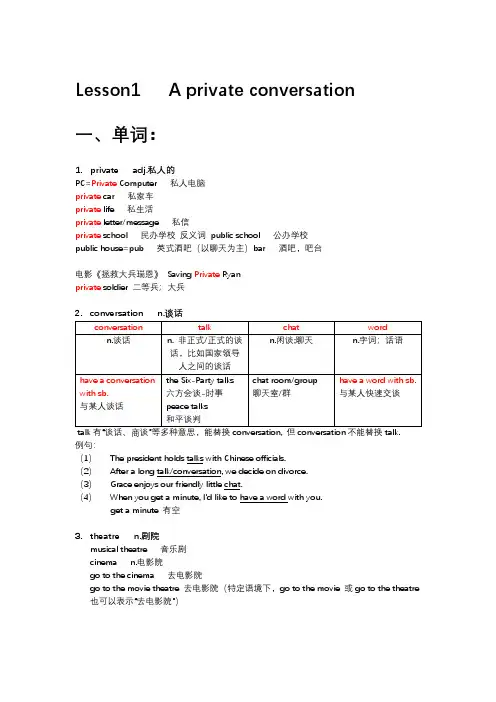
新概念英语第二册第1课-A,private,conversation
- 格式:docx
- 大小:31.36 KB
- 文档页数:6
第1页 共6页 新概念英语第二册第1课:A,private,conversation
First listen and then answer the question.
Why did the writer complain to the people behind him?
Last week I went to the theatre. I had a very good seat.
The play was very interesting.
但我却无法观赏。一青年男子与一青年女子坐在我的身后
They were talking loudly. I got very angry. I could not
hear the actors. I turned round.
怒视着那一男一女,他们却毫不理睬。
In the end, I could not bear it. I turned round again.
I cant hear a word! I said angrily.
不关你的事,那男的毫不客气地说,这是私人间的谈话!
New words and expressions 生词和短语
adj. 私人的
angry
第2页 共6页 n. 谈话
angrily
n. 剧场,戏院
attention
n. 座位
bear(bore, borne)
n. 戏
business
adv. 大声地
rudely
1 go to the theatre,去看戏。
3 turn round,转身,也可用turn around。
5 I could not bear it.我无法忍受。
6 none of your business,不关你的事。
课文详注 Further notes on the text
〔1〕句首的Last week点明表达的事情发生的时间是上星期。第3页 共6页 因此整篇课文的时态根本上应是过去时〔包括过去进展时〕,干脆引语局部的时态除外。
go to school上学
go to church上教堂,去做礼拜(参考第1册第68课at school,
at church;
第1册第85课have been to school/church)
2.had a very good seat,座位很好。
the front seat of a car汽车的前座
请坐。
3.The play was very interesting. 戏很有意思。
它通常与非人称主语连用或修饰某个事物:
这是一本好玩的书/一个令人感爱好的办法。
4.were sitting behind me. They were talking loudly. 坐在我的身后,大声地说着话。
get在这里有渐渐变得的含义,接近become,是个表示过程的动词,表示状态的改变。而I was very angry那么仅表示当时的状态是生气,并不示意过程。
6.in the end, 最终,最终。
She tried hard to finish her homework by herself. In the
end, she had to ask her brother for help. 第4页 共6页
〔1〕 sb. s business指某人〔所关怀的或份内〕的事:
我必需照看你的身体安康。
这根本不关他的事。
She kept none of his letters.
None of my friends left early.
none of这个短语有时可以表达一种断然、甚至粗暴的口气,
None of your silly remarks!
在西方文化中人们对private〔私人的,个人的〕这个概念很看重。这个词的名词形式privacy有隐私〔权〕的意思。所以课文中的小伙子会 振振有词地说This is a private
conversation!不过他忘了他是在一个public place〔公众场合〕,而且他们的说话声太大,已经影响了别人。
语法 Grammar in use
主语局部谓语局部主语动词宾语状语〔通常无强制性〕方式地点时间I
The driver
Bbarbarabought
shouted at
reada hat 第5页 共6页 suddenly
at her roomyesterday
主语一般为名词、代词或名词短语,通常位于动词之前。动词必需与主语相同,所以主语确定动词的单复数形式〔如I am, you are,
he has〕。宾语一般为名词、代词或名词短语。在主动句中,宾语一般位于动词之后。一个句子不总须要有宾语。状语的位置比拟敏捷。当一个句子里有一种以上的 副词时,地点副词的一般位置是在方式副词之后、时间副词之前,如上面的最终一个例句。时间状语可以在句尾,也可以在句首:
昨晚露西去剧院看戏了。
我刚刚听到门口有声音。
萨姆静静地听着故事。
那人很快跑掉了。〔无宾语〕
词汇学习 Word study
根本意义为观赏、享受、宠爱,后面一般跟名词、代词〔包括反身代词〕或动名词形式。
简不喜爱游泳。她喜爱去剧院看戏。
好好玩吧!
我们总是玩得很快乐。
2.pay
Have you paid the taxi-driver? 第6页 共6页 You can pay a deposit of thirty pounds
I paid 50 dollars for this skirt.
Ill pay by instalments.
〔2〕vt., vi. 赐予〔留意等〕;
去〔访问〕:
他们毫不理睬。
〔3〕n. 工资,酬报:
我还没有领到工资。
3.bear vt.
Can the ice bear my weight?
Who will bear the cost?
〔2〕忍受〔一般与can/could连用于疑问句及否认句中〕:
她吃得太快。我看着受不了。
你怎么能受得了住在这个地方?
最终,我忍不住了。