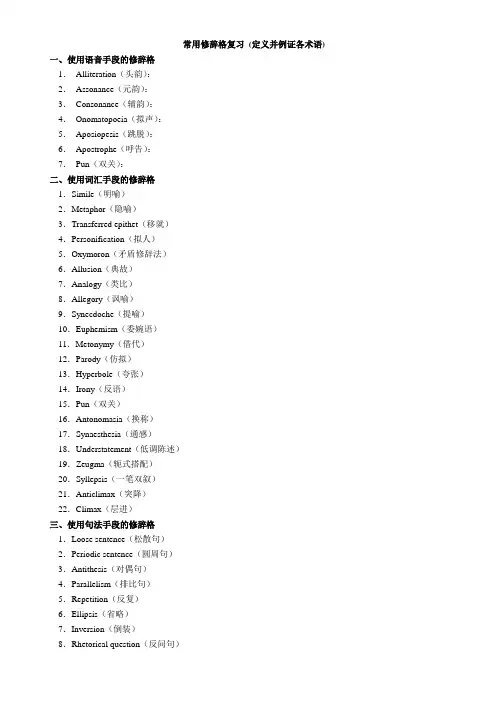
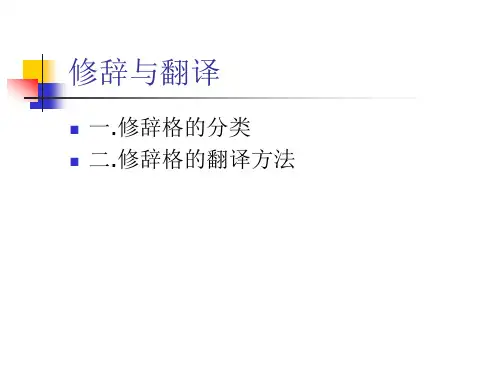
常用修辞格复习(定义并例证各术语) 一、使用语音手段的修辞格1.Alliteration(头韵):2.Assonance(元韵):3.Consonance(辅韵):4.Onomatopoeia(拟声):5.Aposiopesis(跳脱):6.Apostrophe(呼告):7.Pun(双关):二、使用词汇手段的修辞格1.Simile(明喻)2.Metaphor(隐喻)3.Transferred epithet(移就)4.Personification(拟人)5.Oxymoron(矛盾修辞法)6.Allusion(典故)7.Analogy(类比)8.Allegory(讽喻)9.Synecdoche(提喻)10.Euphemism(委婉语)11.Metonymy(借代)12.Parody(仿拟)13.Hyperbole(夸张)14.Irony(反语)15.Pun(双关)16.Antonomasia(换称)17.Synaesthesia(通感)18.Understatement(低调陈述)19.Zeugma(轭式搭配)20.Syllepsis(一笔双叙)21.Anticlimax(突降)22.Climax(层进)三、使用句法手段的修辞格1.Loose sentence(松散句)2.Periodic sentence(圆周句)3.Antithesis(对偶句)4.Parallelism(排比句)5.Repetition(反复)6.Ellipsis(省略)7.Inversion(倒装)8.Rhetorical question(反问句)A General Review on Figures of SpeechIdentify the figure(s) of speech used in the following sentences.1. "Your Heavens, give me that patience, patience I need!" (Shakespeare)2. Finally, brethren, whatever is true, whatever is honorable, whatever is right, whatever is pure, whatever is lovely, whatever is of good repute, if there is any excellence and if anything worthy of praise, let your mind dwell on these things. (The Bible)3. We felt strong, smug, secure.4. Return to her?…No, rather I abjure all roofs, and choose…To be a comrade with the wolf and owl…(Shakespeare)5. "One of my kids wrote four-letter words in his composition," the teacher said.6. When I was a child, I used to speak as a child, think as a child, reason as a child; when I became a man, I didaway with childish things. (The Bible)7. And do whate'er thou wilt, swift-footed time,To the wide world and all her fading sweets;But I forbid thee one most heinous crime. (Shakespeare)8. All are not apostles, are they? All are not prophets, are they? All are not teachers, are they? All are not workers of miracles, are they? (The Bible)9. Now, what advantage do we derive from hearing a man say that he has shaken off the yoke, that he does not believe that there is a God who watches over his actions, that he regards himself as sole judge of his conduct, and that he does not think of accounting for it to anyone but himself? Does he imagine that by saying this he is encouraging us to feel great confidence in him in the future and to expect comfort, advice, and help from him in the difficult situations of life? Do such men imagine that they have greatly rejoiced us by telling us that they think our soul is only a puff of wind or smoke, and still more by telling us so in an arrogant, self-satisfied tone? Is it a thing to be said cheerily? Is it not rather something to be admitted mournfully as though it were the saddest thing in the whole world? (Pascal)10. Good breeding consists in concealing how much we think of ourselves and how little we think of the otherperson. (Mark Twain)11. Shall the potter be considered as equal with the clay, that what is made should say to its maker, "He did not makeme";or what is formed say to him who formed it, "He has no understanding"? (The Bible)12. Greatness, in the works of architecture, may be considered as relating to the bulk and body of the structure.…Not to mention the Tower of Babel, of which an old author says there were the foundations to be seen in his time, which looked like a spacious mountain…(Joseph Addison)13. Now is the time to rise from the dark and desolate valley of segregation to the sunlit path of racial justice. Nowis the time to open the doors of opportunity to all of God's children. Now is the time to lift our nation from the quicksands of radial injustice to the solid rock of brotherhood. (Martin Luthur King)14. You earn your living and you urn your dead.15. Other things may be seized by might, or purchased with money, but knowledge is to be gained only by study,and study to be prosecuted only in retirement.(Samuel Johnson)16. For ours is the age of four "A's":anxiety, apprehension, agonizing, and aspirin. (James Thurber)17. So will these unattractive and mysterious objects lead to a new world economic order, or will the game beplayed according to the usual industrial rules; from each according to his ability, to each according to his investments?18. 0 soul of mine, will you never be good and sincere, all one, all open, visible to the beholder more clearly thaneven your encompassing body of flesh? Will you never taste the sweetness of a loving and affectionate heart?Will you never be filled full and unwanting; craving nothing, yearning for no creature or thing to minister to your pleasures, no prolongation of days to enjoy them, no place or country or pleasant clime or sweet human company? (Marcus Aurelius)19. It is in art as in morals; no character would inspire us with an enthusiastic admiration of his virtue, if that virtueconsisted only in an absence of vice; something more is required; a man must do more than merely his duty to be a hero.(Joshua Reynolds)20. It is no use doing what, you like; you have, got to like what you do. (W Churchill)21. To be, or not to be; that is the question:Whether 'tis nobler in the mind to sufferThe sting and arrows of outrageous fortune:Or to take arms against a sea of troubles,And by opposing end them…(Shakespeare)22. ... Let them recognize that there are only two kinds of person whom we can describe as reasonable; those whoserve God with all their heart because they have found him, and those who seek him with all their heart because, they have not found him. (Pascal)23. O, who can hold a fire in his handBy thinking on the frosty Caucasus?Or cloy the hungry edge of appetiteBy bare imagination of a feast?Or wallow naked in December snowBy thinking on fantastic summer's best? (Shakespeare)24. Let us be ruthless in our criticism, cruel to personal vanities, indifferent to age, rank or experience if these standin our way. Let all theories be subjected to the bright clear light of practice. (Norman Bethune)25. I Came BackI came back to softness and comfort.I came back to Dr. White's.And I wonder why I ever went away.Because only Dr. White's gives me two kinds of comfort. The supper-comfort of their cotton-wool content that makes them so much softer. And the comfort of a safer, more absorbent towel, with a flush-away design, too,for even more convenience.I tried the rest, but I came back.Isn't it time you came back to Dr. White's?Dr. White's Two kinds of comfort. (Women, Apr. 1977)26. What may be done at any time will be done at no time. (Proverb)27. You might as well expect a leopard to change its spots as expect him to give up smoking.28. He intended to take an opportunity this afternoon of speaking to Irene. A word in time saves nine…(John Galsworthy)29. A little boy came up to his mother. "Ma," he said, "I have something to tell you. My teacher kissed me.”"Well, were you a good boy and did you kiss her back?""Of course not!" he denied indignantly, "I kissed her face.”30. I don't have any rich relations who well leave me money when they die. Whatever I get in life, I'll have to earnby the sweat of my brow.31. Magnus. Frankly, I have been accustomed to regard your President as a statesman whose mouth was the mostefficient part of his head. (Bernard Shaw)32. No longer mourn for me when I am deadThen you shall hear the surly sullen bellGive warning to the world that I am fledFrom this vile world, with vilest worms to dwell…(Shakespeare)33. O what can ail thee, knight-at-arms,Alone and palely loitering?The sedge has withered from the lake,And no birds sing.O what can ail thee, knight-at-arms,So haggard and so woe-begone?The squirrel's granary is full,And the harvest's done. (John Keats)34. O, my luve is like a red, red roseThat's newly sprung in June:O, my luve is like the melodieThat's sweetly played in tune. (Robert Bums)35. His behavior was一but I blush to mention that.36. He had passed many anxious hours before he got the phone call from his daughter.37. Music, when soft voices die,vibrates in the memory一odours, when sweet violets sicken,Live within the sense they quicken. (Shelly)38. Child-bearing, hard work, and constant anxiety were beginning to tell on Mrs Athelny; and sometimes her backached in the evening so that she had to sit down and rest herself. (W. S. Maugham) 39. "Now, sir," said my aunt to Mr. Micawber, as she put on her gloves, "we are ready for Mount Vesuvius, oranything else, as soon as you please.”"Madam," returned Mr. Micawber, "I trust you will shortly witness an eruption…”(Charles Dickens)40. Then the fish came alive, with his death in him, and rose high out of the water showing all his great length andwidth and all his power and his beauty. He seemed to hang in the air above the old man in the skiff. Then he fell into the water with a crash that sent spray over the old man and over all of the skiff. (Hemingway )美文欣赏4 (A formal official Letter)Liao Chengzhi' s Letter to Mr. Chiang Ching-KuoDear brother Ching-Kuo,No one ever expected that a strip of water should have become so vast a distance. It is now 36 years since our brief rendezvous in Nanjing. From our childhood friendship to our chats in the Soviet capital, everything in the past is still alive in my memory. But it's unfortunate that we haven't heard from each other for so many years. Recently I was told that you are somewhat indisposed and this has caused me much concern. Men in their seventies are often afflicted with illness. I sincerely hope that you will take good care of yourself.Over the past three years, our party has repeatedly proposed talks with your party to bury the hatchet and work jointly to accomplish the great cause of national reunification. But you have time and again announced that there should be "no contact, no talks and no compromise", which I think is inadvisable. Considering both the public interests and our close friendship which has lasted for generations, I regard it as my duty to offer some advice which I hope you will consider carefully.The peaceful reunification of the motherland would be a great achievement to be recorded in history. Taiwan is bound to return to the embrace of the motherland eventually. An early settlement would be in the interest of all. The compatriots in Taiwan would be able to live in peace and happiness, the people of all nationalities on both sides of the Taiwan straits would no longer have to endure the pains of separation from their kith and kin, and the elders in Taiwan and those who have moved there from the mainland would all be properly placed and provided for. And this would contribute to the stability of Asia and the Pacific region as well as to world peace. You used to spur yourself on with the axiom: "The interests to be considered should be the interests of all; the fame to be sought should be a fame that would last forever.” If the great cause of reunification would be accomplis hed through your work, you will certainly win the esteem of the nation and the praise of all. You would be doing meritorious service to the country and your name would be inscribed in the temple of fame. It is preposterous to regard such a service as “guilt”. After all, putting up in that tight eastern comer is not a long-term solution. This is of course quite clear for a man as intelligent as you. Hesitation, procrastination or leaving the problem to other days would only lead to difficulty and distress and you, my brother, £®would hardly be able to escape the blame. Moreover, peacefulreunification is entirely an internal affair of China. Those outsiders who talk glibly about it have designs on our Taiwan. This is common knowledge. When a decision needs to be made, irresolution is bound to bring trouble. I hope you will consider this carefully.The Kuomintang, founded by Dr. Sun Yat-sen endured countless hardships and finally overthrew the monarchy and established the republic; numerous revolutionaries advanced wave after wave and laid down their lives for the cause. History has recorded this as a glorious contribution. The Kuomintang and the Communist Party twice cooperated and on both occasions they made tremendous contributions to the country and the nation. We know something about the fast cooperation, led by Dr. Sun Yat-sen, though we were still young at that time. The second cooperation proceeded with your father in the chair and, as participants in it, we should know what it was all about. Though the matter was as complicated as could be, an all-round view of the situation would show that cooperation is beneficial to the country and the nation while division is detrimental to them. Since you are presiding over the administration of Taiwan, you have unshirkable responsibility for the realization of cooperation for the third time. It would be easier to talk the matter over when leaders on both sides used to be schoolmates and close friends who know one another well. I find it really hard for me to subscribe to those views which describe cooperation as "surrender", "humiliating", "suffering losses" or "being duped. In reviewing history or looking forward to the future, one should bear in mind the public interest, the interests of the country and the nation, and use this as the supreme criterion, instead of basing oneself on a party's selfish interests. Such talks as "reunifying China with the Three People's Principles" are regarded by all sensible people as unrealistic, deceptive and self-deceiving. People of¡£ generation know the true meaning of the Three People's Principles quite well and there is no need to argue about it. Neither is there any need to dwell on such assertions as Taiwan's "economic prosperity, democracy and easy livelihood", the truth of which the venerable gentlemen in Taiwan know clearly. For the sake of your party, I would think that if you would take up the historical responsibility and resolutely take part in peace talks to accomplish national reunification as required by time and tide, the two parties would be able to co-exist for a long time to come, supervising each other while joining in the glorious effort to revitalize China. Otherwise how the situation existing in that small corner could be maintained for long? This is a question those who are sensible are already turning over in their minds. It involves the survival and development of the Kuomintang and I hope you will think it over again.I recently read one of your writings in which you expressed "fervent hopes that my father's soul would be able to return to the homeland and be reunited with the forefathers". I was overwhelmed with emotion when I read this. The remains of your father are still placed temporarily at Cihu. After reunification, they would be moved back and buried in the native soil---in Fenghua, Nanjing or Lushan---in fulfillment of your filial wishes. You recently said, "filial devotion should be expanded into national devotion, which means love of the nation and dedication to the country". This is an excellent statement. Why don't you apply it to the great cause of national reunification? As far as the country and nation are concerned, this would be an expression of both loyalty and filial piety. Otherwise how could you account for yourself after your passing away? It is hoped that you would think more about it.Dear brother! Your life has been marked by frustration, which should not be attributed to fate. Everything depends on yourself. The good and ill to be judged in the next thousand years hinge on the decision made in a moment. The present international situation is capricious. Throughout Taiwan people of all strata are talking about their future. Time does not stay and brief is the day. A long night is fraught with dreams; time does not wait for us. I hope you, my brother, would be good at making the choice and repair the house before it rains. Vast is the expanse of sky and water. What are you waiting for, staying away from home?The longing for old friends grows with age. If it is convenient to you, I would pack and set out for a visit to Taibei to seek enlightenment from our elders. "For all the disasters the brotherhood has remained; a smile at meeting and enmity is banished.” When I look towards the distant southern sky, my heart is already there. No word is enough to express what I wish to say. It is hoped that you will take good care of yourself. I am waiting impatiently for a reply.Please convey my regards to your mother as well as to Fang-Liang, Wei-Kuo and the children.Best wishes to you,Liao ChengzhiJuly 24, 1982An informal Letter (A student to a teacher)Prof. ChenMar. 26, 1987I have just received your letter of March 21. 1 was happy to hear that you are well and that you are invited to give lectures in Xi'an Foreign Languages Institute during the summer vacation. How nice it will be to see you again!Things here are going smoothly; and I haven't a thing to be unhappy about. I'd like to thank you heartily for your deep concern about me and great confidence in me.For the next three weeks there will be a general checkup on our teaching work and studies. I have already drawn up a plan with the help of other teachers. According to the requirements of the administration of our university, I intend to do the work in this way:a) Organize two demonstration lessons, one for the first grade teachers, the other for the second grade teachers.b) The teachers will attend each other's classes at least once during the period.c) Organize meetings of students of different grades so as to solicit their opinions and suggestions.The plan is based on the consideration that good experience should be popularized and shortcomings overcome as soon as possible.Please let me have your advice and instructions in regard to this plan.I was very glad to know that you are getting on well with your book. I wish it would come out soon, for I'm sure I can get a great deal from it. I hope you and your wife are enjoying yourselves in Beijing.You say your wife will go to the U. S. next month to see your daughter. Who will take care of you during her one-month stay in the U. S? Don't hesitate to ask Huang Yaping, Qi Min and others for help when you need it.Best wishes,Your student,Ding Xiaoya。