
Period 1Section A 1a~1c
- 格式:ppt
- 大小:15.20 MB
- 文档页数:158


□32
Period 1 (Section A la—1c)
设计说明
本课时是本单元的预备环节,引导学生接触话题 “What are you doing?”;教学过程中,应注意已学时态一般现在时和新学时态现在进行时在结构、用法上的不同,使学生能在具体情境中做出正确的判断;重点是帮助学生学会如何将动词变为现在分词;教学中充分利用学生已有的知识和生活经验,创设情景,引导学生在运用语言中巩固所学知识;在课堂中开展小组表演、游戏、报告等多种任务型活动,给学生提供更多的合作交流空间和时间,进行探究性学习。
教学目标
1.知识目标:
(1)掌握单词和短语:newspaper, use, soup, wash;read a newspaper, make soup。
(2)掌握句型:
—What are you doing?
—I'm watching TV.
—What's he doing?
—He's using the computer.
—What are they doing?
—They're listening to a CD.
(3)语法:现在进行时(Present Progressive Tense)
2 .能力目标:
学会用英语谈论人们正在做什么。
3.情感目标:
培养用英语获取信息以及与人合作的能力。激发学生学习英语的兴趣和热情,使他们在接近生活场景的交际中乐于模仿,敢于开口,积极参与。 □32
重点难点
1.重点:
现在进行时的用法。
2 .难点:
(1)现在分词的变化规则。
(2)准确地运用现在进行时来描述和表达正在进行的 动作。
教学准备
多媒体课件、录音机、磁带。
教学过程
Step 1 Leading in
1.Greetings.
How are you today?
What's the weather like today?
2.Sing a song.

*初中英语精品资源*
~初中英语精品资源~ Period 1 Section A 1a—1c
Ⅰ.教学准备
1.教师:录音机、磁带、多媒体课件,以及一本带有十二个月份的大挂历和12张月份卡片。
2.学生:复习基数词的构成;调查了解同学、朋友或家人的生日。
Ⅱ.教学目标
1.知识目标:
(1)词汇:when,January,February,March,April,May,June,July,August,September,October,November,December
(2)句型:—When is your birthday?—My birthday is on May 2nd.
2.能力目标:
通过本课学习,让学生掌握一些英语语言知识,培养英语表达的能力。
3.情感目标:
增进同学之间的了解和友情,学会在交流中关注他人的情感。
4.文化意识:
了解英语国家里人们的日常交际内容,提高跨文化交际的能力。
Ⅲ.教学重点
(1)词汇:when,January,February,March,April,May,June,July,August,September,October,November,December
(2)句型:—When is your birthday?
—My birthday is on May 2nd.
Ⅳ.教学难点
让学生熟练运用When is your birthday?和My birthday is...句型交流和表达信息。
Ⅴ.教学步骤
Step 1:Leadin
建议1:在黑板上挂一幅能反映出十二个月份的挂历,或在课件中展示出一幅挂历。教师介绍月份单词并领读;学生一边观看,一边跟读。
For example: *初中英语精品资源*
~初中英语精品资源~ T:Class!Look at the calendar.How many months are there?
1
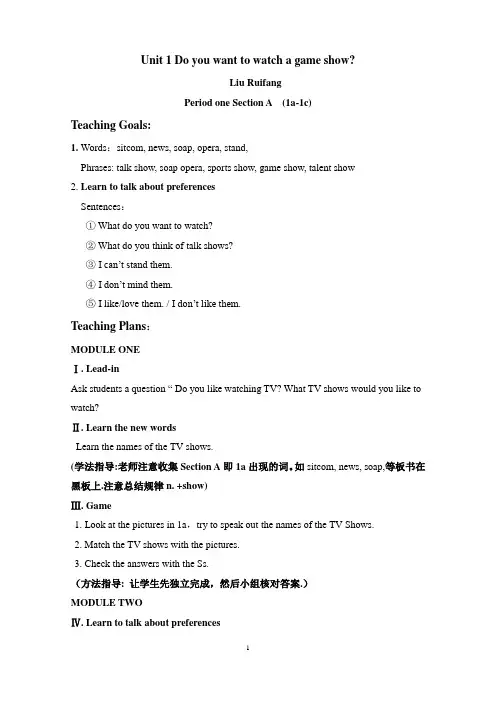
Unit 1 Do you want to watch a game show?
Liu Ruifang
Period one Section A (1a-1c)
Teaching Goals:
1. Words:sitcom, news, soap, opera, stand,
Phrases: talk show, soap opera, sports show, game show, talent show
2. Learn to talk about preferences
Sentences:
① What do you want to watch?
② What do you think of talk shows?
③ I can’t stand them.
④ I don’t mind them.
⑤ I like/love them. / I don’t like them.
Teaching Plans:
MODULE ONE
Ⅰ. Lead-in
Ask students a question “ Do you like watching TV? What TV shows would you like to
watch?
Ⅱ. Learn the new words
Learn the names of the TV shows.
(学法指导:老师注意收集Section A即1a出现的词。如sitcom, news, soap,等板书在黑板上.注意总结规律n. +show)
Ⅲ. Game
1. Look at the pictures in 1a,try to speak out the names of the TV Shows.
2. Match the TV shows with the pictures.

1 Unit 7 Will people have robots?
Period 1 (Section A 1a~1c)
郭灿 陈店中学
一、教学目标
1. 语言知识目标
1)掌握以下单词和短语:
学生能够识记并运用单词paper, prediction, future以及短语 on paper, make predictions,
in the future, in 100 years, live to be 200 years old, etc。
2)掌握以下句型:
- I will be a doctor in the future。
— I will live in China.
- I won't live in Japan.
— Will you look older in 15years?
- Yes,I will。/ No I won't。
2。 能力目标:
1) 学生能够通过听听力材料,准确获取和归纳所需信息以及听写关键字;
2) 学生能够在不看书的情况下使用will进行简单的关于将来的对话.
3. 情感态度价值观目标:
学生能够积极地畅想自己的未来并乐意为之奋斗.
二、教学重难点
1. 教学重点:
1) 教会学生新单词和短语。
2) 让学生听懂、说出、读出含有will的陈述句、否定句、一般疑问句以及特殊疑问句并让学生学会写简单的含有will的陈述句和否定句。
2. 教学难点:
让学生能够在不看书的情况下使用will进行简单的关于将来的对话.
三、教学方法
基于本课和学生的特征,为了更好地突出重点、突破难点,从而实现教学目标,应采用如下教学方法。
1。 教法分析
PWP(pre-listening, while—listening, post—listening) Teaching Method 听前听中听后
Task—based Teaching Method 基于任务的教学方法