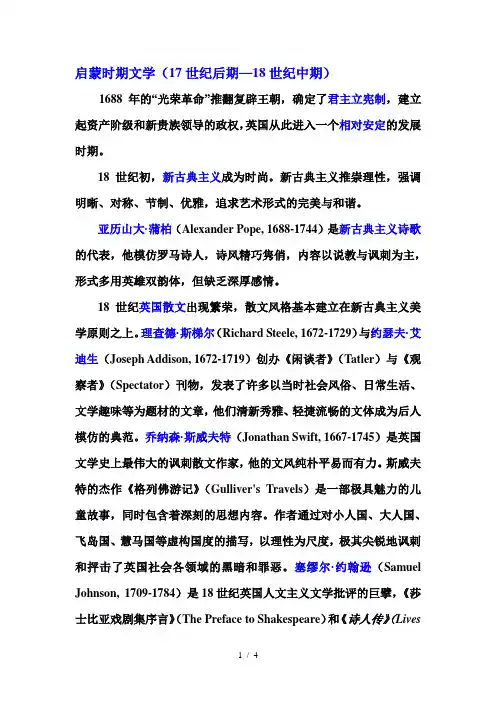
18世纪英国文学发展
- 格式:doc
- 大小:18.00 KB
- 文档页数:3
English Novels’ Development of the 18th Century
Ⅰ.Historical Background
The Revolution of 1688 ended the long struggle for political freedom in England. Sooner, the emergence of the two main parties Tories and Whigs made power shift easily from one to the other. Then newspapers and journals appeared and the press became a might power in England. Another feature of the age was the rapid development of social life. A large number of public coffeehouses and private clubs appeared in London, which were important sources to writing and the social centers. Science and technology changed people’s views toward world and life. And French classicism which focused on reason influenced English writing. Furthermore, Enlightenment was launched and enlighteners argued that science and reason were more important than religion and tradition and believed that reason should be the only basis of one’s thinking and acting.
Ⅱ.Early English Novel
The development of English novel can be divided into two periods-- early English novel and the maturity of the novel. The first period early English novel includes realistic novel, immature dramatizing, the mid-class audience and the bourgeois adventures. Daniel Defoe and Jonathan Swift are the most important figures in this period.
Daniel Defoe is often given the credit for the discovery of the
modern novel. His book Robinson Crusoe, showing an exciting tale with simple and brief words, is one of the forerunners of the English 18th century realistic novel.
In Jonathan Swift’s world famous novel Gulliver’s Travels, he typified the bourgeois world, drew ruthless pictures of the depraved aristocracy and satirically, portrayed the whole of the English state system. This novel is regarded as one of the greatest satires in England. Ⅲ.The Maturity of the Novel
The second period is the maturity of the novel which includes sentimental novel, realistic novel and pre-romantic novel.
Samuel Richardson and Laurence Sterne are outstanding figures of English Sentimentalism. Samuel Richardson’s Pamela, or Virtue Rewarded and Clarissa, or the History of a Young Lady are epistolary novels, which enriched European literature with the method of Psychological analysis. Laurence Sterne’s Tristram Shandy and Sentimental Journey reveal a purely emotional approach to life on the part of the narrator.
Realistic novels show things and people as they are in real life. Henry Fielding and Tobias Smollet are the founders of the genre of the bourgeois realistic novel in England. In Henry Fielding’s novel The History of Tom Jones, a Foundling, he invariably put such characters in position which tear away their masks. Tobias Smollet touched upon
various aspects of English life in his satirical novels.
Pre-romantic novel described romantic adventures in mysterious or frightening surroundings, which can also be called Gothic novel. It is the origin of horrible novel.
ⅠV. Conclusion
Although England’s chief achievement is in the fields of drama and poetry, England’s novel strongly influenced the development of English literature, especially in the 18th century. In this period, many outstanding figures emerged with a large number of excellent and famous books which are very familiar to all of us. For example, Robinson Crusoe showed an image of an enterprising Englishmen, which left a deep impression. These novelists and their famous works have contributed much to the literature of England and Europe and even the whole world.。