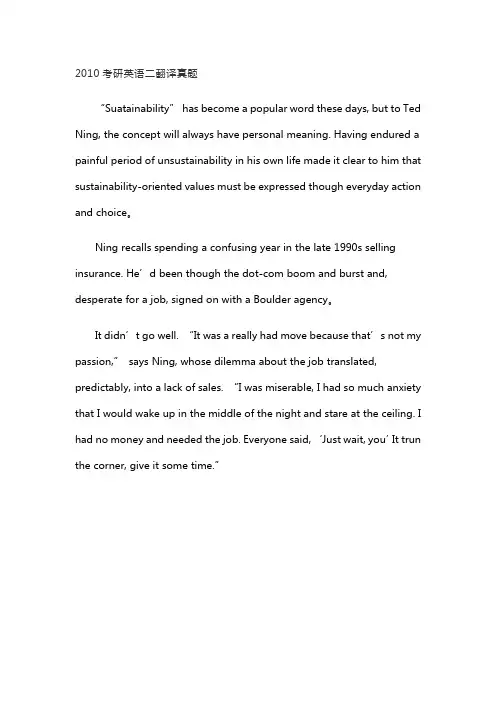
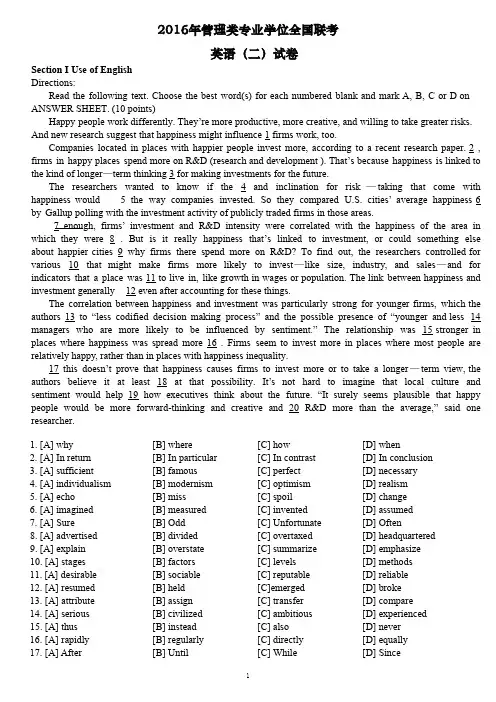
近十年管理类联考英语翻译真题与答案汇总在2018年的联考大纲中,英语翻译共15分.而很多考生的翻译往往都是丢分项,友课教育整理了近10年的英语翻译题与参考答案,大家可以适当练练手.2007Powering the great ongoing changes of our time is the rise of human creativity as the defining feature of economic life.Creativity has come to be valued,because new technologies,new industries and new wealth flow from it.And as a result,our lives and society have begun to echo with creative ideas.It is our commitment to creativity in its varied dimensions that forms the underlying spirit of our age.Creativity is essential to the way we live and work today,and in many senses always has been.The big advances in standard of living--not to mention the big competitive advantages in the marketplace--always have come from"better recipes,not just more cooking."One might argue that's not strictly true.One might point out,for instance,that during the long period from the early days on the Industrial Revolution to modern times,much of the growth in productivity and material wealth in the industrial nations came not just from creative inventions like the steam engine,but from the widespread application of"cooking in quantity"business methods like massive division of labor,concentration of assets,vertical integration and economies of scale.But those methods themselves were creative developments.人类创造力的提升,作为经济生活所定义的特征,为我们这个时代正在发生的巨大变化,提供了巨大的动力.因为新的技术,新的工业,新的财富都伴随着创造力产生,创造力逐渐受到重视.所以,我们的生活中和社会中,开始回响着创造性的思想.正是我们在各个方面对创造力的认同,形成了我们这个时代潜在的精神.创造力对于我们今天的生活和工作是致关重要的,从许多意义上来说曾经也是.在不设计大市场中大的竞争优势的情况下,生活水平的大幅度提高总是来自更好的食谱,而不是更多的烹饪.也许会有人提出这并不完全正确.有人也许会举例指出,从早期的工业革命到现代化时代这么长的时期内,在工业领域中,许多生产效率的进步和物质财富的增长并不仅仅来源煜创造性的发明,如蒸气机,还来源于讲求量的商业方法的广泛应用,比如大规模的劳动力划分,资本集中,纵向联合和经济规模.但是这些方法本身就是创造性的发展.2008The term〞business model〞first came into widespread use with the invention of personal computer and the spreadsheet<空白表格程序>.Before the spreadsheet,business planning usually meant producing a single forecast.At best,you did a little sensitivity analysis around the projection.The spreadsheet ushered in a much more analytic approach to planning because every major line item could be pulled apart,its components and subcomponents analyzed and tested.You could ask what-if questions about the critical assumptions on which.your business depended-for example,what if customers are more price-sensitive than we thought?-and with a few keystrokes,you could see how any change would play out on every aspect of the whole.In other words,you could model the behavior of a business.Before the computer changed the nature of business planning,most successful business models were created more by accident than by elaborate design.By enabling companies to tie their marketplace insights much more tightly to the resulting economics,spread sheet made it possible to model business before they were launched.随着个人计算机和空白表格程序的发明,〞商业模型〞这个属于首次得到了大规模的使用,空白表格程序被发明前,商业计划通常以为着产生一个单一的预测,充其量,你也只能在此单一预测的基础上再做一些敏感性分析.空白表格程序开启了一种更具分析性的规划方法,其原因是空白表格程序中的每一行中的项目都可以被拆分,其中的每一个部分与字部分都可以被分析和测试.你可以对你的商业外所以来的关键设想提出〞的问题,例如,"如果顾客对价格的敏感度超过了我们的预期怎么办〞,只需敲击几下键盘,你就可以看到某个变化对全局的各个方面回产生怎么样的影响,换句话说,你可以对商业的行为建立模型.在计算机改变了商业规划的本质之前,绝大部分成功的商业规划与其说是策划出来的,不如说是运气使然.空白表格程序将公司的时常洞察力与相应的经济结果更为紧密的联系起来,从而使公司在商业运营开始前建立商业模型变为可能.2009With the nation’s financial system teetering on a cliff.The compensation arrangements for executives of the big banks and other financial firms are coming under close examination again.Bankers’excessive risk-taking is a significant cause of this financial crisis and has continued,to others in the past,in this case,it was fueled by low interest rates and kept going by a false sense of security created by a debt-fueled bubble in the economy.Mortgage lenders gladly lent enormous sums to those who could not afford to pay them back dividing the laws and selling them off to the next financial institution along thechain,advantage of the same high-tech securitization to load on more risky mortgage-based assets.Financial regulation will have to catch up with the most irresponsible practices that led banks down in this road,in hopes averting the next crisis,which is likely to involve different financial techniques and different sorts of assets.But it is worth examining the root problem of compensation schemes that are tied to short-term profits and revenue’s,and thus encourage bankers to take irresponsible risks.由于国家金融体制处于危机边缘动荡,一些大银行和金融机构中的高级管理人员的补偿金计划就受到密切关注.银行家们过度冒险是金融危机的至关重要原因,在历史上也有类似情况.在这种情况下,一般是由低息引起并造成持续的错觉,其实是一种债务泡沫经济.抵押贷款人很乐意把大量资金借给无力偿还的人,就把贷款瓜分了,并沿这样的链条出售给下一个金融机构,这些做法都在利用高科技证券业,结果,却增加了抵押资产的风险.金融条例必须能应付这种能使银行下滑的,最不负责任的做法,以期扭转下一个危机,而这下一个危机很可能包括有各种类型的技术和资产.但值得审视补偿金计划的根本问题,因为那是眼前利益,但却让银行家们不负责任的甘冒风险.2010"Sustainability〞has become a popular word these days,but to Ted Ning,the concept will always have personal meaning.Having endured a painful period of unsustainability in his own life made it clear to him that sustainability-oriented values must be expressed through everyday action and choice.Ning recalls spending a confusing year in the late 1990s selling insurance.He’d been through the dot-com boom and burst and,desperate for a job,signed on with a bounder agency.It didn’t go will."It was a really bad move because that’s not my passion,〞says Ning,whose dilemma about the job translated,predictably,into a lack of sales.〞I was miserable.I had so much anxiety that I would wake up in the middle of the night and stare at the ceiling.I had no money and needed the job.Everyone said,"Just wait,you’ll turn the corner,give it some time.〞本质如今已成一个热门话题,但对TedNing而言,这个概念一直有个人含义,经历了一段痛苦非本质个人生活,使他清楚面向本质的价值观,必须惯彻每天的行动和选择中.Ning回忆起了1990年代,买保险的迷茫时光,他通过蓬勃兴起的网络疯狂找工作与Boulder代理机构签了约.事情进展不顺利,TedNing说到:那真是个糟糕的选择,因为我对此没有激情,可以预料到他在工作中的矛盾能解释为没有业务NING说:我很痛苦渴望午夜起来盯着天花板,我没钱需要工作,每个人都说等吧,只要有耐心会好转的.2011Who would have thought that,globally,the IT industry produces about the same volume of greenhouse gases as the world's airlines do-roughly 2 percent of all CO2 emissions?Many everyday tasks take a surprising toll on the environment.A Google search can leak between 0.2 and 7.0 grams of CO2,depending on how many attempts are needed to get the"right"answer.To deliver results to its users quickly,then,Google has to maintain vast data centres round the world,packed with powerful computers.While producing large quantities of CO2,these computers emit a great deal of heat,so the centres need to be wellair-conditioned,which uses even more energy.However,Google and other big tech providers monitor their efficiency closely and make improvements.Monitoring is the first step on the road to reduction,but there is much more to be done,and not just by big companies.有谁会想到,在全球X围内,IT行业产生的温室气体跟全球航空公司产生的一样多?占二氧化碳总排量的2%.很多日常工作对环境造成了让人震惊的破坏作用.根据你查询正确答案的尝试次数,谷歌搜索引擎会插手0.2-7克的二氧化碳的排放量.要快速将结果传递给用户,谷歌必须用强大和大量的计算机系统来维护全球巨大的数据库中心.这些计算机在散发大量热量的同时也产生大量的二氧化碳气体.所以中心处理器必须要有很好的散热装备,然而却耗能更多.2012When people in developing countries worry about migration,they are usually concerned at the prospect of ther best and brightest departure to Silicon Valley or to hospitals and universities in the developed world,These are the kind of workers that countries like Britian,Canada and Australia try to attract by using immigration rules that privilege college graduates.Lots of studies have found that well-educated people from developing countries are particularly likely to emigrate.A big survey of Indian households in 2004 found that nearly 40%of emigrants had more than a high-school education,compared with around 3.3%of all Indians over the age of 25.This"brain drain〞has long bothered policymakers in poor countries,They fear that it hurts their economies,depriving them of much-needed skilled workers who could have taught at their universities,worked in their hospitals and come up with clever new products for their factories to make.发展中国家的人们为移民忧虑时,他们通常担忧的是离开自己国家去去硅谷或发达国家的医院和大学的最优秀、最聪明的群体的前景.这些劳动者正是像英国、加拿大、澳大利亚这样的国家通过赋予受过大学教育者以特权的移民法想要吸引的人群.很多研究发现,来自发展中国家的那些受到良好教育的人们极有可能选择移居他国.20##对印度家庭开展了一项广泛的调查,结果显示约40%的移民受过高中以上的教育.相比而言,在所有年龄超过25岁的印度人中,受过高中以上教育的人数比例只有约3.3%."人才流失〞一直困扰着贫穷国家的政策制定者们.他们担心这会对本国的经济造成损害,造成国家急需的技工的流失.这些技术人员可能曾在他们的大学教学,也可能曾在他们的医院工作,或者曾经构想出智能化的新产品让他们的工厂去生产.2013I can pick a date from the past 53 years and know instantly where I was,what happened in the news and even the day of the week,I’ve been able to do this,since I was four.I never feel overwhelmed with the amount of information my brain absorbs.My mind seems to be able to cope and the information is stored away neatly.When I think of a sad memory,I do what everybody does-try to put it to one side.I don’t think it’s harder for me just because my memory is clearer.Powerful memory doesn’t make my emotions any more acute or vivid.I can recall the day my grandfather died and the sadness I felt when we went to the hospital the day of the week the day of the week day before.I also remember that the musical play Hair opened on Broadway on the same day-they both just pop into my mind in the same way.从过去的53年里随便找出哪一天,我都能够立刻想起那一天我在哪里,那一天发生了什么新闻,甚至那一天是星期几.从4岁起,我就能这么做了.我从来没有为自己所记住的大量的信息而感到不知所措.我的大脑似乎能够应对这种状况,能够有条理地将这些信息记在脑子里.当我想起悲伤的事情时,我会像每个人一样,尽力把它放在一边,不去想它.我并不认因为我的记忆非常强而导致很难把不高兴的事情放在一边.强大的记忆力并不能使我的情感更加敏锐和生动.我能够记得我祖父去世的那一天,以与前一天我们去医院的路上所感到的悲伤.同样,我也能记得同一天在百老汇上演的音乐剧《Hair》——这些事情都以同样的方式在我脑海里突然浮现.2014Most people would define optimism as being endlessly happy,with a glass that’s perpetually half full.But that’s exactly the kind of false cheerfulness that positive psychologists would not recommend."Healthy optimism means being in touch with reality,〞says Taal Ben-Shah-ar,a Harvard professor.According to Ben-Shah-ar,realistic optimists are those who make the best of things that happen,but not those who believe everything happens for the best.Ben-Shah-ar uses three optimistic exercises.When he feels down—say,after giving a bad lecture—he grants himself permission to be human.He reminds himself that not every lecture can be a Nobel winner,some will be less effective than others.Next is reconstruction.He analyzes the weak lecture,learning lessons for the future about what works and what doesnot.Finally,there is perspective,which involves acknowledging that in the grand scheme of life,one lecture really does not matter.在大部分人眼中,乐观主义就意味着永远满怀希望、无忧无虑,遇事只往好的方面想.然而积极心理学专家认为这种乐观只是假象,不建议人们这么做.哈佛大学教授塔尔·本沙哈尔指出:"健康的乐观主义应该是切合实际的.〞他认为,现实的乐观主义者会尽力让事事顺利,而不是迷信万事大吉.本沙哈尔提出了"三步乐观法〞.第一步:在碰到例如演讲表现糟糕这种让人沮丧的情况时,他首先会安慰自己人非圣贤,不是所有的演讲都能拿到诺贝尔奖,总会有些演讲的效果不如他人.第二步:重现场景.他会对这次失败的演讲进行分析,总结优缺点,为以后的演讲吸取经验教训.第三步:形成这样一个观念,要明白在生命的宏大蓝图中,一次演讲着实微不足道.2015Think about driving a route that's very familiar.It could be your commute to work,a trip into town or the way home.Whichever it is,you know every twist and turn like the back of your hand.On these sorts of trips it's easy tolose concentration on the driving and pay little attention to the passing scenery.The consequence is that you perceive that the trip has taken less time thanit actually has.This is the well-travelled road effect:people tend to underestimate the time it takes to travel a familiar route.The effect is caused by the way we allocate our attention.When we travel down awell-known route,because we don't have to concentrate much,time seems to flow more quickly.And afterwards,when we come to think back on it,we can't remember the journey well because we didn't pay much attention to it.So we assume it wasshorter.设想一下,你正开车行驶在一条非常熟悉的路线上.可能是你每天上下班、去城里、或是回家的路.不管是哪一条路,你对每一个拐每一个弯都了如指掌,非常熟悉.在这样的路途中,我们容易在开车的时候心不在焉,对途中的景色也几乎是全然不顾.如此一来,你会觉得路上所花的时间比实际要少.这就是"熟悉路线效应":人们往往会低估行驶在熟悉的路上所花费的时间.这一效应由我们分配精力的方式引起.当行驶在熟悉的路上时,由于我们不用太过集中精力,时间似乎飞逝而过.随后,我们回想行车过程时,由于我们没有过多关注,所以对行车的印象也很模糊.因此我们会认为花费的时间会更短些.2016The supermarket is designed to lure customers into spending as much time as possible within its doors.The reason for this is simple:The longer you stay in the store,the more stuff you’ll see,and the more stuff you see,the more you’ll buy.And supermarkets contain a lot of stuff.The average supermarket,according to the Food Market Institute,carries some 44,000 different items,and many carry tens of thousands more.The sheer volume of available choice is enough to send shoppers into a state of information overload.According to brain-scan experiments,the demands of so much decision-making quickly become too much for us.After about 40 minutes of shopping,most people stop struggling to be rationally selective,and instead begin shopping emotionally—which is the point at which we accumulate the 50 percent of stuff in our cart that we never intended buying.超市旨在吸引顾客在店里停留尽可能长的时间.原因非常简单:顾客在店里停留的时间越长,看到的商品越多;看到的商品越多,买的也就越多.超市陈列了大量的商品.根据食品市场科的调查,一般超市里有约44000种不同的商品,许多超市都有上万种.如此众多的选择足以使顾客陷入信息量超载的状态.根据脑部扫描实验,需要迅速地做出这么多决定就会使我们太累.大约购物40分钟以后,大多数人就放弃了去做理性的选择,取而代之的是冲动购物——正是此时,我们在购物车里已经装了一半根本没想买的东西.2017My DreamMy dream has always been to work somewhere in an area between fashion and publishing.Two years before graduating from secondary school,I took a sewing and design course thinking that I would move on to a fashion design course.However,during that course I realised that I was not good enough in this area to compete with other creative personalities in the future,so I decided that it was not the right path for me.Before applying for university I told everyone that I would study journalism,because writing was,and still is,one of my favourite activities.But,to be absolutely honest,I said it,because I thought that fashion and me together was just a dream-Iknew that no one,apart from myself,could imagine me in the fashion industry atall!So I decided to look for some fashion-related courses that included writing.This is when I noticed the course"Fashion Media&Promotion.〞我的梦想我的梦想一直是在时装设计和出版领域找寻一份工作.在我中学毕业的两年前,我选修了一门"缝纫和设计〞课程,并且以为我能再继续学习一个时装设计的课程.然而,就在这个课程的学习过程中,我意识到,将来在这个领域,我是无法与那些富于创新精神的精英们相比的.于是,我断定这条路行不通.在申请上大学之前,我对所有人都讲,我想学新闻学,因为,写作曾经是并且现在也一直是我最喜欢的事情之一.但是,说实话,我之所以这样说,是因为我认为从事时装设计不过是我的一个梦想,我也知道,除了我之外,没有人能想象出我会从事时装设计的工作.因此,我决定去寻找一些课程,既与时尚相关、又涉与写作.就在这时,我注意到了《时尚媒体与营销》这门课程.。