
Annotated Bibliography
- 格式:docx
- 大小:15.05 KB
- 文档页数:1

AACR 英美编目条例专英词汇表A detailed set of standardized rules for cataloging various types of library materials that had its origin in Catalog Rules: Author and Title Entries, published in 1908 under the auspices of the American Library Association and the Library Association (UK), and the A.L.A. Cataloging Rules for Author and Title Entries (1949), with its companion volume Rules for Descriptive Cataloging in the Library of Congress.academic library 高校图书馆; 学术图书馆A library that is an integral part of a college, university, or other institution of postsecondary education, administered to meet the information and research needs of its students, faculty, and staff. In the United States, the professional association for academic libraries and librarians is the Association of College and Research Libraries (ACRL), which publishes Standards for Libraries in Higher Education. Compare with research library. See also: college library, departmental library, graduate library, undergraduate library, and university library.accession 登录;登录文献To record in an accession list the addition of a bibliographic item to a library collection, whether acquired by purchase or exchange or as a gift. In automated libraries, the addition is usually recorded by enhancing a brief order record that is expanded in cataloging to become the full bibliographic record entered permanently in the catalog. Also refers to the material added. The process of making additions to a collection is known as accessions. The opposite of deaccession. Compare with acquisitions.acquisitions 采访(部);采购(部);收集The process of selecting, ordering, and receiving materials for library or archival collections by purchase, exchange, or gift, which may include budgeting and negotiating with outside agencies, such as publishers, dealers, and vendors, to obtain resources to meet the needs of the institution's clientele in the most economical and expeditious manner. Also refers to the department within a library responsible for selecting, ordering, and receiving new materials and for maintaining accurate records of such transactions,usually managed by an acquisitions librarian. In small libraries, the acquisitions librarian may also be responsible for collection development, but in most public and academic libraries, this responsibility is shared by all the librarians who have an active interest in collection building, usually on the basis of expertise and subject specialization. Compare with accession.almanac 年鉴;年历;历书Originally, a book introduced by the Moors to Spain, listing the days, weeks, and months of the year and providing information about festivals, holidays, astronomical phenomena, etc. In modern usage, an annual compendium of practical dates, facts, and statistics, current and/or retrospective, often arranged in tables to facilitate comparison. Almanacs can be general (example: World Almanac and Book of Facts) or related to a specific subject or academic discipline (Almanac of American Politics). Information Please is an example of a modern online almanac.American Library Association (ALA) 美国图书馆协会he leading professional association of public and academic libraries and librarians in the United States, the ALA was founded in Philadelphia in October 1876 by a group of library leaders (90 men and 13 women) that included Melvil Dewey. An "association of associations," the ALA is organized in divisions, each with its own officers, budget, and programs, and is closely tied to over 50 state and regional chapters. The Association also sponsors round tables on specific issues and topics and is affiliated with other independent library-related organizations. Its imprint is ALA Editions. The most widely read periodicals published by the ALA are the professional journal American Libraries and the review publication Booklist. The ALA is a member of the International Federation of Library Associations and Institutions (IFLA).American Society for Information Science and Technology (ASIS&T)美国信息科学与技术学会An affiliate of the American Library Association, ASIS&T is a nonprofit association established in 1937 to provide opportunities for professionals in the information science field to communicate across the disciplines of library science, computer science, linguistics, mathematics, and the physical sciences. Formerly the American Society for Information Science (ASIS).annotated bibliography 提要式目A bibliography in which a brief explanatory or evaluative note is added to each reference or citation.录An annotation can be helpful to the researcher inevaluating whether the source is relevant to a giventopic or line of inquiry.archives 档案(资料);档案馆An organized collection of the noncurrent records of the activities of a business, government, organization, institution, or other corporate body, or the personal papers of one or more individuals, families, or groups, retained permanently (or for a designated or indeterminate period of time) by their originator or a successor for their permanent historical, informational, evidential, legal, administrative, or monetary value, usually in a repository managed and maintained by a trained archivist. Also refers to the office or organization responsible for appraising, selecting, preserving, and providing access to archival materials.audiovisual (AV) 视听资料; 声像资料A work in a medium that combines sound and visual images, for example, a motion picture or videorecording with a sound track, or a slide presentation synchronized with audiotape. Also spelled audio-visual and abbreviated a-v.Australian Library and Information Association (ALIA) 澳大利图书情报协会The professional association for the Australian library and information services sector, ALIA seeks to empower the library profession in the development, promotion, and delivery of quality services to all Australians, through leadership, advocacy, and mutual support. ALIA sponsors a biennial national conference, presents national and regional awards, and publishes Australian Library Journal (ALJ).auxiliary schedule 辅助分类表;辅表;复分表In library classification, a separate list of classes (with their notations) that serves only to subdivide the classes listed in the main schedules.Bback issue 过刊Any issue of a periodical that precedes the current issue. Back issues are usually retained in a back file, which may be stored in a different location in the periodicals section of a library, sometimes converted to a more compact format, such as microfilm or microfiche. In the catalog record, the extent of the back file is indicated in the holdings statement. Synonymous with back number.Banned Books Week 禁书周An annual event observed in the United States since 1981 during the last week of September, Banned Books Week is sponsored by the American Booksellers Association, American BooksellersFoundation for Free Expression, American Library Association, Association of American Publishers, American Society of Journalists and Authors, and National Association of College Stores and endorsed by the Center for the Book at the Library of Congress. Libraries and bookstores throughout the country celebrate the freedom to read by displaying recently banned books and books that have been banned throughout history.bibliographic instruction (BI) 图书馆指导; 文献检索教育Instructional programs designed to teach library users how to locate the information they need quickly and effectively. BI usually covers the library's system of organizing materials, the structure of the literature of the field, research methodologies appropriate to the discipline, and specific resources and finding tools (catalogs, indexes and abstracting services, bibliographic databases, etc.). Synonymous with library instruction and library orientation. Compare with user education.bibliography 书目Strictly speaking, a systematic list or enumeration of written works by a specific author or on a given subject, or that share one or more common characteristics (language, form, period, place of publication, etc.). A bibliography may be comprehensive or selective. Long bibliographies may be published serially or in book form. The person responsible for compiling a bibliography is the bibliographer. Compare with catalog.bibliotheca 藏书楼;藏书目录;文库From the Greek biblion ("book") and theke ("to place").A library or collection of books. Also refers to a list or catalog of books, especially one prepared by a bibliographer.bibliotherapy 阅读疗法The use of books selected on the basis of content in a planned reading program designed to facilitate the recovery of patients suffering from mental illness or emotional disturbance. Ideally, the process occurs in three phases: personal identification of the reader with a particular character in the recommended work, resulting in psychological catharsis, which leads to rational insight concerning the relevance of the solution suggested in the text to the reader's own experience. Assistance of a trained psychotherapist is advised. See also: readers' advisory.branch library 图书分An auxiliary service outlet in a library system, housed馆in a facility separate from the central library, which hasat least a basic collection of materials, a regular staff,and established hours, with a budget and policiesdetermined by the central library.British National Bibliography (BNB) 英国国家书目The most comprehensive record of books and first issues of serials published since 1950 in the United Kingdom (UK) and Ireland, the BNB has been the responsibility of the British Library since the library's inception in 1973. Since 1990, bibliographic records created in accordance with international cataloging standards have been contributed by all the legal depository libraries in the UK, with CIP data on forthcoming titles provided by the Bibliographic Data Services. Coverage is selective, with emphasis on mainstream monographs available through regular book-buying channels. Research reports and non-trade monographs are recorded separately in the British National Bibliography for Report Literature. The BNB is available weekly in print, monthly on CD-ROM, and online.Ccall number 索书号A unique code printed on a label affixed to the outside of an item in a library collection, usually to the lower spine of a book or videocassette, also handwritten or printed on a label inside the item. Assigned by the cataloger, the call number is also displayed in the bibliographic record that represents the item in the library catalog, to identify the specific copy of the work and give its relative location on the shelf. In most collections, a call number is composed of a classification number followed by additional notation to make the call number unique.card catalog(ue) 卡片目录A list of the holdings of a library, printed, typed, or handwritten on catalog cards, each representing a single bibliographic item in the collection. Catalog cards are normally filed in a single alphabetical sequence (dictionary catalog), or in separate sections by author, title, and subject (divided catalog), in the long narrow drawers of a specially designed filing cabinet, usually constructed of wood.cataloging-in-publicati on (CIP) 在版编目A prepublication cataloging program in which participating publishers complete a standardized data sheet and submit it with the front matter or entire text of a new book (usually still in galleys) to the Library ofCongress for use in assigning an LCCN and preparing a bibliographic record, which is sent back to the publisher within 10 days to be printed on the verso of the title page. The Library of Congress distributes CIP records to large libraries, bibliographic utilities, and book vendors on a weekly basis to facilitate book processing. If incomplete, the initial record may be amended by the Library of Congress after the U.S. Copyright Office receives the deposit copy of the published work. The CIP Program began at the Library of Congress in 1971 and is used throughout the world. British spelling is cataloguing-in-publication.catalog 目录A comprehensive list of the books, periodicals, maps, and other materials in a given collection, arranged in systematic order to facilitate retrieval (usually alphabetically by author, title, and/or subject). In most modern libraries, the card catalog has been converted to machine-readable bibliographic records and is available online. The preparation of entries for a library catalog (called cataloging) is performed by a librarian known as a cataloger. British spelling is catalogue. Abbreviated cat. Compare with bibliography and index.central library 图书总馆The administrative center of a library system where system-wide management decisions are made, centralized technical processing is conducted, and principal collections are located. Synonymous with main library. See also: branch library.Chartered Institute of Library and Information Professionals (CILIP) 英国特许图书情报专业人员协会A new professional association formed in April 2002 by the union of the Institute of Information Scientists (IIS) and the Library Association (UK), CILIP is now is the leading professional body for librarians, information specialists, and knowledge managers in the UK, with nearly 23,000 members working in all sectors, including business and industry, science and technology, education, local and central government, health services, national and public libraries, and the voluntary sector.chief information officer (CIO) 首席信息官The title of the person in a commercial company or nonprofit organization who is responsible for managing the flow of official information, including computing and any library services - a relatively new position in companies and organizations that recognize the need for such a management function.children's librarian 儿 A librarian who specializes in services and collections童图书馆员for children up to the age of 12-13. Most children'slibrarians have extensive knowledge of children'sliterature and are trained in the art of storytelling.church library 教会图书馆A library maintained on the premises of a house of worship, containing books, pamphlets, and other materials related to its faith and to the history of the institution. Very old church libraries often have rare books and manuscripts in their collections, for example, the Hereford Cathedral Library in England which owns a historical collection of chained books. Cathedral libraries may restrict the use of all or a portion of their holdings to readers who have a research interest in their collections (example: Canterbury Cathedral Library in England). Most synagogues also have a library, with some materials in Hebrew.circulating library 租借图书馆;租书处A type of library established by booksellers and other businessmen in Britain in the early 18th century that provided popular reading material to the general public for a limited period of time in exchange for payment of a modest fee (usually no more than a shilling per month), comparable to a modern rental collection. With the introduction of inexpensive paperback editions and the growth of public libraries in the early 20th century, interest in circulating libraries declined. Synonymous with two-penny library. Compare with subscription library.circulation 流通The process of checking books and other materials in and out of a library. Also refers to the total number of items checked out by library borrowers over a designated period of time and to the number of times a given item is checked out during a fixed period of time, usually one year.classification schedule 分类表The names assigned to the classes and subdivisions of a classification system, listed in the order of their symbolic notation. In a hierarchical classification system, the arrangement of the schedule(s) indicates logical subordination. For example, in Dewey Decimal Classification the schedules consist of the class numbers 000-999, the associated headings, and notes concerning use, with logical hierarchy indicated by indention and length of notation.classification scheme分类法; 分类系统See: classification system.classification system 分类系统; 分类法A list of classes arranged according to a set of pre-established principles for the purpose of organizing items in a collection, or entries in an index, bibliography, or catalog, into groups based on their similarities and differences, to facilitate access and retrieval. In the United States, most library collections are classified by subject. In the United States, most public libraries use Dewey Decimal Classification, but academic and research libraries prefer Library of Congress Classification.classification 分类The process of dividing objects or concepts into logically hierarchical classes, subclasses, and sub-subclasses based on the characteristics they have in common and those that distinguish them. Also used as a shortened form of the term classification system or classification scheme.class 类;类别;等级A grouping of objects or concepts based on one or more characteristics, attributes, properties, qualities, etc., that they have in common, for the purpose of classifying them according to an established system, represented in library classification systems by a symbolic notation. In hierarchical classification systems, the members of a class (example: books) are divided into subclasses (children's books), which are in turn subdivided into more specific subclasses (picture books), and so on.In human resources management, a group of positions within an organization for which the qualifications, duties, responsibilities, evaluation procedures, etc., are comparable and which share the same scale of rank and pay. In library employment, positions are typically classified as follows: library director, librarian, library technician, library technical assistant, and clerical assistant.closed reserve 闭架保存资料;闭架保存馆藏An item on reserve that may be checked out by a registered borrower but may not be removed from library premises. Also, a reserve collection shelved in a closed stack from which requested items must be retrieved by a member of the library staff. Compare with open reserve.closed stacks 闭架A shelving area in a library to which only members of the library staff have access, established to protect the collection or conserve space by using aisles narrower than the width that is standard in open stacks.Materials are retrieved from closed stacks by staff members upon request.collaborative reference 协作参考咨询A mode of digital reference in which reference questions are routed to reference librarians at different institutions, based on such criteria as expertise, availability, etc. The QuestionPoint service developed by OCLC and the Library of Congress, with input from participating members of the Global Reference Network, is an example of such a service. Compare with cooperative reference.college library 学院图书馆A type of academic library maintained by an independent four-year college, or by one of several colleges within a larger university, for the use of students and faculty. The Association of College and Research Libraries (ACRL) has established Standards for Libraries in Higher Education (June 2004). Compare with undergraduate library.community information system (CIS) 社区信息系统A centralized source providing government, business, historical, and geographic information about a local community or small group of communities, intended primarily for the use of local residents, prospective residents, and visitors.community information 社区信息;社区信息格式A format in MARC 21 designed to carry descriptions of non-bibliographic resources that fulfill the information needs of a community, including programs, services, events, organizations, and individuals (storytellers, civic leaders, etc.).compact disc (CD) 激光唱盘;激光唱片A digital audiorecording medium introduced in 1982 capable of storing up to 74 minutes of high-fidelity stereophonic sound in a single spiral track on one side of a 4.75-inch disc, similar to the track on a phonograph record. Designed to be read by a laser beam and decoded inside a device called a CD player, compact discs not only provide clearer sound than phonograph records and audiotape but are capable of recording a much wider range of volume.In libraries, CDs are usually shelved separately, often in specially designed display cases. Some libraries provide listening equipment on the premises. In AACR2, the term "sound disc" is used in the physical description area of the bibliographic record representing a compact disc, with "digital" given as type of recording. See also: optical disk.conservation (文献)Physical or chemical intervention to ensure the survival修复;(文献)保护of manuscripts, books, and other documents, forexample, the storage of materials under controlledenvironmental conditions or the treatment ofmildew-infected paper with a chemical inhibitor.Non-invasive techniques are preferred as a means ofpreserving items in their original condition. In a moregeneral sense, any measures taken to protect archivalor library collections from damage or deterioration,including initial examination, documentation, treatment,and preventive care supported by research. Currentethical standards require respect for the historicalintegrity of the item. A person educated, trained, andexperienced in such procedures is a conservator.consortium (图书馆)联盟An association of independent libraries and/or library systems established by formal agreement, usually for the purpose of resource sharing. Membership may be restricted to a specific geographic region, type of library (public, academic, special), or subject specialization. In the United States, two leading examples are the Orbis Cascade Alliance, serving member colleges, universities, and community colleges in Oregon and Washington, and OhioLINK, serving the college and university libraries of Ohio and the Ohio State Library. Plural: consortia.cooperative reference 合作参考咨询Reference services provided by referring the user or the user's question(s) to library or information personnel at another institution, according to a formally established system of protocols, rather than on an informal case-by-case basis. When such services are provided digitally, the service is known as collaborative reference. The Reference and User Services Association (RUSA) of the American Library Association (ALA) has developed Guidelines for Cooperative Reference Service Policy Manuals (1998) to assist libraries in establishing and evaluating cooperative reference service.copyright 著作权;版权The exclusive legal rights granted by a government to an author, editor, compiler, composer, playwright, publisher, or distributor to publish, produce, sell, or distribute copies of a literary, musical, dramatic, artistic, or other work, within certain limitations (fair use and first sale). Copyright law also governs the right to prepare derivative works, reproduce a work or portions of it, and display or perform a work in public.corporate library 企业图书馆; 公司图书馆A type of special library established and maintained as a unit within an incorporated company or organization to meet the information needs of its employees and facilitate the achievement of its mission and goals. Some corporate libraries also serve as the repository for the official records of the organization. For internal security reasons, most corporate libraries are closed to the public except by special appointment. Synonymous with corporation library or company library.current awareness service 新书通报;最新资料通报;新知通报A service or publication designed to alert scholars, researchers, readers, customers, or employees to recently published literature in their field(s) of specialization, usually available in special libraries serving companies, organizations, and institutions in which access to current information is essential. Such services can be tailored to fit the interest profile of a specific individual or group. Synonymous with selective dissemination of information.current issue 现刊The latest number of a serial publication, bearing the most recent issue date. In some libraries, current issues are displayed with the front cover facing forward on sloping shelves or on a periodical stand to facilitate browsing. Back files are typically stored in a different location, sometimes on microfilm or microfiche to conserve space. Synonymous with current number. Compare with back issue.cybrarian 网络图书馆员A shortened form of cyberlibrarian, coined from the terms "cyberspace" and "librarian" to refer to a librarian whose work routinely involves information retrieval and dissemination via the Internet and the use of other online resources. Despite its catchy sound, the appellation has not been widely adopted within the library profession.Ddeaccession 注销馆藏(记录)The process of deleting from an accession record documents and other materials that are to be removed from a library collection. Also refers to any item so removed. The opposite of accession.departmental library 系资料室;系图书馆A type of academic library that serves the information and research needs of the faculty members of a department within an institution of higher learning, usually a large university. Departmental libraries are also used by students enrolled in courses in the discipline(s) taught by the department, especiallygraduate students. If acquisitions are funded through the department, selection is usually the responsibility of the teaching faculty in collaboration with the departmental librarian.deposit copy 呈缴本A copy of a new publication sent without charge to a copyright depository or other designated library by the author or publisher in compliance with national copyright law. In the United States, the deposit copy is sent with the completed copyright application form and copyright fee to the U.S. Copyright Office of the Library of Congress in Washington, D.C. Synonymous with statutory copy.depository library 储存图书馆A library legally designated to receive without charge all or a portion of the government documents provided by the U.S. Government Printing Office (GPO) and other federal agencies to the Superintendent of Documents for distribution through the Federal Depository Library Program (FDLP), having made a legal commitment to comply with federal regulations concerning maintenance and accessibility. Some federal depositories also collect publications issued by state government agencies. A regional depository library receives and retains permanently at least one copy of all the documents distributed through the FDLP, but a selective depository library receives only a percentage of the available publications and is required to retain them for a minimum of 5 years. Depository libraries are required to complete a self-study and/or undergo inspection at intervals of 6-7 years to assure compliance with FDLP rules and regulations. Compare with repository.descriptive cataloging 描述性编目The part of the library cataloging process concerned with identifying and describing the physical and bibliographic characteristics of the item, and with determining the name(s) and title(s) to be used as access points in the catalog, but not with the assignment of subject and form headings. In the United States, Great Britain, and Canada, descriptive cataloging is governed by Anglo-American Cataloguing Rules (AACR2).Dewey, Melvil (1851-1931) 麦威尔•杜威One of the founders of the American Library Association, Melvil Dewey served as editor of Library Journal from 1876 to 1881, published the Dewey Decimal Classification system in 1876, and served aslibrarian at Columbia University from 1883 to 1888, where he founded the first professional library school in 1887. He became the director of the New York State Library in Albany in 1888, taking the library school with him. Dewey was also a spokesman for professionalism in librarianship, for library education, and for equality of opportunity for women in the profession. A dynamic man, he also advocated standardization of library education, methods, tools, equipment, and supplies and was an advocate of spelling reform.Dewey Decimal Classification (DDC) 杜威十进分类法A hierarchical system for classifying books and other library materials by subject, first published in 1876 by the librarian and educator Melvil Dewey, who divided human knowledge into 10 main classes, each of which is divided into 10 divisions, and so on. Developed and updated continuously for the past 125 years, most recently by a 10-member international Editorial Policy Committee (EPC), DDC is the most widely used classification system in the world. According to OCLC, it has been translated into 30 languages and is used by 200,000 libraries in 135 countries. The national bibliographies of 60 countries are organized according to DDC.digital divide 数字鸿沟A term coined by former Assistant Secretary of Commerce for Telecommunication and Communication Larry Irving, Jr., to focus public awareness on the gap in access to information resources and services between those with the means to purchase the computer hardware and software and necessary to connect to the Internet and low-income families and communities that cannot afford network access. Public libraries are helping to bridge the gap between information "haves" and "have-nots" with the assistance of substantial grants from industry leaders such as Bill Gates of Microsoft. The E-rate established by the Telecommunications Act of 1996 (TCA) has helped schools, public libraries, and rural health care institutions bridge the gap. Synonymous with information gap.Digital Libraries Initiative (DLI) 数字图书馆研究计划;数字图书馆工程A multi-agency interdisciplinary research program of the National Science Foundation (NSF) that provides grants to facilitate the creation of large knowledge bases, develop the information technology to access them effectively, and improve their usability in a wide。

English Composition 102Sang LichenHunterProfessor JonesSection: VFTDate: April 21, 2013Annotated BibliographyBu, ., & Fee, E. (2012, October). Family Planning and Economic Development in China. American Journal of Public Health,102(10), 1858-1859. doi: “Family Planning and Economic Development in China,”(American Journal of Public Health, October, 2012) PhD. Liping Bu and Elizabeth Fee point out that the mutual action between economy and population influences both of them. Begin with a attractive poster. The authors describe the new situation of Chinese mother and child as a pair of free birds. Under the family planning policy, the general fertility rate declined. The less population brings lots of advantages, such as health, prosperity, more welfare and socioeconomic development. The population influences the economy and also be affected by it. In the words of Bu and Fee (2012), because of market economy, many young famers migrate to cities to work. It is hard to have more children in such a competitive environment, so that rural couples voluntarily choose to have fewer children. In conclusion, the authors agree deeply that China should insist on implementing family planning policy and market economy.Chen, . (2007, October). Parent-child relationship in single-child families in China. WCPRR, 2(4), 123-127. Retrieved fromIn “Parent-child relationship in single-child families in China,”(WCPRR, October, 2007) Yixin Chen argues that as the Family Planning Policy has been carried out in China, there are some problems emerging and we need to pay much attention to these. Just like Chen (2007) writes, for four reasons causing child spoiled, treasuring, paying high expectations, excessive concerns and the emotional needs. the children who come from one-child families would get more attached and dependent than the children who have siblings. Moreover, in some serious situations, less of them can be violent or immature even getting a hypochondriac condition. By investigating the parent-child relationships, the author strongly states his point of view that we should attach importance to the mental health of parents and children in the process of child development.China’s family planning. (July 21, 2011). Illegal children will be confiscated. The Economist. Retrieved fromIn “Illegal children will be confiscated,” the author criticizes that the one-child policy is going against human-right and caused a demographic problem. There is a fact that those children who are called illegal will be packed off to orphanages. Although Chinese fertility was down, it also leads some problems. Now China becomes one of the world’s lowest “dependency ratios” country. Too few young people cause aging society. It is disturbing to think facing too many elders and too few females’problems brought by policy’s distortions how can the young men do under this generation of one-child policy.Family-planning Policy Helps Offer Better Education to Children. (October 22, 2001). Xinhua News Agency. Retrieved fromIn “Family-planning Policy Helps Offer Better Education to Children,”(Xinhua News Agency, October 22, 2001) the author writes that China’s one-child policy is helpful for China’s education, because the number of school-age children becomes lesser and lesser since this policy has been implemented. For macroscopic view, the less number of students could be helpful to ease the stress of educational system (more students and less school), preventing from too many students taking class in one room causing low efficiency and even no rooms for more children. For microcosmic view, fewer children can alleviate burdens on parents who can’t afford the spending of tuition, and save money for taking higher education. Especially in rural areas, these are far more obvious. In conclusion, the China’s family planning policy is helpful for China’s education to children and parents as well.Hudson ., & Boer . (Spring 2008). China's Security, China's Demographics: Aging, Masculinization, and Fertility Policy. The Brown Journal of World Affairs, 14(2), 185-200. Retrieved fromIn “China's Security, China's Demographics: Aging, Masculinization, and Fertility Policy,”(The Brown Journal of World Affairs, Spring 2008) Valerie M. Hudson and Andrea den Boer intensively criticize the China’s family planning policy by analyzing the cost of it. In the words of authors, the one-child policy indeed helped to control the China’s population to an acceptable level, but, by the time, it also brings the social instability and security risks, such as masculinized sex ratios (gender imbalance) and aging society. The authors point out several serious problems which are caused by the aging and masculinization to prove that the one-child policy needs change. They also provide the supposition that if the Chinese were to move towards a two-child policy, the condition would be better. In sum, the authors are in their effort to persuade the audiences to believe this policy has posed a threat to China.Second child or not when one-child policy relaxes. (November 28, 2011).CNTV. Retrieved formIn “Second child or not when one-child policy relaxes,” the author writes that presently some cities in China have relaxed the one-child policy, and facing this chance, many young couples hesitate to have more than one child. Because of the high living cost, raising more children proves to be stressful and difficult. Another reason given by an senior citizen is that “Young parent nowadays think too much of themselves, they just don’t want to shoulder more responsibilities.”(Para. 6) But facing the problem of aging population, more and more eligible young couples will consider having a second child. For the new policy, people still need some other supporting policy to share the burden of rearing children.Zhang, H. (2012, May). One-child Policy is Harming China. The Economic Observer, (568). Retrieved fromIn “One-child Policy is Harming China,”(The Economic Observer, May, 2012) Hong Zhang claims that China’s one-child policy should be loosened and even abolished. Providing some facts and statistics, the author points out that the Chinese family planning is injustice and violating the human right. Firstly, Zhang shows us many problems which were caused by this policy, such as aging population, unbalanced gender ratio and the lag between this policy and socio-economic impact. And another serious problem is that the policy has caused a huge bureaucratic system. In his words, there are still some wealthy people at large by some evil ways. This is a big bug of the policy and we have no idea to solve it. In sum, basing on many social issues, the author declares that one-child policy is harming China.Zhao, H. X. (2013, March 11). China to maintain family planning policy. China Daily. Retrieved from “China to maintain family planning policy,” (China Daily, March 11, 2013) Huanxin Zhao, writes that China will continue the family planning policy although the government is planning to restructure the ministries. Today we still face lots of social issues like resource and population pressures, so family planning policy is still important for China. As the new government publishes the restructure plan, the implementation of family planning policy will be strengthened. The one-child policy is still important for China.Zhu, C. (2011). China’s Savings and Current Account Balance: A Demographic Transition Perspective. Modern Economy, 2, 804-813. doi: “China’s Savings and Current Account Balance: A DemographicTransition,”Chao Zhu argues that China’s family planning policy should be maintained by analyzing the demographic structure, dependency ratios and China’s savings rate. Basing on some empirical findings and statistics, he points out that the dependency ratios have declined and then will increase to a peak, but finally will decrease to a low level. This is the trend and relax the policy will not change the fact. But on the contrast, if we maintain the policy, the population will goes to a desired level. He also points out that the problems we facing this moment is interim. In the long run, the family planning policy is good for China. So it is good that China should maintain this policy and Chinese people should not be too worried about that.。
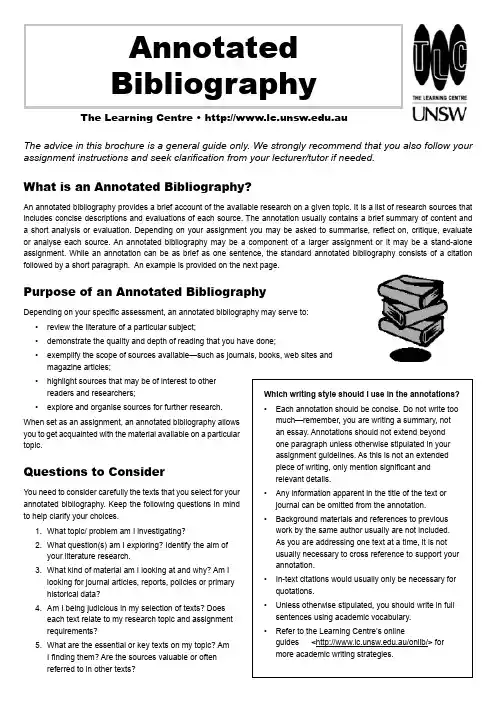

annotated bibliography的组成-回复如何编写一篇关于“annotated bibliography”的文章。
Step 1: 引言(Introduction)[注:在这一部分中,你需要简要介绍annotated bibliography的概念和目的。
你可以解释什么是annotated bibliography以及它在学术研究中的重要性。
]Annotated bibliography是一种重要的学术写作形式,广泛用于研究论文、学术报告和毕业论文等。
本文将一步一步回答如何编写一篇关于annotated bibliography的文章。
首先,我们将讨论annotated bibliography的基本组成部分,然后详细说明每一部分的内容和格式要求。
最后,我们将介绍一些写作时需要注意的要点。
Step 2: 组成部分(Components)[注:在这一部分中,你需要详细介绍annotated bibliography的组成部分。
这些部分通常包括书目信息、摘要和评价。
]一个annotated bibliography通常由三个主要部分组成:书目信息、摘要(或注释)和评价。
书目信息包括作者、标题、出版日期、出版社等重要的引用信息。
摘要是对文献内容的简短总结,可以包括作者的主要观点、方法和结论。
评价部分则是对文献的评价和批判性分析,可以涵盖对作者观点的评估、实证研究的有效性和可靠性等。
Step 3: 书目信息(Bibliographic Information)[注:在这一部分中,你需要详细解释书目信息的内容和格式要求。
这包括作者的姓名、出版日期、标题、出版社等信息。
]在书目信息部分,你需要提供每个文献源的相关信息,以便读者能够追溯到原始文献并了解其来源。
根据引用格式的要求,你需要包括作者的姓名(或姓氏首字母)、出版日期、标题、出版社等信息。
这些信息应该以特定格式排列,并使用适当的标点符号进行分隔。