动词种类及基本形式
- 格式:pdf
- 大小:158.43 KB
- 文档页数:6
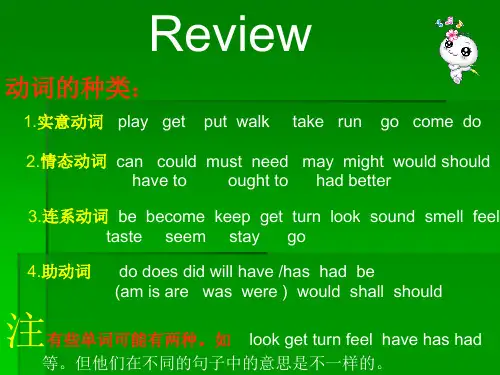
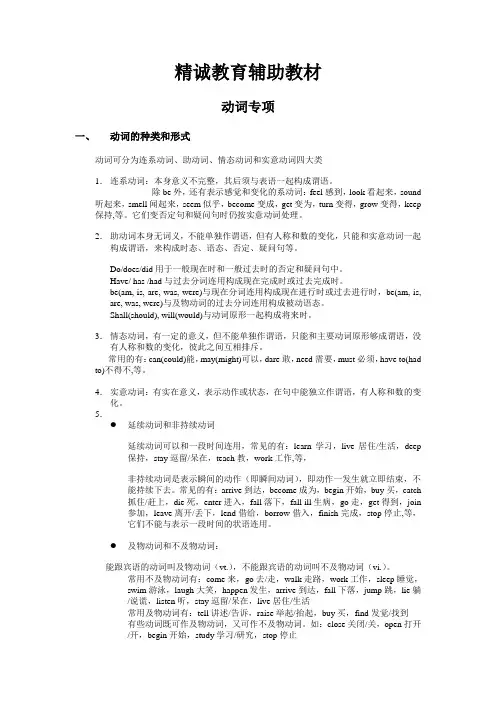
英语动词的分类及基本形式一 、动词的分类按照动词在句中的作用,英语动词可分为四类;实义动词,连系动词,助动词和情态动词,有些动词是兼类词。
1、实义动词(行为动词)实义动词(行为动词)说明动作或状态,能独立作谓语,可分为及物动词和不及物动词。
She types fast.她打字速度很快。
He studies in this school.他在这所学校学习。
(1)及物动词及物动词必须接宾语,才能有完整的意思,这可以有三种情况;①动词+宾语Her father enjoys warm tea very much in summer.她的父亲夏天非常爱喝热茶。
②动词+间接宾语+直接宾语Did he give you a present yesterday?May I ask you a question?③动词+宾语+宾补They call her "Little Li" They elected Bush president.他们选布什当总统(2)不及物动词不及物动词本身有完整的意思其后不需要跟宾语。
例如:His mother works in a hospital. She stayed at home yesterday.有些动词有时用作及物动词,有时用作不及物动词,词义有时相同,有时不同。
When did your father leave Beijing? He left yesterday.记住下面这些可带双宾语的动词buy, bring, build, cook, cut, draw, find, hand, get, leave, lend,make, offer pay, pass, read,return, show, sell,tell, teach, write等。
2、记住下面带宾补的动词① 要求名词作宾补的动词call, name, make, leave, think等。
② 要求形容词作宾补的动词want, keep, find, get, paint, turn,cut等。
2、连系动词连系动词本身有意义,但不能在句子中单独作谓语,必须和表语一起构成谓语,如be, seem, look, become, get, appear, remain, feel, sound等。
He is a lawyer.She looks very beautiful.3、助动词助动词本身没有意义,只能和主要动词一起构成各种时态、语态、语气等动词形式,表示否定,疑问等结构中的谓语动词。
常用的助动词有:shall, will.have, should, would, do, be等。
I don't know where he is.(否定句)Do you have a dictionary with you? (疑问句)I have been to Shanghai twice.(现在完成时)There will be a meeting tomorrow morning.(一般将来时)4、情态动词情态动词表示说话人在能力、必要、义务或猜测等方面的语气或态度,有自已的词义,但不能单独作谓语动词,必须和动词原形一起构成谓语动词,没有人称和数的变化。
如:can, may, must, would, should, need, dare, might, used to 等。
She can speak English fluently.她能流利和说英语。
You may take the book with you if you like.如果你喜欢,可以把这本书拿走。
Need we hand in our exercise-books before class?我们需要在上课前交练习本吗?There must be a mistake.准是弄错了。
You shouldn't do that.你不应该做那件事。
情态动词二要点动词原形跟后面,说话语气较委婉。
can表“能力”,may“许可”, must“责任或义务”, 否定回答needn't 换;“需要”need,dare“敢”,should“应该”,would“愿”,have to“被迫”表客观。
二、动词的基本形式绝大多数动词都有六种基本形式:动词原形、不定式、一般现在时第三人称单数、过去式、过去分词和现在分词。
A. 第三人称单数形式的构成一般现在时主语是第三人称单数时,谓语动词后要加s或es,其变化规则与名词变复数的方法大体相同:1. 一般情况下只在动词后加s,如work—works, write—writes。
2. 以s, x, sh, ch结尾的动词,后加es,如guess—guesses, mix —mix, finish—finishes, catch—catches。
3. 以辅音字母加y结尾的动词,改y为ies,如study—studies。
注:不规则变化的有have—has, be—is, go—goes, do—does 等。
B. 现在分词的构成1. 一般情况下在动词后加ing,如study—studying, work—working。
2. 以不发音的字母e结尾的动词,先去掉e再加ing,如write—writing, move—moving。
3. 以一个元音字母和一个辅音结尾的重读音节结尾的动词,要双写末尾一个辅音字母,再加ing,如get—getting, begin—beginning。
4. 以ie结尾的名词,一般将ie改为y,再加ing,如lie—lying, die—dying, tie—tying。
注:(A) 以l结尾的动词,尾音节重读时,双写l,如control—controlling;尾音节不重读时,双不双写都可以,如travel—traveling(美) /travelling(英) 。
(B) 特例:picnic—picnicking。
C. 过去式和过去分词的构成1. 一般情况直接加ed,如ask—asked, work—worked。
2. 以不发音的e结尾,只加d,如love—loved, dance—danced。
3. 以辅音字母加y结尾,把y变为ied,如try—tried, study—studied。
4. 以一个元音字母和一个辅音结尾的重读音节结尾的动词,先双末尾一个字母,再加ed,如stop—stopped, permit—permitted。
注:(A) 以l结尾的动词,尾音节重读时,双写l,如control—controlled;尾音节不重读时,双不双写都可以,如travel—traveled(美) /traveled(英) 。
(B) 特例:picnic—picnicked。
另外,还有很多动词的过去式和过去分词是不合乎上述规则的,需要熟记。
一、用括号内动词的适当形式填空。
1. He often (have) dinner at home.2. Daniel and Tommy (be) in Class One.3. We (not watch) TV on Monday.4. Nick (not go) to the zoo on Sunday.5. they (like) the World Cup?6. What they often (do) on Saturdays?7. your parents (read) newspapers every day?8. The girl (teach) us English on Sundays.9. She and I (take) a walk together every evening.10. There (be) some water in the bottle.11. Mike (like) cooking.12. They (have) the same hobby.13. My aunt (look) after her baby carefully.14. You always (do) your homework well.5. I (be) ill. I’m staying in bed.16. She (go) to school from Monday to Friday.17. Liu Tao (do) not like PE.18. The child often (watch) TV in the evening.19. Su Hai and Su Yang (have) eight lessons this term.20. -What day (be) it today? ———— It’s Saturday.(一)用动词的正确形式填空1 My mother ______(is)born in 1960.2 The lion_______ ( bite ) the net two days ago.3 He _______( make ) a big hole last week.4 The cat ________( catch) a mouse yesterday.5 What did he do? He _______( try ) to change China.6 She ____( sit ) under a big tree and ____( read ) books yesterday morning.7 He ________( become ) a doctor in 1995.8 Did you _______( learn ) English at school.9 They didn’t ______( go ) to the zoo an hour ago. They ______( go ) to the park.10 He______(play) football on the playground and _______( drink ) a lot of water yesterday afternoon.11 _______you _______( drive ) a car to get there yesterday morning?No. I ______( drive ) a bus.12 I thought he _______( forget) everthing.13 She ______( fall ) over before she got the baton.14 I ________( feed ) the dog an hour ago.15 I _______________( not feel) well this morning.16 The bird _________ (fly) high two days ago.17 Yesterday _____(is) my birthday ,my parents ______(give) me a doll.8 Last year, the plants ______( grew) well.19 We _____(have) a music lesson yesterday morning.20 When I ______( is ) a baby ,I _____(have) no hair. But now I ____(have) long hair.三、改错( )1. Is your brother speak English?A B C( )2. Does he likes going fishing?A B C( )3. He likes play games after class.A B C( )4. Mr. Wu teachs us English.A B C( )5. She don’t do her homework on Sundays.A B C。