
急性肾损伤肾脏替代治疗的KDIGO与ADQI指南解读
- 格式:pptx
- 大小:219.28 KB
- 文档页数:23


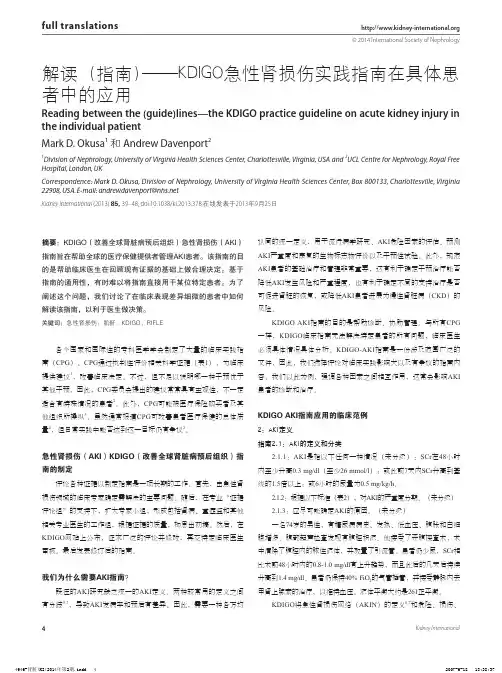
解读(指南)—KDIGO急性肾损伤实践指南在具体患者中的应用Reading between the (guide)lines—the KDIGO practice guideline on acute kidney injury in the individual patientMark D. Okusa1和 Andrew Davenport21Division of Nephrology, University of Virginia Health Sciences Center, Charlottesville, Virginia, USA and 2UCL Centre for Nephrology, Royal Free Hospital, London, UKCorrespondence: Mark D. Okusa, Division of Nephrology, University of Virginia Health Sciences Center, Box 800133, Charlottesville, Virginia 22908, USA. E-mail: andrewdavenport@Kidney International (2013) 85, 39–48; doi:10.1038/ki.2013.378;在线发表于2013年9月25日摘要:KDIGO(改善全球肾脏病预后组织)急性肾损伤(AKI)指南旨在帮助全球的医疗保健提供者管理AKI患者。
该指南的目的是帮助临床医生在回顾现有证据的基础上做合理决定。
基于指南的通用性,有时难以将指南直接用于某位特定患者。
为了阐述这个问题,我们讨论了在临床表现差异细微的患者中如何解读该指南,以利于医生做决策。
关键词:急性肾损伤;肌酐;KDIGO;RIFLE各个国家和国际性的专科医学学会制定了大量的临床实践指南(CPG)。
CPG通过批判性评价相关科学证据(表1),为临床提供建议1,改善临床决定。