
小学英语时态课件
- 格式:ppt
- 大小:1.56 MB
- 文档页数:28

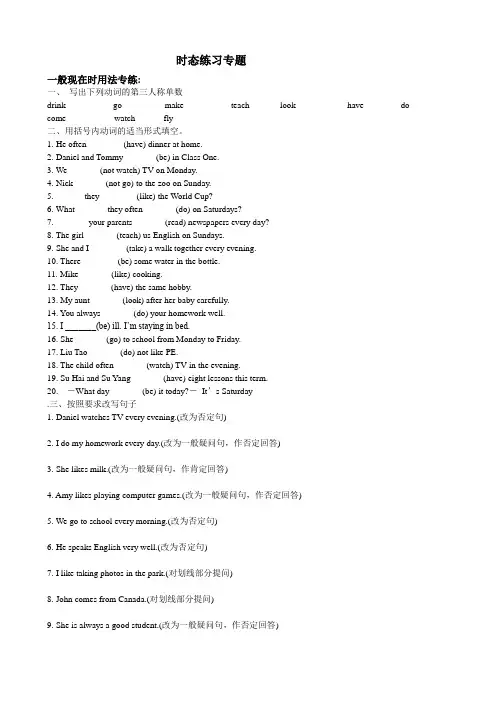
时态练习专题
一般现在时用法专练:
一、 写出下列动词的第三人称单数
drink ________ go _______ make ________ teach_______look _________ have_______ do_________
come________ watch______ fly ________
二、用括号内动词的适当形式填空。
1. He often ________(have) dinner at home.
2. Daniel and Tommy _______(be) in Class One.
3. We _______(not watch) TV on Monday.
4. Nick _______(not go) to the zoo on Sunday.
5. ______ they ________(like) the World Cup?
6. What _______they often _______(do) on Saturdays?
7. _______ your parents _______(read) newspapers every day?
8. The girl _______(teach) us English on Sundays.
9. She and I ________(take) a walk together every evening.
10. There ________(be) some water in the bottle.
11. Mike _______(like) cooking.
12. They _______(have) the same hobby.
13. My aunt _______(look) after her baby carefully.
14. You always _______(do) your homework well.

精品课件英语时态学习《一般将来时
教学内容:
本节课的教学内容选自人教版小学英语PEP教材第六册,第三章第三课时,主要学习一般将来时。本节课通过介绍一般将来时的概念,以及其构成和用法,使学生能够正确运用一般将来时进行日常交流。
教学目标:
1. 学生能够理解一般将来时的概念,并能够正确运用一般将来时进行表达。
2. 学生能够通过听力练习和口语练习,提高对一般将来时的听力和口语运用能力。
3. 学生能够通过小组合作和角色扮演,提高团队合作能力和口语表达能力。
教学难点与重点:
重点:一般将来时的构成和用法。
难点:一般将来时的运用,特别是在实际情景中的运用。
教具与学具准备:
教具:PPT、黑板、粉笔。
学具:课本、练习本、铅笔。
教学过程:
一、实践情景引入(5分钟)
教师通过展示一个未来的场景,如:“明天我们要去游乐园玩”,引出一般将来时的概念。
二、知识讲解(10分钟) 教师在黑板上写出一般将来时的构成:“will + 动词原形”,并解释其用法。
三、例题讲解(10分钟)
教师用PPT展示一些一般将来时的例句,如:“I will go to
the movies tomorrow.”,并让学生跟读。
四、随堂练习(5分钟)
教师给出一些一般将来时的句子,让学生判断其正确与否。
五、小组合作(5分钟)
学生分组,每组编写一个一般将来时的对话,并表演出来。
六、角色扮演(5分钟)
学生分组,每组选择一个角色,用一般将来时进行表演。
板书设计:
一般将来时
构成:will + 动词原形
用法:表示将来要发生的动作或状态。
作业设计:
1. 用一般将来时写一篇关于你未来计划的作文。
答案:I will go to university when I grow up. I will
study engineering because I like to solve problems. I will
also travel to different countries to learn about different
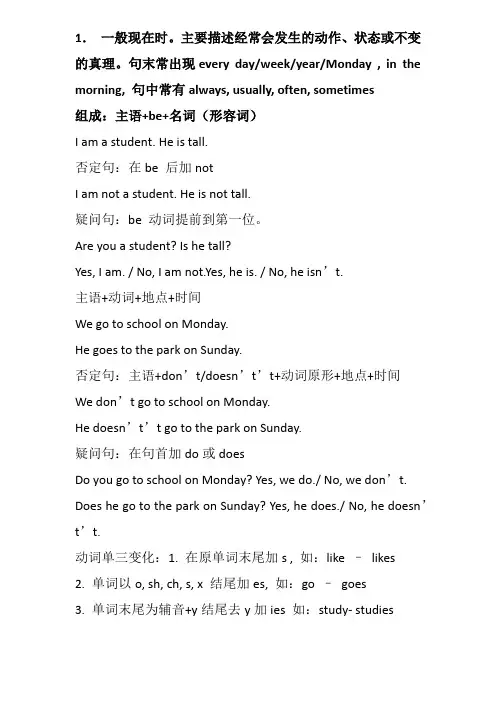
1. 一般现在时。主要描述经常会发生的动作、状态或不变的真理。句末常出现every day/week/year/Monday , in the
morning, 句中常有always, usually, often, sometimes
组成:主语+be+名词(形容词)
I am a student. He is tall.
否定句:在be 后加not
I am not a student. He is not tall.
疑问句:be 动词提前到第一位。
Are you a student? Is he tall?
Yes, I am. / No, I am not.Yes, he is. / No, he isn’t.
主语+动词+地点+时间
We go to school on Monday.
He goes to the park on Sunday.
否定句:主语+don’t/doesn’t’t+动词原形+地点+时间
We don’t go to school on Monday.
He doesn’t’t go to the park on Sunday.
疑问句:在句首加do或does
Do you go to school on Monday? Yes, we do./ No, we don’t.
Does he go to the park on Sunday? Yes, he does./ No, he doesn’t’t.
动词单三变化:1. 在原单词末尾加s , 如:like – likes
2. 单词以o, sh, ch, s, x 结尾加es, 如:go – goes
3. 单词末尾为辅音+y结尾去y加ies 如:study- studies
2. 现在进行时:主要 叙述正在发生的事情。句末常出现now,
句首常出现look, listen
组成:主语+be +动词ing形式

小学英语时态小结
一、现在进行时:用在叙述某人正在做某事的时候。(某动作正在进行)
其结构是“be动词+(动词+ing)”,句中可能会有look,listen,now,be quiet, Where is某某或一个相当具体的时间。
动词加“ing”(现在分词)的变化规则:
1、接在动词后面加“ing”
2、“元音+辅音+e”结尾的单词把e去掉再加ing。
3、重读闭音节双写最后字母再加ing,单词有:run—running、swim—swimming、put—putting、get—getting、shop—shopping
1.) What is Mary doing? She’s shopping.
2.) Is Betty swimming now? No, she isn’t. She’s running.
3.) It’s seven thirty in the evening. We’re having dinner at home.
*关于句型转换:.
否定句,在be 动词 is am are 之后直接加not 变成 isn’t, am not, aren’t
一般疑问句,直接把 be 动词 is am are 提到主语的前面,即句首
对划线部分提问,即特殊疑问句,先找到与与划线部分相关的疑问词,然后把be动词提到主语前面,然后是主语和句子中除划线部分外的其它单词依次按顺序抄下来。
备注:只要是句子中出现be动词的都可以用以上规律来进行句型转换。
eg:Lily is watching a VCD of Japanese cartoons.
否定句_____________________________________________
一般疑问句并回答_________________________________________________________