
英语时态讲解课件
- 格式:ppt
- 大小:495.50 KB
- 文档页数:37

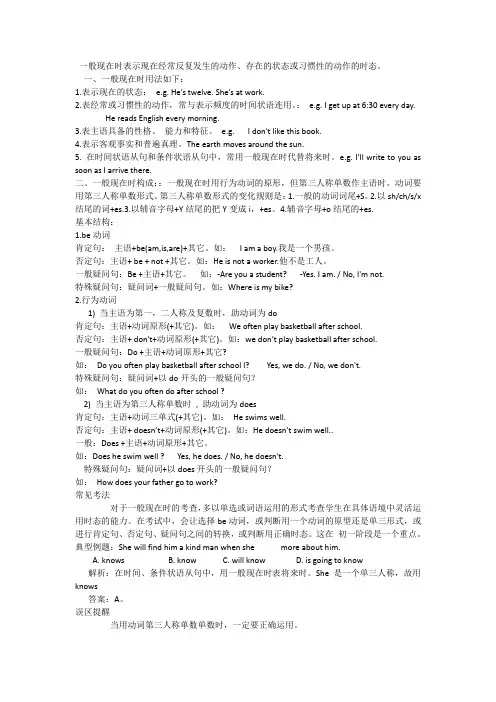
一般现在时表示现在经常反复发生的动作、存在的状态或习惯性的动作的时态。
一、一般现在时用法如下:
1.表示现在的状态: e.g. He’s twelve. She’s at work.
2.表经常或习惯性的动作,常与表示频度的时间状语连用。: e.g. I get up at 6:30 every day.
He reads English every morning.
3.表主语具备的性格、 能力和特征。 e.g. I don't like this book.
4.表示客观事实和普遍真理。The earth moves around the sun.
5. 在时间状语从句和条件状语从句中,常用一般现在时代替将来时。e.g. I'll write to you as
soon as I arrive there.
二、一般现在时构成::一般现在时用行为动词的原形,但第三人称单数作主语时,动词要用第三人称单数形式。第三人称单数形式的变化规则是:1.一般的动词词尾+S。2.以sh/ch/s/x结尾的词+es.3.以辅音字母+Y结尾的把Y变成i,+es。4.辅音字母+o结尾的+es.
基本结构:
1.be动词
肯定句: 主语+be(am,is,are)+其它。如: I am a boy.我是一个男孩。
否定句:主语+ be + not +其它。如:He is not a worker.他不是工人。
一般疑问句:Be +主语+其它。 如:-Are you a student? -Yes. I am. / No, I'm not.
特殊疑问句:疑问词+一般疑问句。如:Where is my bike?
2.行为动词
1) 当主语为第一,二人称及复数时,助动词为do
肯定句:主语+动词原形(+其它)。如: We often play basketball after school.

英语时态8种基本时态讲解
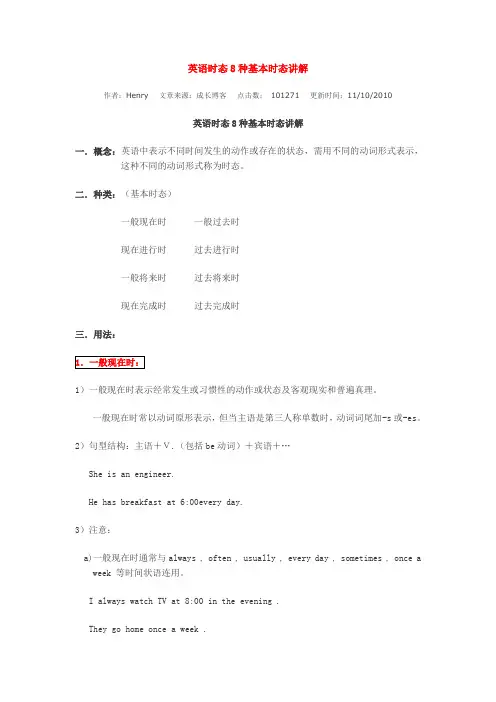
一.概念:英语中表示不同时间发生的动作或存在的状态,需用不同的动词形式表示,这种不同的动词形式称为时态。
二.种类:(基本时态)
一般现在时 一般过去时
现在进行时 过去进行时
一般将来时 过去将来时
现在完成时 过去完成时
三.用法:
1.一般现在时:
1)一般现在时表示经常发生或习惯性的动作或状态及客观现实和普遍真理。
一般现在时常以动词原形表示,但当主语是第三人称单数时,动词词尾加-s或-es。
2)句型结构:主语+V.(包括be动词)+宾语+…
She is an engineer.
He has breakfast at 6:00every day.
3)注意:
a)一般现在时通常与always , often , usually , every day , sometimes , once a
week 等时间状语连用。 I always watch TV at 8:00 in the evening .
They go home once a week .
We usually do our homework at home .
b)表客观现实或普遍真理。
The sun always rises in the east .
The light travels faster than the sound .
c)表永远性的动作或状态。
He lives in the country .
4)第三人称单数变化形式。
a)一般情况动词在词尾加-s .
come---comes speak---speaks work---works live---lives
b)以o, s, x, ch, sh结尾的单词在词后加-es.
英语时态8种基本时态讲解
作者:Henry 文章来源:成长博客 点击数: 101271 更新时间:11/10/2010
英语时态8种基本时态讲解
一.概念:英语中表示不同时间发生的动作或存在的状态,需用不同的动词形式表示,这种不同的动词形式称为时态。
二.种类:(基本时态)
一般现在时 一般过去时
现在进行时 过去进行时
一般将来时 过去将来时
现在完成时 过去完成时
三.用法:
1.一般现在时:
1)一般现在时表示经常发生或习惯性的动作或状态及客观现实和普遍真理。
一般现在时常以动词原形表示,但当主语是第三人称单数时,动词词尾加-s或-es。
2)句型结构:主语+V.(包括be动词)+宾语+„
She is an engineer.
He has breakfast at 6:00every day.
3)注意:
a)一般现在时通常与always , often , usually , every day , sometimes , once a
week 等时间状语连用。
I always watch TV at 8:00 in the evening .
They go home once a week . We usually do our homework at home .
b)表客观现实或普遍真理。
The sun always rises in the east .
The light travels faster than the sound .
c)表永远性的动作或状态。
He lives in the country .
4)第三人称单数变化形式。
a)一般情况动词在词尾加-s .
come---comes speak---speaks work---works live---lives
1 英语时态讲解
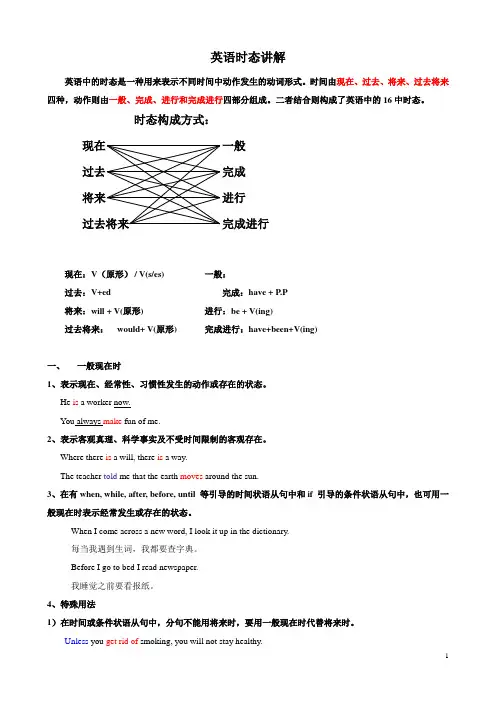
英语中的时态是一种用来表示不同时间中动作发生的动词形式。时间由现在、过去、将来、过去将来四种,动作则由一般、完成、进行和完成进行四部分组成。二者结合则构成了英语中的16中时态。
时态构成方式:
现在 一般
过去 完成
将来 进行
过去将来 完成进行
现在:V(原形) / V(s/es) 一般:
过去:V+ed 完成:have + P.P
将来:will + V(原形) 进行:be + V(ing)
过去将来: would+ V(原形) 完成进行:have+been+V(ing)
一、 一般现在时
1、表示现在、经常性、习惯性发生的动作或存在的状态。
He is a worker now.
You always make fun of me.
2、表示客观真理、科学事实及不受时间限制的客观存在。
Where there is a will, there is a way.
The teacher told me that the earth moves around the sun.
3、在有when, while, after, before, until 等引导的时间状语从句中和if 引导的条件状语从句中,也可用一般现在时表示经常发生或存在的状态。
When I come across a new word, I look it up in the dictionary.
每当我遇到生词,我都要查字典。
Before I go to bed I read newspaper.
我睡觉之前要看报纸。
4、特殊用法
1)在时间或条件状语从句中,分句不能用将来时,要用一般现在时代替将来时。
Unless you get rid of smoking, you will not stay healthy.