
CH5424802_HNMR_22803_MedChemExpress
- 格式:pdf
- 大小:404.37 KB
- 文档页数:1

Inhibitors, Agonists, Screening LibrariesSafety Data Sheet Revision Date:Oct.-11-2018Print Date:Oct.-11-20181. PRODUCT AND COMPANY IDENTIFICATION1.1 Product identifierProduct name :PDD 00017273Catalog No. :HY-108360CAS No. :1945950-21-91.2 Relevant identified uses of the substance or mixture and uses advised againstIdentified uses :Laboratory chemicals, manufacture of substances.1.3 Details of the supplier of the safety data sheetCompany:MedChemExpress USATel:609-228-6898Fax:609-228-5909E-mail:sales@1.4 Emergency telephone numberEmergency Phone #:609-228-68982. HAZARDS IDENTIFICATION2.1 Classification of the substance or mixtureNot a hazardous substance or mixture.2.2 GHS Label elements, including precautionary statementsNot a hazardous substance or mixture.2.3 Other hazardsNone.3. COMPOSITION/INFORMATION ON INGREDIENTS3.1 SubstancesSynonyms:NoneFormula:C23H26N6O4S2Molecular Weight:514.62CAS No. :1945950-21-94. FIRST AID MEASURES4.1 Description of first aid measuresEye contactRemove any contact lenses, locate eye-wash station, and flush eyes immediately with large amounts of water. Separate eyelids with fingers to ensure adequate flushing. Promptly call a physician.Skin contactRinse skin thoroughly with large amounts of water. Remove contaminated clothing and shoes and call a physician.InhalationImmediately relocate self or casualty to fresh air. If breathing is difficult, give cardiopulmonary resuscitation (CPR). Avoid mouth-to-mouth resuscitation.IngestionWash out mouth with water; Do NOT induce vomiting; call a physician.4.2 Most important symptoms and effects, both acute and delayedThe most important known symptoms and effects are described in the labelling (see section 2.2).4.3 Indication of any immediate medical attention and special treatment neededTreat symptomatically.5. FIRE FIGHTING MEASURES5.1 Extinguishing mediaSuitable extinguishing mediaUse water spray, dry chemical, foam, and carbon dioxide fire extinguisher.5.2 Special hazards arising from the substance or mixtureDuring combustion, may emit irritant fumes.5.3 Advice for firefightersWear self-contained breathing apparatus and protective clothing.6. ACCIDENTAL RELEASE MEASURES6.1 Personal precautions, protective equipment and emergency proceduresUse full personal protective equipment. Avoid breathing vapors, mist, dust or gas. Ensure adequate ventilation. Evacuate personnel to safe areas.Refer to protective measures listed in sections 8.6.2 Environmental precautionsTry to prevent further leakage or spillage. Keep the product away from drains or water courses.6.3 Methods and materials for containment and cleaning upAbsorb solutions with finely-powdered liquid-binding material (diatomite, universal binders); Decontaminate surfaces and equipment by scrubbing with alcohol; Dispose of contaminated material according to Section 13.7. HANDLING AND STORAGE7.1 Precautions for safe handlingAvoid inhalation, contact with eyes and skin. Avoid dust and aerosol formation. Use only in areas with appropriate exhaust ventilation.7.2 Conditions for safe storage, including any incompatibilitiesKeep container tightly sealed in cool, well-ventilated area. Keep away from direct sunlight and sources of ignition.Recommended storage temperature:Powder-20°C 3 years4°C 2 yearsIn solvent-80°C 6 months-20°C 1 monthShipping at room temperature if less than 2 weeks.7.3 Specific end use(s)No data available.8. EXPOSURE CONTROLS/PERSONAL PROTECTION8.1 Control parametersComponents with workplace control parametersThis product contains no substances with occupational exposure limit values.8.2 Exposure controlsEngineering controlsEnsure adequate ventilation. Provide accessible safety shower and eye wash station.Personal protective equipmentEye protection Safety goggles with side-shields.Hand protection Protective gloves.Skin and body protection Impervious clothing.Respiratory protection Suitable respirator.Environmental exposure controls Keep the product away from drains, water courses or the soil. Cleanspillages in a safe way as soon as possible.9. PHYSICAL AND CHEMICAL PROPERTIES9.1 Information on basic physical and chemical propertiesAppearance White to light yellow (Solid)Odor No data availableOdor threshold No data availablepH No data availableMelting/freezing point No data availableBoiling point/range No data availableFlash point No data availableEvaporation rate No data availableFlammability (solid, gas)No data availableUpper/lower flammability or explosive limits No data availableVapor pressure No data availableVapor density No data availableRelative density No data availableWater Solubility No data availablePartition coefficient No data availableAuto-ignition temperature No data availableDecomposition temperature No data availableViscosity No data availableExplosive properties No data availableOxidizing properties No data available9.2 Other safety informationNo data available.10. STABILITY AND REACTIVITY10.1 ReactivityNo data available.10.2 Chemical stabilityStable under recommended storage conditions.10.3 Possibility of hazardous reactionsNo data available.10.4 Conditions to avoidNo data available.10.5 Incompatible materialsStrong acids/alkalis, strong oxidising/reducing agents.10.6 Hazardous decomposition productsUnder fire conditions, may decompose and emit toxic fumes.Other decomposition products - no data available.11.TOXICOLOGICAL INFORMATION11.1 Information on toxicological effectsAcute toxicityClassified based on available data. For more details, see section 2Skin corrosion/irritationClassified based on available data. For more details, see section 2Serious eye damage/irritationClassified based on available data. For more details, see section 2Respiratory or skin sensitizationClassified based on available data. For more details, see section 2Germ cell mutagenicityClassified based on available data. For more details, see section 2CarcinogenicityIARC: No component of this product present at a level equal to or greater than 0.1% is identified as probable, possible or confirmed human carcinogen by IARC.ACGIH: No component of this product present at a level equal to or greater than 0.1% is identified as a potential or confirmed carcinogen by ACGIH.NTP: No component of this product present at a level equal to or greater than 0.1% is identified as a anticipated or confirmed carcinogen by NTP.OSHA: No component of this product present at a level equal to or greater than 0.1% is identified as a potential or confirmed carcinogen by OSHA.Reproductive toxicityClassified based on available data. For more details, see section 2Specific target organ toxicity - single exposureClassified based on available data. For more details, see section 2Specific target organ toxicity - repeated exposureClassified based on available data. For more details, see section 2Aspiration hazardClassified based on available data. For more details, see section 212. ECOLOGICAL INFORMATION12.1 ToxicityNo data available.12.2 Persistence and degradabilityNo data available.12.3 Bioaccumlative potentialNo data available.12.4 Mobility in soilNo data available.12.5 Results of PBT and vPvB assessmentPBT/vPvB assessment unavailable as chemical safety assessment not required or not conducted.12.6 Other adverse effectsNo data available.13. DISPOSAL CONSIDERATIONS13.1 Waste treatment methodsProductDispose substance in accordance with prevailing country, federal, state and local regulations.Contaminated packagingConduct recycling or disposal in accordance with prevailing country, federal, state and local regulations.14. TRANSPORT INFORMATIONDOT (US)This substance is considered to be non-hazardous for transport.IMDGThis substance is considered to be non-hazardous for transport.IATAThis substance is considered to be non-hazardous for transport.15. REGULATORY INFORMATIONSARA 302 Components:No chemicals in this material are subject to the reporting requirements of SARA Title III, Section 302.SARA 313 Components:This material does not contain any chemical components with known CAS numbers that exceed the threshold (De Minimis) reporting levels established by SARA Title III, Section 313.SARA 311/312 Hazards:No SARA Hazards.Massachusetts Right To Know Components:No components are subject to the Massachusetts Right to Know Act.Pennsylvania Right To Know Components:No components are subject to the Pennsylvania Right to Know Act.New Jersey Right To Know Components:No components are subject to the New Jersey Right to Know Act.California Prop. 65 Components:This product does not contain any chemicals known to State of California to cause cancer, birth defects, or anyother reproductive harm.16. OTHER INFORMATIONCopyright 2018 MedChemExpress. The above information is correct to the best of our present knowledge but does not purport to be all inclusive and should be used only as a guide. The product is for research use only and for experienced personnel. It must only be handled by suitably qualified experienced scientists in appropriately equipped and authorized facilities. The burden of safe use of this material rests entirely with the user. MedChemExpress disclaims all liability for any damage resulting from handling or from contact with this product.Caution: Product has not been fully validated for medical applications. For research use only.Tel: 609-228-6898 Fax: 609-228-5909 E-mail: tech@Address: 1 Deer Park Dr, Suite Q, Monmouth Junction, NJ 08852, USA。
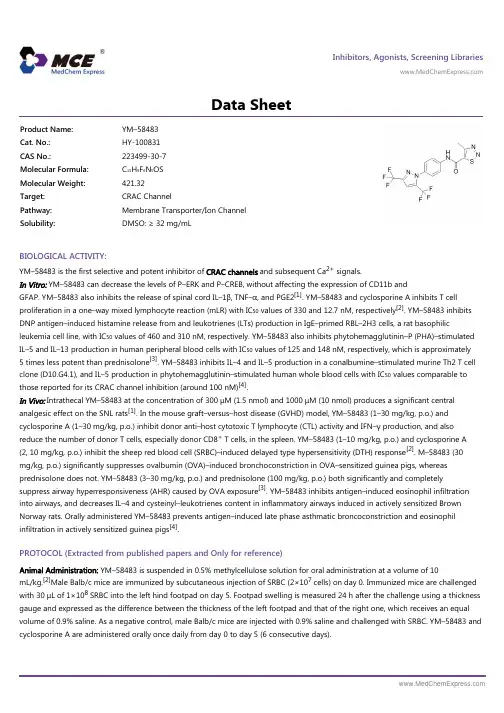
Inhibitors, Agonists, Screening Libraries Data SheetBIOLOGICAL ACTIVITY:YM–58483 is the first selective and potent inhibitor of CRAC channels and subsequent Ca 2+ signals.In Vitro: YM–58483 can decrease the levels of P–ERK and P–CREB, without affecting the expression of CD11b andGFAP. YM–58483 also inhibits the release of spinal cord IL–1β, TNF–α, and PGE2[1]. YM–58483 and cyclosporine A inhibits T cell proliferation in a one–way mixed lymphocyte reaction (mLR) with IC 50 values of 330 and 12.7 nM, respectively [2]. YM–58483 inhibits DNP antigen–induced histamine release from and leukotrienes (LTs) production in IgE–primed RBL–2H3 cells, a rat basophilic leukemia cell line, with IC 50 values of 460 and 310 nM, respectively. YM–58483 also inhibits phytohemagglutinin–P (PHA)–stimulated IL–5 and IL–13 production in human peripheral blood cells with IC 50 values of 125 and 148 nM, respectively, which is approximately 5 times less potent than prednisolone [3]. YM–58483 inhibits IL–4 and IL–5 production in a conalbumine–stimulated murine Th2 T cellclone (D10.G4.1), and IL–5 production in phytohemagglutinin–stimulated human whole blood cells with IC 50 values comparable to those reported for its CRAC channel inhibition (around 100 nM)[4].In Vivo: Intrathecal YM–58483 at the concentration of 300 μM (1.5 nmol) and 1000 μM (10 nmol) produces a significant central analgesic effect on the SNL rats [1]. In the mouse graft–versus–host disease (GVHD) model, YM–58483 (1–30 mg/kg, p.o.) and cyclosporine A (1–30 mg/kg, p.o.) inhibit donor anti–host cytotoxic T lymphocyte (CTL) activity and IFN–γ production, and also reduce the number of donor T cells, especially donor CD8+ T cells, in the spleen. YM–58483 (1–10 mg/kg, p.o.) and cyclosporine A (2, 10 mg/kg, p.o.) inhibit the sheep red blood cell (SRBC)–induced delayed type hypersensitivity (DTH) response [2]. M–58483 (30mg/kg, p.o.) significantly suppresses ovalbumin (OVA)–induced bronchoconstriction in OVA–sensitized guinea pigs, whereas prednisolone does not. YM–58483 (3–30 mg/kg, p.o.) and prednisolone (100 mg/kg, p.o.) both significantly and completelysuppress airway hyperresponsiveness (AHR) caused by OVA exposure [3]. YM–58483 inhibits antigen–induced eosinophil infiltration into airways, and decreases IL–4 and cysteinyl–leukotrienes content in inflammatory airways induced in actively sensitized Brown Norway rats. Orally administered YM–58483 prevents antigen–induced late phase asthmatic broncoconstriction and eosinophil infiltration in actively sensitized guinea pigs [4].PROTOCOL (Extracted from published papers and Only for reference)Animal Administration: YM–58483 is suspended in 0.5% methylcellulose solution for oral administration at a volume of 10mL/kg.[2]Male Balb/c mice are immunized by subcutaneous injection of SRBC (2×10⁷ cells) on day 0. Immunized mice are challenged with 30 μL of 1×10⁸ SRBC into the left hind footpad on day 5. Footpad swelling is measured 24 h after the challenge using a thickness gauge and expressed as the difference between the thickness of the left footpad and that of the right one, which receives an equal volume of 0.9% saline. As a negative control, male Balb/c mice are injected with 0.9% saline and challenged with SRBC. YM–58483 and cyclosporine A are administered orally once daily from day 0 to day 5 (6 consecutive days).Product Name:YM–58483Cat. No.:HY-100831CAS No.:223499-30-7Molecular Formula:C 15H 9F 6N 5OS Molecular Weight:421.32Target:CRAC Channel Pathway:Membrane Transporter/Ion Channel Solubility:DMSO: ≥ 32 mg/mLReferences:[1]. Qi Z, et al. The Central Analgesic Mechanism of YM–58483 in Attenuating Neuropathic Pain in Rats. Cell Mol Neurobiol. 2016 Oct;36(7):1035–43.[2]. Ohga K, et al. Characterization of YM–58483/BTP2, a novel store–operated Ca2+ entry blocker, on T cell–mediated immune responses in vivo. Int Immunopharmacol. 2008 Dec 20;8(13–14):1787–92[3]. Ohga K, et al. The suppressive effects of YM–58483/BTP–2, a store–operated Ca2+ entry blocker, on inflammatory mediator release in vitro and airway responses in vivo. Pulm Pharmacol Ther. 2008;21(2):360–9.[4]. Yoshino T, et al. YM–58483, a selective CRAC channel inhibitor, prevents antigen–induced airway eosinophilia and late phase asthmatic responses via Th2 cytokine inhibition in animal models. Eur J Pharmacol. 2007 Apr 10;560(2–3):225–33.Caution: Product has not been fully validated for medical applications. For research use only.Tel: 609-228-6898 Fax: 609-228-5909 E-mail: tech@Address: 1 Deer Park Dr, Suite Q, Monmouth Junction, NJ 08852, USA。

专利名称:(3R,4R)-4-(3,4-二甲氧基苄基)-3-(4-羟基-3-甲氧基苄基)-二氢呋喃的制备方法
专利类型:发明专利
发明人:易加明,陈国祥,陶春蕾,杨欣怡,李杰,邵凤
申请号:CN201410734153.9
申请日:20141208
公开号:CN104447234A
公开日:
20150325
专利内容由知识产权出版社提供
摘要:本申请描述了用适当的化学合成方法制备以下所示类型的(3R,4R)-4-(3,4-二甲氧基苄基)-3-(4-羟基-3-甲氧基苄基)-二氢呋喃及其中间体。
此化合物可用作抗胰腺癌细胞。
申请人:安徽万邦医药科技有限公司
地址:230088 安徽省合肥市高新区天达路71号华亿科学园D2栋601
国籍:CN
更多信息请下载全文后查看。
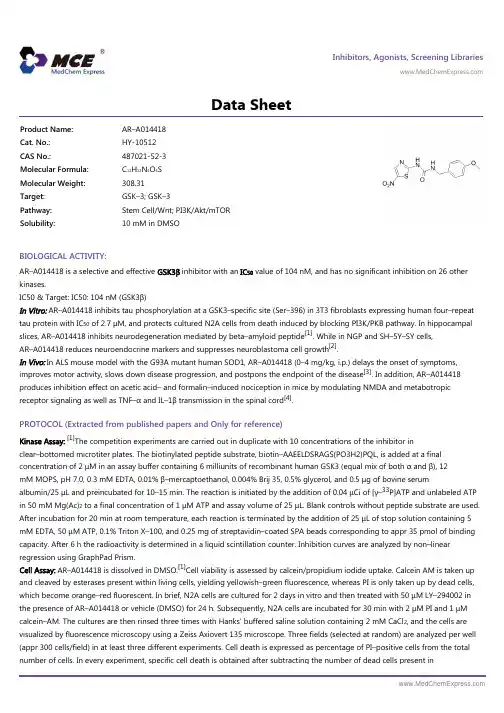
Inhibitors, Agonists, Screening Libraries Data SheetBIOLOGICAL ACTIVITY:AR–A014418 is a selective and effective GSK3β inhibitor with an IC 50 value of 104 nM, and has no significant inhibition on 26 other kinases.IC50 & Target: IC50: 104 nM (GSK3β)In Vitro: AR–A014418 inhibits tau phosphorylation at a GSK3–specific site (Ser–396) in 3T3 fibroblasts expressing human four–repeat tau protein with IC 50 of 2.7 μM, and protects cultured N2A cells from death induced by blocking PI3K/PKB pathway. In hippocampal slices, AR–A014418 inhibits neurodegeneration mediated by beta–amyloid peptide [1]. While in NGP and SH–5Y–SY cells,AR–A014418 reduces neuroendocrine markers and suppresses neuroblastoma cell growth [2].In Vivo: In ALS mouse model with the G93A mutant human SOD1, AR–A014418 (0–4 mg/kg, i.p.) delays the onset of symptoms,improves motor activity, slows down disease progression, and postpons the endpoint of the disease [3]. In addition, AR–A014418produces inhibition effect on acetic acid– and formalin–induced nociception in mice by modulating NMDA and metabotropic receptor signaling as well as TNF–α and IL–1β transmission in the spinal cord [4].PROTOCOL (Extracted from published papers and Only for reference)Kinase Assay:[1]The competition experiments are carried out in duplicate with 10 concentrations of the inhibitor inclear–bottomed microtiter plates. The biotinylated peptide substrate, biotin–AAEELDSRAGS(PO3H2)PQL, is added at a final concentration of 2 μM in an assay buffer containing 6 milliunits of recombinant human GSK3 (equal mix of both α and β), 12mM MOPS, pH 7.0, 0.3 mM EDTA, 0.01% β–mercaptoethanol, 0.004% Brij 35, 0.5% glycerol, and 0.5 μg of bovine serumalbumin/25 μL and preincubated for 10–15 min. The reaction is initiated by the addition of 0.04 μCi of [γ–33P]ATP and unlabeled ATP in 50 mM Mg(Ac)2 to a final concentration of 1 μM ATP and assay volume of 25 μL. Blank controls without peptide substrate are used.After incubation for 20 min at room temperature, each reaction is terminated by the addition of 25 μL of stop solution containing 5mM EDTA, 50 μM ATP, 0.1% Triton X–100, and 0.25 mg of streptavidin–coated SPA beads corresponding to appr 35 pmol of binding capacity. After 6 h the radioactivity is determined in a liquid scintillation counter. Inhibition curves are analyzed by non–linear regression using GraphPad Prism.Cell Assay: AR–A014418 is dissolved in DMSO.[1]Cell viability is assessed by calcein/propidium iodide uptake. Calcein AM is taken up and cleaved by esterases present within living cells, yielding yellowish–green fluorescence, whereas PI is only taken up by dead cells,which become orange–red fluorescent. In brief, N2A cells are cultured for 2 days in vitro and then treated with 50 μM LY–294002 in the presence of AR–A014418 or vehicle (DMSO) for 24 h. Subsequently, N2A cells are incubated for 30 min with 2 μM PI and 1 μM calcein–AM. The cultures are then rinsed three times with Hanks' buffered saline solution containing 2 mM CaCl 2, and the cells are visualized by fluorescence microscopy using a Zeiss Axiovert 135 microscope. Three fields (selected at random) are analyzed per well (appr 300 cells/field) in at least three different experiments. Cell death is expressed as percentage of PI–positive cells from the total number of cells. In every experiment, specific cell death is obtained after subtracting the number of dead cells present inProduct Name:AR–A014418Cat. No.:HY-10512CAS No.:487021-52-3Molecular Formula:C 12H 12N 4O 4S Molecular Weight:308.31Target:GSK–3; GSK–3Pathway:Stem Cell/Wnt; PI3K/Akt/mTOR Solubility:10 mM in DMSOvehicle–treated cultures.Animal Administration: AR–A014418 is formulated in normal saline.[3]First, to examine the effects of GSK–3 inhibition on the clinical symptoms, life span, and motor behavior function of ALS, 56 Tg mice are divided into four groups. In each group, 0.5 mL of normal saline is mixed with either 0 μg (control group), 1 μg (group A), 2 μg (group B) or 4 μg (group C) of AR–A014418 per gram of mouse, and injected intraperitoneally into 14 animals per group 5 days a week beginning 60 days after birth. The mice are sacrificed at the endpoint described below.References:[1]. Bhat R, Xue Y, Berg S, Structural insights and biological effects of glycogen synthase kinase 3–specific inhibitor AR–A014418. J Biol Chem. 2003 Nov 14; 278(46):45937–45.[2]. Carter YM, et al. Specific glycogen synthase kinase–3 inhibition reduces neuroendocrine markers and suppresses neuroblastoma cell growth. Cancer Biol Ther. 2014 May;15(5):510–5.[3]. Koh SH, et al. Inhibition of glycogen synthase kinase–3 suppresses the onset of symptoms and disease progression of G93A–SOD1 mouse model of ALS. Exp Neurol. 2007 Jun;205(2):336–46.[4]. Martins DF, et al. The antinociceptive effects of AR–A014418, a selective inhibitor of glycogen synthase kinase–3 beta, in mice. J Pain. 2011 Mar;12(3):315–22.Caution: Product has not been fully validated for medical applications. For research use only.Tel: 609-228-6898 Fax: 609-228-5909 E-mail: tech@Address: 1 Deer Park Dr, Suite Q, Monmouth Junction, NJ 08852, USA。